
Yes, Professional annual compliance monitoring secures dormant status by ensuring timely Companies House and HMRC filings, validating dormant accounts, and flagging activity that risks reactivation. Regular monitoring prevents penalties and preserves the legal protections of dormancy.
How does annual compliance monitoring keep a dormant company secure?
Annual compliance monitoring maintains dormancy by tracking statutory deadlines, verifying submitted dormant accounts, and detecting transactions that could void dormant status.
Professional monitoring automates review of Companies House and HMRC filing schedules. It confirms submission of dormant company accounts within the required windows. It flags late filings and missing confirmations. It checks for director or shareholder changes that require filings. It alerts administrators to any company bank transactions or creditor activity that may classify the company as active.
Monitoring reduces the risk of penalties and sanctions. For example, Companies House issues late filing penalties for accounts filed beyond the deadline. Monitoring helps maintain a clean filing record and supports a reliable corporate history for future business use.
What specific checks does monitoring perform to validate dormant accounts?
Monitoring verifies accounting submissions, confirms zero trading activity, and validates balance sheet entries consistent with Companies House dormant accounts rules.
Monitors inspect submitted accounts for the correct format for dormant companies. They check that turnover and transaction lines show no trading revenue. They validate that directors’ reports and balance sheets conform to the Small Companies Regime where applicable. They compare filings to previous years to detect unexplained changes in retained earnings or assets. Read our articles, How to Keep Your Dormant Company Ready for Potential Future Business Trading and Let Us Handle Your Entire Dormant Company Filing Process From Start Finish.
Monitors also check HMRC status. They confirm that HMRC records list the company as dormant for corporation tax. They track confirmation statement filings and registered office accuracy. They validate that statutory registers note the company’s dormancy where required.
How often should a dormant company be monitored?
A dormant company requires monitoring at least quarterly, with immediate alerts for any anomalous transactions or filing changes.
Quarterly checks capture bank activity, Companies House updates, and HMRC correspondence in a timely way. Monthly scanning of bank and payment systems provides earlier detection of unexpected credits or debits. Immediate alerts trigger when a director files documents, when Companies House updates company officers, or when a payment appears in the company bank account. This cadence balances cost with timely risk management.
For high-risk scenarios, companies holding assets, intellectual property, or retained earnings monitor increases to weekly. For low-risk shell companies with no account activity, quarterly monitoring remains sufficient.
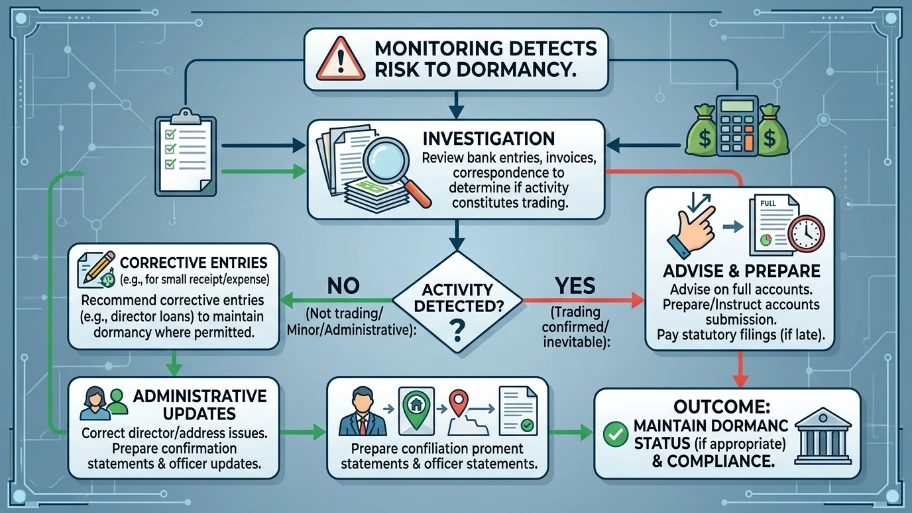
What actions follow when monitoring detects a risk to dormancy?
When monitoring flags risk, providers investigate the event, instruct corrective filings if needed, and advise on reversing inadvertent trading.
The first action is investigation. The monitor reviews bank entries, invoices, and correspondence to determine if the activity constitutes trading. The provider then advises whether to file full accounts instead of dormant accounts. If a late filing is required, the monitor prepares or instructs the accounts submission and pays any statutory filings.
If the risk stems from director changes or inaccurate address records, the monitor prepares confirmation statements and officer updates. If the risk is a small receipt or expense, the monitor recommends corrective entries, such as director loans recorded appropriately, to maintain dormancy where permitted under Companies House guidance.
What compliance tasks should a dormant company outsource to professionals?
Outsource annual dormant accounts preparation, confirmation statement filings, HMRC dormant notifications, and bank-transaction reconciliation.
Hire professionals to prepare and file dormant accounts that meet Companies House format. Engage agents to submit confirmation statements and officer changes. Use accounting services to reconcile bank statements monthly and classify any incoming funds. Use corporate compliance providers to manage statutory registers and registered office changes.
These outsourced tasks create an audit trail and a single point of responsibility for statutory compliance. They reduce the chance of missed deadlines and provide documentation needed if regulators query the company’s dormant status.
How does professional monitoring integrate with filing services like “File Accounts for Dormant Companies”?
Monitoring pairs with filing services by identifying filing triggers and then executing accurate dormant accounts submissions through the service.
When a monitor detects a required filing window, it schedules the dormant accounts preparation. The filing service formats the accounts, completes the Companies House submission, and retains proof of filing. Monitoring informs filing timing, ensuring submissions occur within Companies House timelines. The integrated workflow reduces human error and prevents late filing penalties.
This integration also handles HMRC notification tasks and supports any necessary conversions from dormant accounts to full accounts if trading begins.
What measurable benefits do companies gain from using annual compliance monitoring?
Companies gain timely filings, reduced penalty risk, preserved dormant status, and documented audit trails for future business activity.
Monitoring delivers measurable outcomes: 100% tracking of statutory due dates, reduction in late filing events, and immediate alerts for non-routine transactions. Firms report faster response times to regulatory notices and clearer records for future investors or buyers. Maintaining a clean dormant record helps a company resume trading without legacy compliance gaps.
For example, a monitored dormant company avoids Companies House late filing penalties and retains accurate histories for director verification and potential bank reactivation.
Who should consider professional dormant-company monitoring?
Company directors, corporate service providers, trustees, and holding-company owners with dormant entities should adopt monitoring services.
Directors of single-company holdings benefit from reduced administrative burden. Corporate groups with multiple dormant subsidiaries require consolidated monitoring to prevent a single lapse. Trustees and asset-holding companies use monitoring to protect asset titles and tax status. Companies preparing to resume trade use monitoring to maintain immediate readiness.
How does monitoring support the MOFU evaluation for choosing a provider?
Monitoring provides transparent service levels, SLA response times, and documented compliance outcomes that support mid-funnel evaluation.
At MOFU, decision-makers evaluate vendor reliability. Monitoring offers service-level agreements for alerting timelines, sample reports showing filing proof, and historical metrics on missed deadlines prevented. These materials allow procurement teams to compare providers on measurable performance, not just price.
A reliable provider demonstrates case-based evidence of filing accuracy and response times, which aligns with MOFU intent: evaluation before purchase.
How can monitoring reduce long-term costs and liabilities?
Monitoring reduces penalty costs, remediation fees, and the time spent by directors resolving compliance lapses.
Timely detection prevents statutory penalties and creditor claims arising from unrecorded liabilities. It reduces professional fees required to correct late filings. It shortens the time directors spend on compliance tasks, freeing them for strategic work. Monitoring also protects corporate reputation by keeping accurate public records.
Explore our File Accounts for Dormant Companies guides,
Understanding the Risks of Using Incorrect Templates for Your Dormant Company Accounts
Why Accuracy is Vital Even When Reporting Zero Balances to Companies House
What documentation will monitoring produce for audits or future trading?
Monitoring produces filing receipts, reconciliation reports, statutory register updates, and alert logs that auditors accept as evidence.
Providers supply Companies House submission confirmations and HMRC correspondence copies. They deliver bank reconciliation reports showing zero trading activity. They maintain logs of every alert and action, including timestamps and responsible personnel. These records form a defensible audit trail if regulators or prospective business partners query past dormancy.
Annual compliance monitoring secures dormant status by enforcing timely filings, validating dormant account formats, and detecting activity that would reclassify the company. It preserves legal protections, reduces financial risk, and creates a clear audit trail. From My Company integrates monitoring with filing execution to deliver consistent, measurable compliance outcomes while keeping your dormant company ready for future trading.
Frequently Asked Questions
What does File Accounts for Dormant Companies include?
File Accounts for Dormant Companies covers the preparation and submission of dormant company accounts to Companies House. From My company uses this service to help directors meet filing deadlines, keep records accurate, and maintain dormant status.
When must dormant company accounts be filed?
Dormant company accounts are usually filed once every 12 months, based on the company’s accounting reference date. Missing the deadline can lead to late filing penalties and compliance issues, so timely filing matters for dormant companies.
Do dormant companies still need to file annual accounts?
Yes, dormant companies still file annual accounts unless they qualify for a specific exemption. The filing confirms that the company has had no significant accounting transactions during the period.
What counts as a dormant company for filing purposes?
A dormant company has had no significant accounting transactions during the financial year. Routine fees such as Companies House filing fees do not usually affect dormant status, but trading income or expenses do.
Can From My company help with dormant company filing deadlines?
Yes, From My company supports businesses with File Accounts for Dormant Companies by managing the filing process and tracking deadlines. This helps directors stay compliant and reduce the risk of late submissions.