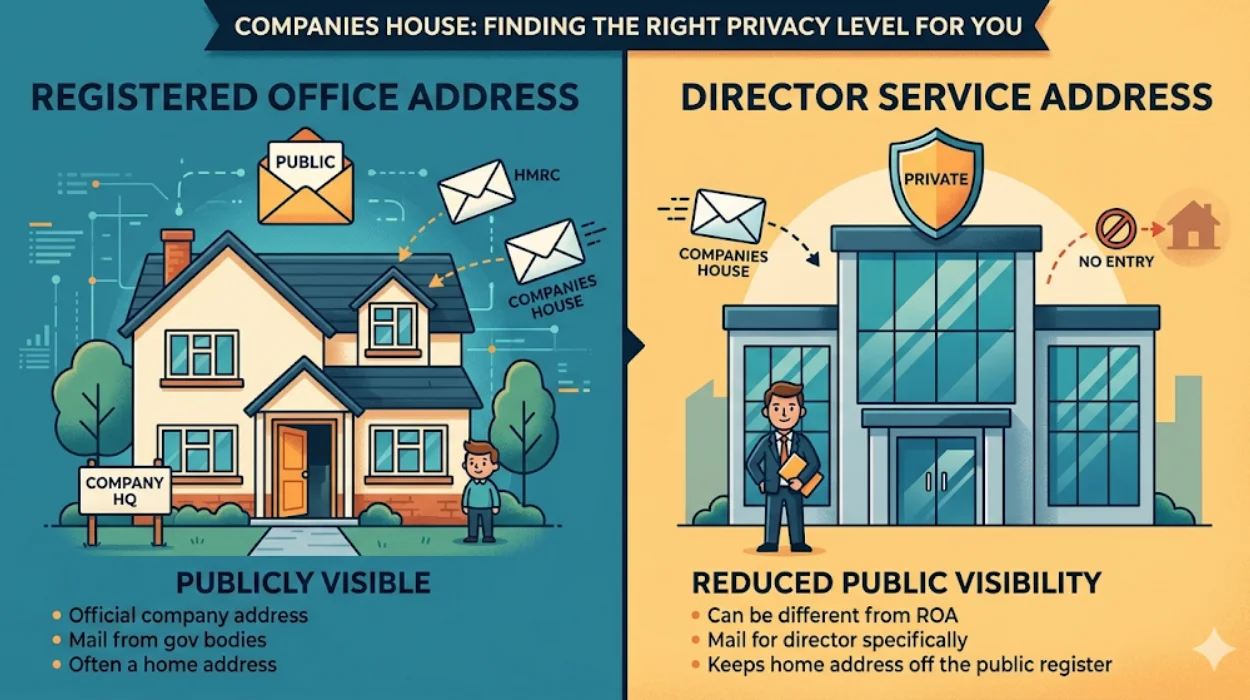
For UK limited companies, the registered office address serves as the official location for legal documents and Companies House records, while the director service address protects individual directors’ correspondence from public exposure of their home details. Choosing between or combining these options allows entrepreneurs to balance compliance with privacy needs effectively. This strategic decision impacts how much personal information appears on public registers.
When forming a limited company in the UK, entrepreneurs face critical decisions about addresses that go beyond mere formality they define privacy, professionalism, and compliance. The registered office address is the company’s public-facing hub, mandatory under the Companies Act 2006, where statutory mail from Companies House, HMRC, and courts must arrive. In contrast, the director service address applies to individuals, enabling directors, shareholders, and persons with significant control (PSCs) to shield residential details from the public Companies House register while still providing a valid contact point for official matters.
This distinction matters profoundly for business owners, especially sole traders transitioning to limited structures or those operating from home amid rising data privacy concerns. Public registers expose addresses to anyone, potentially leading to unwanted mail, spam, or security risks. Professional services like virtual offices from providers such as Form My Company offer compliant alternatives, often in prestigious locations like London, enhancing credibility without revealing personal spaces. Semantic elements like company formation, VAT registration, PAYE compliance, and business structures tie into this, as addresses influence HMRC interactions and lender perceptions.
Understanding these addresses ensures founders navigate Companies House filings (e.g., IN01 form) correctly from day one. With over 4 million active UK companies as of 2026, privacy breaches via public data have surged, prompting smarter choices. This guide unpacks differences, steps, benefits, risks, and best practices to empower you in selecting the optimal privacy level for your venture’s growth and security.
Understanding Registered Office and Director Service Addresses Step by Step
What is a Registered Office Address?
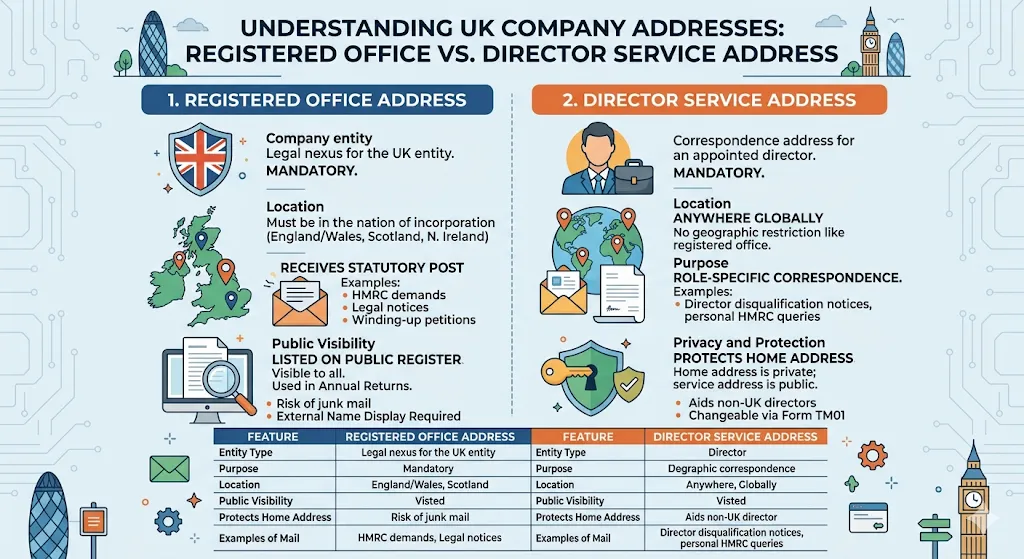
The registered office address acts as the legal nexus for your company, required for all UK-incorporated entities regardless of trading location. It must reside in the same UK nation as incorporation England/Wales, Scotland, or Northern Ireland and receive all statutory post, including winding-up petitions or HMRC demands. Companies House mandates its listing on the public register, annual returns (CS01), and confirmation statements.
Consider a tech startup in Manchester using a London virtual registered office: official mail scans and forwards digitally, maintaining compliance without physical presence. Implications include public visibility, aiding transparency but risking junk mail floods. For VAT or PAYE-registered firms, HMRC verifies this address during audits, underscoring its role in tax compliance. Failure to maintain it e.g., not displaying the company name externally if physical triggers fines up to £5,000.
What is a Director Service Address?
Directors must nominate a service address upon appointment via form AP01, distinct from their residential address held privately (accessible only to authorities). This can be anywhere globally, unlike the geo-restricted registered office, and handles role-specific correspondence like director disqualifications. For multiple directors or PSCs, each needs one, listed publicly but changeable via TM01.
Example: A director in Lahore forming a UK entity uses a UK service address to avoid home exposure, receiving scanned HMRC queries securely. This protects families from public scrutiny, vital for high-profile shareholders. Unlike home addresses pre-2009 (now protected), service addresses ensure ongoing privacy post-Economic Crime Act updates. Integration with company structures means aligning it during formation for seamless compliance.
Step-by-Step Comparison and Selection Process
- Assess needs: Home-based? Prioritise privacy—opt for virtual services.
- During formation: Input registered office on IN01; service addresses for directors/PSCs.
- Post-incorporation: Update via WebFiling if changing, within 14 days.
- Compliance check: Ensure forwarding for timely responses.
This process integrates with broader company formation, where mismatched addresses delay VAT/PAYE setups.
Benefits and Potential Risks
Opting for separate registered office and director service addresses maximises privacy tiers. Benefits include enhanced security home details stay off public view, reducing doxxing risks for directors in competitive sectors like fintech. Professional addresses boost credibility, impressing investors during funding rounds or bank applications for business loans.
For compliance-heavy businesses (e.g., those with PAYE employees), reliable mail handling prevents missed deadlines, averting £150+ late-filing penalties. Virtual services often bundle scanning, forwarding, and Companies House notifications, streamlining operations for remote founders.
Risks arise from misalignment: Using home as registered office exposes full business operations publicly, inviting spam or creditor pursuits. Director service addresses, if residential, defeat privacy goals. Over-reliance on cheap providers may lead to mail mishandling, breaching duties under Companies Act Section 858. Cost-benefit: £20-£100/year per address, versus fines or reputational damage. Balanced use e.g., same virtual address for both offers efficiency without overexposure.
Legal and Compliance Considerations
UK law via Companies Act 2006 mandates a valid registered office from incorporation, verifiable by post. Directors’ service addresses, per Section 167, must facilitate communication, with residential details protected under data laws post-2015 reforms. Recent 2024-2026 Economic Crime and Corporate Transparency Act tightens verification, requiring ID checks and SAIL options for record inspections.
HMRC links addresses to VAT/PAYE: Mismatches flag audits. Non-UK residents forming companies must still comply, using UK registered offices. PSC registers demand alignment, with non-disclosure fines up to £30,000. Brexit hasn’t altered core rules, but enhanced due diligence applies. Providers must be “appropriate addresses” no POs. Annual confirmation statements (CS01) confirm accuracy, tying into dissolution risks if lapsed. Expert navigation ensures EEAT-aligned operations.
Common Mistakes to Avoid
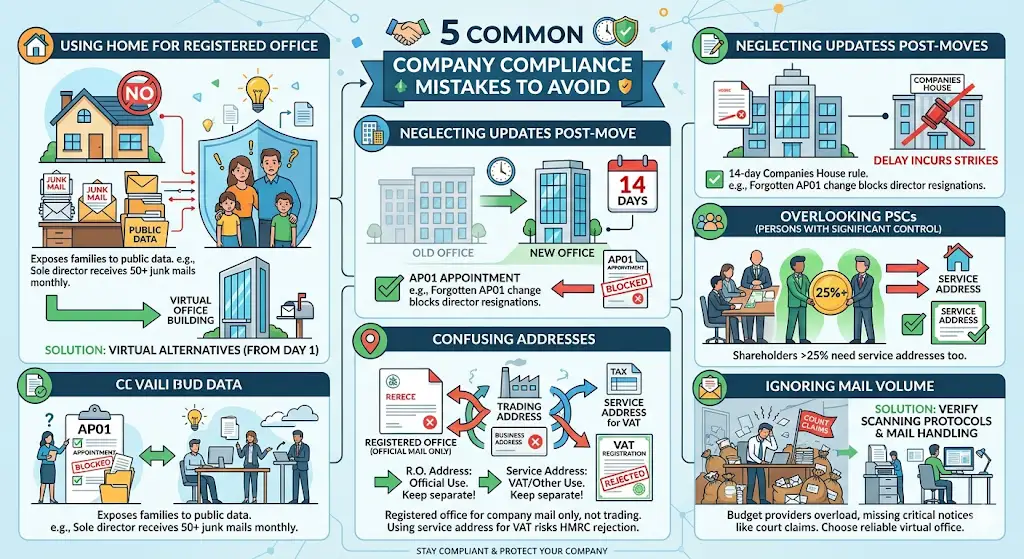
A frequent error: Using home for registered office, exposing families to public data, e.g., a sole director receives 50+ junk mails monthly. Solution: Virtual alternatives from formation day.
Neglecting updates post-move: 14-day Companies House rule; delays incur strikes. Example: Forgotten AP01 change blocks director resignations.
Confusing addresses: Registered office for company mail only not trading. Using service address for VAT risks HMRC rejection.
Overlooking PSCs: Shareholders >25% need service addresses too.
Ignoring mail volume: Budget providers overload, missing critical notices like court claims. Always verify scanning protocols.
Practical Tips and Best Practices
Select reputable providers like Form My Company for London addresses, ensuring Companies House compliance and 24/7 scanning. Bundle with formation packages for cost savings (£50+/year).
For multi-director firms, uniform service addresses simplify registers. Integrate with virtual offices for director/SAIL needs.
Monitor via Companies House dashboard; set calendar reminders for CS01.
Test forwarding: Send trial mail pre-launch.
For international directors, global service addresses ease compliance without UK residency. Pair with GDPR tools for data control. Track ROI: Privacy saves time/stress, professionalism wins clients.
Mastering registered office vs. director service addresses empowers UK entrepreneurs with tailored privacy, from basic shielding to full professional facades. Align choices with your structure home-based solopreneurs lean virtual, scaling firms add SAILs ensuring Companies House, VAT, PAYE harmony.
If you’re ready to register your company with confidence, Form My Company provides fast, fully online company formation with expert compliance support, VAT & PAYE handling, virtual office addresses, and professional guidance. Get started today and let our specialists handle the paperwork while you focus on growing your business.
Frequently Asked Questions
Can I use the same address for registered office and director service?
Yes, a single virtual address suffices for both, streamlining compliance while maximising privacy. Providers handle company-wide mail, forwarding scans promptly ideal for startups avoiding dual costs. Ensure it’s UK-based for registered office.
Is a PO Box allowed as registered office?
No, Companies House rejects PO Boxes/virtual postcodes; needs physical, accessible locations. Virtual offices comply with street addresses and signage.
How do address changes affect VAT/PAYE?
Minimal impact if updated promptly; HMRC syncs via Companies House. Notify via VAT401 for core changes. Delays risk audit flags.
Who sees director residential addresses?
Only credit agencies, police, or regulators not public. Service addresses protect fully.
Costs for these services?
£20-£150/year; bundles with formation save 20-30%.