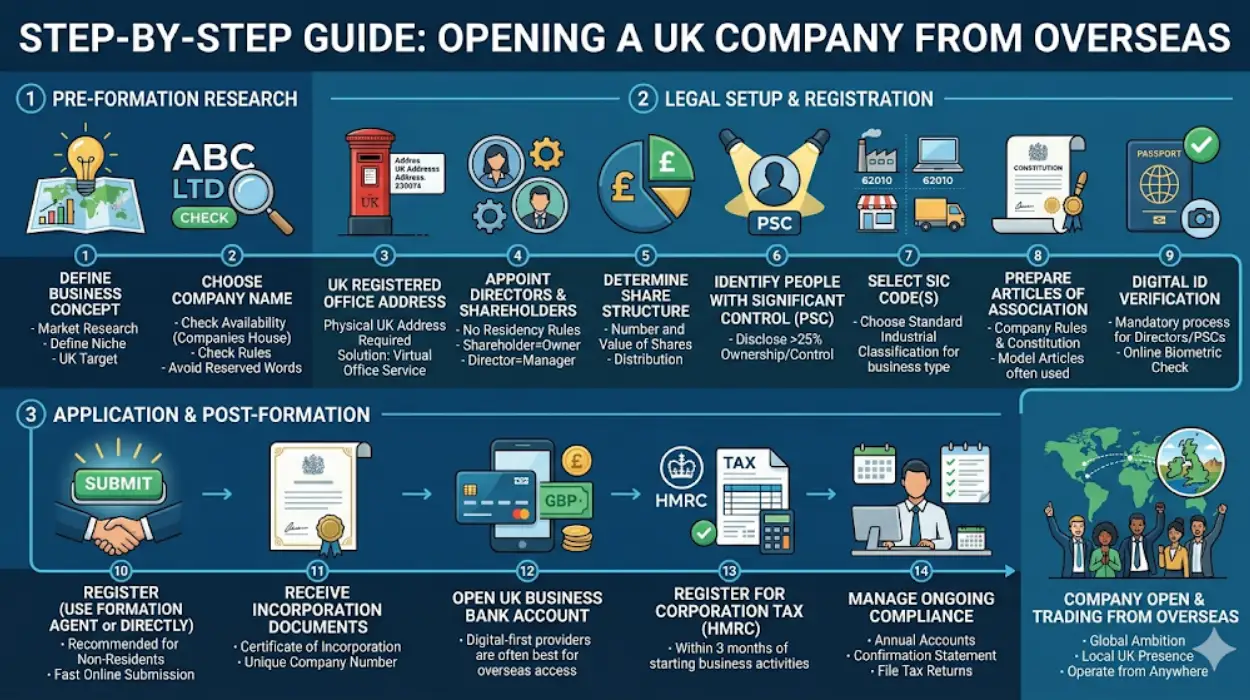
Opening a UK company from overseas is entirely feasible and can be completed online in as little as 24 hours through Companies House, without requiring physical presence or UK residency. Non-residents can serve as sole directors and shareholders, provided they secure a UK registered office address and comply with basic identification verification. This process unlocks access to the UK’s stable economy, global banking, and credible limited company structure.
Establishing a UK company from overseas represents a strategic move for international entrepreneurs seeking to tap into one of the world’s most business-friendly environments. The United Kingdom’s private limited company (Ltd) structure offers limited liability protection, separating personal assets from business debts, and positions your venture for seamless international trade, e-commerce, and fintech integration. With Companies House enabling fully digital registration since 2016, barriers like travel or local residency have dissolved, allowing founders from Asia, Europe, the Middle East, or the Americas to incorporate rapidly.
This guide draws on authoritative UK regulations to deliver a comprehensive roadmap, emphasising practical execution for non-UK residents. Key considerations include selecting the optimal business structure, navigating Companies House requirements, and addressing post-incorporation obligations such as VAT, PAYE, and HMRC filings. By prioritising compliance from day one, overseas founders mitigate risks like rejection or penalties, while leveraging semantic advantages such as enhanced credibility with UK suppliers and customers. For instance, a tech entrepreneur in Dubai might form a UK Ltd to access Stripe or Wise payments more efficiently, bypassing home-country restrictions. Form My Company specialises in streamlining this for global clients, ensuring EEAT-compliant setups that foster long-term growth. This 1300–1400-word resource equips you with actionable insights, avoiding common pitfalls and highlighting best practices tailored to overseas company formation.
Choose Your Business Structure
Selecting the right business structure is foundational for overseas incorporators, as it dictates liability, taxation, and administrative burdens under UK law. The private limited company (Ltd) stands out as the preferred choice for most non-residents due to its simplicity, prestige, and tax efficiency offering corporation tax rates of 19-25% on profits, with no personal liability beyond share capital. Unlike sole traders, which expose personal assets, or partnerships, an Ltd shields directors while enabling global scalability.
For overseas founders, alternatives like registering an overseas company branch (via Form OS IN01) suit expansions of existing foreign entities, but require certified home-country documents and English translations within one month of UK operations. Public limited companies (PLCs) demand £50,000 share capital and are overkill for startups. Consider your operational needs: if trading primarily in the UK, an Ltd facilitates VAT registration; for holding assets, it minimises double taxation via treaties.
Practical example: A Lahore-based exporter forms an Ltd to invoice EU clients, appointing themselves as sole director/shareholder. Key decisions include SIC codes (Standard Industrial Classification) to classify activities e.g., 62020 for IT consultancy affecting HMRC scrutiny. Structure implications extend to shareholders (minimum one, no residency rule) and directors (at least one, over 16), with Persons with Significant Control (PSC) declarations mandatory for transparency. This step typically takes 1-2 hours of research, setting the stage for seamless Companies House submission.

Select and Verify a Company Name
Your company name must be unique, compliant, and brand-aligned, checked instantly via Companies House webCHeck service to avoid rejection. Sensitive words like “Royal” or “Bank” trigger approvals from regulators, while names implying regulated activities (e.g., “Insurance”) need clearance. Overseas founders often append “Ltd” for instant recognition, ensuring domain availability for .co.uk sites to boost SEO.
The process involves brainstorming 3-5 options, verifying no identical “exact match” exists (similar names allowed if distinguishable), and considering trademarks via UK IPO search. Implications are profound: a memorable name enhances marketability, while infringement risks fines up to £5,000. For example, “GlobalTech Solutions Ltd” passes if unavailable variants like “GlobalTechUK Ltd” work.
Submit via the Companies House online portal, where real-time checks prevent 90% of issues. Non-residents face no extra hurdles, but cultural nuances matter avoid offensive terms. This 30-minute step prevents delays, directly impacting your registered office and memorandum of association filings.
Register with Companies House
Registration demands a UK registered office address (not PO Box), director/shareholder details, and Articles of Association (standard model or bespoke). Overseas applicants upload ID scans (passport) for KYC, appoint at least one director (yourself qualifies), and define share capital (often £1-£100).
File Form IN01 digitally (£12 standard, £50 same-day), including SIC codes, PSC register, and memorandum signed electronically. Approval yields a Certificate of Incorporation within 24 hours, assigning your CRN (Company Registration Number). Example: A Pakistani founder uses a virtual office for the address, lists overseas residency (service address protected), and declares 100 ordinary shares.
Post-registration, update PSC within 14 days. This core step establishes legal entity status, enabling bank account applications and contracts.
Handle Post-Registration Essentials
Secure a business bank account (challenging for non-residents; fintechs like Revolut Business or Starling excel), register for Corporation Tax with HMRC (automatic UTR issuance), and assess VAT (£90,000 threshold) or PAYE needs. Virtual offices provide mail handling, crucial for compliance.
Benefits and Potential Risks
Benefits abound: UK’s 0% bank deposit insurance up to £85,000, double-tax treaties (e.g., with Pakistan), and gateway to 27 EEA markets via Northern Ireland protocol. Risks include HMRC audits if non-compliant, banking rejections (30% for non-residents), or fines (£1,500 late accounts).
Legal and Compliance Considerations
Directors owe fiduciary duties under Companies Act 2006; file annual Confirmation Statement (£13), Accounts (dormant free), and CT600 tax returns. VAT/PAYE mandatory if employing/hitting thresholds; GDPR applies for data handling. Overseas directors report via service address.

Common Mistakes to Avoid
Overlooking UK address leads to rejection (40% cases); mismatched SIC codes trigger HMRC queries. Skipping PSC or using personal addresses exposes privacy. Late filings incur £150-£1,500 penalties always calendar deadlines.
Practical Tips and Best Practices
Use formation agents for bundles (address, VAT setup); opt for 1,000 shares at £0.01 for flexibility. Engage accountants early for IR35 compliance. Leverage tools like FreeAgent for filings.
Mastering UK company formation from overseas empowers global scalability with minimal friction. Follow these steps diligently for a robust launch.
If you’re ready to register your company with confidence, Form My Company provides fast, fully online company formation with expert compliance support, VAT & PAYE registration, virtual office solutions, and professional guidance. Get started today and let our specialists handle the paperwork while you focus on growing your business.
Frequently Asked Questions
Can I be the sole director from overseas?
Yes, no residency required; provide ID and service address. Companies House verifies digitally.
How long until I get a UK bank account?
1-4 weeks; prepare incorporation docs, business plan, proof of funds.
What if my home country taxes UK profits?
Claim relief via treaties; consult advisors.
Do I need a UK visa to operate?
No for remote management; Skilled Worker visa if relocating.
How much does formation cost?
£12-£100 direct; £50-£300 with agents including extras.