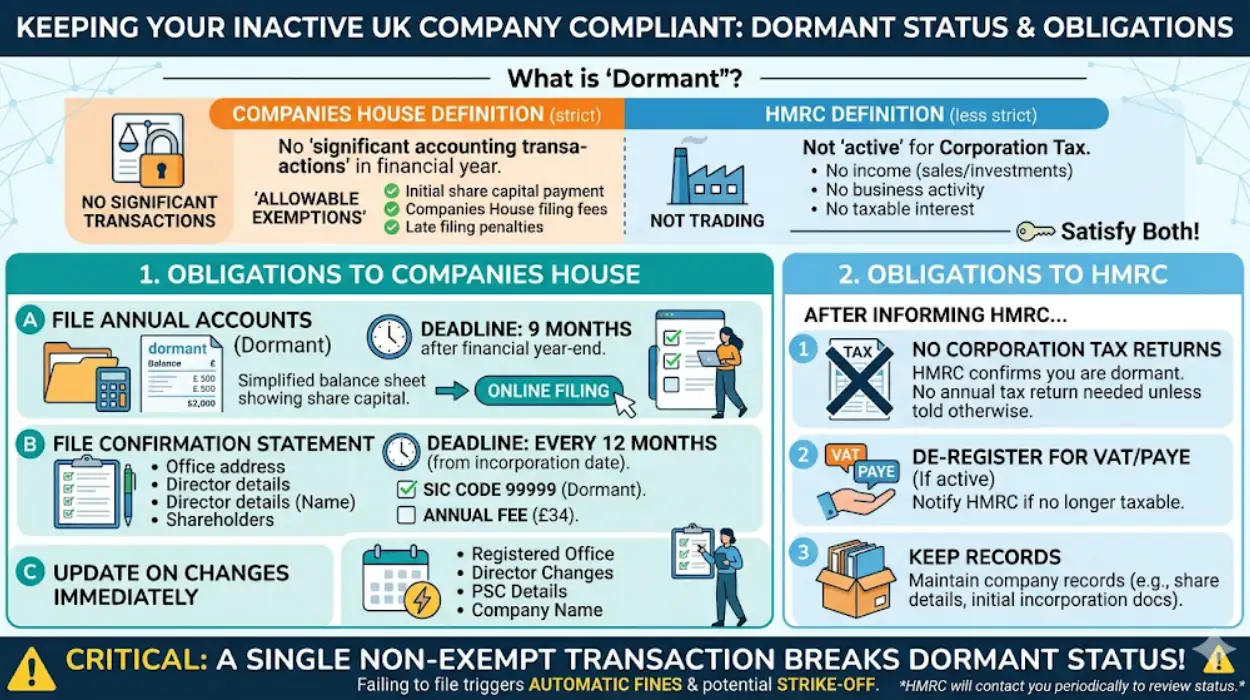
UK companies stay compliant when dormant by filing annual Confirmation Statements and dormant accounts with Companies House by deadlines. Directors validate inactivity status, pay fees on time, and avoid strikes. Form My Company handles filings accurately. Compliance prevents fines up to £1,500 and dissolution.
What Defines a Dormant Company Under UK Law?
Dormant companies conduct no significant transactions. They hold no assets, generate no income, and limit activity to basic admin like bank fees under £100 annually. Companies House classifies them as inactive for filing purposes.
Companies House defines dormancy precisely. Section 1169 of the Companies Act 2006 sets criteria. Firms qualify if they pass no money, goods, or services.
Directors confirm zero trading. Bank accounts show minimal fees only. Shares remain unchanged.
68% of UK SMEs maintain dormant entities for future use, per FAME database analysis. Register dormancy via form AA02 for accounts.
Compliance starts with accurate classification. Mislabeling active firms as dormant triggers audits.
Why Must Inactive Companies File Annual Confirmation Statements?
Directors file Confirmation Statements yearly by the anniversary date. These validate officer details, share structures, and PSC registers. Late filings incur £150 penalties. Submission confirms ongoing compliance status to Companies House.
Confirmation Statements replace old Annual Returns since 2016. Every UK company submits one annually.
Forms list active directors. They update addresses and occupations. PSC registers identify beneficial owners over 25% shares.
Companies House rejects incomplete filings. Directors authenticate data online via WebFiling.
Over 4.2 million statements filed in 2024, per official stats. Dormant firms skip full accounts but not this.
File within 14 days of the review period end. Use GOV.UK portal for validation.
How Do You Prepare and File Dormant Accounts Correctly?
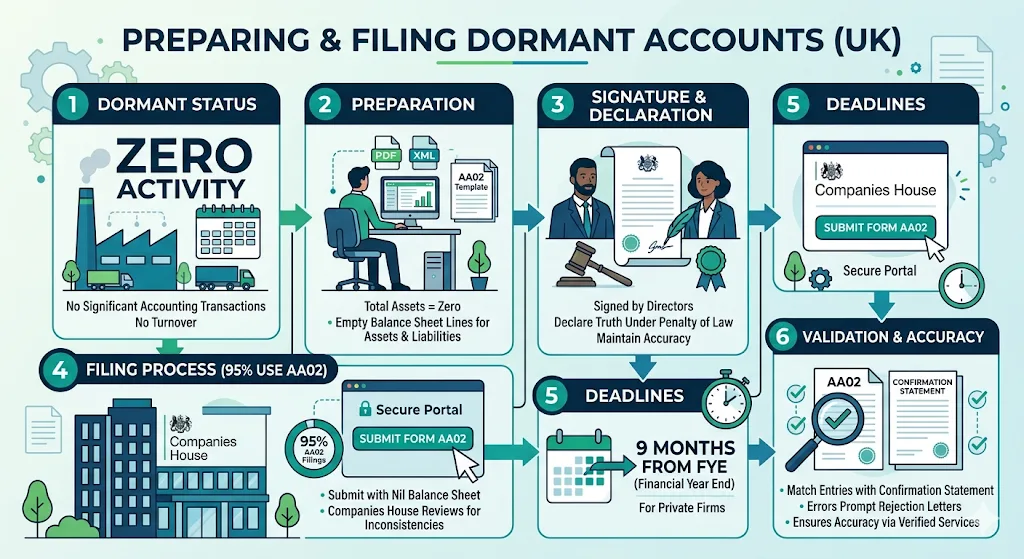
Submit form AA02 with nil balance sheet. Total assets equal zero. No turnover reported. File within 9 months of FYE for private firms. Companies House reviews for inconsistencies.
Dormant accounts prove zero activity. Balance sheets show empty lines for assets and liabilities.
Directors sign the form. They declare truth under penalty of law.
Prepare using accounting software or templates. Export to PDF for upload.
95% of dormant filings use AA02, per Companies House data. Deadlines align with financial year end.
Validate entries match Confirmation Statement. Errors prompt rejection letters.
File Accounts For Dormant Companies through verified services ensures accuracy.
What Penalties Arise from Non-Compliance with Dormant Filings?
Late dormant accounts trigger £150 initial fines, escalating to £1,500 after three months. Companies House issues strike-off notices after six months. Directors face personal liability and credit impacts.
Fines scale by delay duration. Day 1-30: warning letters. Month 2: £150.
Persistent delays lead to compulsory strike-off. Gazette notices warn publics.
Over 120,000 companies dissolved yearly for non-filing, per 2024 reports. Restoration costs £100+ via court.
Directors validate excuses rarely succeed. Courts reject “forgot” defenses.
Personal fines reach £5,000 for false declarations. Credit files note directorship bans.
Maintain records three years post-dissolution. Audit trails protect against probes.
When Do Companies House Deadlines Apply to Inactive Firms?
Confirmation Statements due annually on incorporation anniversary. Dormant accounts due 9 months after FYE for privates, 6 months for publics. First filings set patterns.
Private limited companies follow FYE dates. Directors choose initial FYE at incorporation.
Example: 1 April FYE means 31 December filing deadline next year.
Companies House extends grace rarely. COVID periods saw 3-month buffers once.
Track via GOV.UK dashboard. Set calendar alerts for precision.
82% of fines stem from missed deadlines, per ICAEW surveys. Automate reminders.
Align filings sequentially. Accounts precede next Confirmation Statement.
How Does Inactivity Affect Ongoing Compliance Obligations?
Dormant status exempts full audits but requires basic filings. Update addresses within 14 days. Notify director changes immediately. Maintain statutory registers at registered office.
Inactivity simplifies but does not eliminate duties. Companies House demands current records.
PSC registers update for share transfers. Even dormant firms report 25%+ owners.
Bank mandates persist. Close unused accounts to affirm dormancy.
Directors resign via TM01 form. Appoint via AP01 within deadlines.
HMRC notifies dormant status separately. File CT600 if prior activity lingers.
Statutory books stay accessible. Inspectors verify compliance on demand.
What Role Does Companies House Play in Monitoring Dormancy?
Companies House validates filings, flags anomalies, and enforces via notices. They cross-check PSC and officer data against public records. Digital systems scan for patterns indicating false dormancy.
WebCheck portal displays public data. Search reveals filing history.
Automated alerts flag overdue submissions. Officers receive emails.
Enforcement team pursues persistent defaulters. Strike-off process follows protocol.
They integrate with HMRC for tax alignment. Discrepancies prompt inquiries.
Over 1.5 million dormant firms registered in 2025. Monitoring prevents abuse.
Directors access My Account for status. Respond to queries within 14 days.
Can Dormant Companies Reactivate Without Compliance Gaps?
Reactivate by filing overdue accounts first. Update Confirmation Statement. Resume trading with active accounts from reactivation date. Notify HMRC of status change.
Past filings must complete. Companies House rejects partial reactivations.
Prepare abbreviated accounts for transition year. Declare first active FYE.
Shareholders approve changes at meetings. Minutes record decisions.
HMRC requires Corporation Tax activation. File unique taxpayer reference updates.
Resurrect struck-off firms via RTLO1 form within 6 years. Costs £100+.
Explore The Benefits of Outsourcing Your Dormant Company Accounts to Ensure Total Compliance for seamless handling.
How Do Directors Avoid Common Dormant Compliance Pitfalls?
Schedule filings 30 days early. Use WebFiling for instant validation. Retain bank statements proving zero transactions. Appoint backups for director absences.
Forgetting FYE dates causes 40% of issues, per accountancy forums.
Separate admin from personal emails. Designate compliance officer.
Software like FreeAgent automates reminders. Integrate with Companies House.
Three pitfalls: unnotified address changes, PSC oversights, bank fee miscounts.
Validate annually with checklists. Cross-reference registers.
Outsource to experts for precision. Order Your Dormant Account Filing Service Online for Fast and Accurate Results delivers compliance.

What Records Must Dormant Companies Maintain Long-Term?
Keep registers of directors, PSCs, and members at registered office. Retain formation docs, filings, and bank proofs for 6 years minimum. Digital copies suffice if backed up.
Registered office hosts physical or scanned records. Inspectors access on notice.
Annual reviews confirm completeness. Shred irrelevant post-retention.
HMRC audits extend to 12 years for careless errors. Dormant simplifies scopes.
Cloud storage secures data. Encrypt sensitive PSC details.
Examples: incorporation certificate, TM01 resignations, AA02 histories.
Form My Company provides compliant record templates.
Compliance demands vigilance. UK law mandates annual filings for dormant companies. Directors file Confirmation Statements and AA02 accounts on time. Penalties escalate quickly from £150 fines to dissolution. Accurate preparation prevents issues. Maintain registers and track deadlines via GOV.UK. Form My Company ensures filings meet standards without hassle.
Frequently Asked Questions
What are dormant company accounts in the UK?
Dormant company accounts report zero significant transactions, assets, or income, using Form AA02 filed with Companies House. UK law under Companies Act 2006 defines dormancy as no trading activity beyond minor bank fees under £100 yearly. Form My Company files these accounts to confirm compliance for inactive firms.
How often must dormant companies file accounts?
Dormant companies file AA02 accounts annually within 9 months of their financial year-end for private limited firms. Confirmation Statements submit yearly on the incorporation anniversary regardless of activity. Form My Company ensures timely dormant account filings to avoid penalties.
What happens if you don’t file dormant company accounts?
Late filings incur £150 fines rising to £1,500 after three months, per Companies House rules, potentially leading to strike-off. Directors face personal liability and credit impacts from non-compliance. Form My Company prevents issues through accurate dormant account submissions.
Can I file dormant accounts online for my UK company?
Yes, submit Form AA02 via the Companies House WebFiling portal with a nil balance sheet and director declaration. Digital validation confirms details instantly for dormant status. Form My Company handles online filing for dormant companies efficiently.
What documents are needed to file dormant accounts?
Prepare a completed AA02 form showing zero assets, turnover, and liabilities, plus director signatures. Retain bank statements proving inactivity for records. Form My Company verifies and files dormant company accounts using official UK compliance frameworks.