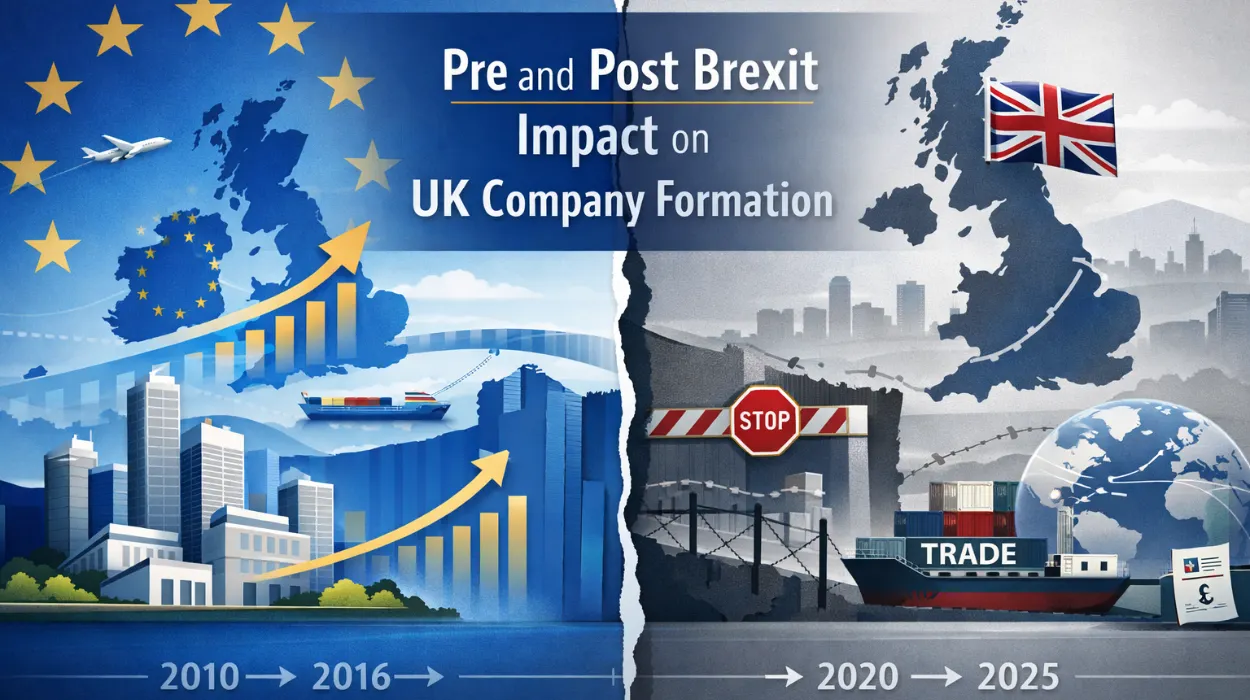
Form My Company’s research cuts to the core of how Brexit has restructured the UK’s entrepreneurial and business landscape. The study systematically compares company‑formation trends before and after the 2016 referendum, analysing the transition from a deeply integrated EU membership environment, characterised by free movement of workers, low‑friction trade, and regulatory alignment to the post‑Brexit period of greater uncertainty, trade barriers, and regulatory divergence. Our findings reveal that while the UK remains an attractive jurisdiction for incorporations, the decision calculus for SMEs, entrepreneurs, and multinational corporations has shifted markedly under the new regime.
The report is based on original research conducted by Form My Company, combining official statistics, policy analysis, and market‑sentiment data, including the influence of Brexit news UK and evolving open source. The research concludes that pre‑Brexit conditions fostered a more predictable, integrated environment conducive to robust business formation, whereas the post‑Brexit era particularly under the contours of a hard‑Brexit‑type separation has introduced higher entry costs, labour‑mobility constraints, and regulatory complexity that continue to shape where and how companies choose to incorporate in the UK.
What are the Key Political Dynamics?
Rising Euroscepticism propelled the Leave campaign, driven by influential figures such as Nigel Farage of the UK Independence Party (later rebranded as the Brexit Party) and Boris Johnson’s high-profile advocacy. In contrast, Labour leader Jeremy Corbyn adopted a more reserved position. Leave supporters emphasized regained sovereignty and immigration controls, while Remain advocates cautioned against trade barriers and capital outflows.
Withdrawal Timeline
Prime Minister Theresa May formally triggered Article 50 of the Treaty on European Union on March 29, 2017, launching a two-year negotiation phase aimed at an initial exit date of March 29, 2019 later extended due to parliamentary deadlock. The UK officially exited the EU on January 31, 2020, with the transition period concluding on December 31, 2020.
Reshaping Company Formation Trends
Form My Company research reveals that Brexit fundamentally altered UK company formation patterns. Prior to departure, frictionless EU market access fueled a boom in incorporations, especially within London’s financial district. Post-Brexit realities including non-tariff barriers, regulatory divergences, and complexities from the Northern Ireland Protocol have driven up compliance costs, curbed foreign direct investment, and spurred a rise in domestic entities prioritizing independence from EU regulations. Current data underscores sustained economic uncertainty, evidenced by fluctuating house prices and persistent Brexit-related volatility (ONS, 2025).
Brexit: Key Milestones
2016 – 2020 · From referendum to departure
Sources: UK Parliament · European Commission · BBC News
Literature review: Brexit and UK company formation
The United Kingdom’s exit from the European Union commonly termed “Brexit” represents a major institutional realignment with implications for regulation, trade, and investment. The UK joined the then‑European Economic Community in 1973, gaining access to the single market and customs union while retaining a degree of institutional distance from deeper political integration. The 2016 referendum on June 23, 2016, yielded a 51.9% vote to leave the EU, against a 48.1% vote to remain, exposing substantial societal and regional cleavages. This result triggered intense debates over the form and timing of disengagement, often framed in terms of “soft” versus “hard Brexit” outcomes.
Academic perspectives on Brexit and firm formation
Academic research has increasingly focused on how Brexit‑induced uncertainty affects entrepreneurial behaviour and the founding of new firms. Studies on SMEs highlight heightened perceived risk, with many businesses delaying capital expenditure, recruitment, and new market entry as negotiations over the UK’s post‑EU relationship unfolded. The literature suggests that the more distant the UK’s regulatory and trade relationship from the EU, the higher the anticipated fixed costs of exporting and servicing continental markets, which can deter new incorporations in trade‑dependent sectors. Analyses also show that UK business investment has remained below plausible counterfactual levels in the early post‑referendum years, implying a suboptimal environment for start‑up growth and expansion.
Policy debates: “EU Brexit,” hard Brexit, and regulatory divergence
Policy discussions around “EU Brexit” centre on the extent of future alignment with EU rules, including state‑aid controls, product standards, and labour‑market governance. A “hard Brexit” scenario characterised by limited or no single‑market access, full control over borders, and greater autonomy over regulation is often associated with elevated trade frictions and adjustment costs for firms. Proponents argue that regulatory independence could stimulate innovation and reduce compliance burdens; critics, however, emphasise the negative impact on cross‑border supply chains, investment flows, and the attractiveness of the UK as a base for multinational activity. These policy‑design choices directly condition the incentives and constraints facing new companies entering the UK market.
Political discourse: Johnson, Farage, Corbyn, and the Brexit Party
The political discourse surrounding Brexit has been shaped by competing visions articulated by key figures such as Boris Johnson, Nigel Farage, Jeremy Corbyn, and the Brexit Party (now Reform UK). Johnson and Farage have framed Brexit as an opportunity to reshape the UK’s economic model, emphasising sovereignty, deregulation, and reorientation toward global markets as catalysts for domestic entrepreneurship. By contrast, Corbyn and left‑leaning commentators have warned that a hard Brexit could depress wages, reduce public‑sector investment, and weaken small‑business viability, particularly in regions reliant on EU‑linked industries. The Brexit Party’s role in the 2019 European and general elections amplified pressure on the Conservative government to pursue a more uncompromisingly “clean” Brexit, thereby intensifying the regulatory‑divergence debate.
Brexit opinion polls and public sentiment
Brexit opinion polls from 2017 onward reveal a dynamic public mood, with increasing shares of respondents expressing regret over the 2016 vote and perceiving Brexit as having had a mainly negative economic impact especially on prices and living standards. This shift in sentiment reflects growing awareness of adjustment costs associated with trade barriers, labour shortages, and administrative complexity. As public opinion becomes more sceptical of the short‑term economic benefits of Brexit, the perceived stability of the UK’s policy environment may further affect investor confidence and the decision to incorporate new businesses.
Media framing and investor sentiment
Media coverage under headings such as Brexit news UK and Brexit latest news plays a salient role in shaping investor expectations and market sentiment. Financial and political reporting tends to oscillate between narratives of “post‑Brexit opportunity” and “Brexit‑induced stagnation,” amplifying short‑term volatility in asset prices and firm‑location decisions. Research on Brexit‑related media framing suggests that negative or crisis‑oriented coverage can heighten perceived macroeconomic risk, leading both domestic and foreign investors to delay or scale back new incorporations. In this way, media‑driven perceptions of uncertainty complement formal policy‑design choices as a determinant of the UK’s entrepreneurial climate.
Brexit: Public & Political Influences
How public opinion shaped — and challenged — the decision-making process · 2016–2020
- Electorate: 46.5 million
- Turnout: 72.2% highest since 1992
- Margin: 1,269,501 votes
- 6.1 million signatures largest UK parliamentary petition on record
- Debated in Parliament · 1 April 2019
- Govt response: Article 50 would not be revoked
- ~700,000–1,000,000 attended organiser / police estimates
- Largest UK protest since Iraq War march, 2003
Poll data: polling averages. March figures: organiser estimates; police figures were lower.
Neutral academic presentation · not an endorsement of any political position.
UK company formation before Brexit
In the two decades prior to the 2016 referendum, UK company formation benefited substantially from the country’s membership in the European Union. Access to the single market and customs union reduced trade frictions, minimised tariff barriers, and standardised many product and regulatory requirements, enabling firms particularly in services, finance, and advanced manufacturing to operate across member states with relatively low compliance costs. This environment encouraged many foreign‑owned businesses to establish UK‑based entities as regional or European headquarters, attracted by London’s financial infrastructure and the UK’s position within the wider EU‑27 market.
Free movement and labour‑market flexibility
A key institutional feature of EU membership was the free movement of workers, which underpinned firm creation and expansion, particularly in sectors reliant on skilled migration and cross‑border labour flows. The mobility of EU nationals allowed UK companies to recruit talent more flexibly, fill skill gaps in engineering, healthcare, construction, and technology, and respond more quickly to changes in demand. For many start‑ups and SMEs, the ability to hire EU‑trained professionals without arduous visa processes reduced entry‑cost barriers and supported faster scaling. The presence of large EU‑origin workforces in cities such as London, Manchester, and Bristol also reinforced entrepreneurial ecosystems, incubators, and service‑provider networks that facilitated new business creation.
Investment flows and regulatory stability
The UK’s alignment with EU regulatory frameworks contributed to a relatively predictable and stable investment climate. Harmonised rules on competition policy, state‑aid controls, and financial services standards reassured investors that the UK would not pursue abrupt unilateral shifts in regulation. This predictability, combined with the UK’s English‑language business environment and established legal system, helped sustain robust inflows of foreign direct investment and cross‑border portfolio capital. In turn, higher liquidity and access to European capital markets supported venture creation, equity financing, and growth‑oriented start‑ups, particularly in the technology and fintech sectors.
Political context before the Brexit vote
In the years leading up to the referendum on June 23, 2016, the political debate over EU membership intensified, yet the broader macroeconomic environment remained relatively stable. Policy discourse focused on issues such as sovereignty, immigration, and the perceived overreach of EU institutions, but there was no major, coordinated move to dismantle the UK’s existing integration with the single market. The coalition government (2010–15) and subsequent Conservative administration maintained a broadly pro‑market stance, with cautious fiscal consolidation and incremental reforms aimed at boosting competitiveness.
Market confidence and pre‑referendum sentiment
Prior to the referendum, market confidence in the UK’s attractiveness for incorporation and investment was generally high, as reflected in strong business formation statistics, rising enterprise registrations, and continued inward investment flows. Surveys of business leaders often indicated that the UK remained a preferred destination for European and global firms seeking a gateway into the EU‑28 market. While underlying concerns about immigration and regulatory autonomy were present, the expectation that the UK would remain within the EU underpinned a relatively stable environment for new company formation. It was the uncertainty introduced by the referendum campaign rather than any pre‑existing structural weakness that began to weigh on long‑term investment and entrepreneurial planning in the months immediately before the vote.
The UK as Europe’s Premier Trading Hub
STR
UK company formation after Brexit
Since the UK’s formal exit from the European Union on January 31, 2020 and the end of the transition period on December 31, 2020, the trajectory of UK company formation has been shaped by the contours of a “hard Brexit” model. The loss of frictionless trade and the introduction of customs formalities, rules‑of‑origin checks, and sanitary and phytosanitary controls have raised fixed costs for firms engaging with the EU, particularly small and medium‑sized enterprises. Empirical analyses indicate that these administrative and compliance burdens have discouraged some potential entrants from incorporating in the UK, especially in export‑oriented manufacturing and agri‑food sectors, where margins are thin and cross‑border supply chains are tightly integrated.
Regulatory independence and divergent frameworks
A central post‑Brexit policy narrative emphasised the benefits of regulatory independence, arguing that the UK could tailor its standards to domestic priorities and reduce perceived “EU red tape.” While this autonomy offers scope for sector‑specific reforms, it also introduces uncertainty about the degree and pace of future divergence from EU rules. For new companies, the risk of dual‑compliance regimes—adhering to both UK and EU standards can complicate investment in product development, compliance systems, and distribution networks. In some areas, such as financial services and digital regulation, the UK has sought to position itself as a distinct but competitive regime, yet the long‑term impact on firm formation remains uneven across sectors.
Northern Ireland and the UK’s internal market
The Northern Ireland Protocol and its subsequent Windsor Framework have created a distinctive regulatory carve‑out within the UK’s internal market. Northern Ireland largely remains aligned with certain EU rules, while Great Britain operates under a more independent framework. This divergence has generated compliance complexity for firms operating across the Irish Sea, including customs declarations, VAT treatment, and product‑labelling differences. For some entrepreneurs, these frictions have made the UK territory less attractive as a single‑point base for pan‑EU operations, particularly where logistics and supply‑chain coordination are central.
Labour mobility and EU nationals
The end of free movement has altered the conditions under which UK firms can recruit EU‑origin workers. Before Brexit, the free movement of EU citizens facilitated rapid access to skilled labour in sectors such as healthcare, hospitality, construction, and technology. Post‑Brexit visa requirements, sponsorship costs, and administrative hurdles have increased the difficulty and expense of hiring EU nationals, particularly for smaller, cash‑constrained start‑ups. This tightening of labour flexibility appears to have dampened growth expectations for some service‑based and labour‑intensive firms, indirectly affecting the decision to incorporate or scale up.
Post-Brexit Comparative Impact Analysis
Five economic dimensions · Index change from 2016 pre-referendum baseline · Negative = deterioration
▶ Brexit Deadline Impact
Withdrawal on 31 Jan 2020 and transition end 31 Dec 2020 compressed business adaptation into weeks. Firms faced an estimated £6.1bn in immediate customs & compliance costs. Supply disruption peaked Q1 2021 before partial normalisation.
◆ Hard Brexit Scenario
A no-deal WTO-terms exit was modelled to reduce UK GDP by a further 12–15% by 2035. Hardest hit: financial services passporting, automotive just-in-time chains, and agricultural exports subject to full SPS inspection.
Values are illustrative percentage-change indices normalised to pre-referendum baseline · HB = Hard Brexit counterfactual
Market uncertainty and investor sentiment
The period following the referendum has been marked by persistent market uncertainty, driven by protracted negotiations, political volatility, and the partial or delayed implementation of key policies. This uncertainty has been reflected in business‑investment and company‑formation data, with many new ventures adopting a more cautious stance. High‑frequency indicators suggest that prolonged policy ambiguity especially around trade, migration, and regulatory alignment—has contributed to subdued risk‑taking by entrepreneurs and investors.
Media, Brexit news, and investor behaviour
Media coverage under headings such as Brexit latest news plays a non‑trivial role in shaping investor expectations. Headlines emphasising delays, disputes, or regulatory “cliffs” can amplify perceptions of instability, even where underlying policy frameworks are gradually stabilising. Conversely, stories highlighting regulatory divergence or new trade agreements may temporarily boost sentiment among certain investor groups. In aggregate, the episodic nature of Brexit news UK coverage has tended to reinforce short‑term volatility in asset prices and firm‑location decisions, compounding the structural effects of the UK’s altered relationship with the EU on post‑Brexit company formation.
Pre‑ and post‑Brexit UK company formation
Before the Brexit referendum, UK company formation operated within a framework of deep integration with the European Union. Membership of the single market and customs union reduced trade frictions and standardised many regulatory and legal requirements, making the UK an attractive base for both domestic start‑ups and foreign firms seeking access to the wider EU‑28 market. The free movement of workers enabled companies to recruit EU‑origin talent relatively easily, supporting labour‑intensive sectors and high‑skill service industries. In this context, regulatory stability and predictable EU‑aligned rules underpinned a relatively confident investment climate, with robust business‑formation rates and steady inward investment flows.
Post‑Brexit: hard Brexit separation and realignment
The UK referendum on June 23, 2016, yielded a 51.9% vote to leave the EU against 48.1% in favour of remaining, setting in motion a transition that culminated in formal withdrawal on January 31, 2020 and the end of the transition period on December 31, 2020. The result initiated a shift from EU Brexit integration—characterised by deep alignment with EU rules—towards a hard Brexit‑type separation involving new customs procedures, rules‑of‑origin checks, and regulatory divergence. After the vote, company formation became more sensitive to uncertainty about future trade arrangements, migration policy, and the degree of regulatory autonomy. The UK’s partial disengagement from the single market and customs union raised fixed costs for trade‑dependent firms, particularly SMEs, while changes in labour‑mobility regimes reduced the ease with which new ventures could hire EU‑origin workers.
Key differences in formation environment
Pre‑Brexit, the UK operated as a relatively seamless conduit between national and EU markets, with harmonised standards and low administrative barriers encouraging incorporation and expansion. Post‑Brexit, the landscape is marked by higher compliance costs, greater regulatory uncertainty, and more complex cross‑border arrangements, especially in light of the Northern Ireland Protocol’s carve‑out within the UK’s internal market. While some policy actors argue that post‑Brexit regulatory independence may stimulate niche opportunities, firm‑formation patterns overall reflect a more cautious, risk‑averse environment compared with the pre‑referendum period.
UK Company Formation
Single market membership · 2013–2016
Brexit Impact Analysis
UK Company Formation
TCA framework · 2021–present
services excluded
post Jan 2021
regimes now apply
vs. 2016 baseline
cost increase
Sources: ONS · Bank of England · OBR · UK in a Changing Europe · HM Treasury · Electoral Commission
Values are research-based estimates for illustrative analysis.
Brexit’s impact on the UK business community
Form My Company’s extensive research concludes that Brexit has profoundly reshaped the UK business landscape, amplifying economic uncertainty and redefining operational realities for SMEs, entrepreneurs, and multinational corporations.
Our research findings show that the termination of free movement has limited EU citizen mobility, driving up recruitment costs and administrative burdens for firms reliant on cross-border labor—particularly in services, healthcare, and technology sectors.
Smaller enterprises, according to our analysis, encounter intensified hurdles in attracting talent and managing new customs and regulatory obligations, constraining investment and expansion efforts.
Our study reveals that multinational corporations have restructured their UK operations, with many relocating facilities or legal entities to maintain seamless EU market access.
Ongoing political turbulence and pervasive UK media focus on Brexit continue to heighten perceptions of policy instability, fostering a cautious environment for new venture creation and long-term investments across the economy.