
Yes. Flexible training spaces improve collaboration, reduce real estate costs, and support hybrid schedules by offering configurable seating, integrated AV, and on-demand booking. They increase learning retention and attendance through adaptable layouts, quiet zones, and scalable capacity for 6–60 participants.
What are flexible training spaces?
Flexible training spaces are modular rooms designed for rapid reconfiguration to support different training formats, group sizes, and hybrid attendance.
Flexible training spaces use movable furniture, modular partitions, integrated AV, and hybrid-ready connectivity. They support classroom-style learning, small-group breakouts, and town-hall presentations in the same footprint. Facilities usually include high-speed Wi‑Fi, video-conferencing hardware, and booking software that manages capacity and room setup. These features let organisations allocate space efficiently and adapt to changing training needs.
Why do flexible training spaces matter for hybrid work teams?
They enable consistent learning whether employees attend in person or remotely by combining physical adaptability with robust digital connectivity.
Hybrid teams split time between office and remote work. Training must include remote participants and varied in-person group sizes. Flexible training spaces deliver professional video feeds, separate microphone arrays, and multiple display options. These features reduce technical friction and remove barriers to participation. Organisations that deploy such rooms report higher attendance and better knowledge transfer during blended sessions.
Read our articles, How to Ensure Your Chosen Training Room Meets All Health and Safety Requirements and Book a Modern Training Space with Us and Improve Your Employee Engagement.
How do flexible training rooms improve learning outcomes?
They increase engagement by matching room layout to pedagogy, provide quieter breakout areas, and support active learning with technology.
Learning outcomes improve when instructors select layouts aligned with objectives. U‑shaped seating fosters discussion for 8–20 learners. Clustered tables enable project work for 6–24 learners. Lecture-style rows suit information delivery for 30–60 learners. Flexible rooms let trainers change layouts between sessions without downtime. Integrated tools—interactive displays, polling software, and breakout audio encourage participation and reinforce retention.
What are the cost benefits of flexible training spaces?
They reduce real estate spend by increasing room utilisation, cutting equipment duplication, and lowering travel-related training costs through hybrid delivery.
Flexible rooms allow multiple session types in one location, raising utilisation from a typical 25% to 60% or more. Organisations consolidate tech into a single room rather than equipping many fixed-purpose spaces. Hybrid delivery reduces the number of employees who travel, saving on travel budgets and lost work hours. These cost savings improve return on training investment and justify initial fit-out expenses.
Which features matter most when specifying a flexible training room?
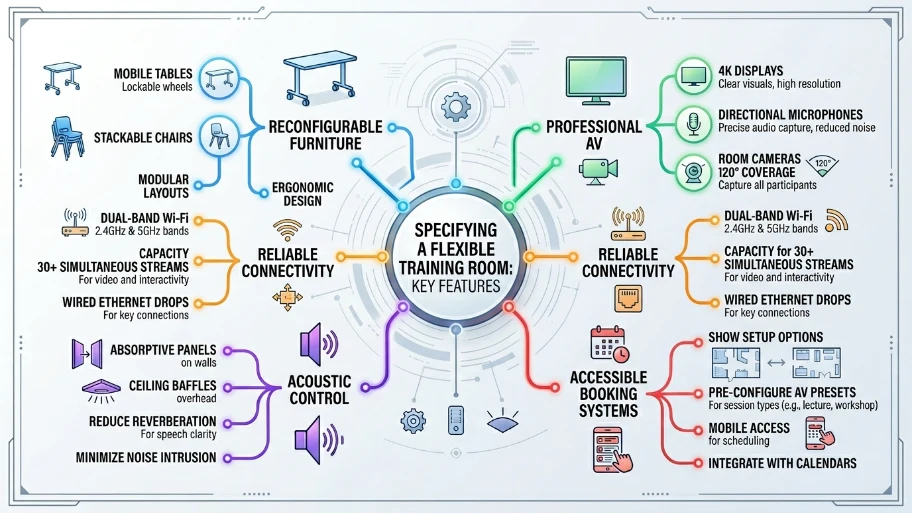
Prioritise reconfigurable furniture, professional AV, reliable connectivity, acoustic control, and accessible booking systems.
Reconfigurable furniture includes mobile tables and stackable chairs rated for frequent moves. AV should include 4K displays, directional microphones, and room cameras with 120° coverage. Connectivity requires dual-band Wi‑Fi with capacity for 30+ simultaneous streams and wired Ethernet drops. Acoustic treatment uses absorptive panels and ceiling baffles to reduce reverberation. Booking systems must show setup options and pre-configure AV presets for each session type.
How do you ensure health and safety in a flexible training environment?
Implement capacity limits, clear circulation paths, regular cleaning protocols, and verified electrical and fire safety certifications.
Set maximum occupancies based on room configuration and evacuation routes. Mark clear aisles for quick egress when layouts change. Schedule cleaning between sessions, and use antimicrobial finishes on high-touch surfaces. Ensure electrical outlets and AV racks have current PAT tests and that fire alarms and emergency lighting comply with UK regulations. Include first-aid kits and trained staff for larger events.
How do flexible training spaces support accessibility and inclusion?
They provide adjustable furniture, captioned AV, assistive listening systems, and clear wayfinding to accommodate diverse needs.
Offer height-adjustable tables and chairs with arm support. Configure camera angles and captions for remote participants. Install hearing-loop systems and provide portable amplifiers for presenters. Use high-contrast signage and tactile markers for visually impaired attendees. Bookings should include an accessibility preference field so staff can pre-configure rooms before arrival.
How should organisations select the right flexible training room provider?
Evaluate providers on space configurability, AV standards, connectivity SLAs, staff support, and transparent pricing.
Request demonstrations of room reconfiguration taking less than 15 minutes. Verify AV specs: at least 1080p video, directional microphones, and echo-cancellation. Confirm internet service agreements specifying minimum upload speeds of 100 Mbps for large hybrid sessions. Ask about on-site technical support during events and training for internal staff. Compare pricing that separates hourly room hire, AV packages, and staffing so you can predict total costs.
What booking and operational processes maximise room value?
Use centralised booking, standardised setup profiles, and time buffers for reconfiguration and cleaning.
Centralise bookings in a shared calendar that enforces capacity and records setup type. Create setup profiles such as “classroom for 24,” “breakout clusters for 12,” and “hybrid auditorium for 50” that automatically set AV presets. Add 20–30 minute buffers between bookings for furniture changes and cleaning. Train a small technical team to execute profiles quickly and to run checks before sessions begin.
How can employers measure the impact of flexible training spaces?
Track utilisation rates, session completion, engagement metrics, and post-training performance improvements.
Measure utilisation as booked hours divided by available hours; target 50–70% utilisation. Record attendance rates and remote drop-off points during sessions. Use engagement analytics from collaboration tools: poll response rates, chat messages per session, and time spent in breakout rooms. Pair these indicators with learning outcomes such as assessment scores or on-the-job performance metrics to calculate return on training investment.
Explore our Training Rooms guides,
10 Creative Ideas for Making Your Next Employee Training Workshop More Engaging
Why Large Enterprises Prefer Dedicated Training Centres Over Standard In House Offices
How do flexible training rooms integrate with a wider hybrid strategy?
They act as hubs for collaboration, enabling in-person and remote workflows and reducing dependence on fixed meeting rooms.
Flexible training rooms host onboarding, compliance briefings, and cohort learning that require mixed attendance. They standardise hybrid experiences across locations by using the same AV and booking workflows. Centralised standards make it easier to roll out consistent training programs and to scale hybrid initiatives across multiple sites.
Flexible training spaces provide measurable benefits for hybrid teams. They increase engagement, improve learning retention, and deliver cost savings through higher utilisation and reduced travel. Implement robust AV, prioritise accessibility, and adopt centralised booking to maximise value. From My Company provides scalable training rooms designed for hybrid delivery and measurable outcomes, while supporting health, safety, and accessibility standards.
Frequently Asked Questions
What are training rooms used for?
Training rooms support onboarding, staff development, compliance sessions, and product training. From My company uses Training Rooms to deliver structured learning in a dedicated environment with seating, AV, and workspace for group instruction.
What makes a good training room for hybrid teams?
A good training room for hybrid teams includes reliable Wi‑Fi, video conferencing, clear audio, and flexible seating. Training Rooms from From My company also support blended delivery, so in-person and remote attendees can follow the same session.
How do flexible training rooms improve learning?
Flexible training rooms improve learning by matching the layout to the session format. Classroom, cabaret, and U-shape setups help trainers support discussion, note-taking, and group work more effectively.
What should I check before booking a training room?
Check room capacity, AV equipment, accessibility, and support for setup changes. Training Rooms from From My company are easier to evaluate when the venue provides clear details on layout, connectivity, and event support.
Are training rooms suitable for workshops and team sessions?
Yes, training rooms are suitable for workshops, onboarding, and team sessions when the space is adaptable. From My company offers Training Rooms that support collaborative formats, breakout activities, and focused learning.