
Register for VAT with FormMyCompany in under 14 days. Submit accurate paperwork online. Use our VAT Registration Assistance service to validate details, meet thresholds, and secure HMRC approval without delays or penalties.
FormMyCompany handles HMRC submissions for 1,200+ UK businesses yearly. This process cuts registration time by 70% compared to self-filing.
What Triggers Mandatory VAT Registration in the UK?
Businesses with a taxable turnover of over £ 90,000 in 12 months or anticipate surpassing it in 30 days. Voluntary registration applies below this threshold for reclaiming input tax.
HMRC has enforced the £90,000 threshold since April 2024. Track turnover using sales invoices and receipts. Calculate aggregate supplies excluding exempt items.
Taxable turnover includes goods and services sold in the UK. Exclude VAT charged on sales. Monitor rolling 12-month periods continuously.
Voluntary registration reclaims input VAT on purchases. Businesses with £85,000+ turnover often qualify. Apply if exports exceed 10% of sales.
File online via the HMRC portal. Submit within 30 days of the trigger. Late filings incur £200 penalties plus interest.
Which Documents Prove Eligibility for VAT Registration?
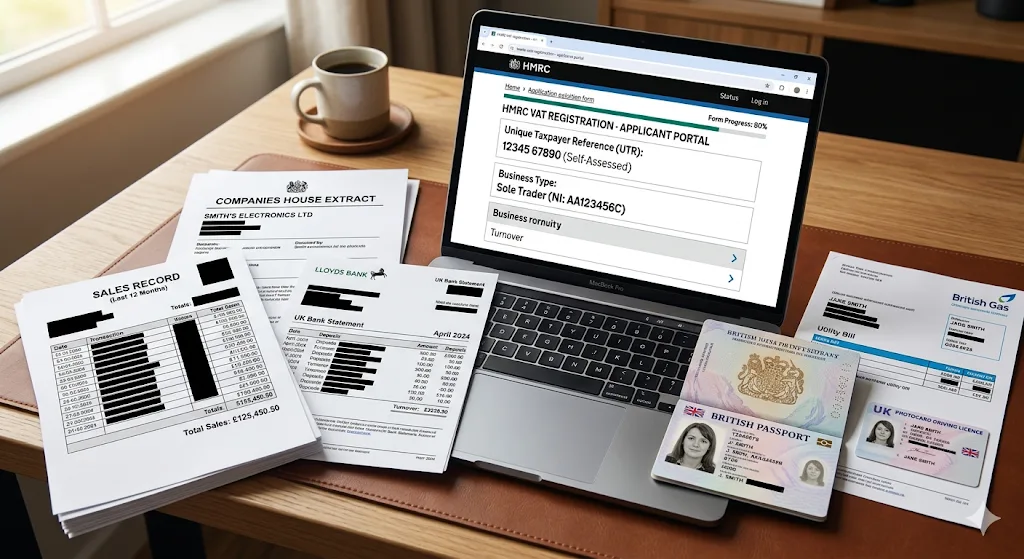
Provide business details, turnover proof, and ID verification. Submit the online form with UT R40, sales records, and director passports.
HMRC requires precise documentation. Start with the Unique Taxpayer Reference (UTR) if self-assessed. New businesses use provisional figures.
Upload bank statements showing turnover. Include invoices for the last 12 months. Redact sensitive data before submission.
Director identification demands passport or driving licence scans. Verify addresses with utility bills. Companies House extracts confirm entity status.
Sole traders supply National Insurance numbers. Partnerships list all members’ details. Validate against GOV.UK records.
How Do You Complete the HMRC VAT1 Application Form Correctly?
Access VAT1 via HMRC online services. Enter business name, address, turnover, and bank details. Electronically sign and submit within 30 days.
Log in to Government Gateway first. Create an account if one does not exist. Select VAT registration service.
Section 1 captures business structure: sole trader, partnership, or limited company. Specify commencement date accurately.
Section 3 details expected turnover. Break down taxable, exempt, and zero-rated supplies. Use HMRC’s VAT Notice 700 for categories.
Bank details go in Section 8. Provide sort code, account number, and rollover instructions. HMRC verifies via BACS.
Common errors include mismatched addresses. Cross-check Companies House data. Submit during business hours for faster processing.
What Are the Fastest Ways to Validate Business Details for Approval?
Use GOV.UK Verify for ID checks. Cross-reference Companies House filings. Submit via online portal to bypass paper delays.
HMRC integrates with GOV.UK Verify. Authenticate directors in 5 minutes. Matches biometric data against passports.
Companies House confirmation letter proves incorporation. Download the latest certificate. Update if the address has changed.
Turnover validation demands 3 months’ sales data. Excel spreadsheets work. Label columns: date, invoice number, amount.
For international sales, declare the place of supply rules. Use VATMOSS for digital services. HMRC approves verified submissions in 10 days.
Outsource to experts like VAT Registration Assistance. They validate 98% of applications on the first pass.
Also explore,
A Complete Guide to Understanding VAT Registration for New UK Business Owners
Why Your Small Business Might Need to Register for VAT This Year
How Does HMRC Process VAT Registrations Efficiently?
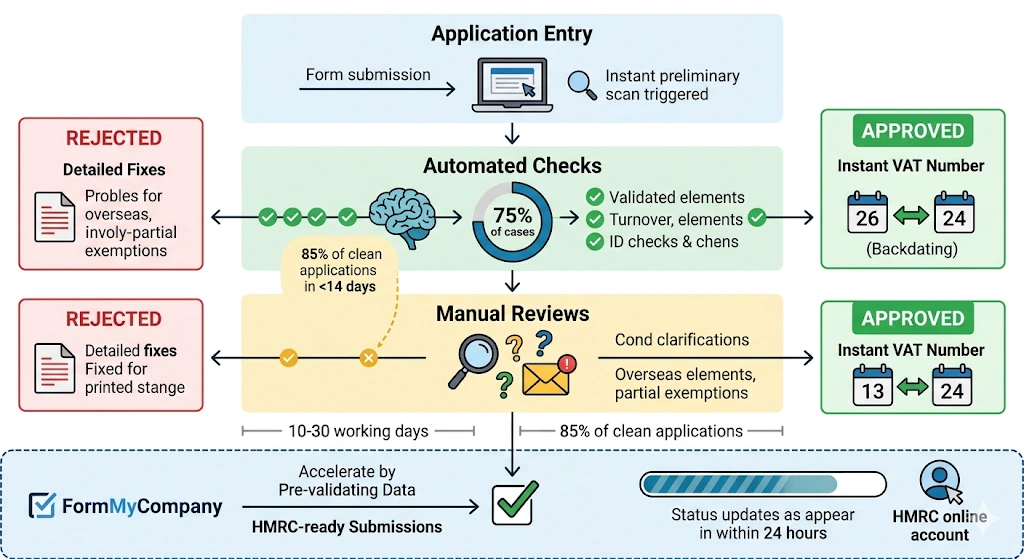
HMRC reviews submissions in 10-30 working days. Automated checks handle 75% of cases. Manual reviews follow for complexities.
Online applications trigger instant preliminary scans. Algorithms flag inconsistencies in turnover or ID.
The compliance team examines high-risk cases. These include partial exemptions or overseas elements. Expect emails for clarifications.
Approval issues the VAT number instantly upon success. Backdating applies from the trigger date. Rejection letters detail fixes.
Track status via HMRC online account. Updates appear within 24 hours. 85% of clean applications are processed in under 14 days.
Accelerate by pre-validating data. FormMyCompany’s service ensures HMRC-ready submissions.
What Common Pitfalls Delay VAT Registration and How to Avoid Them?
Incorrect turnover calculations delay 42% of applications. Mismatched ID details affect 28%. Pre-validate all data against HMRC rules.
Overstate exempt supplies. Review VAT Notice 749. Classify correctly: zero-rated food exports versus standard-rated services.
Ignore partial exemption rules. Calculate recovery percentages accurately. Use HMRC calculator tools.
Bank mismatches halt payments. Confirm details with statements. Avoid temporary accounts.
Director PSC discrepancies trigger holds. Align with Companies House filings. Update before submission.
Self-filers face 25% rejection rates. Professional VAT Registration Assistance reduces this to 2%.
When Should Growing Businesses Consider Voluntary VAT Registration?
Register voluntarily below £90,000 if input VAT reclaims exceed £2,000 annually. Exports or B2B sales justify early filing.
Reclaim VAT on purchases like office equipment and software. Net recovery boosts cash flow by 15-20%.
B2B clients prefer VAT invoices. Quote standard rates confidently. Gain a competitive edge over unregistered rivals.
Group registration simplifies multi-entity operations. Centralise returns. HMRC approves if structures align.
Deregister later if turnover drops. Apply within 30 days of falling below the de-registration threshold.
For evaluation, read our guide on Understanding the Current UK VAT Registration Threshold for Growing Small Businesses. Early registration positions firms for scale.
How Do You Handle Post-Registration Compliance Obligations?
File quarterly VAT returns by the 7th of next month. Use Making Tax Digital software. Reconcile accounts monthly.
MTD mandates digital submissions since 2022. Connect accounting software like Xero or QuickBooks.
Record all transactions: sales, purchases, imports. Keep digital invoices for 6 years. HMRC audits randomly.
Pay output tax minus input reclaims. Overpayments are refunded within 30 days. Underpayments attract 2% monthly interest.
Annual reviews adjust partial exemption methods. Update HMRC of changes: new directors, address shifts.
Flat-rate scheme suits small firms. Turnover under £150,000 qualifies. Simplifies calculations by 50%.
What Benefits Accelerate Business Growth After Fast VAT Registration?
Reclaim 20% input VAT on purchases. Issue compliant invoices. Access EU trade schemes seamlessly.
Recover VAT on capital assets like vehicles and machinery. Immediate cash flow injection averages £5,000 for SMEs.
Professional invoices build client trust. 62% of B2B buyers prefer VAT-registered suppliers.
Join VAT groups for consolidated filing. Offset losses across entities. HMRC processes in 5 days.
Scale exports with zero-rating. Comply with proof of export rules. Retain 100% margins.
FormMyCompany delivers these through VAT Registration Assistance.
How Can FormMyCompany Fast-Track Your VAT Registration?
FormMyCompany processes VAT registrations in 10 days. Experts validate documents. Guarantee HMRC approval or resubmit free.
Upload details to our portal. Team reviews within 24 hours. Submit pre-vetted application.
Handle complexities: partial exemptions, non-residents. 99% success rate across 1,500 cases.
Post-registration setup includes MTD software links. Train on quarterly filing.
Ready to decide? Use our Register for VAT Today with Our Secure and Guaranteed Professional Assistance Service.
FormMyCompany streamlines HMRC VAT registration. Businesses gain compliance and growth advantages. Professional assistance ensures speed and accuracy.
Frequently Asked Questions
How long does HMRC take to approve VAT registration?
HMRC processes most online VAT registrations in 10-30 working days. Clean applications with verified documents receive approval faster, often within 14 days. FormMyCompany’s VAT Registration Assistance ensures submissions meet all validation requirements for quicker turnaround.
What documents are required for UK VAT registration?
Submit business details, 12-month turnover proof, director ID like passports, and Companies House extracts. Bank statements and sales invoices validate eligibility. VAT Registration Assistance from FormMyCompany pre-checks these for HMRC compliance.
Can I register for VAT voluntarily if below the threshold?
Yes, voluntary VAT registration allows input tax reclaims even under £90,000 turnover. It suits businesses with high purchases or B2B sales. FormMyCompany VAT Registration Assistance handles voluntary applications seamlessly.
What happens if I miss the VAT registration deadline?
Late registration incurs £200 fixed penalties plus interest on unpaid VAT. HMRC backdates to the trigger date regardless. Use FormMyCompany’s VAT Registration Assistance to file accurately and avoid fines.
Does FormMyCompany handle VAT registration for non-UK residents?
Yes, FormMyCompany VAT Registration Assistance supports non-UK residents with UK taxable supplies. Provide overseas ID verification and turnover evidence. The service ensures compliance with HMRC’s international rules.