Updating your Persons with Significant Control register requires submitting ownership alterations to Companies House within 14 days, alongside updating internal compliance documentation to reflect new voting rights, share allocations, or dominant influence thresholds exceeding 25%.
Corporate ownership shifts alter the legal control structure of any UK business. When shares transfer or voting rights shift, identifying who holds ultimate authority becomes a primary legal duty. Companies House enforces strict transparency frameworks to ensure public records match actual corporate ownership.
Navigating these regulatory adjustments demands a structured approach to data collection and statutory filings. Business leaders must authenticate incoming controllers and record outgoing individuals accurately. Understanding the statutory timeline prevents financial penalties and maintains corporate good standing across all operational jurisdictions.
Why Must Companies Update the PSC Register Promptly?
Companies must update the register promptly because UK law mandates a strict 14-day notification window for recording ownership changes, preventing regulatory penalties and maintaining corporate transparency.
Statutory compliance protects corporate entities from severe legal consequences enforced by regulatory authorities. When ownership structures shift, failing to record alterations leaves public databases outdated. This discrepancy breaches the Companies Act 2006 and invites administrative scrutiny.
Accurate record-keeping establishes clear accountability for every corporate entity operating within the UK market. Stakeholders, financial institutions, and potential investors rely on verified public data to assess enterprise risk. Promptly recording new controllers safeguards the business reputation and ensures seamless commercial operations without regulatory friction.
What Information Is Required to Record a New PSC?
Recording a new controller requires gathering verified personal details, exact service addresses, full residential locations, birth dates, nationality, and the precise legal nature of their significant control.
Capturing accurate data points ensures compliance with rigorous government standards. Business administrators must collect comprehensive biographical information before submitting updates to the central registry.
Verify identity credentials using government-issued documentation like passports or biometric residence permits
Document the exact date when the individual met the significant control criteria
Record specific ownership thresholds, such as holding more than 25% of shares or voting rights
Collecting these verified details eliminates submission errors and accelerates the processing time at Companies House. Maintaining high data integrity protects the corporate entity from administrative rejections and subsequent filing delays.
How Does an Ownership Change Trigger PSC Obligations?
An ownership change triggers PSC obligations whenever share transfers, allotment adjustments, or altered voting agreements grant an individual more than 25% ownership or dominant influence.
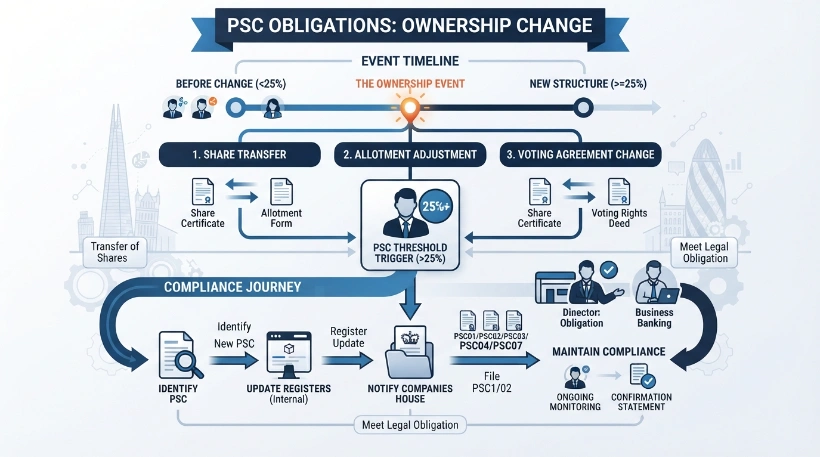
Corporate transactions alter the distribution of power within registered companies. When a shareholder acquires additional equity, their percentage stake crosses the legal threshold defined by corporate legislation. This shift transforms a standard shareholder into a registrable person with significant control.
Evaluating these thresholds requires continuous monitoring of share ledgers and voting agreements. Even indirect control through trusts or partner firms can trigger statutory reporting duties. Management teams must assess every equity transfer against established legal criteria to identify new controllers instantly.
What Steps Complete the PSC Update Process?
Completing the update process involves calculating the notification period, preparing the statutory filing data, authenticating controller identities, and submitting the alteration directly to Companies House.
Executing a seamless transition requires a methodical approach to corporate administration. Business owners can follow this structured guide to ensure total compliance:
| Step | Action Required | Statutory Deadline |
| 1 | Calculate ownership percentage and voting rights threshold | Immediately upon transfer |
| 2 | Gather verified personal details and official documentation | Within 7 days of change |
| 3 | Submit notification data to Companies House electronically | Within 14 days of change |
| 4 | Update internal company books and digital registers | Within 14 days of change |
Following this sequence minimizes administrative errors and ensures complete alignment between internal records and public registries. Utilizing professional compliance pathways streamlines these technical requirements efficiently.
How Can Businesses Ensure Seamless Compliance Moving Forward?
Businesses ensure seamless compliance moving forward by establishing rigorous internal monitoring protocols, utilizing expert administrative support, and partnering with specialized corporate service providers.
Maintaining long-term regulatory health demands proactive management of all corporate registers. Companies that implement automated tracking systems rarely miss critical statutory deadlines or filing windows.
When complex ownership structures involve multiple corporate layers or international holdings, expert intervention becomes invaluable. Utilizing specialized services like those provided by Form My Company ensures every filing meets stringent legal standards. Professional oversight eliminates compliance risks and allows leadership teams to focus entirely on core business growth.
Managing ownership transitions requires strict adherence to statutory deadlines and accurate data submission protocols. Maintaining an up-to-date control register protects the enterprise from legal liabilities and fosters corporate transparency. Form My Company delivers comprehensive PSC Register solutions to streamline your administrative duties effortlessly. Professional guidance ensures every ownership alteration satisfies UK regulatory frameworks without operational disruption.
Explore our PSC Register guide,
How to File a PSC Change With Companies House Correctly
Company Seal for International Trade: What to Know Before You Buy
Frequently Asked Questions
What happens if I update my PSC register late?
Failing to update your PSC register within the statutory 14-day limit constitutes a criminal offense under the Companies Act 2006. Companies House can issue default fines, and defaulting officers may face personal criminal records or daily default penalties. Using Form My Company for your PSC Register management ensures filings are submitted on time to avoid these severe penalties.
Who counts as a Person with Significant Control?
A Person with Significant Control is generally anyone who holds more than 25% of shares or voting rights, or exerts dominant influence over the company. This definition also includes individuals exercising control through trusts or unincorporated firms. Form My Company helps businesses accurately identify and document all qualifying controllers on their PSC Register.
Do I need to update the PSC register if share ownership changes?
Any shift in equity or voting rights that crosses the 25% threshold requires an immediate update to your PSC register. Companies must record these alterations internally and notify Companies House within the statutory timeframe. Form My Company simplifies this process by updating your PSC Register efficiently following any corporate ownership restructure.
What details must be submitted when adding a new PSC?
Adding a new controller requires recording their full legal name, residential address, service address, date of birth, nationality, and the precise nature of their control. These verified details must match official government identification documents. Form My Company assists businesses in collating this exact data for accurate PSC Register submissions.
Can a company have zero Persons with Significant Control?
Every UK company must maintain a PSC register, even if no individual meets the ownership or control criteria. In such cases, the register must formally state that the company knows or has no reason to believe any registrable person exists. Form My Company provides expert guidance on maintaining a compliant PSC Register regardless of your ownership structure.