Articles of Association are legally binding constitutional documents defining a UK company’s internal governance rules, director powers, and shareholder rights. They matter because Companies House requires them during incorporation, and financial institutions inspect them to verify authorized corporate signatories before opening business accounts.
What Are Articles of Association in UK Company Law?
Articles of Association constitute the primary internal rulebook governing director decision-making, shareholder voting rights, and share transfer procedures for registered corporate entities under the Companies Act 2006.
The corporate governance framework establishes how directors manage daily business operations. Directors must operate strictly within the boundaries defined by these constitutional rules. When companies issue new shares, directors rely on specific clauses within the governing document to authorize allotments. Shareholders exercise voting power during general meetings according to procedures outlined in these internal rules.
Every UK company must adopt governing rules when filing incorporation documents with Companies House. Founders often choose model articles provided by the government. Growing enterprises frequently adopt custom clauses to restrict share transfers or grant specific voting rights to investors. External parties examine these rules to understand corporate authority before entering into commercial contracts.
Why Do Articles of Association Matter for Business Operations?
Articles of Association matter for business operations because they dictate corporate governance standards, resolve internal management deadlocks, and provide legal certainty for commercial transactions.
Operational efficiency depends on clear internal governance structures. When management disputes arise, directors reference the governance document to resolve voting ties or quorum requirements. Banks and payment processors review these constitutional rules during onboarding to confirm who holds signing authority. Investors examine governance provisions before releasing venture capital funds to ensure their minority or majority protections remain enforceable.
Commercial partners occasionally request proof of governance compliance before signing high-value supply contracts. Companies maintain legal compliance by updating their constitutional rules whenever governance structures change. Form My Company assists growing businesses by supplying accurate Supplementary Company Documents tailored for corporate compliance and operational clarity.
How Do Model Articles Differ from Custom Provisions?
Model articles serve as standard default governance rules provided by the UK government, whereas custom provisions allow founders to tailor internal voting, share transfers, and director powers.
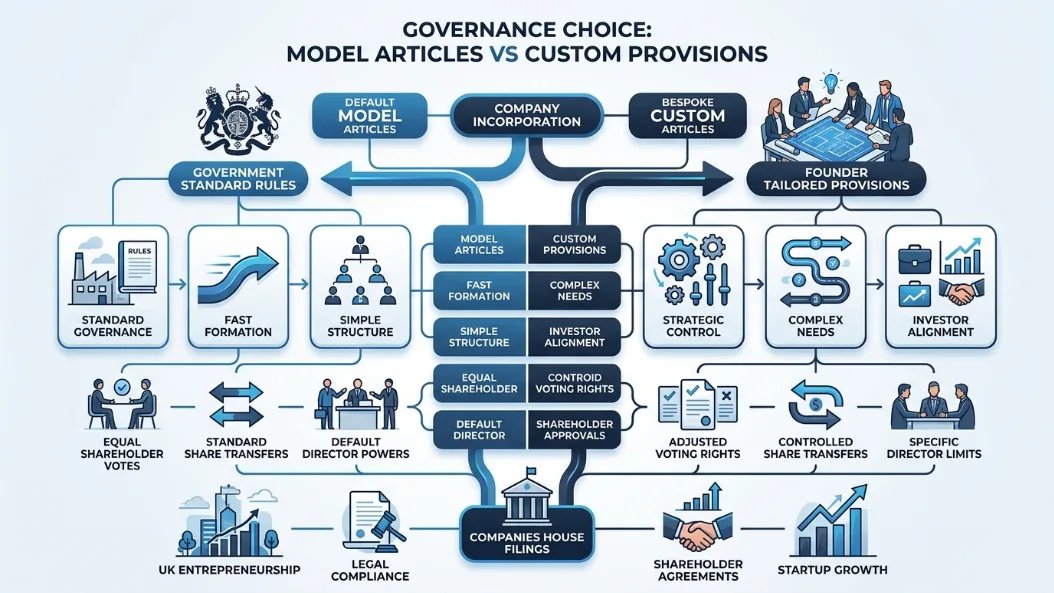
Standard model rules suit basic trading enterprises with simple ownership structures. Single-owner companies rarely require customized governance clauses because decision-making authority rests with one individual. Multi-shareholder enterprises frequently draft custom provisions to protect investor interests or restrict share sales to external buyers. Custom clauses override standard default rules once filed correctly at Companies House.
Founders must carefully evaluate their long-term operational goals before selecting a governance format. Drafting custom rules requires precision to prevent legal conflicts with the Companies Act 2006. Businesses scaling rapidly often review comprehensive guides on how to get a bound copy of your articles of association to understand formatting standards for official corporate records.
When Do Companies Need to Update Their Articles?
Companies need to update their articles when altering share capital structures, appointing new classes of shareholders, or changing internal management voting thresholds.
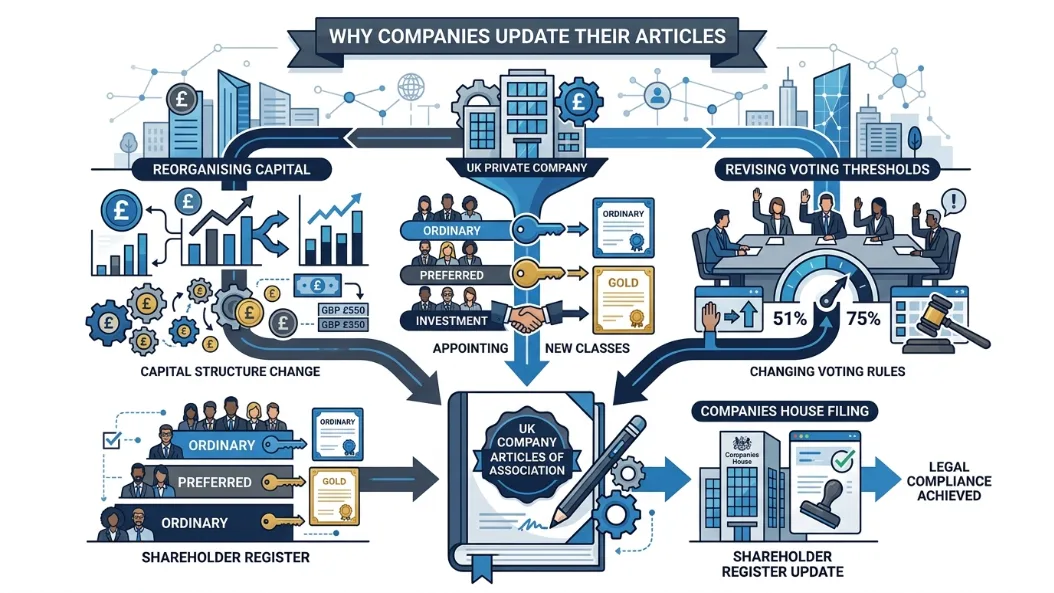
Corporate expansion often triggers the necessity for constitutional amendments. Issuing preference shares requires inserting specific dividend rights and liquidation preferences into the governing document. Passing a special resolution with a 75% shareholder majority remains mandatory whenever a company alters its constitutional rules. Companies House records these updates within 15 days of passing the special resolution.
Outdated governance rules create friction during corporate audits and due diligence reviews. Maintaining accurate constitutional records protects directors from allegations of unauthorized decision-making. Enterprises seeking official documentation can get bound articles of association from Form My Company to ensure compliance with statutory presentation standards.
Articles of Association remain foundational legal instruments required for UK corporate formation and operational governance. Form My Company delivers reliable administrative solutions, ensuring businesses maintain accurate constitutional records and statutory compliance standards through professional corporate document services.
Frequently Asked Questions
What are supplementary company documents and why are they needed?
Supplementary company documents are official legal records beyond standard incorporation certificates, such as bound Articles of Association, share certificates, and minutes of meetings. Businesses require these records to satisfy corporate compliance standards, verify corporate authority with financial institutions, and maintain accurate internal governance trails. Form My Company provides these essential administrative records through their specialized Supplementary Company Documents service to support smooth corporate operations.
Can I order a replacement copy of my company’s Articles of Association?
Founders can easily order replacement copies of their governing rules if the original statutory records become misplaced or damaged over time. Form My Company supplies official, high-quality replacement copies through their Supplementary Company Documents service to ensure your corporate registry remains accurate and up to date. Having readily accessible constitutional documents is vital for bank audits, investor due diligence, and statutory compliance checks.
Why do banks require supplementary corporate documents for business accounts?
Financial institutions review supplementary corporate documents, including certified Articles of Association and share registers, to verify director identities and confirm authorized signatories. Banks use these official records to satisfy strict anti-money laundering regulations and corporate governance requirements before activating business bank accounts. Form My Company assists businesses in securing these exact compliance records through their Supplementary Company Documents service.
What is included in a complete set of supplementary company documents?
A complete set of supplementary company documents typically includes custom or model Articles of Association, share certificates, register of members, and director resolution records. These legal instruments work together to establish transparent internal governance and protect shareholder rights under the UK Companies Act. Form My Company delivers these comprehensive files through their professional Supplementary Company Documents service.
How long does it take to receive official supplementary company documents?
Official supplementary company documents are typically processed and dispatched swiftly once the corporate request is verified against Companies House registry data. Timely delivery ensures that business owners can immediately meet urgent compliance deadlines, investor due diligence requests, or banking requirements. Form My Company streamlines this process efficiently via their dedicated Supplementary Company Documents service.