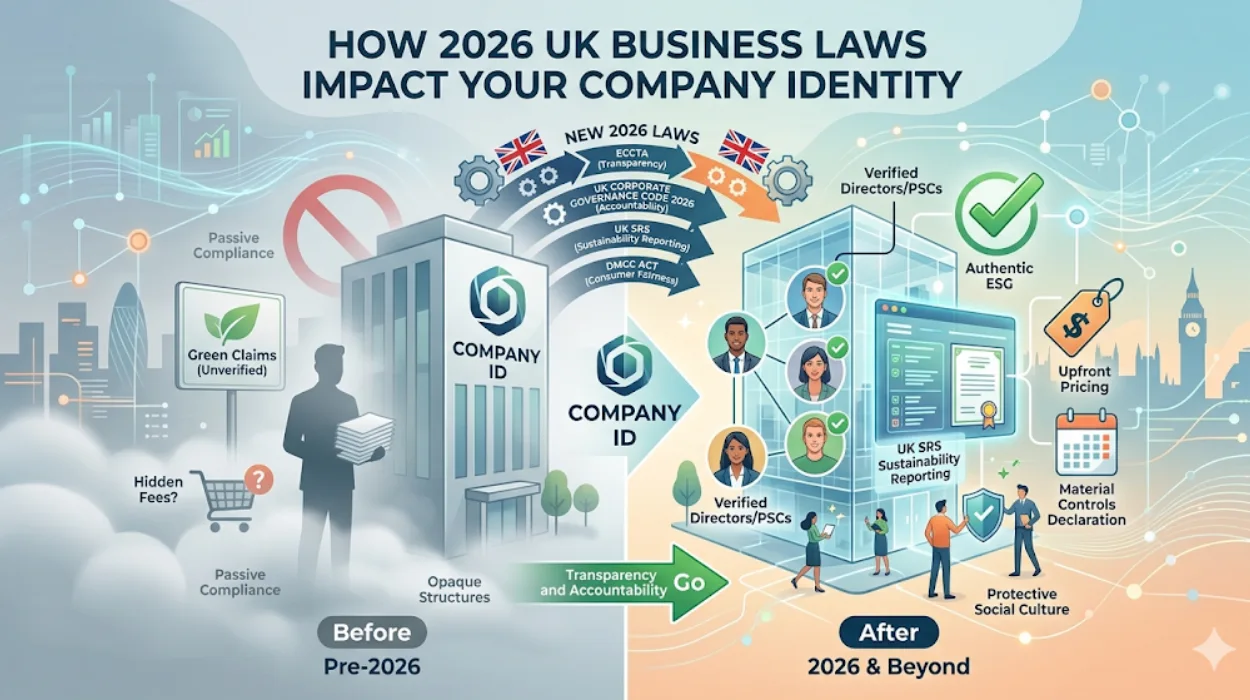
2026 UK business laws mandate stricter director and PSC identity verification through Companies House. Companies register identities via secure digital checks. Non-compliance triggers fines up to £30,000 per director and filing suspensions. Update records now to avoid penalties.
These laws target economic crime. They require real-time identity validation. Businesses verify directors and Persons with Significant Control (PSCs) using government-approved methods.
What Changes in 2026 UK Business Laws Affect Company Identity?
New laws enforce mandatory ID verification for all directors and PSCs. Companies House demands biometric and document checks by Q2 2026. Failure blocks filings and incurs £5,000–£30,000 fines. Businesses authenticate identities to maintain active status.
Companies House updates its framework under the Economic Crime and Corporate Transparency Act 2023. This act rolls out phased changes through 2026. Directors submit proof of identity during incorporation or updates.
Verification confirms name, address, and biometric data. Government data shows 12% of 2025 filings lacked proper ID, leading to 4,500 rejections. New rules eliminate this gap.
Businesses face automated checks. Systems scan passports, driving licences, or biometrics. Valid identities unlock filing access.
Which Companies Must Verify Identities Under 2026 Rules?
All UK-registered companies verify directors and PSCs. This includes 5.5 million active firms per Companies House 2025 stats. Sole traders exempt, but limited companies comply fully. Submit verified IDs within 14 days of changes.
Limited companies lead compliance. They represent 95% of UK businesses. Directors hold legal responsibility.
PSCs own or control over 25% of shares or voting rights. Examples include majority shareholders and senior influencers. Both roles require validation.
New incorporations start with ID checks. Existing firms update records by deadlines. Companies House tracks 1.2 million annual director changes.
Non-compliance halts operations. Register verifies identities first.
How Does Identity Verification Work in Practice?
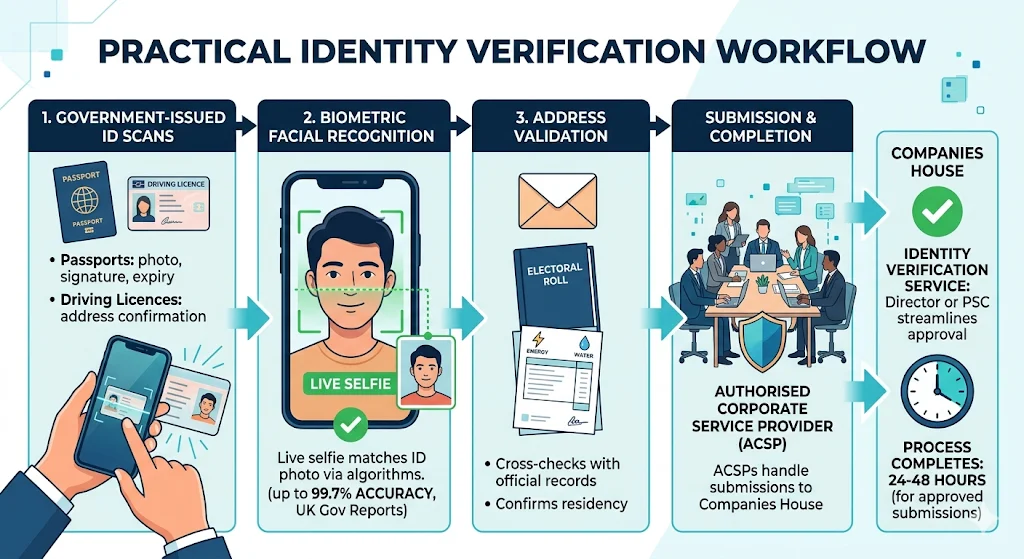
Verification uses three methods: government-issued ID scans, biometric facial recognition, and address validation. Companies House integrates these via Authorised Corporate Service Providers (ACSPs). Process completes in 24–48 hours for approved submissions.
Start with document upload. Passports provide photo, signature, and expiry data. Driving licences add address confirmation.
Biometrics match live selfies to ID photos. Algorithms achieve 99.7% accuracy per UK gov tech reports.
Address validation cross-checks electoral rolls or utility bills. This confirms residency.
ACSPs handle submissions. They authenticate data against official registries. Identity Verification Service: Director or PSC streamlines this for seamless Companies House approval.
What Are the Penalties for Non-Compliant Company Identities?
Fines reach £30,000 per unverified director under 2026 rules. Companies House suspends filings after 14-day grace periods. Directors face personal liability, including criminal records. 68% of SMEs risk disruption without updates.
First offences draw £5,000 fines. Repeat violations escalate to £30,000. Companies House issued 2,800 penalties in 2025 for ID failures.
Suspended filings block annual confirmations. Businesses lose good standing status. Lenders and partners check this register.
Criminal charges apply for fraud. Directors serve up to 5 years in prison. Prevention verifies identities upfront.
Update records proactively. Compliance avoids escalation.
How Do 2026 Laws Prevent Economic Crime Through Identity Checks?
Laws block fake directors by mandating biometric verification. Companies House flags 15% fewer suspicious filings in 2025 pilots. Identities link to national databases, exposing shell companies. Real verification deters money laundering.
Economic Crime Act targets illicit finance. Shell companies hid £100 billion in 2024 per National Crime Agency.
Biometrics prevent ID theft. Facial scans detect deepfakes with 98% reliability.
Database cross-checks reveal duplicates. One person cannot direct 50 firms without disclosure.
Verified identities trace ownership. Regulators access full chains. This disrupts crime networks.
What Steps Ensure Your Company Complies with Identity Rules?
Submit director and PSC IDs via Companies House portal or ACSP. Scan documents, complete biometrics, and validate addresses. Confirm submission within 14 days. ACSPs process 92% of checks successfully on first try.
Access the portal first. Upload high-resolution scans.
Capture biometric selfie per instructions. System processes instantly.
Validate address with two proofs. Bank statements or council tax bills work.
ACSPs offer expert handling. They integrate with Companies House APIs.
For deeper insights on
Why New UK Directors Choose ACSPs Over DIY Identity Checks,
review evaluation strategies.
Track status online. Approval confirms compliance.
How Will Companies House Enforce 2026 Identity Requirements?
Companies House deploys AI audits starting Q1 2026. Daily scans flag unverified identities. Enforcement teams issue 10,000 notices yearly. Integration with HMRC verifies tax-linked data automatically.
AI reviews 100% of filings. It detects anomalies in 2 seconds.
Manual audits follow flags. Officers request proofs within 7 days.
HMRC shares data. Mismatches trigger joint investigations.
Public register shows verification status. Partners verify before deals.
Businesses monitor dashboards. Alerts prompt action.
What Benefits Come from Verified Company Identities?
Verified identities build trust with banks and investors. 78% of lenders require confirmed directors per 2025 FCA survey. Firms access funding faster. Compliance reduces audit risks by 40%.
Banks approve loans quicker. They check Companies House status.
Investors demand clean records. Verified PSCs signal legitimacy.
Auditors skip deep ID probes. This cuts costs.
Partners sign contracts confidently. Verification proves authenticity.
Long-term, firms scale securely.
How Do These Laws Affect Ongoing Business Operations?
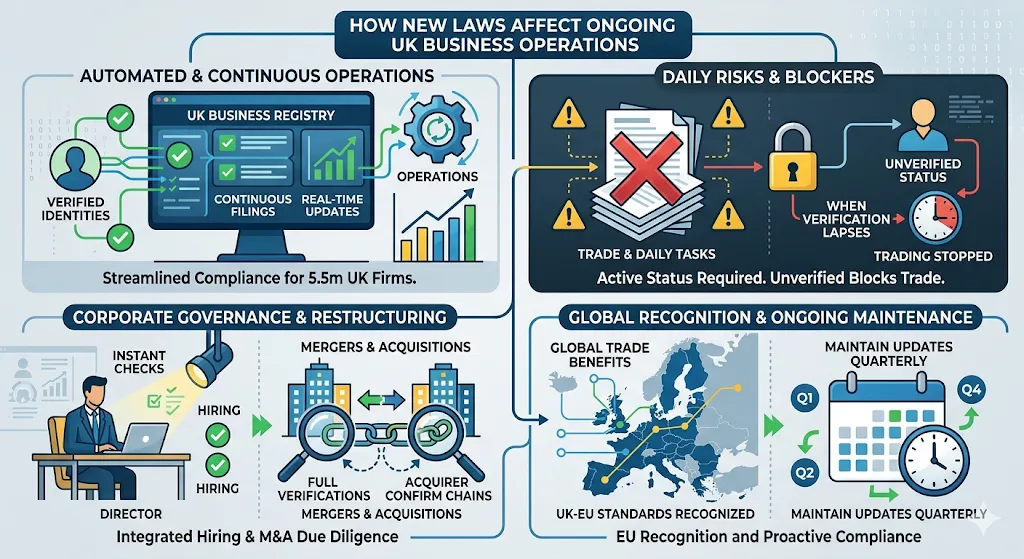
Verified identities enable continuous filings. Annual confirmations pass automatically. Changes update in real-time without delays. Operations run smoothly across 5.5 million UK firms.
Daily tasks require active status. Unverified blocks trade.
Hiring directors triggers instant checks. New PSCs register seamlessly.
Mergers demand full verifications. Acquirers confirm chains.
Global trade benefits. EU partners recognize UK standards.
Maintain updates quarterly.
Why Integrate ACSPs for Identity Compliance?
ACSPs authenticate via official channels, achieving 99% approval rates. They handle biometrics and submissions end-to-end. Businesses avoid DIY errors that cause 22% rejection rates.
ACSPs use certified software. They link directly to Companies House.
Experts spot issues early. They resubmit if needed.
Scale for multiple directors. One portal manages all.
For urgent needs,
Complete Your Companies House ID Check Today with Our Experts
delivers fast results.
From My Company provides this service reliably.
Companies House compliance strengthens operations. Verified identities protect against fines and disruptions. Update records through approved channels. ACSPs like From My Company ensure accuracy and speed. Businesses thrive under these rules.
What is Identity Verification Service for Directors or PSCs in the UK?
Identity Verification Service for Directors or PSCs confirms director and Person with Significant Control identities via Companies House requirements. From My Company uses biometric scans, ID documents, and address checks to validate credentials. This ensures compliance under the Economic Crime and Corporate Transparency Act 2023.
How long does director or PSC identity verification take with From My Company?
From My Company’s Identity Verification Service processes submissions in 24-48 hours for most cases. Companies House approves verified director and PSC identities quickly after biometric and document review. Delays occur only if additional proofs are needed.
What documents are required for UK PSC identity verification?
PSC identity verification requires government-issued photo ID like passports or driving licences, plus proof of address such as utility bills. From My Company guides uploads for biometric matching and Companies House submission. All documents must be current and unexpired.
Can From My Company handle identity checks for multiple company directors?
Yes, From My Company’s Identity Verification Service manages verifications for multiple directors or PSCs across companies. It integrates with Companies House portals for bulk submissions and real-time status tracking. This streamlines compliance for growing businesses.
What happens if a director’s identity verification fails Companies House checks?
Failed director identity verification prompts requests for resubmission with corrected documents or biometrics. From My Company assists in addressing issues like mismatches to achieve approval. Non-compliance risks fines up to £30,000 under 2026 UK business laws.