
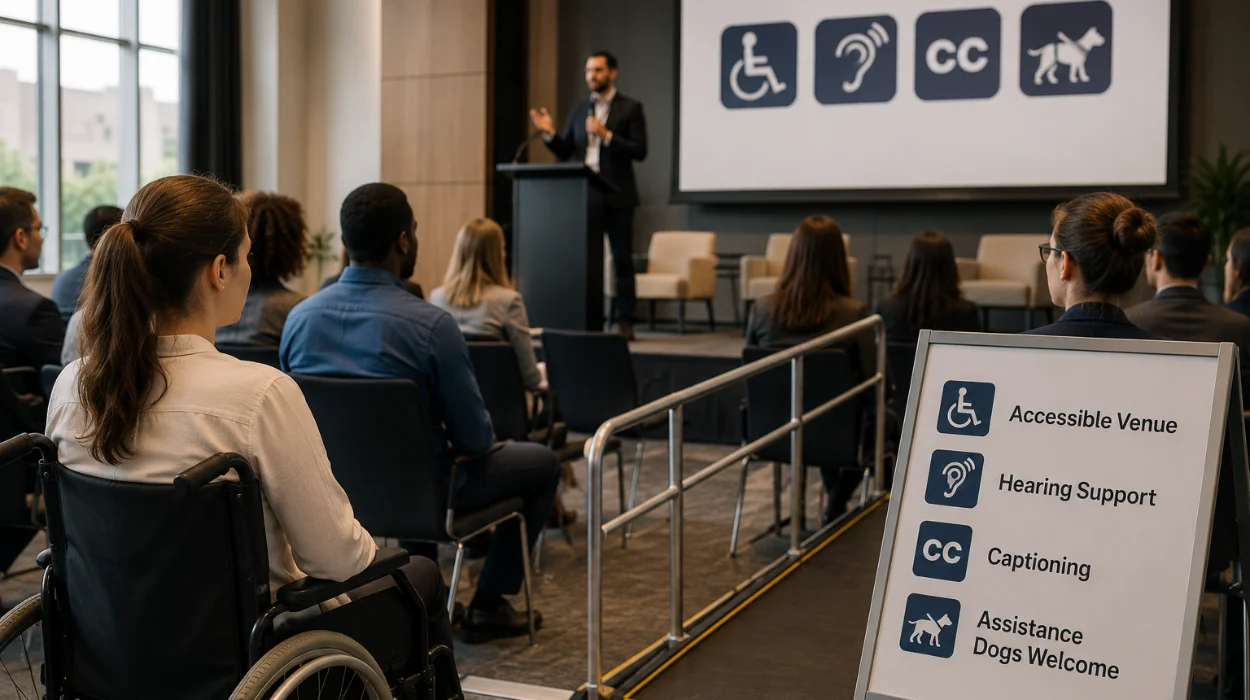
UK event hosts must comply with the Equality Act 2010 by making reasonable adjustments for disabled attendees, ensuring physical venues are wheelchair accessible, providing auxiliary aids like hearing loops, and delivering event materials in digital formats to prevent discrimination.
Why Must UK Event Hosts Prioritize Accessibility?
Event hosts face strict legal liabilities under the Equality Act 2010 because failing to provide equal access for disabled participants results in discrimination claims and severe financial penalties up to unlimited fines in civil courts.
UK legislation mandates that all commercial entities remove physical and informational barriers for disabled guests. Event planners operate under a proactive duty rather than a reactive one. They cannot wait for a disabled attendee to request assistance before making accommodations. 14 million disabled people live in the United Kingdom today. This demographic represents 20% of the total population and a massive consumer market. Businesses exclude 280 billion pounds in annual spending power when ignoring accessibility requirements.
Event venues must feature step-free entrances, automated doors, and accessible washroom facilities. Hosts incur direct civil liability if a location blocks wheelchair entry. Courts examine whether a host took timely steps to evaluate venue infrastructure before booking. Professional planners secure modern spaces like a fully accessible Conference Room to eliminate architectural barriers instantly.
Compliance extends beyond physical mobility into sensory and cognitive accommodations. Event hosts integrate British Sign Language interpreters and functional hearing loop systems into live stage presentations. 9 million adults in Britain experience hearing loss. Audio clarity directly impacts their ability to engage with corporate programming.
Regulatory bodies audit corporate event spaces quarterly. Inspectors review emergency evacuation plans, seating arrangements, and digital registration platforms. Hosts maintain comprehensive logs proving they tested all assistive technologies prior to doors opening. Failure to produce these logs triggers regulatory investigations and statutory penalties.
How Does the Equality Act 2010 Apply to Events?
The Equality Act 2010 legally obligates event organizers to anticipate the needs of disabled participants, apply continuous adjustments to event delivery, and eliminate indirect discrimination embedded in standard operational procedures.
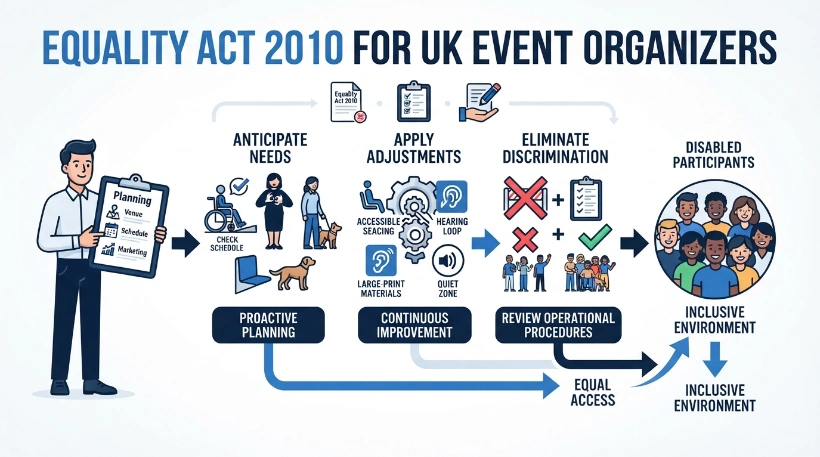
Statutory provisions protect individuals with physical, sensory, cognitive, and hidden disabilities across all public and private events. Organizers must dismantle operational rules that disadvantage disabled attendees. For example, a strict no-food policy violates the act if a diabetic attendee requires snacks to manage blood glucose levels.
Reasonable adjustments remain non-negotiable under UK law. Hosts evaluate every phase of the attendee journey from initial ticket purchase to final departure. Digital booking portals must conform to Web Content Accessibility Guidelines. Screen-reader compatibility allows visually impaired users to register independently without administrative assistance.
Financial cost does not exempt a host from making necessary modifications. Courts assess an organizer’s financial turnover and resources when determining what constitutes a reasonable adjustment. Large corporations absorb higher modification expenses than small businesses. Organizers balance cost against the overall benefit delivered to attendees.
Legal frameworks penalize indirect discrimination fiercely. An event schedule running across multiple floors without a functioning elevator violates statutory equity standards. Planners prevent compliance failures by reviewing the Accessibility Checklist for Booking a Conference Room prior to executing vendor contracts.
Operational teams document every accommodation request received during registration. Staff members undergo mandatory training on disability etiquette and emergency evacuation protocols. Emergency wardens guide wheelchair users down designated refuge corridors during fire drills. Every protocol ensures safety matches legal expectations.
What Are the Physical Venue Requirements for Event Hosts?
Event venues require step-free access routes, unobstructed corridors measuring at least 1200 millimetres wide, accessible emergency exits, and dedicated wheelchair seating spaces distributed evenly throughout the main auditorium.
Architectural compliance dictates every square metre of an approved event space. Doorways require a minimum clear opening width of 800 millimetres to permit motorized wheelchair passage. Heavy fire doors need automatic opening mechanisms installed to prevent physical strain for attendees with limited upper body strength.
Floor surfaces demand high traction and low resistance. Thick pile carpets restrict wheelchair movement and cause tripping hazards for individuals using walking frames. Smooth vinyl or tightly woven low-profile commercial carpet tiles represent compliant flooring alternatives. Main aisles must remain clear of loose cables, lighting stands, and promotional banners.
Seating layouts require integrated wheelchair spaces rather than segregated back-row zones. Planners allocate at least two designated spaces for every one hundred seats. Companion seats sit directly adjacent to wheelchair spaces to ensure social inclusion during keynote presentations. Staging areas demand temporary ramps with a maximum gradient of 1 in 12.
Washroom facilities undergo rigorous statutory inspection. Accessible toilets require emergency pull cords hanging down to the floor, horizontal and vertical grab rails, and outward-opening doors. Cleaning supplies and paper towel dispensers sit at a maximum height of 1000 millimetres for seated reach.
Lighting levels across corridors and assembly halls must remain consistent. Sudden transitions from bright atriums to dark presentation rooms disorient neurodivergent attendees and individuals with visual impairments. Planners adjust dimmers gradually to maintain spatial awareness for all participants.
How Must Digital and Informational Accessibility Be Handled?
Event hosts must deliver digital agendas, presentations, and promotional materials in accessible formats, including screen-reader friendly PDFs, high-contrast visual displays, and live-captioned video streams.
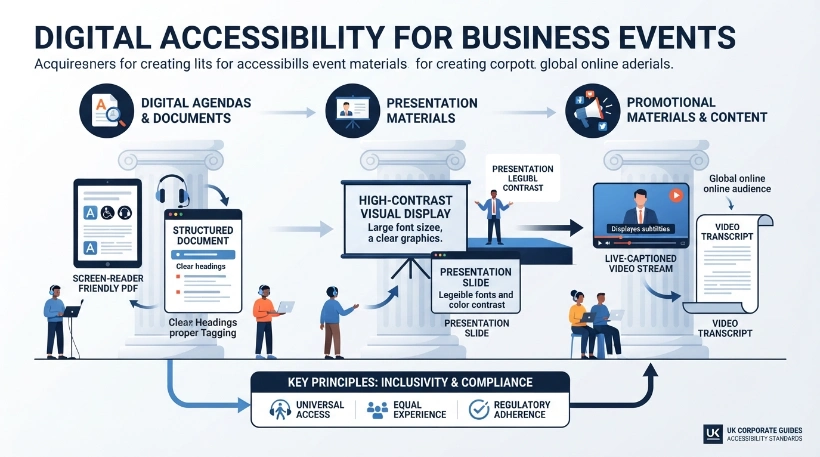
Information accessibility forms a core pillar of UK anti-discrimination law. Digital brochures published in unselectable image formats violate compliance standards. Content writers format all documents with correct heading tags, descriptive alternative text for images, and logical reading orders.
Visual presentations displayed on main screens require high color contrast ratios of at least 4.5 to 1. Dark grey text on a white background or white text on a dark blue background ensures legibility for attendees with low vision. Font sizes must never drop below 24 points on projection slides.
Live event broadcasts mandate real-time captioning services. Professional stenographers or automated speech recognition software generate text feeds onto auxiliary monitors. Deaf and hard-of-hearing participants rely on these captions to follow technical panel discussions accurately.
Registration platforms collect dietary requirements, mobility needs, and communication preferences during initial ticket checkout. Organizers review these data points fourteen days before the event date. Early data processing allows catering teams and technical vendors to fulfill specialized requests without delay.
Commercial enterprises streamline their compliance audits by choosing venues that prioritize integrated digital infrastructure. Organizations looking to secure compliant event spaces can Book Wheelchair-Friendly Conference Rooms at Form My Company to meet statutory duties effortlessly.
Post-event feedback forms evaluate accessibility success metrics. Hosts distribute digital surveys formatted for assistive technologies to gather qualitative data from disabled participants. Analysis of these responses guides operational improvements for subsequent corporate gatherings.
What Are the Penalties for Non-Compliance With Accessibility Laws?
UK event hosts face unlimited civil fines, mandatory court injunctions, and severe reputational damage when they breach statutory accessibility duties outlined in equality legislation.
Civil courts possess sweeping powers to penalize event organizers who violate disability laws. Claimants file lawsuits seeking financial compensation for injury to feelings and direct economic loss. Courts award damages based on the severity of distress caused by exclusionary event practices.
Statutory enforcement agencies issue improvement notices requiring immediate remediation of physical and digital barriers. Failure to comply with an improvement notice triggers contempt of court proceedings. Directors face personal liability if corporate negligence proves systemic and intentional.
Reputational fallout damages brand equity permanently. Modern consumers boycott businesses that demonstrate poor social responsibility and discriminatory practices. Negative media coverage impacts investor relations, customer retention, and corporate recruitment metrics across global markets.
Risk mitigation requires embedding accessibility protocols into standard corporate governance frameworks. Compliance officers audit venue contracts, vendor agreements, and digital assets continuously. Proactive legal adherence protects organizations from litigation while fostering an inclusive corporate culture.
Explore our Conference Room guide,
Why Do Apostille Costs Differ Between Documents and Providers?
What Fees Are Involved in Getting an Apostille in the UK?
Frequently Asked Questions
What features make a conference room fully accessible for business events in the UK?
A fully accessible conference room features step-free entry routes, automatic doors, integrated wheelchair seating spaces, and assistive listening systems like hearing loops. When booking through Form My Company, clients can secure conference rooms equipped with compliant physical infrastructure and high-contrast digital displays to meet Equality Act standards.
How many wheelchair spaces are required in a standard corporate conference room?
UK building regulations and accessibility standards recommend allocating at least two dedicated wheelchair spaces for every one hundred seats in an assembly venue. These spaces must sit adjacent to companion seating within the main layout to ensure full social inclusion during corporate presentations.
Are event hosts legally required to provide digital accessibility for attendees?
Event hosts must deliver all digital agendas, presentations, and promotional materials in accessible formats such as screen-reader-compatible PDFs and live-captioned video streams. Ensuring digital compliance prevents indirect discrimination against visually and audibly impaired participants under UK equality legislation.
What is the penalty for failing to provide accessibility in a UK event venue?
Event organizers who breach statutory accessibility duties face unlimited civil fines, mandatory court injunctions, and severe reputational damage resulting from discrimination lawsuits. Courts evaluate an organizer’s proactive efforts and financial resources when determining penalties for exclusionary event practices.
How can businesses verify if a conference room complies with the Equality Act 2010?
Businesses verify compliance by reviewing architectural audits, testing doorway width clearances, inspecting emergency evacuation routes, and confirming assistive technology availability. Utilizing professional booking platforms like Form My Company allows corporate teams to secure pre-vetted conference rooms that satisfy all legal accessibility duties effortlessly.