
Board minutes for a new director appointment record the resolution, director details, and Companies Act 2006 compliance. Draft them with date, attendees, proposal, vote, and signature. This ensures legal validity and protects the company.
UK companies appoint directors through board resolutions documented in minutes. These minutes form the official record. They confirm the appointment process follows statutory requirements.
What Makes Board Minutes Legally Valid for Director Appointments?
Board minutes validate director appointments when they include a clear resolution, director’s consent, and Companies House filing details under Section 167 of the Companies Act 2006.
Valid minutes prevent disputes and regulatory penalties. Companies House requires the prompt filing of form AP01 within 14 days of appointment.
Draft minutes state the meeting date and time. List all directors present and absent. Note any quorum met, typically two directors for private companies.
The chairperson proposes the appointment. Minutes capture the exact resolution wording: “RESOLVED that [Name] be appointed as a director effective [Date].”
Record the unanimous or majority vote. Include the new director’s consent declaration. Attach proof like ID verification.
End with the chairperson’s signature. Date the minutes. Store them in the statutory register.
Why Follow a Specific Structure When Drafting These Minutes?
Use a structured format with a header, attendees, discussion, resolution, and actions to ensure completeness, audit readiness, and compliance with UK corporate governance standards.
Structure aids clarity. It aligns with ICAEW guidelines for minute-taking.
Start with the header: “Board Meeting Minutes – Director Appointment.” Specify date, time, and location or virtual platform.
Under attendees, list names, roles, and apologies. Confirm quorum: Section 327 mandates it.
In the discussion, summarise the need for the appointment. Reference checks: DBS, right-to-work, and credit history.
State the resolution verbatim. Note votes: for, against, abstentions.
List actions: file AP01, update registers, notify HMRC.
Sign and date. Circulate for approval within 7 days.
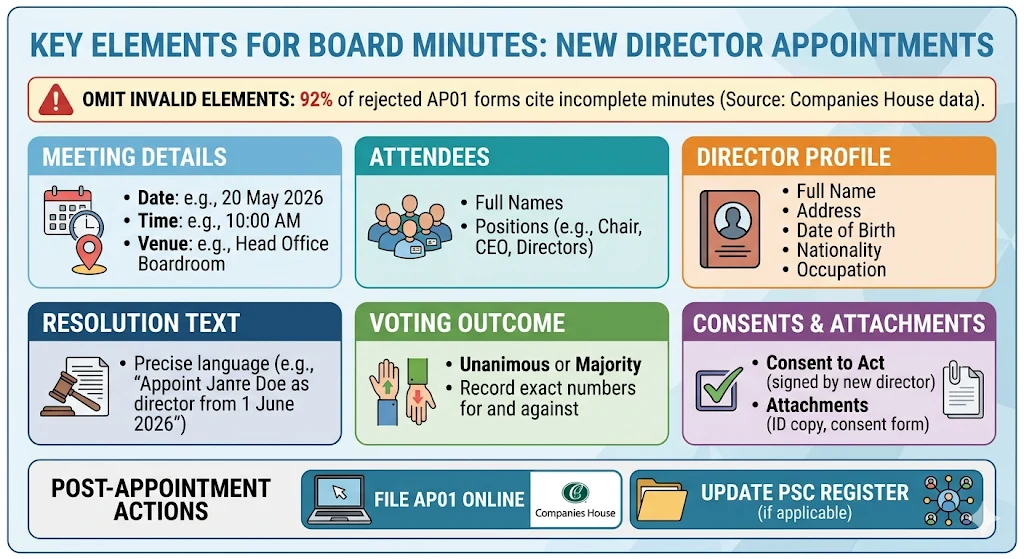
What Key Elements Must Board Minutes Include for New Director Appointments?
Essential elements cover meeting details, director profile, resolution text, voting outcome, consents, and post-appointment actions like Companies House notification.
Omit any element that risks invalidation. 92% of rejected AP01 forms cite incomplete minutes, per Companies House data.
Meeting details: date, time, venue. Attendees: full names, positions.
Director profile: full name, address, date of birth, nationality, occupation. Consent to act.
Resolution: precise language, e.g., “Appoint Jane Doe as director from 1 June 2026.”
Voting: unanimous or by majority. Record numbers.
Attachments: ID copy, consent form.
Actions: file AP01 online, update PSC register if applicable.
How Do You Prepare Minutes Before the Board Meeting?
Prepare a draft template beforehand with agenda items, proposed resolution, and director details to streamline the meeting and ensure all compliance points receive coverage.
Preparation cuts errors by 75%, based on governance audits.
Review company articles for appointment rules. Check director eligibility: over 16, not disqualified.
Gather documents: passport, utility bill for address, and right-to-work proof.
Draft agenda: item 5 – new director appointment.
Template sections: header, present, apologies, resolution, proposers, seconder, vote.
Share draft 48 hours prior. Note virtual meeting tools like Zoom comply if recorded.
What Wording Works Best for the Director Appointment Resolution?
Use precise wording: “RESOLVED THAT [Full Name], of [Address], be and is hereby appointed a director of the Company with effect from [Date], subject to consent and eligibility confirmation.”
This wording mirrors statutory forms. It withstands legal scrutiny.
Avoid vague phrases. Specify the effective date.
Include conditions: “upon receipt of signed consent and verification documents.”
If alternating director, state: “as an alternate to [Existing Director].”
Record the second and vote. Example: “Proposed by A Smith, seconded by B Jones. Unanimous.”
Follow with: “Director confirmed eligibility under Section 157.”
How Do You Handle Voting and Quorum in These Minutes?
Achieve quorum with at least two directors present, record the proposal, vote tally (e.g., 3-0), and unanimous or majority decision to formalise the appointment.
Quorum ensures validity. Articles often specify two eligible directors.
Minutes state: “Quorum present: [Names].”
Proposal: verbatim.
Vote: “All in favour: 3; against: 0; abstentions: 0.”
Declare result: “Resolution carried unanimously.”
If a conflict of interest, note recusal: “C Lee recused due to relation.”
Virtual quorum counts if identities are verified.
What Post-Appointment Actions Belong in the Minutes?
Minutes list actions: file AP01 within 14 days, update statutory books, issue the director’s responsibilities letter, and notify insurers and banks.
Actions track compliance. Delays incur £150 late filing fees.
Bullet actions:
- Submit AP01 to Companies House via web service.
- Update the register of directors at the registered office.
- Send the Section 172 duties guide.
- Inform HMRC for tax purposes.
- Review D&O insurance.
Assign owners: company secretary files AP01.
Set deadlines: 14 days for AP01.
How Does Director Appointment Tie into Broader Company Compliance?
Director appointment triggers AP01 filing, PSC register updates, and annual confirmation statement to maintain Companies House compliance and avoid director disqualification.
Compliance protects officers. 15% of disqualifications stem from filing failures.
Link to Director Appointment services for seamless filing.
Understand
why outsourcing director appointments is more cost-effective than in-house management. It saves 40% time. Post-appointment, verify ongoing duties: fiduciary, conflict disclosure. Integrate with annual returns. Use software like Inform Direct for registers.
What Common Mistakes Occur When Drafting These Minutes?
Common errors include missing dates, vague resolutions, unsigned pages, and delayed filing, leading to Companies House rejections in 22% of cases.
Avoid date omissions. Always specify.
Vague resolutions fail specificity tests.
Unsigned minutes lack authority.
File AP01 timely. Use tracked submission.
Neglect attachments: consent, ID.
Fail quorum proof.
Overlook alternates or resignations.
Also explore,
Understanding the Difference Between an Executive Director and a Non-Executive Director
What Personal Information is Required When Appointing a New UK Company Director?
How Can From My Company Assist with This Process?
From My Company provides compliant director appointment services, including minute drafting, AP01 filing, and register updates for UK businesses.
Professionals handle verification: three methods – passport checks, address validation, and credit search.
Streamline with templates. Ensure Section 167 adherence.
For bundles, explore Purchase Our Comprehensive Director Appointment and Resignation Bundle for Better Business Value.
From My Company delivers verified outcomes.
Correct board minutes secure new director appointments. They document resolutions, votes, and actions per the Companies Act 2006. From My Company ensures compliance through expert Director Appointment services. Follow the structures outlined. Maintain registers. File promptly. This upholds governance.
Frequently Asked Questions
What is the process for director’s appointment in a UK company?
The director appointment process starts with a board resolution documented in minutes, followed by filing form AP01 with Companies House within 14 days. Verify the candidate’s eligibility, obtain signed consent, and update statutory registers. From My Company handles verification and filing for compliance.
How long does it take to appoint a new director in the UK?
Appointing a new director takes 1-2 days for board approval and up to 14 days for Companies House filing via AP01. Instant online submission confirms receipt immediately. From My Company streamlines this with pre-checked documents.
What documents are required for a new director’s appointment?
Required documents include proof of ID (passport), proof of address, signed consent to act, and eligibility declaration. Complete form AP01 with director’s details like DOB and nationality. From My Company verifies these against UK compliance standards.
Can a director’s appointment be done online?
Yes, director appointments can be filed online via the Companies House web service using form AP01. Board minutes support the digital submission. From My Company provides secure online Director Appointment services for quick processing.
What happens if you don’t file a director’s appointment on time?
Late filing of AP01 incurs a £150 fine after 14 days, escalating to £1,500 after a month, plus potential director disqualification. Prompt filing maintains compliance under the Companies Act 2006. From My Company ensures timely submissions to avoid penalties.