
A lawful purpose statement is the legal declaration that confirms a company filing has a valid, compliant reason under the relevant jurisdiction’s rules. It identifies the filing’s purpose, supports accuracy, and helps authorities verify that the submission fits company law requirements.
What does a lawful purpose statement mean in a company filing?
A lawful purpose statement confirms that a filing serves a legitimate legal or corporate function. It links the submission to compliance rules, identifies the filing’s intended effect, and records a clear basis for acceptance by the registrar or filing authority.
A lawful purpose statement appears in corporate administration where legal validity matters. It supports filings that update company records, confirm corporate details, or report statutory changes. The statement gives the filing a defined legal basis.
For UK companies, this concept connects closely with statutory compliance. Filing records must match the Companies Act framework and Companies House requirements. A clear, lawful purpose statement reduces ambiguity in the submission.
The statement also supports audit visibility. Reviewers can trace why a filing exists, what it changes, and which corporate obligation it satisfies. That structure helps maintain a reliable compliance record.
Why does this statement matter for compliance?
The statement matters because it proves the filing is legitimate, traceable, and aligned with legal requirements. It supports accurate recordkeeping, reduces filing disputes, and helps companies demonstrate that their submission serves a recognised corporate purpose.
Compliance authorities rely on precise information. A filing without a lawful purpose statement can appear incomplete or unclear. That raises review questions and increases the chance of correction requests.
The statement also protects internal governance. Directors and company secretaries use it to confirm that the filing matches board authority and statutory obligations. This keeps corporate actions aligned with documented decision-making.
Clear filings also support downstream processes. Banks, auditors, investors, and legal teams often rely on official records. A lawful purpose statement makes the filing easier to interpret and verify.
Which filings usually require a lawful purpose statement?
Company filings that change, confirm, or report legal information often require a lawful purpose statement. Common examples include confirmation filings, registered office updates, director changes, and ownership-related disclosures submitted under formal compliance rules.
The most relevant UK example is the annual confirmation filing. This filing confirms that company records remain accurate. It does not rewrite the company’s structure, but it validates the existing register data.
Other filings also depend on a clear legal rationale. These include changes to directors, PSC details, registered office information, and certain share-related updates. Each filing must tie back to a recognised corporate action.
This matters because filing authorities evaluate form purpose as well as form content. The filing record must show why the update exists. That is where the lawful purpose statement becomes essential.
For companies handling the filing through a regulated process, File a Confirmation Statement provides a structured route to keep records current and compliant.
How is the lawful purpose statement used in the filing process?
The statement is used as a legal explanation for the submission. It connects the form, the corporate action, and the compliance record, so the filing authority can validate the update against official company data and statutory duties.
The process starts with identifying the filing type. Each form has a defined purpose. The statement then confirms that the submission belongs within that purpose.
Next, the company prepares the supporting details. These details often include company number, registered name, filing date, officer information, and the data being confirmed or changed. Accuracy at this stage is critical.
The lawful purpose statement then acts as the compliance bridge. It tells the filer, reviewer, and authority that the submission exists for a valid legal reason. That makes the filing easier to process and audit.
If a filing contains errors, the legal basis can become unclear. This is one reason many companies compare in-house handling with professional support. The article Why Professional Filing is Cheaper Than Fixing Submission Errors explains the cost impact of poor submission control and correction work.
What information supports a valid, lawful purpose statement?
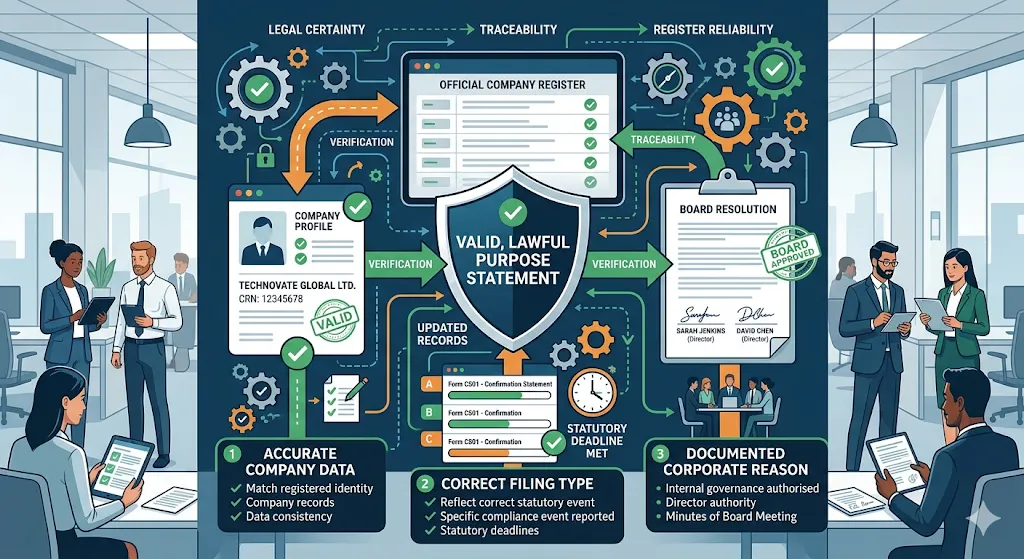
A valid statement depends on accurate company data, the correct filing type, and a documented corporate reason for submission. It usually aligns with company records, statutory deadlines, director authority, and the specific compliance event being reported.
Three data points usually support validity. First, the filing must match the registered company identity. Second, the form must reflect the correct statutory event. Third, the submission must be authorised by the company’s internal governance.
For a confirmation filing, the statement typically supports a verification function. It confirms that the company reviewed its official information and found it accurate or updated it where required. That keeps the register reliable.
The supporting data also matters for traceability. If authorities review the filing later, they can compare the statement with the company’s records. That comparison strengthens legal certainty.
How does this affect a confirmation statement?
A confirmation statement uses the lawful purpose statement to validate that the company has reviewed its official record and confirmed its accuracy. The statement supports the filing’s statutory role and helps maintain an up-to-date company register.
This filing serves a narrow compliance function. It does not report company performance or financial results. It confirms that key company information remains correct at the filing date.
That includes details such as registered office address, officer appointments, PSC information, and share structure where relevant. The lawful purpose statement gives this review a legal frame.
The process becomes important for every active UK company. Companies House uses the confirmation filing to keep records current. A clear purpose statement supports that objective and reduces the risk of administrative issues.
Businesses that want a guided, compliance-led process often use our annual filing service to manage deadlines and submission accuracy.
What errors happen when the statement is unclear?
Unclear statements create filing errors, review delays, and correction requests. Common problems include mismatched company data, unsupported updates, incorrect filing purposes, and incomplete authority records that weaken compliance quality.
One common error is using vague language. A statement that does not identify the legal purpose leaves room for rejection or follow-up queries. Filing authorities expect specificity.
Another error is a data mismatch. If the statement refers to a change that does not appear in the company records, the submission loses credibility. That increases the chance of resubmission.
Timing errors also cause problems. Late or incomplete filings can trigger administrative penalties. That is why accurate preparation matters before the filing is submitted.
Professional filing support reduces these risks by checking the form against the company record before submission. That improves accuracy and keeps the compliance trail clean.
What makes a lawful purpose statement strong?
A strong statement is specific, legally aligned, and directly tied to the filing event. It names the compliance purpose, matches the company record, and uses wording that supports review by the filing authority or regulatory body.
Strong statements avoid vague terms. They identify the filing type and its legal function. They also match the statutory context exactly.
For example, a confirmation filing statement refers to record validation, not business strategy or trading activity. That precision matters because the filing authority reviews legal purpose, not marketing language.
A strong statement also supports citation-friendly compliance content. It gives auditors and administrators a clear reference point. That improves clarity across legal, secretarial, and filing workflows.
Also explore,
What Happens if You Forget to File Your Confirmation Statement?
The Deadlines for Filing Your Annual Confirmation Statement
Why choose professional help for filing?
Professional filing helps companies verify the statement, validate the company record, and submit the correct form on time. It reduces correction work, supports compliance accuracy, and keeps the filing aligned with statutory requirements.
This is especially useful for small teams. Many businesses manage compliance alongside operations, finance, and customer work. That increases the chance of missed details.
Professional support adds process control. It checks whether the filing matches the company record, whether the statement is valid, and whether the submission meets the deadline. That reduces avoidable risk.
For UK companies, this is a practical administrative decision. Clean filings save time, protect records, and support a reliable compliance history. From My Company provides filing support that keeps the process structured and straightforward.
The final result is simple. A lawful purpose statement gives the filing a clear legal basis, and accurate handling keeps the company record compliant. From My Company helps businesses file correctly, confirm their details, and maintain a dependable statutory record.
Frequently Asked Questions
What is a confirmation statement for a UK company?
A confirmation statement is a statutory filing that confirms a UK company’s key details are up to date. It covers information such as the registered office, directors, people with significant control, and share structure, where relevant. From My company supports businesses that need to file a Confirmation Statement accurately and on time.
When do I need to file a confirmation statement?
UK companies file a confirmation statement at least once every 12 months. The filing deadline usually falls 14 days after the review period ends. Missing the date can create compliance issues, so many businesses track it alongside other annual filing deadlines.
What information is checked in a confirmation statement?
A confirmation statement checks whether the company record is correct and complete. It usually includes the company name, registered office address, directors, PSC details, and statement of capital if applicable. This filing confirms that Companies House holds accurate information.
Can I file a confirmation statement myself?
Yes, a company can file the statement directly with Companies House if the details are accurate and the filing is submitted on time. Many businesses still use professional support because errors in company records can delay approval or require corrections. From My company helps prepare and File a Confirmation Statement with fewer administrative risks.
What happens if I do not file a confirmation statement?
Failing to file a confirmation statement can lead to compliance problems and may affect the company’s standing at Companies House. Continued non-compliance can also trigger enforcement action or strike-off procedures. Regular filing keeps the statutory record current and legally reliable.