You can avoid late filing penalties by submitting your company’s confirmation statement on time, ensuring accurate company records, and using a professional filing service that validates data before submission and files directly with Companies House within the required statutory deadlines.
What Causes Late Filing Penalties for UK Companies?
Late filing penalties occur when a company fails to submit its confirmation statement or statutory filings by the Companies House deadline, triggering automatic fines that increase with delay duration and repeat offences within a financial year.
Companies House enforces strict deadlines for compliance filings. A confirmation statement must be filed at least once every 12 months. Missing this deadline triggers penalties immediately.
The penalty structure escalates based on delay length. For example, a delay of one day still counts as late, while delays beyond 28 days lead to significantly higher fines. Repeated late filings within the same financial year double the penalty amount.
Errors also contribute to late filings. Incorrect shareholder details, outdated registered office addresses, and mismatched SIC codes cause rejections. When Companies House rejects a filing, the deadline does not reset.
Administrative gaps remain a primary cause. Businesses that rely on manual tracking miss deadlines due to staff turnover, calendar mismanagement, or a lack of compliance systems.
How Does an Annual Filing Service Prevent Penalties?
An annual filing service prevents penalties by tracking deadlines, verifying company data, correcting errors before submission, and filing confirmation statements directly with Companies House within statutory timeframes.
Professional services automate compliance tracking. They monitor filing windows and trigger alerts before deadlines. This removes reliance on internal reminders.
Data validation is a core function. Services verify director details, shareholder structures, and registered office information before submission. This reduces rejection rates significantly.
Submission accuracy improves compliance outcomes. Filing services use structured digital forms aligned with Companies House requirements. This eliminates formatting errors and incomplete fields.
Error correction happens proactively. When discrepancies appear, the service resolves them before submission. This prevents last-minute delays that lead to penalties.
A professional service also ensures that filings align with regulatory updates. UK compliance frameworks evolve, and service providers integrate these updates into their processes.
What Is a Confirmation Statement and Why Is It Mandatory?
A confirmation statement is a legally required filing that verifies a company’s registered details, including directors, shareholders, and business activities, ensuring Companies House records remain accurate and compliant.
The confirmation statement replaced the annual return in 2016. It confirms that company information on record is correct as of a specific date, known as the confirmation date.
Companies must review and confirm key data points:
- Director and secretary details
- Share capital and shareholder structure
- Registered office address
- Standard Industrial Classification (SIC) codes
Accuracy matters because Companies House uses this data to maintain public records. Financial institutions, investors, and regulators rely on this information for due diligence.
Failure to file leads to penalties and potential company strike-off. A company removed from the register loses legal standing and cannot operate legally.
To ensure compliance, businesses often choose to file a confirmation statement through a structured service that guarantees accuracy and timeliness.
Why Is Professional Filing More Reliable Than Manual Submission?
Professional filing is more reliable because it uses automated validation systems, compliance checklists, and direct submission channels, reducing human error and ensuring filings meet Companies House standards on the first attempt.
Manual filing depends on internal accuracy. Errors occur during data entry, document preparation, and deadline tracking. These issues increase rejection rates.
Professional services use predefined validation rules. These rules check for inconsistencies such as mismatched share allocations or invalid director details.
Automation improves efficiency. Filing platforms integrate with Companies House APIs, enabling direct submission without manual formatting or document uploads.
Compliance expertise adds another layer of reliability. Professionals understand regulatory nuances and apply them during filing preparation.
Businesses that compare costs often find that professional filing is cheaper than fixing submission errors because correction fees, penalties, and administrative time exceed the cost of a managed service.
How Does Data Accuracy Impact Filing Approval?
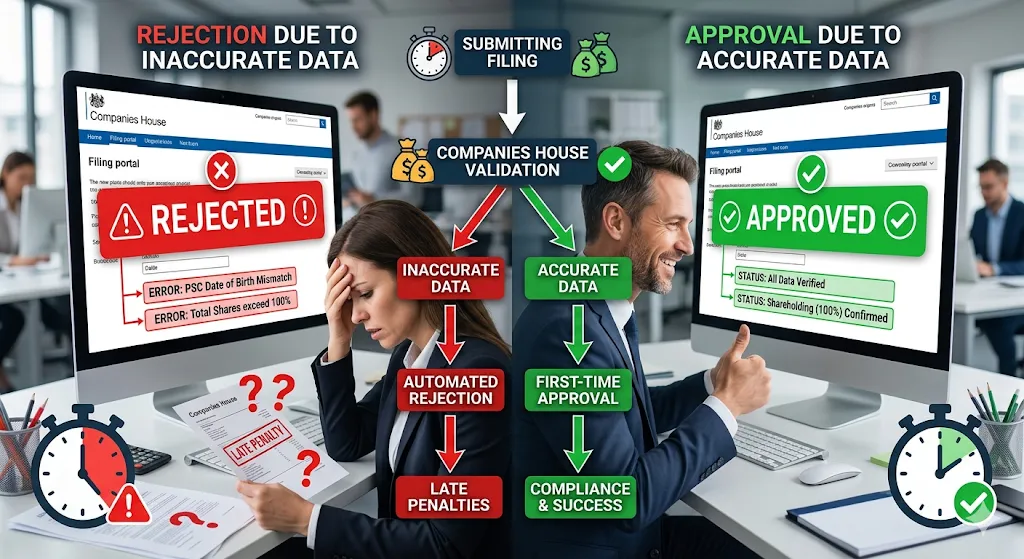
Data accuracy directly impacts filing approval because Companies House validates submitted information against existing records, rejecting filings with inconsistencies, missing fields, or incorrect company details.
Companies House uses automated systems to cross-check submitted data. Even minor discrepancies trigger rejection. For example, a mismatch in shareholder percentages or an outdated registered address leads to failure.
Rejected filings create delays. The company must correct errors and resubmit, often after the deadline has passed. This results in penalties despite the initial submission attempt.
Accurate data ensures first-time approval. This reduces administrative overhead and eliminates the need for repeated submissions.
Data accuracy also supports legal compliance. Incorrect filings can misrepresent company ownership or control, leading to regulatory scrutiny.
Understanding requirements such as lawful purpose statements in filings helps ensure that submitted information aligns with UK compliance expectations.
What Happens If You Miss the Confirmation Statement Deadline?
Missing the confirmation statement deadline results in financial penalties, increased compliance scrutiny, and potential company strike-off if non-compliance continues over an extended period.
The immediate consequence is a late filing penalty. This penalty increases with time and doubles for repeated offences within 12 months.
Companies House may also flag the company for non-compliance. This increases the likelihood of further regulatory checks and enforcement actions.
Persistent failure to file leads to strike-off proceedings. Companies House can remove the company from the register, making it legally inactive.
Reinstating a struck-off company involves legal processes, court applications, and additional costs. This creates operational disruption and reputational damage.
Maintaining consistent filing compliance prevents these outcomes and ensures uninterrupted business operations.
How Does Deadline Tracking Improve Compliance?
Deadline tracking improves compliance by providing automated reminders, structured filing schedules, and real-time monitoring of statutory deadlines, ensuring companies submit required documents before due dates.
Tracking systems operate on predefined timelines. They calculate confirmation dates and alert businesses in advance. This removes reliance on manual calendar entries.
Automated reminders reduce missed deadlines. Notifications occur at multiple intervals, such as 30 days, 14 days, and 7 days before the due date.
Real-time monitoring allows adjustments. If company details change, the system updates filing requirements accordingly.
Structured schedules align filings with other compliance obligations. This creates a unified compliance framework that reduces administrative burden.
Businesses using managed services benefit from integrated tracking systems that eliminate deadline uncertainty.
What Role Does Error Prevention Play in Filing Services?
Error prevention ensures that all submitted information is verified, formatted correctly, and aligned with regulatory standards, reducing rejection rates and eliminating delays caused by incorrect filings.
Error prevention begins with data validation. Services cross-check entries against official records to identify inconsistencies.
Formatting checks ensure compliance with Companies House submission standards. Incorrect formats lead to automatic rejection.
Pre-submission reviews act as a final checkpoint. These reviews confirm that all required fields are complete and accurate.
Error prevention reduces rework. Businesses avoid the need to correct and resubmit filings, saving time and resources.
This process ensures that filings are accepted on the first attempt, maintaining compliance without interruption.
Why Is BOFU Decision-Making Focused on Risk Reduction?
At the bottom-of-funnel stage, decision-making focuses on risk reduction, cost efficiency, and compliance assurance, leading businesses to choose services that guarantee accurate and timely filings.
Businesses at this stage evaluate tangible outcomes. They compare service reliability, compliance guarantees, and cost implications.
Risk reduction becomes the primary driver. Late penalties, rejected filings, and compliance failures represent measurable risks.
Cost efficiency includes both direct and indirect costs. Direct costs involve service fees, while indirect costs include penalties and administrative time.
Decision-makers prioritise services that deliver consistent results. A structured filing service provides predictability and reduces uncertainty.
From My Company aligns with these priorities by offering a streamlined approach to confirmation statement filing, ensuring compliance without operational disruption.
Also explore,
Done-For-You Confirmation Statement Filing – Fast & Secure
Get Your Confirmation Statement Filed by Our Expert Team
How Does From My Company Ensure Timely and Accurate Filing?
From My Company ensures timely and accurate filing by combining automated deadline tracking, expert data validation, and direct Companies House submission to deliver compliant confirmation statements without delays or errors.
The service integrates compliance tracking with data verification. This ensures that all required information is accurate before submission.
Direct submission channels reduce processing time. Filings are sent electronically to Companies House without manual intervention.
The system maintains updated compliance frameworks. This ensures alignment with current UK regulations and filing requirements.
From My Company also provides structured workflows. These workflows guide businesses through the filing process, ensuring completeness and accuracy.
This approach minimises risk and ensures that confirmation statements are filed correctly and on time.
Avoiding late filing penalties requires consistent deadline management, accurate data verification, and reliable submission processes. Businesses that rely on manual systems face higher risks of errors and missed deadlines.
A structured annual filing service eliminates these risks by automating compliance tracking and ensuring accurate submissions. From My Company provides a reliable solution for businesses that need to maintain compliance and avoid penalties through efficient confirmation statement filing.
Frequently Asked Questions
What is a confirmation statement, and when must it be filed?
A confirmation statement is a mandatory Companies House filing that verifies a company’s directors, shareholders, and registered details. UK companies must file at least once every 12 months to remain compliant. From My Company helps businesses file a confirmation statement accurately within deadlines.
What happens if you fail to file a confirmation statement on time?
Missing the deadline leads to automatic late filing penalties and possible company strike-off if non-compliance continues. Companies House does not reset deadlines after rejection, so delays increase risk. Using a service like From My Company to file a confirmation statement reduces these risks.
Can you file a confirmation statement yourself or use a service?
You can file directly with Companies House using their online system or use a professional service for accuracy. Errors in manual submissions often cause rejections and delays. From My Company ensures you file a confirmation statement correctly and on time.
What information is required to file a confirmation statement?
You must confirm the director details, shareholder structure, registered office address, and SIC codes. Companies House validates this data against existing records, so accuracy is essential. From My Company verifies this information before you file a confirmation statement.
How long does it take to file a confirmation statement?
Filing online usually takes a few hours to process if the data is accurate and complete. Delays occur when submissions contain errors or missing information. From My Company streamlines the process to help businesses file a confirmation statement efficiently.