Professional accountants streamline dormant company reporting by verifying eligibility, preparing compliant dormant accounts, submitting filings to Companies House, and ensuring deadlines are met. They reduce director workload, eliminate filing errors, and maintain full compliance with UK statutory reporting requirements.
What does it mean for accountants to streamline dormant company reporting?
Accountants streamline dormant company reporting by managing eligibility checks, preparing statutory dormant accounts, and submitting filings accurately and on time. They standardise compliance processes, reduce administrative errors, and ensure directors meet Companies House requirements without delays or penalties.
Dormant company reporting follows a defined UK compliance framework. A company qualifies as dormant when it has no significant accounting transactions during the financial year. Accountants verify this status using financial records, bank activity, and transaction logs.
They then prepare dormant accounts using Companies House templates. These include a balance sheet, director statement, and minimal financial disclosures. The process removes unnecessary reporting complexity.
Submission is handled digitally using HMRC and Companies House systems. Accountants ensure that filing deadlines are met, typically within 9 months of the accounting period end.
This structured workflow reduces errors and ensures consistent compliance. Directors avoid penalties that range from £150 to £1,500 depending on the delay duration.
Why do directors struggle with dormant company filings?
Directors struggle with dormant filings because they lack technical accounting knowledge, misunderstand eligibility criteria, and miss strict submission deadlines. These gaps lead to incorrect filings, rejected submissions, and financial penalties imposed by Companies House.
Dormant status rules are precise. A single unauthorised transaction, such as a bank fee or invoice payment, invalidates dormant status. Directors often overlook these triggers.
Filing formats also create confusion. Companies House requires specific templates and disclosures. Errors in formatting or missing statements result in rejected submissions.
Deadlines present another challenge. Companies must file dormant accounts within fixed timelines. Late submissions trigger automatic penalties, even if delays are minor.
Administrative burden increases when directors manage multiple entities. Tracking deadlines across several dormant companies leads to missed filings and compliance risks.
Professional accountants remove this complexity by managing the entire reporting lifecycle.
How do professional accountants ensure compliance with Companies House requirements?
Accountants ensure compliance by applying UK accounting standards, validating dormant status, preparing accurate balance sheets, and submitting filings within statutory deadlines. They use structured workflows and compliance checks to eliminate errors and maintain regulatory alignment.
Compliance begins with verification. Accountants review financial records to confirm zero significant transactions. This step prevents incorrect dormant classification.
They apply UK GAAP (Generally Accepted Accounting Practice) standards to prepare dormant accounts. Even minimal accounts must meet legal formatting requirements.
Submission accuracy is critical. Accountants use digital filing systems to upload accounts directly to Companies House. These systems include validation checks that detect formatting or data errors.
They also monitor deadlines using automated tracking tools. These tools trigger alerts before due dates, ensuring timely submissions.
Three key compliance actions include:
- Verify dormant eligibility using financial records and transaction logs
- Prepare statutory dormant accounts using Companies House formats
- Submit filings digitally with validation checks to prevent rejection
This process ensures that filings meet legal standards and avoid penalties.
What steps are involved in filing dormant company accounts professionally?
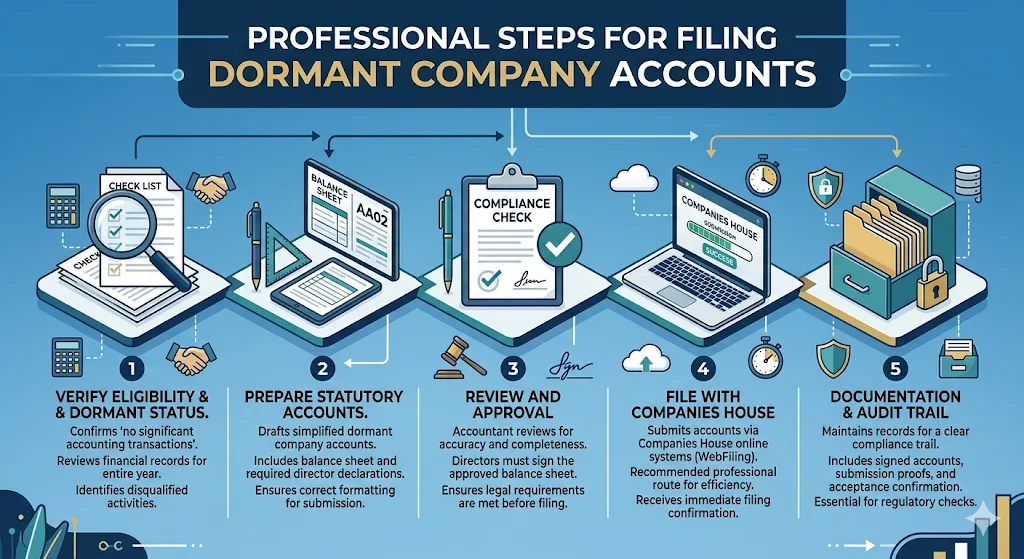
Professional filing involves verifying dormant status, preparing statutory accounts, reviewing compliance requirements, and submitting documents to Companies House. Each step follows a structured workflow that ensures accuracy, completeness, and timely delivery.
The process begins with eligibility confirmation. Accountants review all transactions during the financial year. Any disqualifying activity is flagged immediately.
Next, they prepare dormant accounts. These include a balance sheet and director declarations. The format aligns with Companies House templates.
Accounts undergo internal review before submission. This step ensures that all required fields are completed and disclosures are accurate.
Submission is completed through Companies House online systems. Accountants track submission status and confirm acceptance.
Directors who want a fully managed solution often use a dedicated service such as File Accounts for Dormant Companies, which ensures end-to-end compliance without manual effort.
Each step is documented for audit purposes. This provides a clear compliance trail if regulatory checks occur.
How do accountants reduce errors in dormant account submissions?
Accountants reduce errors by using standardised templates, automated validation systems, and multi-stage reviews. These controls ensure accuracy in financial data, correct formatting, and complete compliance with Companies House submission requirements.
Errors often occur in manual submissions. Missing fields, incorrect formatting, and misclassified transactions lead to rejection.
Accountants use structured templates aligned with Companies House requirements. These templates eliminate formatting inconsistencies.
Automated validation tools check data before submission. These tools detect errors such as missing balance sheet values or incorrect dates.
Multi-stage reviews add another layer of accuracy. A second accountant verifies the submission before final filing.
Three common error prevention methods include:
- Validate financial data using accounting software checks
- Review submissions through internal quality control processes
- Cross-check compliance requirements against Companies House standards
These measures significantly reduce rejection rates and ensure successful first-time submissions.
How does outsourcing dormant company reporting benefit directors?
Outsourcing dormant reporting saves time, ensures compliance accuracy, and eliminates administrative burden. Directors gain expert oversight, avoid penalties, and maintain accurate records without managing complex filing requirements internally.
Time savings are immediate. Directors avoid hours spent learning compliance rules and preparing accounts.
Accuracy improves through professional oversight. Accountants apply verified processes and reduce submission errors.
Penalty avoidance is a key benefit. Late filing penalties increase progressively. Professional management ensures deadlines are consistently met.
Scalability also improves. Directors managing multiple dormant companies benefit from centralised reporting systems.
For those evaluating whether to handle filings independently, understanding the transition process is essential. This guide on how to transition your active company to dormant status without legal issues explains the compliance steps required before filing begins.
Outsourcing transforms a compliance task into a managed process with predictable outcomes.
What risks do directors face without professional support?
Directors face risks including late filing penalties, incorrect dormant classification, rejected submissions, and potential compliance investigations. These risks increase when filings are handled manually without technical accounting expertise or regulatory knowledge.
Late filing penalties escalate quickly. Companies House imposes fines starting at £150 and increasing to £1,500 for extended delays.
Incorrect classification is another risk. If a company conducts even one qualifying transaction, it loses dormant status. Filing dormant accounts in this case breaches compliance rules.
Rejected submissions create delays. Each rejection requires correction and resubmission, increasing the risk of missing deadlines.
Regulatory scrutiny may follow repeated errors. Companies House monitors filing accuracy and consistency across reporting periods.
Professional accountants mitigate these risks through structured compliance processes and continuous monitoring.
How do accountants handle deadlines and regulatory timelines?
Accountants manage deadlines using automated tracking systems, compliance calendars, and real-time alerts. These tools ensure dormant accounts are prepared and submitted within statutory timeframes, preventing late penalties and missed filings.
Every dormant company has a fixed accounting reference date. Filing deadlines are calculated from this date, typically 9 months after the financial year ends.
Accountants use compliance software to track these deadlines. Alerts are triggered at key intervals, such as 60 days and 30 days before submission.
Workflows are scheduled in advance. Account preparation begins early, allowing time for review and corrections.
Digital submission ensures immediate confirmation from Companies House. This reduces uncertainty around filing status.
Directors benefit from predictable timelines and consistent compliance.
Also explore,
Why Outsource Your Inactive Company Compliance is a Smart Strategic Business Move
How to Ensure Your Dormant Company Accounts Meet All Statutory Legal Standards
When should directors hire professionals for dormant filings?
Directors should hire professionals when managing multiple companies, facing compliance uncertainties, or lacking accounting expertise. Professional support ensures accurate filings, reduces risk, and simplifies the reporting process.
Hiring professionals is particularly valuable when directors oversee more than three entities. Managing multiple deadlines increases the likelihood of missed filings.
Complex compliance situations also require expert handling. For example, companies transitioning between active and dormant status involve additional checks.
Directors without accounting knowledge face higher error rates. Professional accountants eliminate this gap through structured processes.
Those seeking a reliable and efficient solution often choose to hire our specialists for accurate and fast dormant company account submission services to ensure compliance without delays.
Professional involvement transforms dormant reporting into a controlled, error-free process.
Professional accountants bring structure, accuracy, and compliance to dormant company reporting. They verify eligibility, prepare statutory accounts, and submit filings within strict deadlines. This reduces errors, eliminates penalties, and ensures alignment with Companies House requirements.
From My Company delivers this process through specialised systems and compliance workflows. Their File Accounts for Dormant Companies service ensures directors meet all statutory obligations without administrative burden or risk exposure.
Frequently Asked Questions
What are dormant company accounts in the UK?
Dormant company accounts are simplified financial statements filed with Companies House when a company has no significant transactions during a financial year. Services like File Accounts for Dormant Companies ensure these accounts meet UK compliance standards and are submitted correctly.
Do dormant companies need to file accounts every year?
Yes, dormant companies must file accounts annually with Companies House even if there is no financial activity. From My company helps directors meet these legal requirements by managing the File Accounts for Dormant Companies process accurately and on time.
What qualifies a company as dormant for accounting purposes?
A company qualifies as dormant when it has no significant accounting transactions, such as sales, purchases, or bank activity. File Accounts for Dormant Companies services, verify eligibility by reviewing financial records before preparing compliant filings.
What happens if dormant company accounts are filed late?
Late filing results in automatic penalties ranging from £150 to £1,500 depending on the length of the delay. Using From My company for File Accounts for Dormant Companies reduces this risk by ensuring deadlines are tracked and submissions are completed on time.
Can I file dormant company accounts myself?
Directors can file dormant accounts самостоятельно using Companies House systems, but errors in format or eligibility often lead to rejection. File Accounts for Dormant Companies services provide structured preparation and validation to ensure accurate and compliant submissions.