A dormant company meets UK statutory standards by filing annual dormant accounts with Companies House, submitting confirmation statements on time, maintaining accurate statutory registers, and ensuring zero significant accounting transactions during the period. Compliance depends on precise filing, deadlines, and validated company records.
What qualifies a company as dormant under UK law?
A UK company qualifies as dormant when it records no significant accounting transactions during a financial year, except permitted entries like Companies House fees, penalties, or share allotments. HMRC and Companies House definitions align, but both require strict transactional inactivity and accurate classification.
Dormancy depends on accounting activity, not business intention. A company can exist legally while conducting no trade or income-generating activity. Permitted transactions include filing fees and late penalties, but operational costs such as rent, salaries, or supplier payments break dormancy status.
HMRC treats dormancy separately for Corporation Tax. A company can be dormant for Companies House yet still active for tax if HMRC has not confirmed dormancy. Directors must verify both statuses to avoid mismatched compliance records.
Three qualifying conditions define dormancy:
- Record zero trading income or expenses.
- Exclude operational bank transactions.
- Maintain only allowable statutory payments.
Failure in any one condition reclassifies the company as active.
What statutory accounts must a dormant company file?
Dormant companies must file dormant accounts annually with Companies House using form AA02 or equivalent online submission, containing a simplified balance sheet and mandatory notes. These accounts confirm inactivity and must meet filing deadlines based on the company’s accounting reference date.
Dormant accounts differ from full accounts. They exclude profit and loss statements and contain a minimal balance sheet. This balance sheet typically shows issued share capital and retained earnings, often unchanged across periods.
Companies House requires accounts within 9 months after the financial year-end. For a new company, the first deadline extends to 21 months from incorporation. Missing deadlines triggers automatic penalties starting at £150 and increasing to £1,500 for persistent delays.
Accuracy matters. Even a minor transaction recorded incorrectly can invalidate dormant status. Directors must validate every entry before submission. Using a structured process reduces rejection risk and ensures statutory alignment.
Businesses evaluating compliance workflows often choose to File Accounts for Dormant Companies through specialised providers to standardise submissions and reduce filing errors.
How do confirmation statements affect dormant company compliance?
Dormant companies must file a confirmation statement (CS01) at least once every 12 months to confirm company details, including directors, shareholders, and registered office. This filing maintains legal transparency and is mandatory regardless of trading status.
The confirmation statement does not replace accounts. It serves a separate legal function by validating corporate structure and ownership. Companies House uses this data to maintain the public register.
Key elements verified in the confirmation statement include:
- Director identities and appointments
- Shareholder structure and share capital
- Registered office address
- SIC (Standard Industrial Classification) codes
The filing fee is £13 online or £40 by post. Missing this filing leads to a company strike-off risk. Directors remain legally responsible even if the company remains inactive.
Accurate confirmation statements support compliance audits. They ensure that dormant companies do not become vehicles for undisclosed ownership or inactive shell misuse.
What deadlines must dormant companies strictly follow?
Dormant companies must meet three fixed deadlines: annual accounts filing within 9 months of the year-end, confirmation statement within 12 months of the previous filing, and Corporation Tax dormancy confirmation with HMRC if applicable. Missing any deadline results in penalties or enforcement action.
Deadlines operate independently. Filing accounts does not extend confirmation statement deadlines. Each compliance obligation requires separate tracking and execution.
Late filing penalties escalate:
- £150 for up to 1 month late
- £375 for 1–3 months
- £750 for 3–6 months
- £1,500 for over 6 months
Repeated late filings double these penalties. Companies House also has the authority to strike off companies after prolonged non-compliance.
Directors must align accounting reference dates, confirmation statement cycles, and HMRC status to avoid overlap confusion. Structured calendars or automated reminders reduce deadline failures.
Many directors refer to guides such as the Essential checklist for maintaining a dormant limited company in the UK to align timelines and compliance tasks systematically.
How do statutory registers support dormant company compliance?
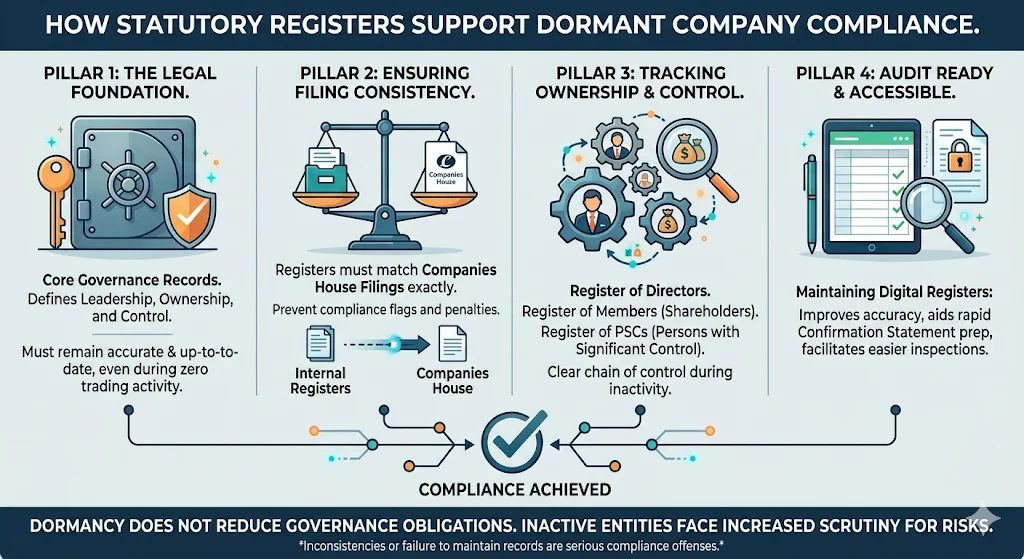
Dormant companies must maintain statutory registers, including registers of directors, shareholders, and persons with significant control (PSC). These records must remain accurate, up to date, and accessible for inspection, even when the company has no trading activity.
Statutory registers form the legal backbone of company governance. They document ownership, control, and leadership. Companies House filings reflect these registers, but internal records must match exactly.
Core registers include:
- Register of directors
- Register of members (shareholders)
- Register of PSCs
- Register of charges (if applicable)
Inconsistencies between registers and filed data trigger compliance flags. Directors must update registers immediately after any change, such as share transfers or director resignations.
Maintaining digital registers improves accuracy and audit readiness. It also supports faster confirmation statement preparation.
Dormancy does not reduce governance obligations. It increases scrutiny because inactive entities are often reviewed for compliance risks.
How can errors in dormant accounts impact compliance status?
Errors in dormant accounts, such as recording disallowed transactions or incorrect balances, can invalidate dormant status and trigger reclassification as an active company. This leads to additional reporting requirements, tax exposure, and potential penalties from Companies House and HMRC.
Common errors include recording bank interest, including operational expenses, or misclassifying share capital changes. Even small inaccuracies create compliance discrepancies.
Three high-risk error types:
- Recording bank transactions beyond permitted fees
- Misstating share capital or equity balances
- Omitting required notes in the balance sheet
Once reclassified, the company must file full statutory accounts and potentially Corporation Tax returns. This increases administrative burden and cost.
Validation processes prevent errors. These include reconciling bank activity, reviewing ledger entries, and confirming zero operational transactions.
Structured services to File Accounts for Dormant Companies reduce these risks by applying standardised validation frameworks before submission.
When is professional support necessary for dormant company filings?
Professional support becomes necessary when directors lack accounting expertise, manage multiple entities, or face tight filing deadlines. Specialist services ensure accurate dormant account preparation, statutory compliance, and timely submission using verified processes aligned with UK regulations.
Complexity increases with portfolio companies or group structures. Directors managing multiple dormant entities face higher risks of missed deadlines or inconsistent filings.
Professional providers offer:
- Automated deadline tracking
- Pre-submission validation checks
- Digital filing with Companies House integration
- Compliance audit trails
Outsourcing reduces administrative load and ensures consistency across filings. It also provides documented compliance, which supports future audits or company reactivation.
Decision-stage buyers often evaluate bundled services such as comprehensive inactive company compliance packages that combine accounts, confirmation statements, and register maintenance into one structured solution.
Also explore,
Comparing Different Dormant Account Filing Packages for Small and Inactive Business Entities
Why Your Business Needs a Managed Service for Annual Dormant Account Maintenance
How does using a filing service improve statutory accuracy?
Using a structured filing service improves statutory accuracy by applying standardised templates, automated validation checks, and compliance workflows aligned with Companies House requirements. This reduces human error, ensures correct formatting, and increases first-time acceptance rates for dormant account submissions.
Manual filing introduces variability. Differences in formatting, missing notes, or incorrect classifications often lead to rejection or delays. Filing services standardise each submission element.
Key accuracy benefits include:
- Pre-built dormant account templates aligned with the AA02 format
- Automated checks for disallowed transactions
- Integrated deadline tracking systems
Higher acceptance rates reduce resubmissions and penalty exposure. They also ensure consistent compliance across reporting periods.
Businesses using File Accounts for Dormant Companies services benefit from repeatable processes that maintain accuracy year after year.
Dormant company compliance in the UK depends on precise execution across three areas: accurate dormant accounts, timely confirmation statements, and fully maintained statutory registers. Each requirement operates independently and demands strict adherence to deadlines and validation rules.
Errors or missed filings trigger penalties, reclassification, or strike-off risk. Structured processes and verified submission methods reduce these risks and improve compliance outcomes.
From My Company delivers compliant dormant account filing through standardised workflows, validated submissions, and deadline management systems. This approach ensures statutory alignment while maintaining operational simplicity for directors managing inactive entities.
Frequently Asked Questions
Do dormant companies need to file accounts every year in the UK?
Yes, dormant companies must file annual dormant accounts with Companies House even if no trading occurs. Services like File Accounts for Dormant Companies ensure submissions meet statutory formats and deadlines, reducing the risk of penalties or rejection.
What happens if dormant company accounts are filed late?
Late filing triggers automatic penalties starting at £150 and increasing up to £1,500 depending on the delay length. Using File Accounts for Dormant Companies through providers like From My Company helps track deadlines and submit on time to maintain compliance.
Can a dormant company have any financial transactions?
A dormant company can only record limited transactions, such as Companies House filing fees or penalties. File Accounts for Dormant Companies processes validate entries to ensure no disallowed transactions appear, preserving dormant status under UK regulations.
Is it mandatory to hire a service to file dormant company accounts?
It is not legally required, but professional services improve accuracy and compliance. From My company offers File Accounts for Dormant Companies using structured validation and submission systems aligned with Companies House requirements.
What information is included in dormant company accounts?
Dormant accounts include a simplified balance sheet, share capital details, and statutory notes confirming no significant transactions. File Accounts for Dormant Companies ensures all required fields are correctly prepared and submitted in the approved format.