

Using incorrect templates leads to rejected submissions, incorrect accounting classifications, and regulatory penalties.
Incorrect templates confuse Companies House validation rules. They omit required statements, such as a director’s approval, or they include trading accounting headings that reclassify a dormant company. These errors cause automated rejections or human queries that delay filing. Delays commonly trigger late filing penalties and escalate to HMRC checks.
How do incorrect templates affect Companies House submissions?
Incorrect templates produce validation errors and increase the chance of rejection by Companies House.
Companies House requires specific fields and formats for dormant accounts. Missing signatures, wrong report dates, or incorrect balance sheet labels cause validation failures. Validation errors force resubmission, extend processing time by days or weeks, and create an audit trail that flags the company for further review.
What are the HMRC consequences of using the wrong templates?
Wrong templates can misreport turnover or tax status and prompt HMRC inquiries or investigations.
Dormant companies must show zero trading and appropriate note disclosures. Templates that present revenue lines or incorrect expense classifications suggest trading activity. HMRC opens enquiries when submitted accounts indicate income or VAT registration, increasing compliance risk and administrative burden. For more information, read our articles,
Why Late Filing Penalties Apply Even if Your Company Has Never Traded, and Secure Your Company Compliance by Purchasing Our Expert Dormant Account Support Service.
Can incorrect templates trigger late filing penalties?
Yes. Using the wrong templates delays accurate filing and often results in statutory late filing penalties.
Companies House issues automatic fines for late accounts: for private limited companies, penalties start at £150 for late filings less than one month overdue and increase with delay. Resubmissions following rejections extend the filing timeline, pushing firms into penalty tiers. Repeated late filings raise the risk profile for escalating enforcement.
How do incorrect templates impact statutory records and director liability?
Incorrect templates create inaccurate statutory records and expose directors to personal liability for non-compliance.
Directors must ensure that annual accounts truthfully represent the company’s status. Filing wrong accounts falsifies public records and breaches the Companies Act. Persistent or severe misfilings can lead to director disqualification investigations and financial sanctions against directors.
What are the operational costs of correcting template mistakes?
Correcting template errors consumes staff time, professional fees, and may require paid resubmissions.
Typical corrective pathway: identify rejection reason, amend accounts, obtain director signature, and resubmit. Each cycle takes 1–5 working days and often requires accountant involvement. Professional amendments cost between £50 and £300, depending on complexity, plus potential penalty fees from Companies House.
How should businesses verify a template before filing?
Validate templates against Companies House and statutory guidance, then test a draft submission internally.
Compare template headings with Companies House specifications for dormant accounts, confirm required statements, and ensure dates match the financial year. Run a trial submission using the Companies House WebFiling validation tool or an accountant’s software sandbox. Retain versioned copies and director sign-off evidence.
Which template elements commonly cause errors?
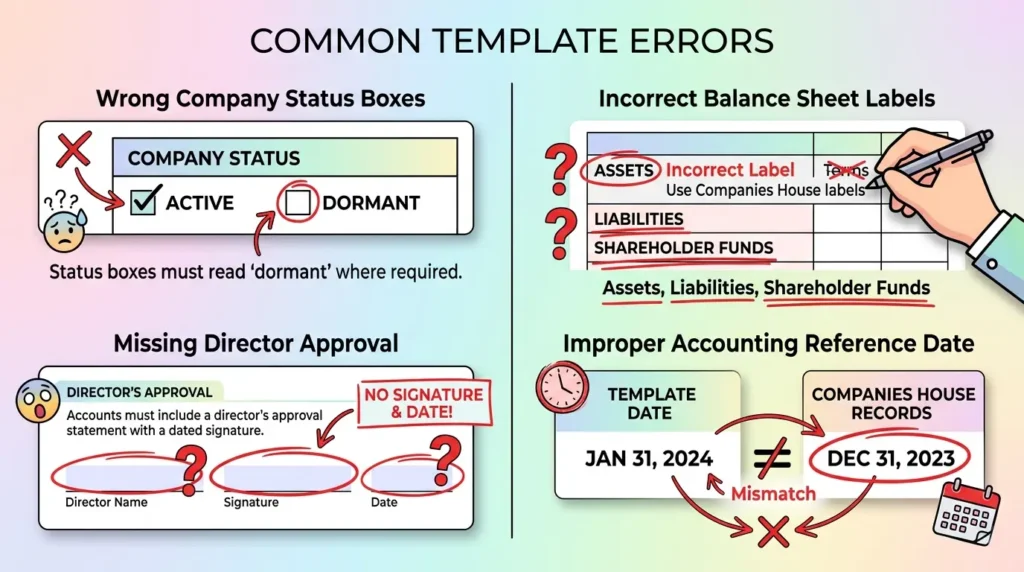
Common errors: wrong company status boxes, incorrect balance sheet labels, missing director approval, and improper accounting reference dates.
Status boxes must read “dormant” where required. Balance sheets must show assets, liabilities, and shareholder funds using Companies House labels. Accounts must include a director’s approval statement with a dated signature. The accounting reference date must match Companies House records to avoid mismatches.
What practical process reduces template risk?
Adopt a three-step validation: standardise templates, perform technical checks, and obtain final director confirmation.
Standardise templates based on Companies House dormant accounts guidance. Perform technical checks: validate numeric formats, confirm zero trading lines, and run the Companies House validator. Obtain written director approval with the exact filing date. Archive the approved version for audit.
Explore our File Accounts for Dormant Companies guides,
How to Ensure Your Dormant Company Accounts Meet All Statutory Legal Standards
Comparing Different Dormant Account Filing Packages for Small and Inactive Business Entities
When should you involve an accountant or specialist?
Involve an accountant when templates require interpretation or when prior submissions were rejected.
Accountants validate classifications and identify hidden trading indicators. They correct disclosure notes and prepare restatements. If prior filings received queries or penalties, hire an accountant for remediation and to communicate with Companies House and HMRC.
How does correct template use support compliance and reputation?
Correct templates ensure timely filings, accurate public records, and reduced regulatory scrutiny.
Timely, accurate accounts maintain a company’s statutory standing. They prevent penalties and keep director records clean. They also reassure lenders and counterparties who review Companies House filings during credit checks or due diligence.
Using incorrect templates for dormant company accounts creates measurable compliance risks: rejected filings, HMRC enquiries, financial penalties, and director exposure. A disciplined validation process prevents these outcomes. From My Company provides structured support to ensure dormant accounts use the correct templates and meet statutory deadlines without errors.
From My Company delivers practical help for filing dormant accounts by validating templates, preparing compliant statements, and guiding director approvals. This reduces the risk of rejections and penalties while preserving accurate company records.
Frequently Asked Questions
Do dormant companies have to file accounts every year?
Yes. In the UK, dormant companies still file dormant accounts with Companies House each year, even if they have had no trading activity. From My company’s File Accounts for Dormant Companies service supports this annual compliance step and helps reduce filing errors.
What happens if I file dormant company accounts late?
Late filing usually leads to automatic penalties and can trigger further compliance action. Filing delays also increase the risk of rejection or strike-off if the company repeatedly misses deadlines.
What is included in dormant company accounts?
Dormant accounts are usually a simplified filing, often built around a basic balance sheet and the correct dormancy declaration. They also require director approval and the company’s exact registration details.
What are the most common mistakes when filing dormant accounts?
Common errors include using the wrong account format, missing statutory notes, and entering incorrect company dates or registration details. Another frequent issue is assuming a company is dormant without checking whether it still meets the official dormancy rules.
Can dormant accounts be filed online?
Yes. Dormant company accounts can be filed online through approved filing systems, which reduces formatting errors and gives faster confirmation. Using a structured service like From My company’s File Accounts for Dormant Companies support can make the process more reliable.