For more than two decades, the UK occupied a unique position in global business registration. Entrepreneurs from Europe, Asia, Africa, and the Commonwealth regularly used UK limited company structures as gateways into the EU single market, relying on the UK’s legal framework, banking ecosystem, and international reputation. That position shifted sharply after Brexit.
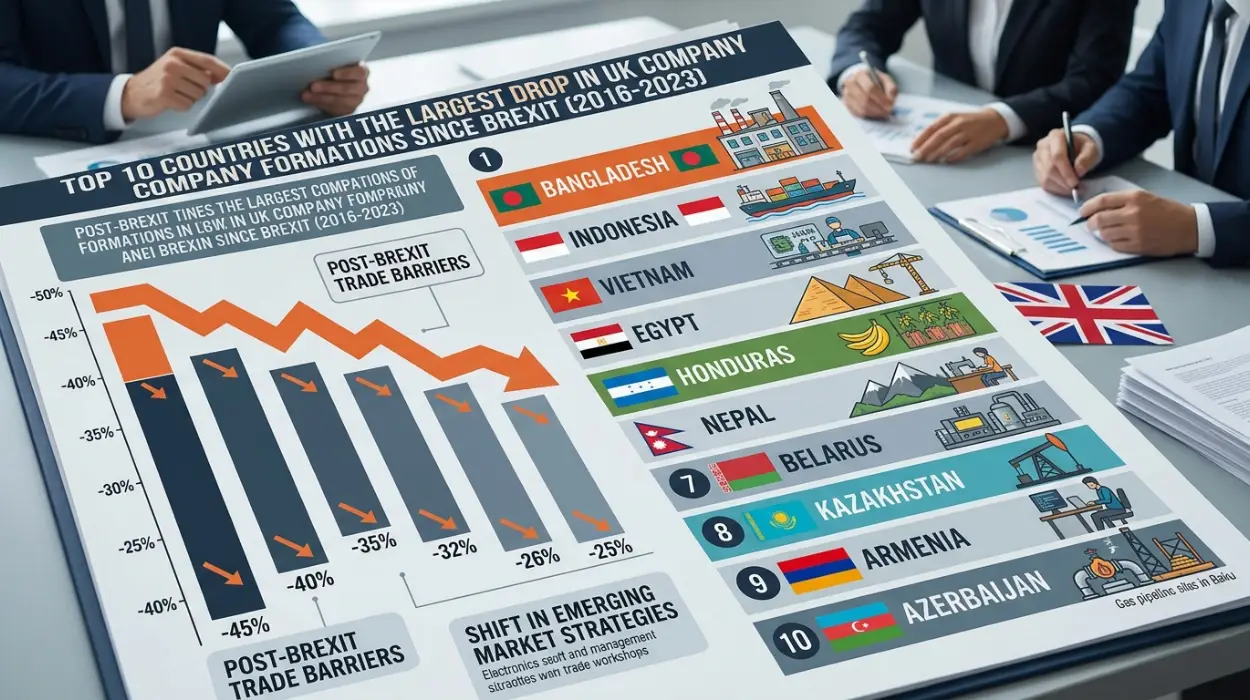
New research based on Google Trends search-interest data across 93 countries shows a dramatic collapse in international demand for UK company formation following the UK’s departure from the European Union. In 40 countries, search demand for UK company registration fell by as much as 98%, while many historically active markets recorded declines above 90%.
The findings reveal a structural change in how international entrepreneurs perceive the UK as a business destination. Countries including Armenia, Azerbaijan, Belarus, Indonesia, Kazakhstan, and Vietnam experienced near-total collapses in search interest for UK business registration. Meanwhile, a smaller group of markets — including Germany, Denmark, Australia, Brazil, and Argentina — maintained comparatively resilient demand despite Brexit-related disruption.
The full dataset, published by Form My Company research, Pre-Brexit Interest to Post-Brexit Decline: UK Company Formation Down 98% in 40 Countries, offers one of the clearest quantitative pictures yet of how Brexit reshaped global perceptions of UK company formation trends and non-resident demand for UK company formation.
Which countries recorded the biggest collapse in UK company formation interest after Brexit?
The sharpest declines were concentrated across emerging markets, Eastern Europe, parts of Asia, and several Commonwealth-linked economies that had historically viewed the UK as a commercial bridge into Europe.
Key findings from the dataset include:
- Armenia recorded a decline from approximately 55 to 1 in relative search interest, representing a 98% collapse.
- Azerbaijan fell from roughly 65 to 1, one of the largest declines in the dataset.
- Vietnam, Kazakhstan, Indonesia, Nepal, and Honduras all registered declines of approximately 98%.
- Pakistan declined from roughly 55 to 6, an 89% reduction in interest.
- Bangladesh dropped from approximately 50 to 3, equating to a 94% decline.
- Germany showed one of the strongest levels of resilience, declining only 3% post-Brexit.
After years in which international founders viewed the UK as a practical route into the European market, the data suggests many countries rapidly reassessed the value of UK incorporation after January 2020.
Why did Brexit trigger such a steep decline in global UK company formation trends?
The dataset points toward a major restructuring of international founder behaviour after Brexit. Before 2020, a <a href=”https://formmycompany.uk/”>UK company formation</a> strategy frequently offered dual advantages: access to the UK’s respected legal framework and indirect access to the European single market.
That value proposition weakened sharply after the UK exited the EU. The countries showing the largest declines were often those where international entrepreneurs had previously used UK companies as strategic gateway entities. Eastern European countries such as Belarus, Georgia, Armenia, and Azerbaijan all recorded near-total collapses in demand. Similar patterns appeared across South Asia and Southeast Asia, including Pakistan, Bangladesh, Indonesia, Laos, Vietnam, and Nepal.
In many cases, the declines were not gradual. Search interest fell rapidly after 2020 and remained persistently low throughout the post-Brexit period. The consistency of those patterns across multiple regions suggests that Brexit did not merely create temporary uncertainty. Instead, it fundamentally altered how international founders evaluated UK incorporation.
The trend is particularly visible in countries where pre-Brexit interest had been exceptionally high. Pakistan recorded a pre-Brexit trend level near 55 before falling to roughly 6. Bangladesh declined from around 50 to 3. Turkey dropped from approximately 55 to 2. Romania fell from 45 to 3.
The post-Brexit landscape also appears to have fragmented global demand. Rather than broad-based international interest, surviving demand increasingly concentrates in a smaller number of advanced economies with established bilateral commercial relationships with the UK.
Which regions proved most resilient after Brexit?
Despite widespread declines, several countries retained comparatively strong post-Brexit search interest in UK business registration.
Germany recorded one of the strongest performances in the dataset, falling only from approximately 30 to 29. Denmark also remained highly resilient, declining just 11%, while maintaining one of the highest post-Brexit interest levels globally at roughly 31.
Other relatively durable markets included:
- Netherlands: approximately 45 to 27
- Australia: approximately 45 to 25
- Austria: approximately 40 to 25
- Belgium: approximately 45 to 23
- India: approximately 45 to 21
- Switzerland: approximately 30 to 20
These countries did not avoid decline entirely, but the scale differed sharply from the near-total collapses visible elsewhere.
The data suggests that countries with deep legal, trade, financial, or linguistic relationships with the UK retained a continuing interest in UK limited company structures even after the loss of EU passporting advantages.
Several of these markets also maintain strong demand for UK companies for non-residents services, particularly among internationally active entrepreneurs seeking English-law corporate structures outside the EU framework.
How did Europe and Asia respond differently to post-Brexit UK business registration?
The regional contrast between Europe and Asia is one of the clearest patterns in the data.
Across continental Europe, many countries experienced meaningful declines but retained substantial residual demand. Germany, Denmark, the Netherlands, Belgium, France, Italy, and Austria all maintained post-Brexit interest levels above 19.
By contrast, large parts of Asia experienced dramatic collapses. Vietnam, Laos, Kazakhstan, Indonesia, Iran, Iraq, and Azerbaijan all fell to approximately 1 in post-Brexit search interest. Pakistan, Bangladesh, Sri Lanka, and Malaysia also experienced declines exceeding 89%.
This divergence matters because it suggests that European businesses continued viewing the UK as commercially relevant even after Brexit. At the same time, many Asian markets appear to have reassessed the UK’s strategic usefulness more aggressively.
Countries that maintained stronger demand often shared several characteristics visible in the dataset:
- Existing bilateral trade relationships
- Established legal familiarity with UK corporate structures
- High levels of internationalisation
- Continued commercial exposure to the London-based finance
Meanwhile, countries recording near-total collapses were frequently markets where the UK’s value proposition had depended heavily on indirect EU access.
Which countries unexpectedly grew after Brexit?
While the overall direction of travel was negative, several countries recorded post-Brexit growth rather than decline.
Argentina increased from roughly 10 to 28, representing a growth of approximately 180%. Brazil rose from around 15 to 22. Djibouti increased from approximately 3 to 15.
These cases stand out because they contradict the broader trend visible across most of the dataset.
The growth markets were not concentrated in Europe. Instead, they were distributed across Latin America, Africa, and smaller offshore-oriented jurisdictions. That pattern suggests that some international entrepreneurs still view the UK as an attractive jurisdiction for stability, legal certainty, or international trading structures independent of EU membership.
Brazil’s rise is particularly notable because it occurred despite broader global declines in UK incorporation interest. The country maintained growing search demand for <a href=”https://formmycompany.uk/register-company”>register a UK company</a> services even after Brexit reshaped European access routes.
Argentina showed an even stronger trajectory. Its post-Brexit trend level substantially exceeded pre-Brexit demand, making it one of the strongest positive outliers in the research.
| Country | Post-Brexit Interest | Change |
|---|---|---|
| Denmark | ~31 | -11% |
| Germany | ~29 | -3% |
| Netherlands | ~27 | -40% |
| Australia | ~25 | -44% |
| Brazil | ~22 | +47% |
| Argentina | ~28 | +180% |
What does the dataset reveal about Commonwealth countries after Brexit?
One of the more striking findings is that Commonwealth relationships did not automatically protect countries from post-Brexit decline.
Several Commonwealth nations experienced severe contractions in UK incorporation interest:
- Bangladesh: -94%
- Jamaica: -98%
- Ghana: -96%
- Pakistan: -89%
- South Africa: -80%
- New Zealand: -60%
At the same time, Australia and Canada remained comparatively resilient, with post-Brexit interest levels still significantly above global averages.
This split suggests that historical ties alone were insufficient to preserve demand. Markets with stronger institutional trade links, higher business integration with the UK economy, or more internationally diversified corporate sectors performed considerably better.
The findings also indicate that international entrepreneurs increasingly distinguish between the UK’s legal environment and its former EU gateway role. For some countries, the UK remains commercially attractive on its own merits. For others, Brexit appears to have removed the core rationale for incorporation.
How has non-resident UK company formation changed since Brexit?
The dataset provides a broader picture of changing international founder behaviour.
Before Brexit, many overseas entrepreneurs viewed UK incorporation as a relatively frictionless route into European commerce. The UK’s reputation for fast digital incorporation, low setup costs, and international credibility helped fuel demand for <a href=”https://formmycompany.uk/packages/”>UK company packages</a> across dozens of markets.
Post-Brexit, demand became more selective.
Countries still showing meaningful interest often appear linked to sectors where English-law structures, London finance, or bilateral trade relationships remain strategically valuable. Germany, Denmark, the Netherlands, India, Australia, and Switzerland all fit that profile.
At the operational level, surviving demand also appears increasingly connected to practical infrastructure around non-resident business activity. International founders searching for UK business bank account services or virtual office UK solutions continue to rely on the UK’s business ecosystem, even outside the EU framework.
The post-Brexit market therefore, looks narrower, more concentrated, and more commercially specialised than the broad global interest visible before 2020.
Which countries experienced near-total collapse in UK incorporation demand?
The most severe collapses occurred in countries where post-Brexit search demand effectively disappeared.
Countries recording approximately 97–98% declines included:
- Armenia
- Azerbaijan
- Belarus
- Benin
- Bhutan
- Guatemala
- Haiti
- Honduras
- Indonesia
- Iran
- Kazakhstan
- Laos
- Lebanon
- Madagascar
- Nepal
- Oman
- Vietnam
In most cases, post-Brexit trend levels fell to approximately 1. That pattern matters because the declines were not isolated to one geography or economic bloc. The collapse stretched across Latin America, Central Asia, the Middle East, Africa, and Southeast Asia.
The breadth of the downturn indicates that Brexit reshaped the global perception of UK incorporation more profoundly than many policymakers anticipated.
At the same time, the data also shows the UK did not lose all international relevance. Demand survived where underlying commercial relationships remained independently strong.
The long-term picture emerging from the research is therefore not one of total collapse, but of strategic narrowing. The UK remains important for a smaller group of internationally engaged markets, while many countries that once explored UK incorporation have sharply reduced or abandoned that interest altogether.
The findings ultimately reveal how closely global demand for UK company registration had become tied to the UK’s former position inside the European economic system. Once that framework disappeared, international entrepreneurs recalibrated quickly. Some markets retained confidence in the UK’s legal system, financial infrastructure, and business environment. Others moved on almost entirely.
What remains is a more concentrated post-Brexit landscape in which UK limited companies continue to hold value but no longer carry the same universal international appeal they once did.