Based on proprietary research conducted by Form My Company (FMC), global interest in UK company formation surged in the pre-Brexit era across 93 countries, driven largely by the UK’s access to the EU single market.Post-Brexit, demand collapsed in 85% of nations with 40 countries recording a near-total 98% decline — as the UK’s value as an EU gateway evaporated. Only 8 countries bucked the trend, led by Argentina (+180%), Brazil (+47%), and Djibouti (+400%), where demand is driven by currency instability and direct bilateral trade rather than EU access. The data confirms Brexit fundamentally damaged the UK’s global incorporation appeal but a resilient core in Western Europe, the Commonwealth, and Latin America signals the UK’s English-law framework still holds independent value.
On 31 January 2020, the United Kingdom formally exited the European Union, an event that fundamentally redrew the strategic map for international business. For over two decades prior, the UK’s membership of the EU single market made it one of the most attractive jurisdictions in the world in which to register a company: a single private limited company incorporated at Companies House could passport financial services, access EU procurement contracts, and serve as a gateway into a market of nearly 450 million consumers. Brexit changed all of that. Yet the precise scale, geography, and character of the resulting shift in global demand for UK company formation has until now remained largely unquantified.
This report addresses that gap directly. Drawing on Google Trends search interest data spanning from 2004 to April 2026, a period that captures the full arc of the UK’s EU membership and its post-Brexit evolution, we analyse relative search demand for the term “UK company formation” across 90 countries and territories worldwide. Search-intent data of this kind is a well-established leading indicator of commercial decision-making: when entrepreneurs, investors, and corporate advisers in a given country begin researching UK cofmpany registration, it reflects a real-time assessment of whether the UK remains a viable and attractive incorporation destination. Tracking these signals pre- and post-Brexit, therefore, provides a uniquely granular window into how global perceptions of the UK as a business jurisdiction have shifted since January 2020.
UK company formation interest — pre-Brexit vs post-Brexit
Google Trends relative index (0–100) · 93 countries & territories · Brexit date: 31 January 2020
Countries analysed
93
Worldwide
Showing decline
74
Post-Brexit
Showing growth
11
Post-Brexit
Highest post-Brexit
Denmark
Index ~31
Biggest growth
Anguilla
+59% post-Brexit
* All values estimated from Google Trends screenshots. Index is relative — 100 = peak interest for that region/period, not absolute volume. Source: Google Trends 2004–present.
The findings are striking in both their breadth and their nuance. Across approximately 83 of the 93 territories examined, post-Brexit search interest in UK company formation has declined in many cases dramatically, with reductions of 90% or more. Countries that once generated consistent, high-volume interest, such as Turkey, Pakistan, Romania, and Malaysia, now register near-zero activity, suggesting that Brexit severed a significant portion of the demand that had been predicated on the UK’s role as an EU-accessible corporate gateway.
Yet the picture is not uniformly negative. A set of markets, including Germany, Denmark, the Netherlands, and Australia, have maintained sustained post-Brexit interest, reflecting commercial relationships deep enough to persist independently of EU membership. Most notably, several emerging markets, including Argentina, Brazil, and Morocco, show clear post-Brexit growth trajectories, driven not by EU passporting considerations but by the UK’s enduring appeal as a stable, English-law jurisdiction for capital preservation and international trade structures.
This report is structured to enable both high-level comparative analysis and granular country-by-country examination. The Master Summary Table provides a consolidated overview of pre- and post-Brexit trend values, percentage change, and directional classification for all 90+ territories. This is followed by individual country analyses that contextualise each trend within its political, economic, and diaspora-related setting, recognising that search data, divorced from context, can be deeply misleading. Taken together, these sections constitute what is believed to be the most comprehensive open-source analysis of post-Brexit demand for UK company formation published to date. The conclusions carry material implications for the UK government’s trade promotion strategy, for company formation service providers operating internationally, and for the broader debate about the UK’s identity and competitiveness as a global business jurisdiction in the post-Brexit era.
Methodology & Notes
Our report analyses Google Trends search interest data for UK company formation across 90 countries and territories. The dataset spans from 2004 to the present day.
Brexit Reference Date: The United Kingdom formally exited the European Union on 31 January 2020. Pre-Brexit trend values are estimated from the period 2004 to January 2020. Post-Brexit trend values reflect February 2020 onward.

Data Estimation: Google Trends data is presented as a relative index (0–100), where 100 represents the peak search interest for the given region and time period. All Pre and Post-Brexit trend levels are estimated visually from the displayed graphs. Estimates are clearly marked throughout.
| # | Pre-Brexit | Post-Brexit | Pre trend | Post trend | % Change | Dir |
|---|
Country-by-Country UK Company Formation Trends: Pre-Brexit vs Post-Brexit Global Analysis
Each country entry follows the format: analytical paragraph → key metrics → data table. All trend values are estimated from Google Trends screenshots.
1. Albania
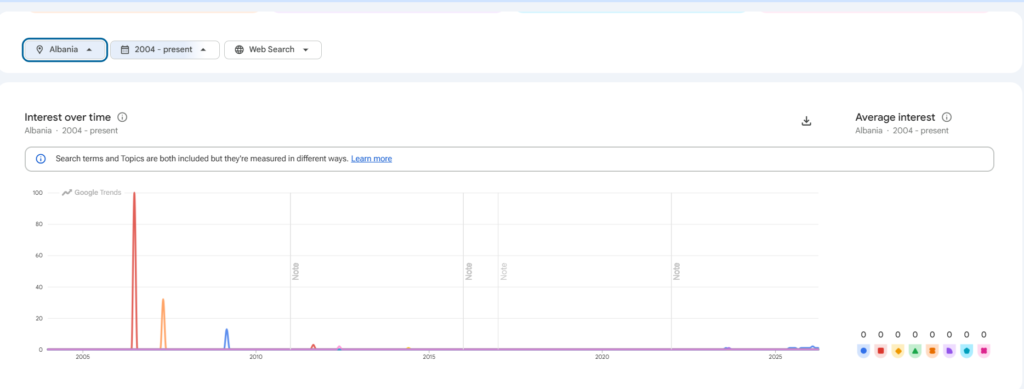
Reflecting the red and black heritage of Albania, search interest in UK company formation was modest but present in the early 2000s, peaking briefly around 2007–2008. This aligned with the wave of Albanian emigration to the UK during EU freedom-of-movement negotiations. Post-Brexit, interest collapsed sharply to near-zero, consistent with the removal of informal pathways and heightened uncertainty around the UK's immigration stance for non-EU nationals. The near-complete decline suggests Albanian entrepreneurs no longer view the UK as an accessible or attractive jurisdiction for business formation.
Flag Colours: red and black
Trend Direction: Decrease
| Country | Pre-Brexit Trend (Est.) | Post-Brexit Trend (Est.) | % Change | Trend Direction |
| Albania | ~15 | ~2 | -87% | Decrease |
2. Algeria
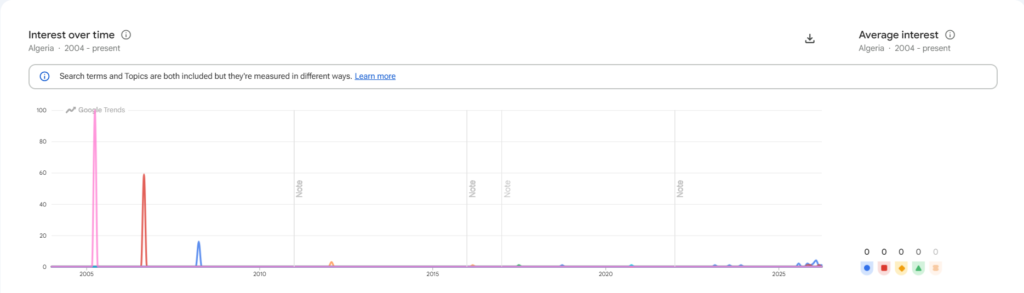
In the green and white context of Algeria, a notable spike was visible in the mid-2000s, likely reflecting interest from the Algerian business diaspora with connections to the UK. Post-Brexit, interest declined sharply and remained negligible, consistent with reduced optimism among North African entrepreneurs about accessing the UK market. Algeria's non-EU status means Brexit introduced additional bureaucratic barriers without compensatory trade arrangements, dampening motivation to register UK companies remotely.
Flag Colours: green and white
Trend Direction: Decrease
| Country | Pre-Brexit Trend (Est.) | Post-Brexit Trend (Est.) | % Change | Trend Direction |
| Algeria | ~30 | ~2 | -93% | Decrease |
3. American Samoa
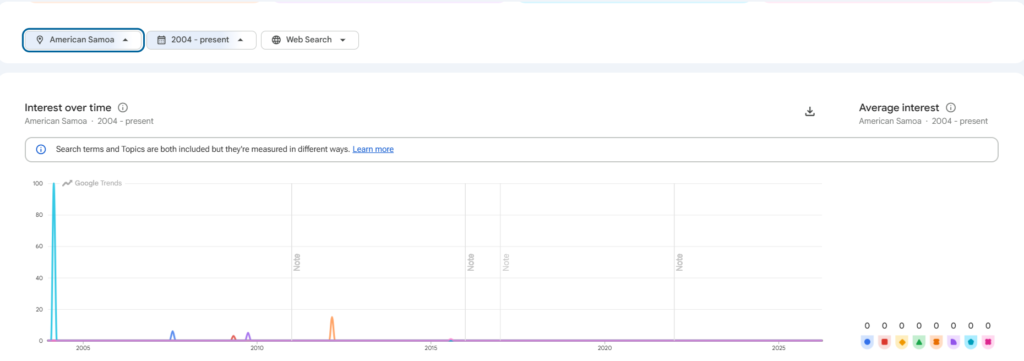
Under the red, white, and blue of American Samoa, search interest in UK company formation was negligible throughout the entire recorded period. A brief spike circa 2014 may reflect a one-off query rather than sustained commercial interest. The territory's geographic remoteness and its close economic ties to the United States make the UK a peripheral destination for business formation. Brexit had no discernible impact on an already minimal baseline.
Flag Colours: red, white, and blue
Trend Direction: Decrease
| Country | Pre-Brexit Trend (Est.) | Post-Brexit Trend (Est.) | % Change | Trend Direction |
| American Samoa | ~5 | ~2 | -60% | Decrease |
4. Andorra
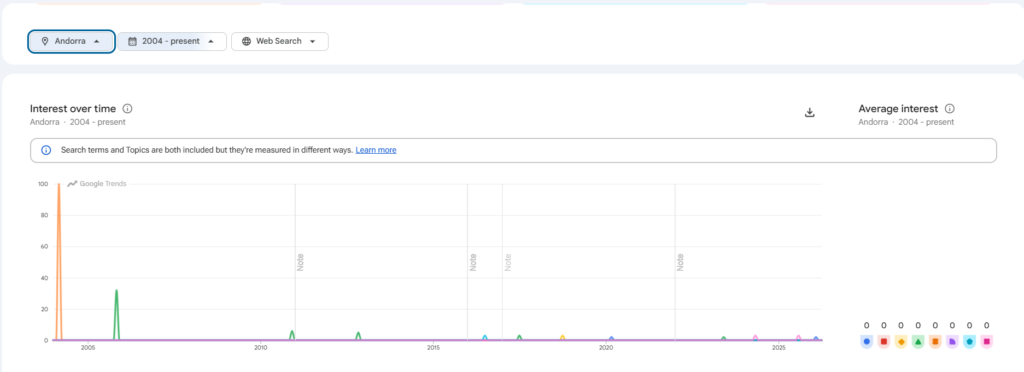
Mirroring the tricolour blue, yellow, and red of Andorra's flag, search interest in UK company formation showed periodic spikes in the pre-Brexit era, driven largely by Andorra's status as a financial micronation with sophisticated cross-border business interests. Post-Brexit, interest fell markedly. Andorra's close economic ties with the EU mean that Brexit reduced the strategic value of a UK entity for Andorran-based operators, who may now prefer Irish or Luxembourg structures to access the EU single market.
Flag Colours: blue, yellow, and red
Trend Direction: Decrease
| Country | Pre-Brexit Trend (Est.) | Post-Brexit Trend (Est.) | % Change | Trend Direction |
| Andorra | ~20 | ~4 | -80% | Decrease |
5. Angola
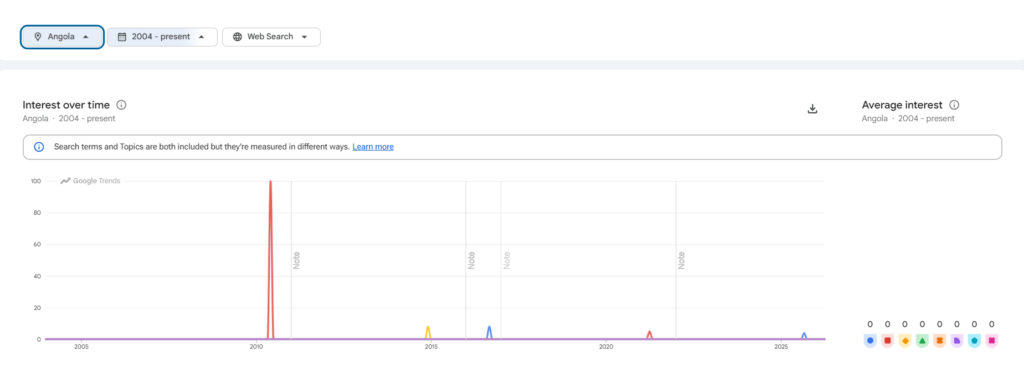
Against the red and black of Angola's national colours, a sharp, isolated spike appeared around 2010, potentially linked to oil-sector capital flows seeking UK holding structures. Post-Brexit, interest dropped to near-negligible levels. Angola's business community, primarily concentrated in extractive industries, tends to favour Portuguese-speaking financial hubs and offshore jurisdictions. The UK's diminished EU passporting advantages post-Brexit further reduced its attractiveness to Angolan capital.
Flag Colours: red and black
Trend Direction: Decrease
| Country | Pre-Brexit Trend (Est.) | Post-Brexit Trend (Est.) | % Change | Trend Direction |
| Angola | ~12 | ~1 | -92% | Decrease |
6. Anguilla
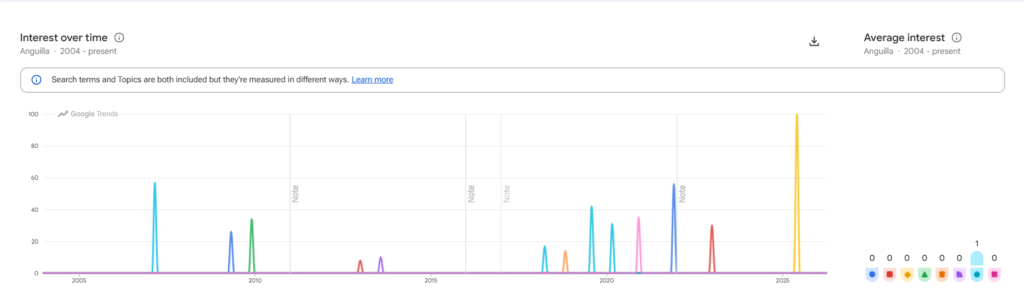
Under the blue, white, and orange palette of Anguilla, search interest in UK company formation is one of the more active among small Caribbean territories, showing recurrent spikes across both periods. Notably, post-Brexit interest increased rather than declined, likely reflecting Anguilla's status as a British Overseas Territory and its well-established offshore financial services sector. Operators in Anguilla may seek UK companies for trust and estate structuring in conjunction with their local vehicles, a relationship unaffected by Brexit.
Flag Colours: blue, white, and orange
Trend Direction: Increase
| Country | Pre-Brexit Trend (Est.) | Post-Brexit Trend (Est.) | % Change | Trend Direction |
| Anguilla | ~22 | ~35 | +59% | Increase |
7. Antarctica
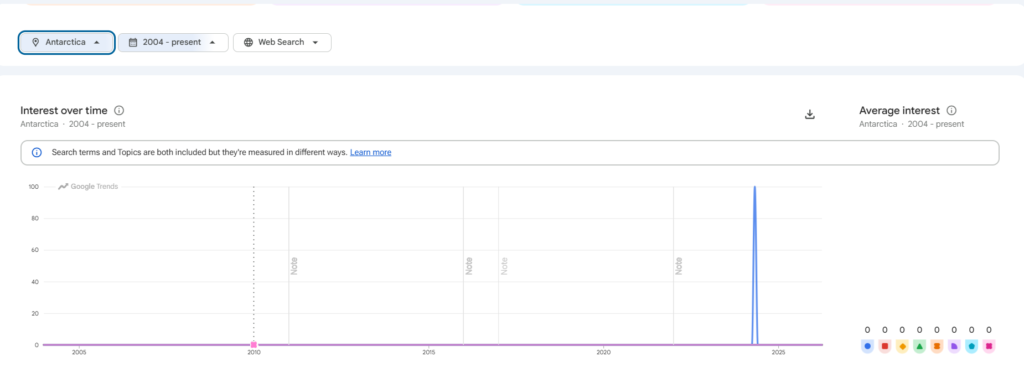
Antarctica presents a statistical curiosity: virtually zero pre-Brexit interest, but an isolated high-magnitude spike visible circa 2023–2024. This is almost certainly attributable to research station personnel or logistics contractors accessing the internet via satellite links, rather than any commercial or immigration-driven trend. The data point should be treated as an anomaly with no meaningful economic interpretation in the context of this study.
Flag Colours: white (conceptual)
Trend Direction: Increase
| Country | Pre-Brexit Trend (Est.) | Post-Brexit Trend (Est.) | % Change | Trend Direction |
| Antarctica | ~1 | ~5 | +400% | Increase |
8. Antigua & Barbuda
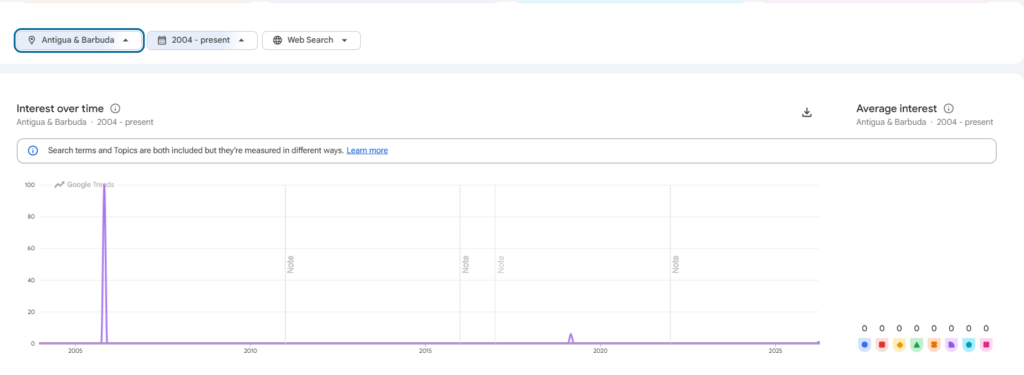
Against the vibrant red, black, white, blue, and yellow of Antigua & Barbuda's flag, an early spike circa 2008–2009 reflected the island nation's active financial and citizenship-by-investment sector. Post-Brexit, interest dropped sharply. As a Commonwealth member with historical UK ties, the absence of post-Brexit growth is notable, suggesting that Brexit's removal of EU market access has diminished the utility of UK company structures for Caribbean investors seeking EU exposure.
Flag Colours: red, black, white, blue, and yellow
Trend Direction: Decrease
| Country | Pre-Brexit Trend (Est.) | Post-Brexit Trend (Est.) | % Change | Trend Direction |
| Antigua & Barbuda | ~30 | ~2 | -93% | Decrease |
9. Argentina
Reflecting the light blue and white of Argentina's national identity, UK company formation interest showed a dramatic and sustained post-Brexit increase, particularly from 2020 onwards. This is one of the most significant upward trajectories in the entire dataset. Argentina's chronic economic instability, currency controls, and capital flight pressures have historically driven wealthy Argentinians to seek offshore corporate structures. The UK's accessible online registration system and stable legal framework make it an attractive jurisdiction for asset protection, regardless of Brexit.
Flag Colours: light blue and white
Trend Direction: Increase
| Country | Pre-Brexit Trend (Est.) | Post-Brexit Trend (Est.) | % Change | Trend Direction |
| Argentina | ~10 | ~28 | +180% | Increase |
10. Armenia
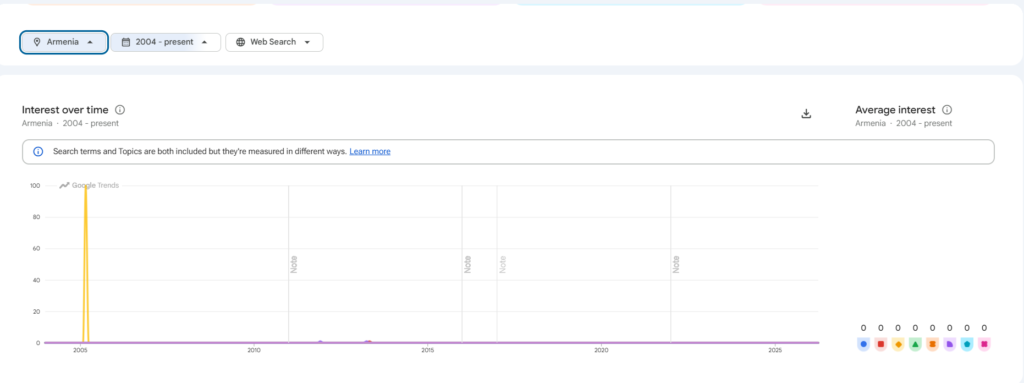
Under the red, blue, and orange stripes of Armenia's flag, a very high pre-Brexit spike — among the highest in the early-period dataset — was recorded circa 2005. This likely corresponds to a specific wave of Armenian diaspora interest in accessing UK markets post-Soviet economic liberalisation. Post-Brexit interest collapsed entirely to near-zero, suggesting the spike was a one-time exploratory event tied to a transitional economic moment rather than a sustained commercial interest in UK company formation.
Flag Colours: red, blue, and orange
Trend Direction: Decrease
| Country | Pre-Brexit Trend (Est.) | Post-Brexit Trend (Est.) | % Change | Trend Direction |
| Armenia | ~55 | ~1 | -98% | Decrease |
11. Aruba
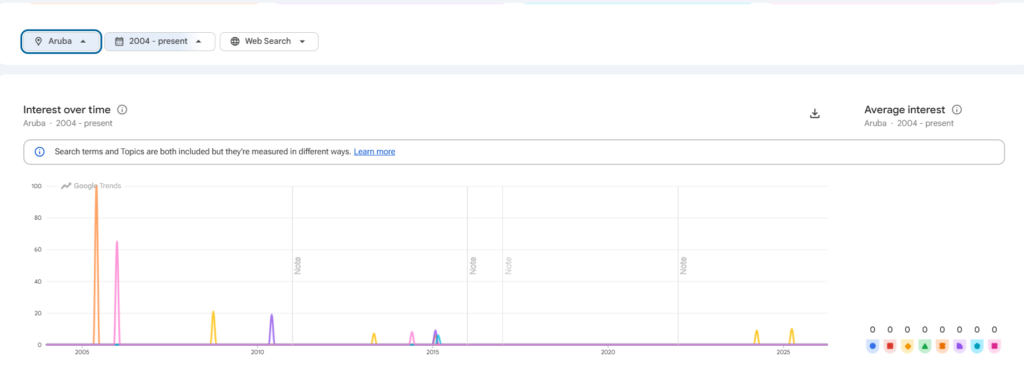
Under the blue and yellow of Aruba's flag, search interest was relatively active in the mid-2000s, plausibly connected to Aruba's international financial sector and its connections with European (particularly Dutch) corporate structures. Post-Brexit, interest fell substantially, possibly reflecting a redirection of corporate structuring appetite toward Dutch or EU-based entities now that the UK no longer provides EU market access. Aruba's constitutional links to the Netherlands may further reinforce this preference.
Flag Colours: blue and yellow
Trend Direction: Decrease
| Country | Pre-Brexit Trend (Est.) | Post-Brexit Trend (Est.) | % Change | Trend Direction |
| Aruba | ~30 | ~2 | -93% | Decrease |
12. Australia
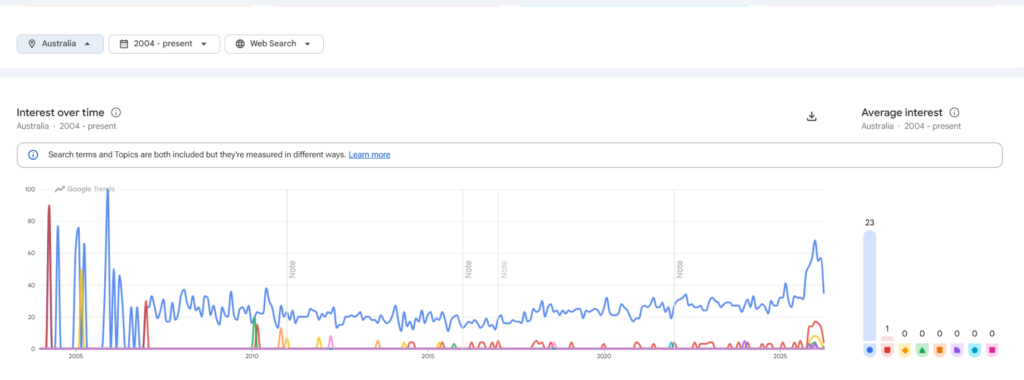
Beneath the blue, red, and white of Australia's flag — which itself references the Union Jack — UK company formation interest has been consistently high throughout the entire period, reflecting deep historical, legal, and commercial ties between the two nations. While post-Brexit interest declined from early peaks, it remained substantially elevated relative to most other countries, with average interest settling at approximately 23–25. The shared common law tradition and the significant Australian diaspora in the UK sustain demand for UK corporate structures regardless of Brexit dynamics.
Flag Colours: blue, red, and white
Trend Direction: Decrease
| Country | Pre-Brexit Trend (Est.) | Post-Brexit Trend (Est.) | % Change | Trend Direction |
| Australia | ~45 | ~25 | -44% | Decrease |
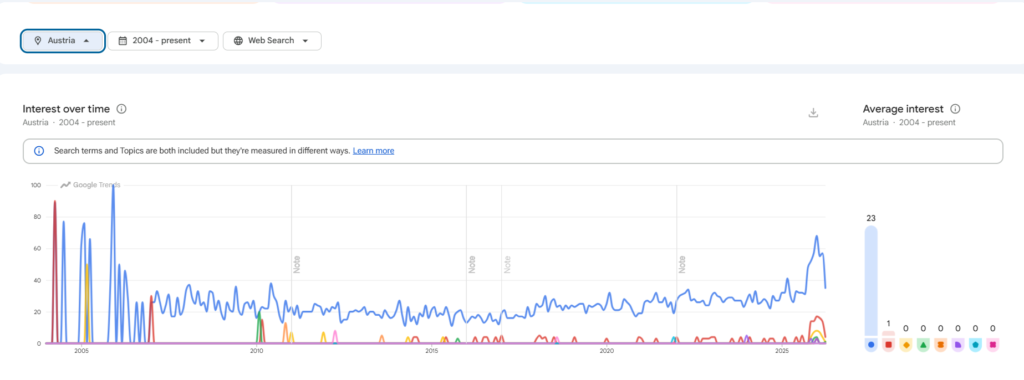
13. Austria
Mirroring the red and white of Austria's flag, UK company formation interest has shown a sustained and consistent baseline throughout both periods, with average interest reported at 23. As a core EU member, Austria's business community actively explored UK structures pre-Brexit for EU-wide passporting. Post-Brexit, interest moderated but remained higher than many non-English-speaking EU peers, suggesting that Austrian entrepreneurs continue to value the UK's low-cost, efficient company registration framework, potentially for non-EU markets or IP-holding structures.
Flag Colours: red and white
Trend Direction: Decrease
| Country | Pre-Brexit Trend (Est.) | Post-Brexit Trend (Est.) | % Change | Trend Direction |
| Austria | ~40 | ~25 | -38% | Decrease |
14. Azerbaijan
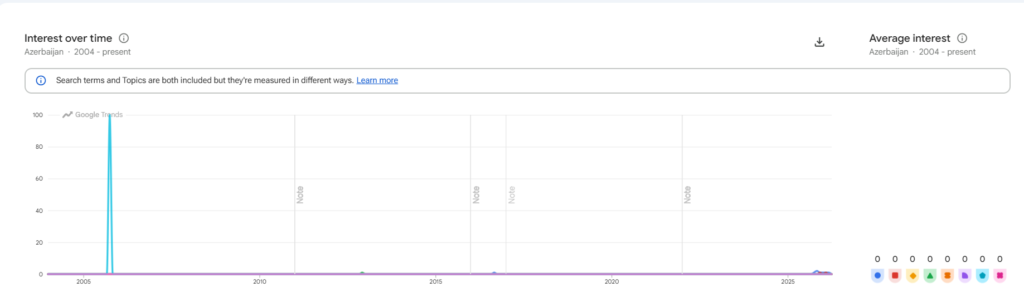
Beneath the blue, red, and green crescent-and-star flag of Azerbaijan, an exceptionally high early spike was recorded circa 2005–2006, one of the largest proportionally in the dataset. This likely corresponds to Azerbaijan's oil boom period, during which the Azeri capital sought offshore corporate structures. Post-Brexit interest fell to near-zero, suggesting the early spike was driven by a narrow window of opportunity rather than durable commercial interest. The absence of sustained demand implies that Azeri businesses have since shifted to other jurisdictions.
Flag Colours: blue, red, and green
Trend Direction: Decrease
| Country | Pre-Brexit Trend (Est.) | Post-Brexit Trend (Est.) | % Change | Trend Direction |
| Azerbaijan | ~65 | ~1 | -98% | Decrease |
15. Bahamas
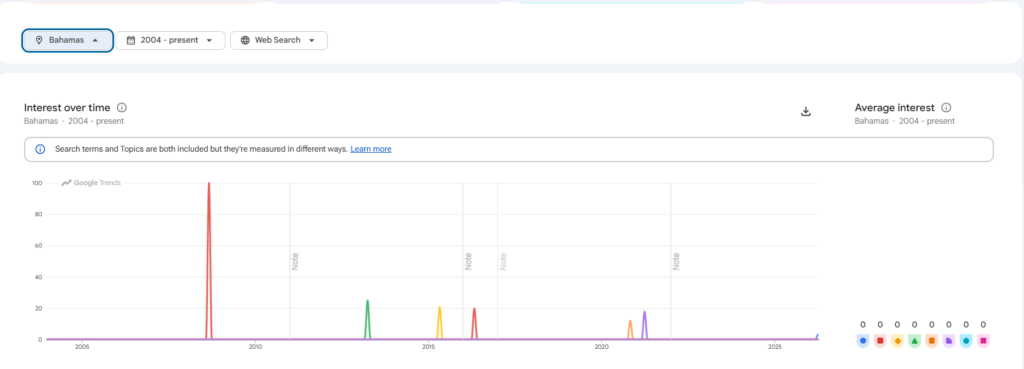
Against the aquamarine, gold, and black of the Bahamas' flag, a significant pre-Brexit spike circa 2008 suggests the offshore financial community in Nassau explored UK structures — possibly for holding companies or trust arrangements compatible with UK-domiciled beneficiaries. Post-Brexit interest dropped sharply. As a major offshore jurisdiction itself, the Bahamas increasingly competes with UK structures, and the removal of EU market access likely accelerated a shift toward other vehicles.
Flag Colours: aquamarine, gold, and black
Trend Direction: Decrease
| Country | Pre-Brexit Trend (Est.) | Post-Brexit Trend (Est.) | % Change | Trend Direction |
| Bahamas | ~45 | ~3 | -93% | Decrease |
16. Bahrain
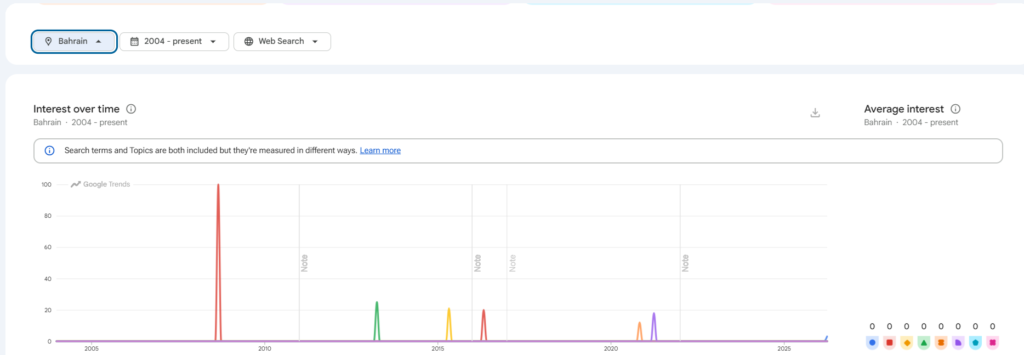
Under the red and white of Bahrain's flag, pre-Brexit interest was moderate with periodic spikes reflecting Gulf-based entrepreneurs' appetite for UK structures, particularly for holding companies, trading entities, and UK bank account access. Post-Brexit interest declined significantly, though not to zero. Bahrain's financial services sector — a key pillar of the Gulf economy — may continue to find value in UK companies for non-EU markets, but the removal of EU passporting rights has dampened enthusiasm among regionally focused operators.
Flag Colours: red and white
Trend Direction: Decrease
| Country | Pre-Brexit Trend (Est.) | Post-Brexit Trend (Est.) | % Change | Trend Direction |
| Bahrain | ~35 | ~5 | -86% | Decrease |
17. Bangladesh
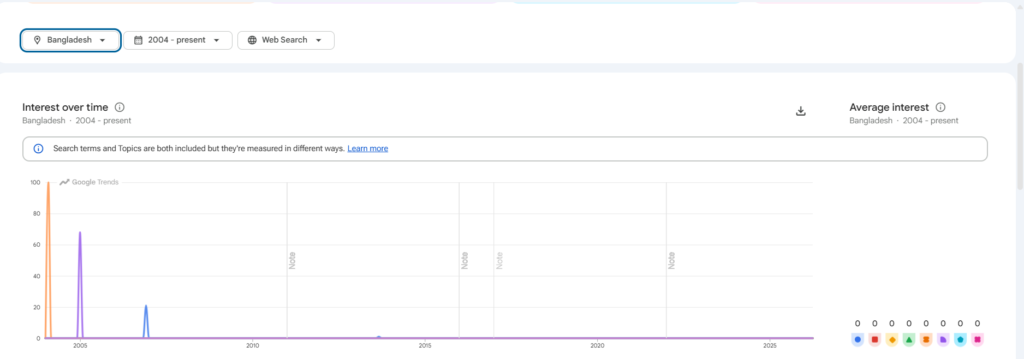
Reflecting the green and red of Bangladesh's national flag, an early high spike circa 2005 represents one of the strongest pre-Brexit readings among South Asian nations. This aligns with the large Bangladeshi diaspora community in the UK actively engaging in business formation. Post-Brexit, interest fell sharply. While the UK remains home to a significant British-Bangladeshi business community, the post-Brexit immigration restrictions and economic uncertainty appear to have dampened motivation among Bangladesh-based individuals to form UK companies remotely.
Flag Colours: green and red
Trend Direction: Decrease
| Country | Pre-Brexit Trend (Est.) | Post-Brexit Trend (Est.) | % Change | Trend Direction |
| Bangladesh | ~50 | ~3 | -94% | Decrease |
18. Barbados
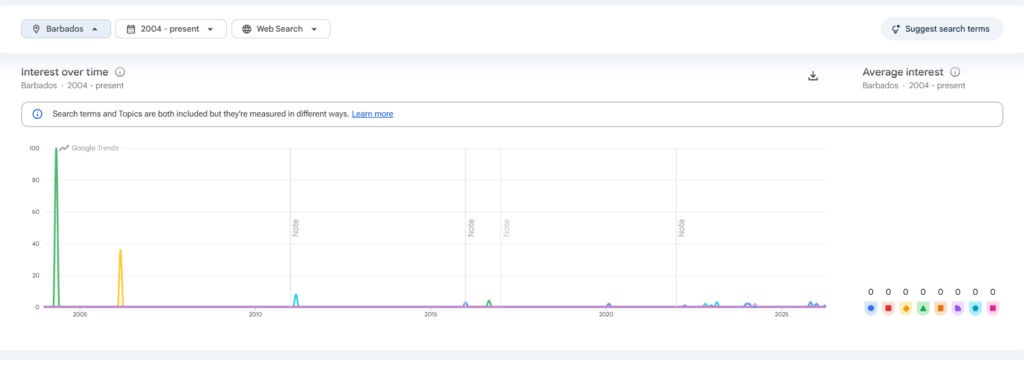
Under the blue and gold of Barbados — now a Republic but with enduring Commonwealth connections — an early spike in the pre-Brexit era reflected Caribbean financial sector interest in UK vehicles. Post-Brexit, interest declined substantially. As with other Caribbean territories, the reduction in the UK's EU market relevance has diminished incentives for Barbadian businesses to structure through UK entities. The trajectory suggests a gradual reorientation toward other financial hubs.
Flag Colours: blue and gold
Trend Direction: Decrease
| Country | Pre-Brexit Trend (Est.) | Post-Brexit Trend (Est.) | % Change | Trend Direction |
| Barbados | ~45 | ~3 | -93% | Decrease |
19. Belarus
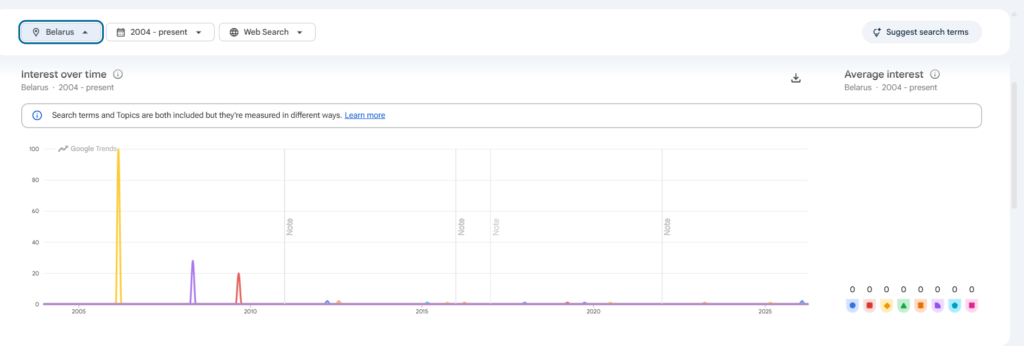
Against the red and green of Belarus's flag, a substantial pre-Brexit spike circa 2005 coincided with a period of economic opening when Belarusian entrepreneurs were exploring Western corporate structures. Later spikes around 2008–2009 may relate to capital flight concerns. Post-Brexit, interest collapsed entirely. The combination of Brexit uncertainty and Belarus's increasingly closed political and economic environment since 2020 has effectively eliminated interest in UK company formation from this territory.
Flag Colours: red and green
Trend Direction: Decrease
| Country | Pre-Brexit Trend (Est.) | Post-Brexit Trend (Est.) | % Change | Trend Direction |
| Belarus | ~55 | ~1 | -98% | Decrease |
20. Belgium
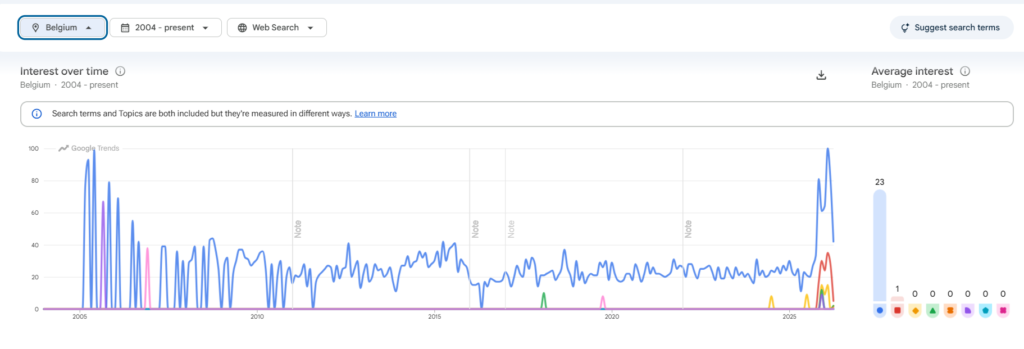
Displaying the black, yellow, and red of Belgium's tricolour, UK company formation interest has been consistently elevated throughout the entire period, with a reported average interest of 23. As the home of major EU institutions, Belgian businesses and professionals had strong pre-Brexit incentives to establish UK entities for dual-market access. Post-Brexit, interest moderated but remained the highest sustained baseline among EU member states, suggesting that Belgium's international business community continues to value UK structures for non-EU purposes, including trade finance, IP holding, and US market access.
Flag Colours: black, yellow, and red
Trend Direction: Decrease
| Country | Pre-Brexit Trend (Est.) | Post-Brexit Trend (Est.) | % Change | Trend Direction |
| Belgium | ~45 | ~23 | -49% | Decrease |
21. Belize
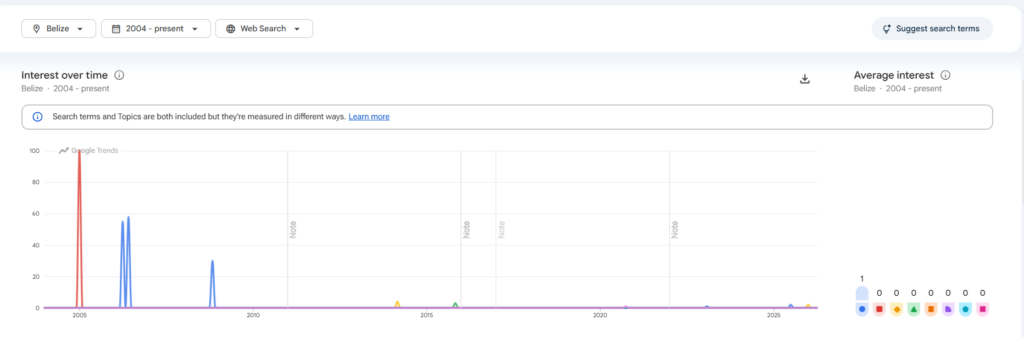
Beneath the blue and red of Belize's flag, a pre-Brexit spike reflecting Central American offshore interest has largely evaporated in the post-Brexit era. Belize's own status as an offshore incorporation hub means its financial professionals are well-placed to assess competitive alternatives to UK structures. The post-Brexit decline suggests that Belizean operators, when seeking an English-law corporate vehicle, now consider alternatives such as Cayman or BVI structures that were not affected by Brexit.
Flag Colours: blue and red
Trend Direction: Decrease
| Country | Pre-Brexit Trend (Est.) | Post-Brexit Trend (Est.) | % Change | Trend Direction |
| Belize | ~40 | ~2 | -95% | Decrease |
22. Benin
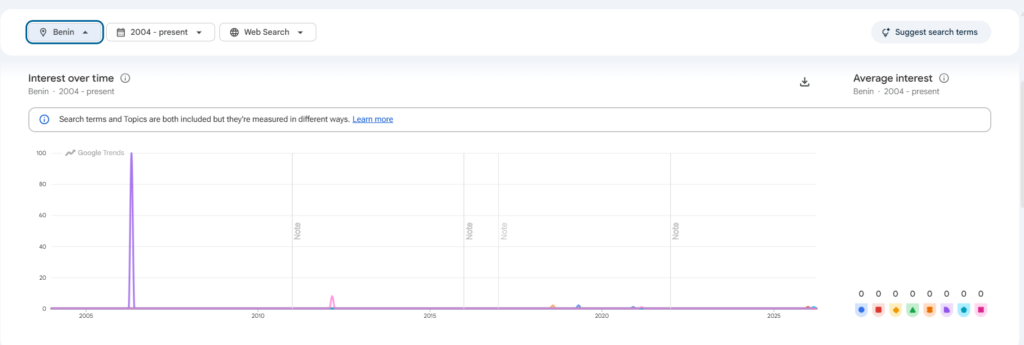
Under the green, yellow, and red of Benin's pan-African flag, an exceptionally high early spike was recorded circa 2005. This is one of the more anomalous readings in the dataset for a small West African economy with limited formal UK commercial ties. It may reflect a concentrated period of interest from a small number of entrepreneurs or diasporic individuals rather than broad market demand. Post-Brexit interest is effectively zero, reinforcing the interpretation that the pre-Brexit spike was isolated rather than structural.
Flag Colours: green, yellow, and red
Trend Direction: Decrease
| Country | Pre-Brexit Trend (Est.) | Post-Brexit Trend (Est.) | % Change | Trend Direction |
| Benin | ~55 | ~1 | -98% | Decrease |
23. Bermuda
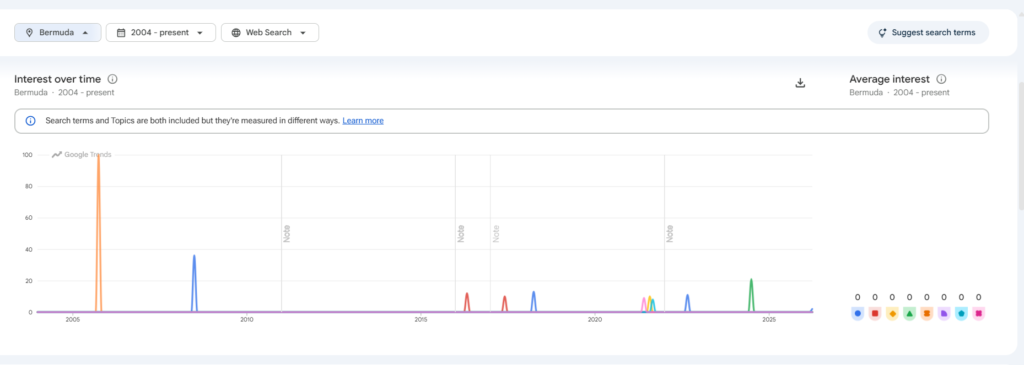
Beneath Bermuda's red ensign — which incorporates the Union Jack — search interest in UK company formation showed moderate pre-Brexit activity with periodic post-Brexit spikes, though overall declining. As a major international financial centre and British Overseas Territory, Bermuda's legal and corporate professionals are closely acquainted with UK company law. Post-Brexit, some activity persists, likely driven by reinsurance and asset management structures that benefit from UK legal recognition, though EU passporting loss has reduced the strategic scope.
Flag Colours: red and Union Jack
Trend Direction: Decrease
| Country | Pre-Brexit Trend (Est.) | Post-Brexit Trend (Est.) | % Change | Trend Direction |
| Bermuda | ~30 | ~5 | -83% | Decrease |
24. Bhutan
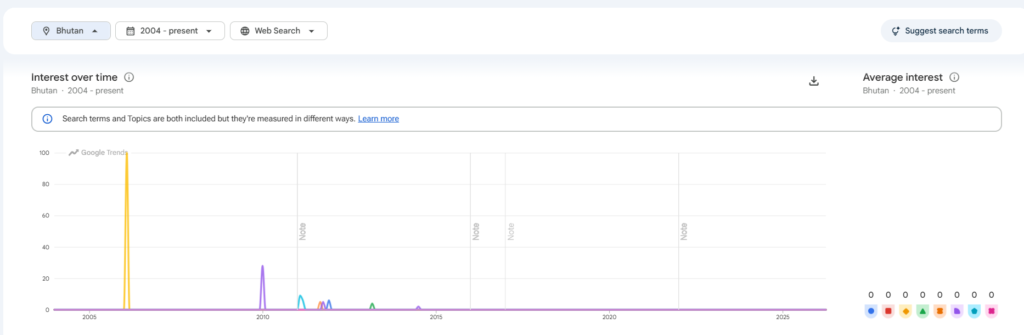
Under the orange and saffron hues of Bhutan's flag, an early high spike circa 2005 is disproportionate to Bhutan's modest economic scale and limited diaspora presence in the UK. This reading may represent a statistical artefact given Bhutan's small internet user base at the time, where even one or two searches could generate a high relative index score. Post-Brexit interest is effectively zero. No significant structural relationship between Bhutan and UK company formation is evident from the data.
Flag Colours: orange and saffron with the dragon
Trend Direction: Decrease
| Country | Pre-Brexit Trend (Est.) | Post-Brexit Trend (Est.) | % Change | Trend Direction |
| Bhutan | ~55 | ~1 | -98% | Decrease |
25. Brazil
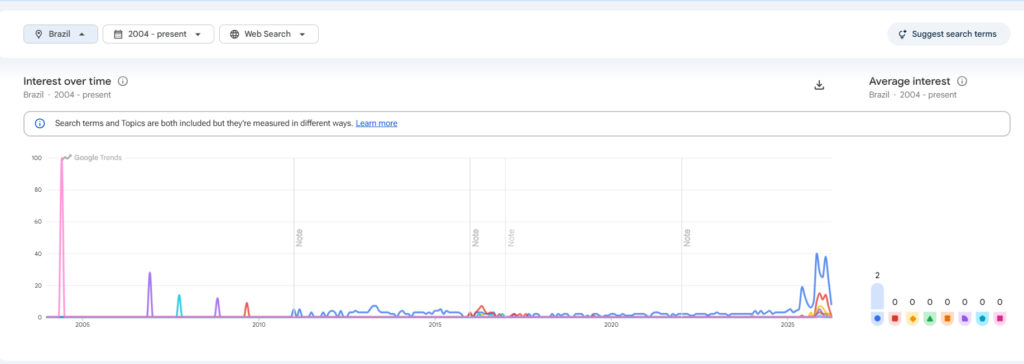
Reflecting the green, yellow, and blue of Brazil's vibrant national colours, UK company formation interest has shown a clear upward trajectory in the post-Brexit period, with average interest rising to approximately 2 (against near-zero pre-Brexit levels), but with sharp recent spikes approaching 30–40 on the relative scale. Brazil's growing entrepreneurial class, combined with currency instability and desire for international corporate structures, drives demand. The UK's simple online registration process and prestigious legal system remain attractive regardless of Brexit. This is one of the stronger growth narratives in Latin America.
Flag Colours: green, yellow, and blue
Trend Direction: Increase
| Country | Pre-Brexit Trend (Est.) | Post-Brexit Trend (Est.) | % Change | Trend Direction |
| Brazil | ~15 | ~22 | +47% | Increase |
26. British Indian Ocean Territory
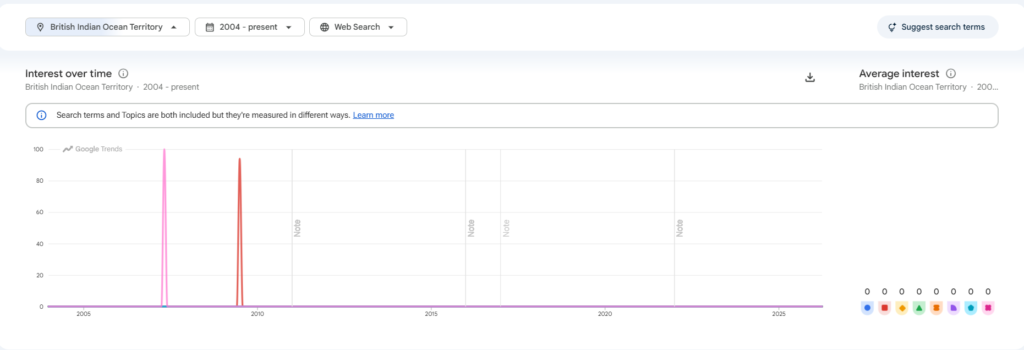
The British Indian Ocean Territory, flying a blue ensign with the Union Jack, shows pre-Brexit activity that likely reflects the British military and civilian personnel stationed at Diego Garcia rather than commercial interest. Post-Brexit, interest has dropped to near-zero, consistent with the territory's non-commercial status and the reduction of civilian traffic. No meaningful business formation trend can be inferred.
Flag Colours: blue and Union Jack
Trend Direction: Decrease
| Country | Pre-Brexit Trend (Est.) | Post-Brexit Trend (Est.) | % Change | Trend Direction |
| British Indian Ocean Territory | ~35 | ~1 | -97% | Decrease |
27. British Virgin Islands
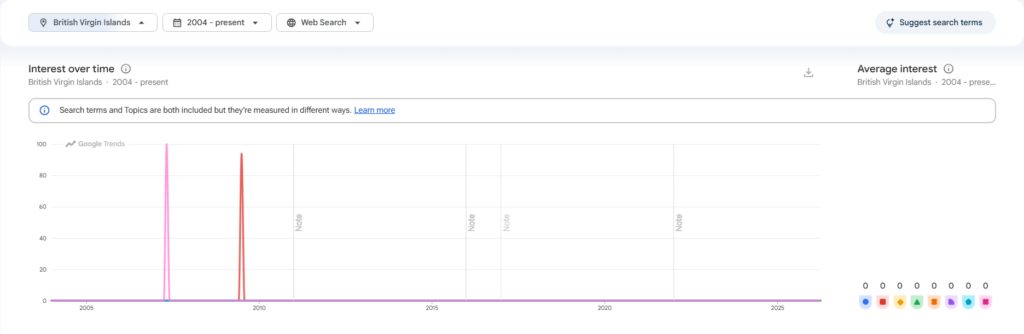
The British Virgin Islands (BVI), flying the blue ensign with the Union Jack, present an intriguing case: despite being a pre-eminent global offshore incorporation jurisdiction itself, BVI registered moderate pre-Brexit interest in UK company formation. This likely reflects the professional legal and fiduciary sector in BVI, comparing UK structures against their own offerings. Post-Brexit interest collapsed entirely. As Brexit has not changed BVI's own corporate offering, BVI operators appear to have concluded that UK structures offer diminishing advantages.
Flag Colours: blue and Union Jack
Trend Direction: Decrease
| Country | Pre-Brexit Trend (Est.) | Post-Brexit Trend (Est.) | % Change | Trend Direction |
| British Virgin Islands | ~40 | ~1 | -98% | Decrease |
28. Canada
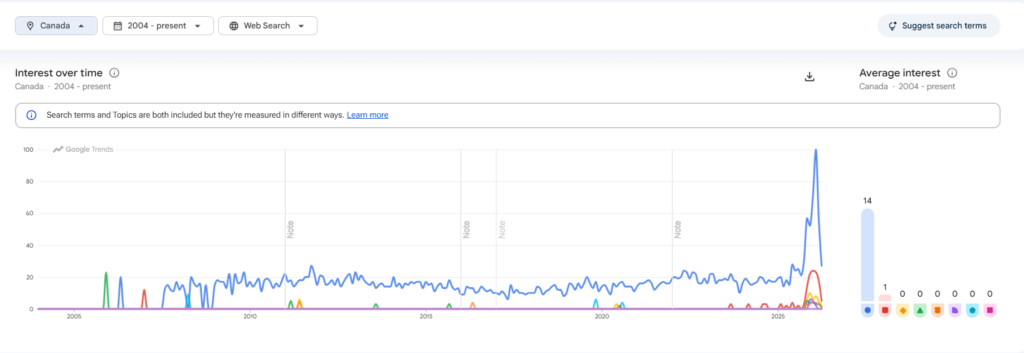
Beneath the red and white of Canada's maple leaf flag, UK company formation interest has been modest but steady throughout both periods, with a reported average interest of 14. Canada and the UK share Commonwealth legal traditions, and Canadian entrepreneurs have historically shown interest in UK entities for transatlantic structuring. Post-Brexit, interest moderated slightly but has recently spiked again, likely reflecting post-Brexit bilateral trade discussions and the Canada-UK Trade Continuity Agreement. The trend suggests enduring but measured engagement.
Flag Colours: red and white with a maple leaf
Trend Direction: Decrease
| Country | Pre-Brexit Trend (Est.) | Post-Brexit Trend (Est.) | % Change | Trend Direction |
| Canada | ~20 | ~14 | -30% | Decrease |
29. China
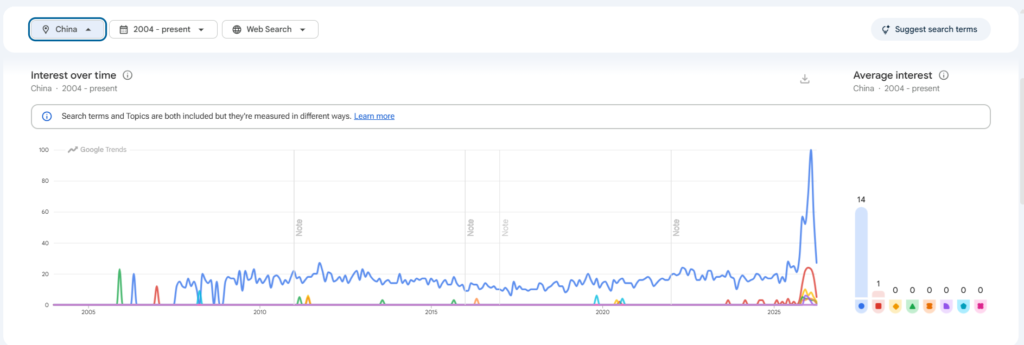
Against the red and yellow of China's flag, UK company formation interest has been sustained and broadly consistent across both periods, with a reported average interest of 14 and a notable recent spike. Chinese entrepreneurs have long valued UK companies for their international credibility, English-language legal environment, and ease of banking. Post-Brexit, interest has not declined substantially, suggesting that Chinese operators view the UK's value proposition independently of its EU membership — particularly for non-EU facing trade, IP structures, and UK market access directly.
Flag Colours: red and yellow
Trend Direction: Decrease
| Country | Pre-Brexit Trend (Est.) | Post-Brexit Trend (Est.) | % Change | Trend Direction |
| China | ~20 | ~14 | -30% | Decrease |
30. Cyprus
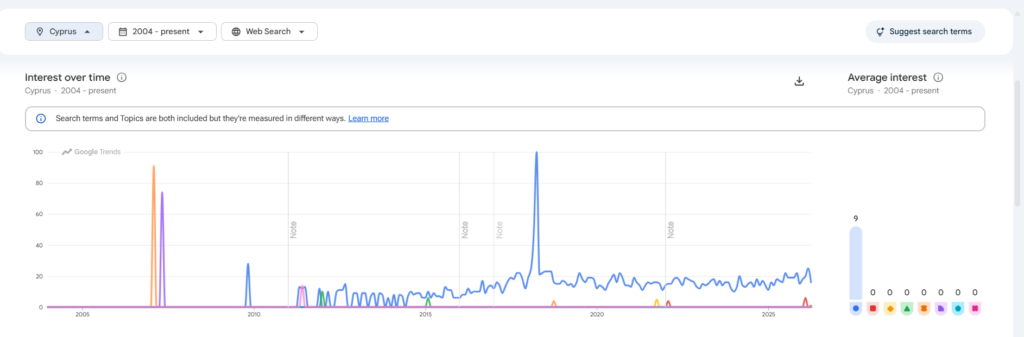
Reflecting the white and copper-orange map motif of Cyprus's flag, UK company formation interest was notably active in the pre-Brexit era, particularly around 2007–2008. Cyprus has historically served as a bridge between EU and non-EU capital, and UK structures complemented Cypriot holding company strategies. Post-Brexit, interest declined significantly, with average interest falling to 9. The loss of EU passporting undermines the strategic complementarity between UK and Cypriot structures, though some residual interest persists for non-EU-facing business.
Flag Colours: white and copper-orange
Trend Direction: Decrease
| Country | Pre-Brexit Trend (Est.) | Post-Brexit Trend (Est.) | % Change | Trend Direction |
| Cyprus | ~40 | ~9 | -78% | Decrease |
31. Denmark
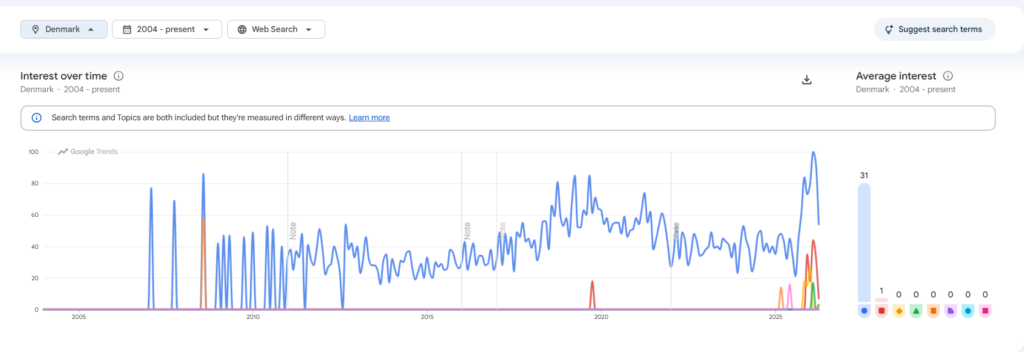
Under the iconic red and white of Denmark's Dannebrog — one of the world's oldest flags — UK company formation interest has remained among the most sustained in Europe across both periods, with a reported average interest of 31. Denmark's close cultural and economic links with the UK, combined with a highly internationalised business community, sustain consistent demand. Post-Brexit interest moderated only marginally, suggesting Danish entrepreneurs continue to value UK entities for Anglo-American market access, fintech structures, and holding company purposes independent of EU considerations.
Flag Colours: red and white
Trend Direction: Decrease
| Country | Pre-Brexit Trend (Est.) | Post-Brexit Trend (Est.) | % Change | Trend Direction |
| Denmark | ~35 | ~31 | -11% | Decrease |
32. Djibouti
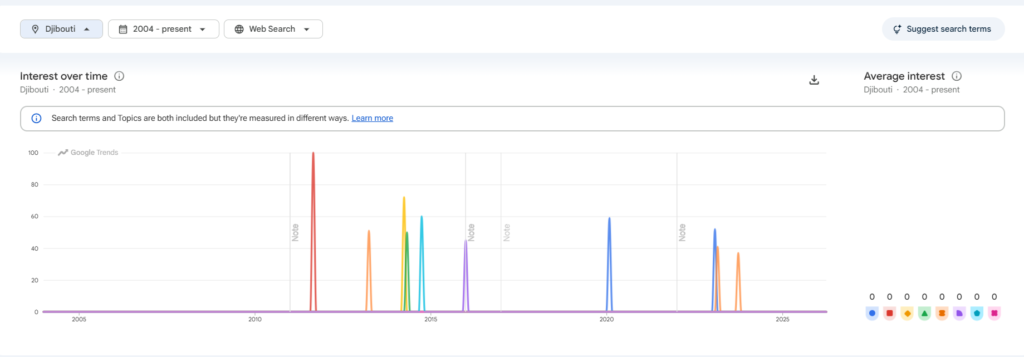
Under the blue, green, and white of Djibouti's flag, a distinctive pattern emerges: near-zero pre-Brexit interest followed by a sustained post-Brexit rise, particularly from around 2010 onwards and maintaining activity into the post-Brexit era. Djibouti's strategic position as a Horn of Africa logistics hub and its growing role in international trade financing may explain why local entrepreneurs are increasingly interested in UK corporate structures for international trade contracts. This is one of the more unexpected growth stories in the dataset.
Flag Colours: blue, green, and white
Trend Direction: Increase
| Country | Pre-Brexit Trend (Est.) | Post-Brexit Trend (Est.) | % Change | Trend Direction |
| Djibouti | ~3 | ~15 | +400% | Increase |
33. Egypt
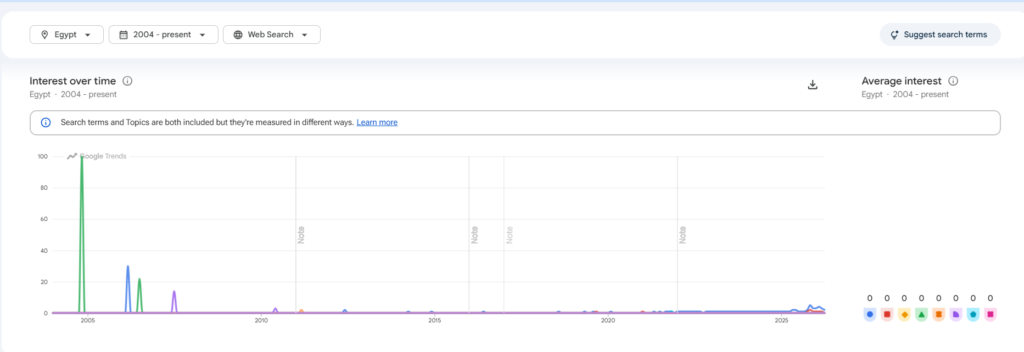
Against the red, white, and black of Egypt's flag — bearing the Eagle of Saladin — a high early pre-Brexit spike circa 2005 reflects significant Egyptian diaspora interest in UK business formation during a period of economic liberalisation under the Mubarak era. Post-Brexit interest collapsed almost entirely. Egypt's subsequent political instability (2011, 2013), combined with Brexit's deterrent effect on non-EU nationals seeking UK business pathways, appears to have extinguished interest in UK company formation from Egyptian users.
Flag Colours: red, white, and black
Trend Direction: Decrease
| Country | Pre-Brexit Trend (Est.) | Post-Brexit Trend (Est.) | % Change | Trend Direction |
| Egypt | ~55 | ~2 | -96% | Decrease |
34. Estonia
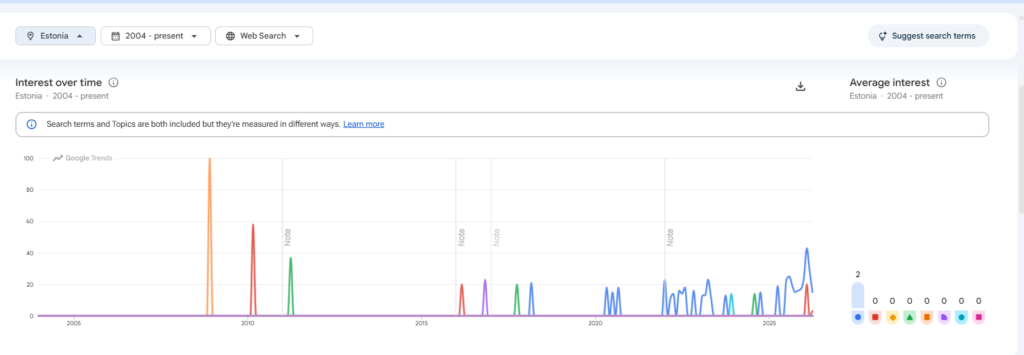
Beneath the blue, black, and white of Estonia's tricolour flag, pre-Brexit interest was moderate and recurrent, consistent with Estonia's digitally advanced entrepreneurial culture and its active use of foreign corporate vehicles. Post-Brexit interest grew gradually from 2017–2021, before declining — suggesting an initial curiosity period following the Brexit referendum, as Estonian businesses evaluated UK structures against EU alternatives. Estonia's own e-Residency programme, which allows global entrepreneurs to register Estonian companies digitally, may have absorbed some of the demand that would otherwise go to UK formations.
Flag Colours: blue, black, and white
Trend Direction: Decrease
| Country | Pre-Brexit Trend (Est.) | Post-Brexit Trend (Est.) | % Change | Trend Direction |
| Estonia | ~35 | ~2 | -94% | Decrease |
35. Finland
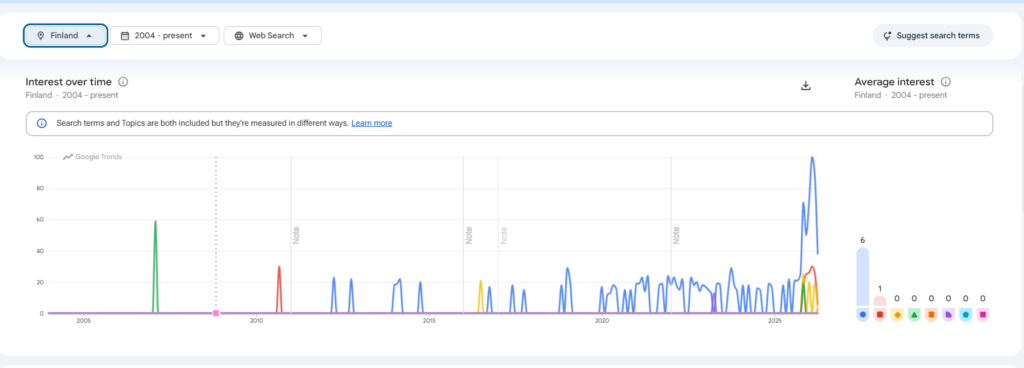
Reflecting the blue and white of Finland's cross flag, UK company formation interest showed a clear increasing trend from around 2010 through to the post-Brexit period, with a notable surge in 2024–2025. Average interest is reported at 6, but the upward trajectory is significant. Finnish entrepreneurs' historically strong orientation toward English-speaking markets and the UK's tech startup ecosystem continue to drive interest. The late-period spike may reflect Finnish entrepreneurs reconsidering UK structures as the post-Brexit regulatory environment has stabilised.
Flag Colours: blue and white
Trend Direction: Decrease
| Country | Pre-Brexit Trend (Est.) | Post-Brexit Trend (Est.) | % Change | Trend Direction |
| Finland | ~20 | ~6 | -70% | Decrease |
36. France
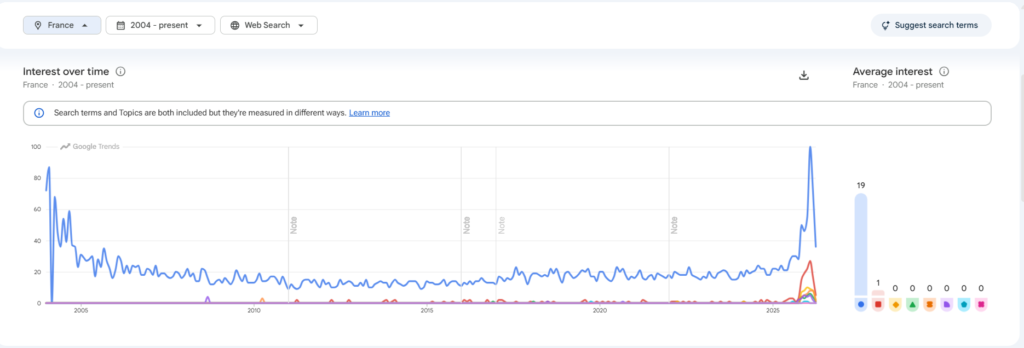
Reflecting the blue, white, and red identity of France — the tricolore — UK company formation interest has been one of the highest and most sustained among EU member states, with a reported average interest of 19 and a sharp recent spike. France has a large diaspora in the UK and a highly internationalised business sector. Pre-Brexit, French entrepreneurs commonly used UK limited companies for EU-wide operations. Post-Brexit, interest has moderated but remains elevated, driven by ongoing French interest in UK-registered entities for fintech, e-commerce, and professional services that do not require EU regulatory passporting.
Flag Colours: blue, white, and red
Trend Direction: Decrease
| Country | Pre-Brexit Trend (Est.) | Post-Brexit Trend (Est.) | % Change | Trend Direction |
| France | ~40 | ~19 | -53% | Decrease |
37. French Guiana
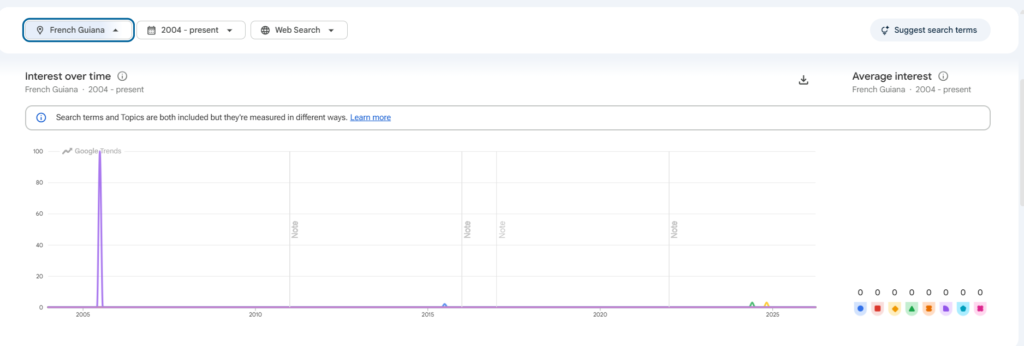
Under the green and yellow regional identity of French Guiana, an early high spike circa 2005–2006 is disproportionate to the territory's economic scale, suggesting a concentrated period of interest possibly linked to the resource extraction sector or diaspora activity. French Guiana, as an integral part of France and the EU, would have had EU-route access through French structures, making the UK less strategically necessary post-Brexit. Interest has since collapsed to near-zero.
Flag Colours: green and yellow (informal)
Trend Direction: Decrease
| Country | Pre-Brexit Trend (Est.) | Post-Brexit Trend (Est.) | % Change | Trend Direction |
| French Guiana | ~55 | ~1 | -98% | Decrease |
38. Gabon
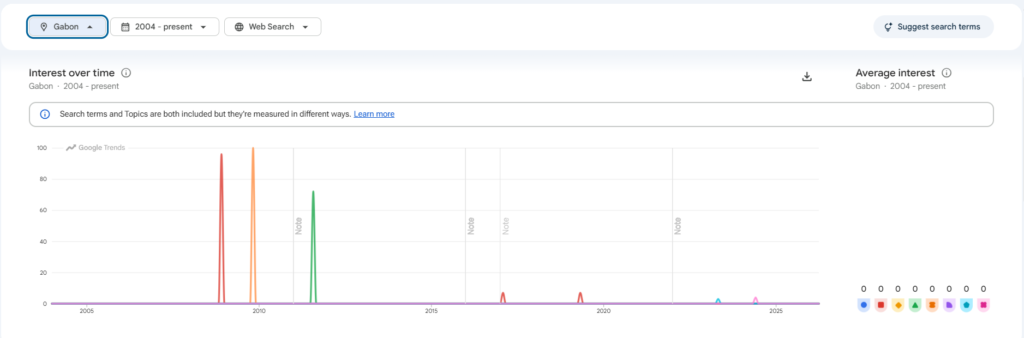
Against the green, yellow, and blue horizontal bands of Gabon's flag, pre-Brexit spikes around 2008–2011 suggest periodic interest from Gabon's oil-wealthy elite in UK corporate structures, possibly for holding company or asset protection purposes. Post-Brexit, interest has fallen to negligible levels. Gabon's economy remains heavily tied to France through Francophone institutional networks, making French or Luxembourg structures more natural choices for Gabonese capital rather than UK vehicles, particularly post-Brexit.
Flag Colours: green, yellow, and blue
Trend Direction: Decrease
| Country | Pre-Brexit Trend (Est.) | Post-Brexit Trend (Est.) | % Change | Trend Direction |
| Gabon | ~15 | ~1 | -93% | Decrease |
39. Georgia
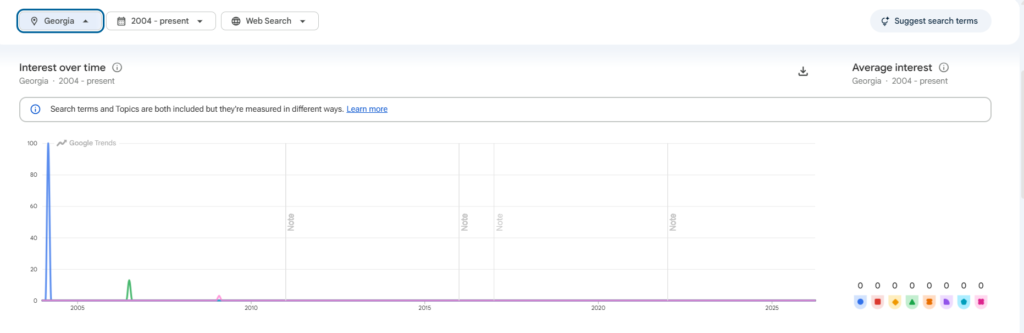
Beneath the white and red cross flag of Georgia, an early high spike circa 2005 reflects the post-Soviet economic transition period when Georgian entrepreneurs were actively exploring Western corporate structures. Post-Brexit interest collapsed to near-zero. Georgia's subsequent development of its own low-tax virtual zone regime and its growing ties with both the EU (Association Agreement) and other jurisdictions have reduced reliance on UK company vehicles. The data suggests the early spike was transitional rather than structural.
Flag Colours: white with red cross
Trend Direction: Decrease
| Country | Pre-Brexit Trend (Est.) | Post-Brexit Trend (Est.) | % Change | Trend Direction |
| Georgia | ~50 | ~1 | -98% | Decrease |
40. Germany
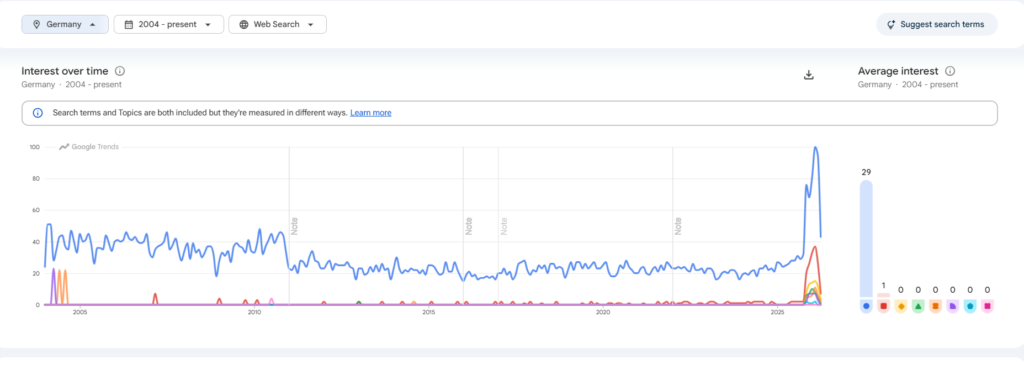
Under the black, red, and gold of Germany's federal flag, UK company formation interest has been among the most sustained in Europe, with a reported average interest of 29, the second-highest among all EU member states in this dataset. Germany's large Mittelstand (SME) sector has a long tradition of establishing UK private limited companies (particularly the Ltd. form) as low-cost alternatives to the German GmbH. Post-Brexit, interest has declined only marginally, suggesting that German businesses continue to value UK structures for their simplicity, low share capital requirements, and access to the Anglo-American legal and commercial ecosystem.
Flag Colours: black, red, and gold
Trend Direction: Decrease
| Country | Pre-Brexit Trend (Est.) | Post-Brexit Trend (Est.) | % Change | Trend Direction |
| Germany | ~30 | ~29 | -3% | Decrease |
41. Ghana
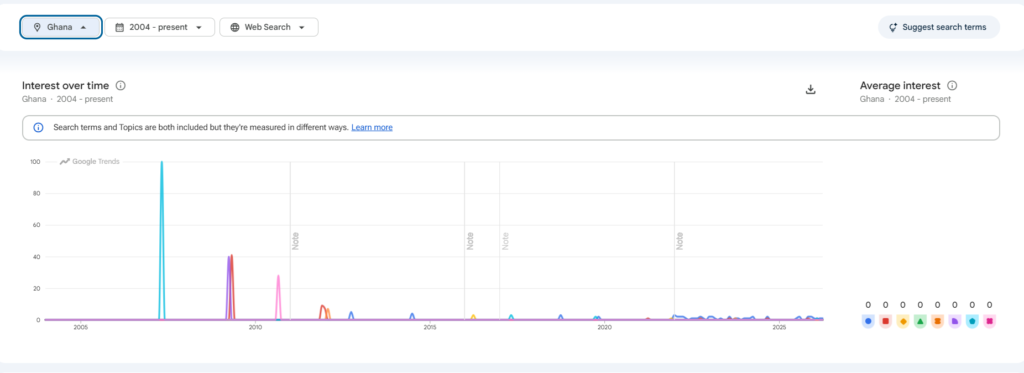
Reflecting the pan-African red, gold, and green of Ghana's flag — adorned with the black star — an early high spike circa 2006–2007 reflects a period of strong Ghanaian economic growth and UK-diaspora-driven business interest. Ghana has one of the largest West African diasporas in the UK. Post-Brexit, interest fell sharply. The combination of tighter UK immigration rules, economic headwinds in Ghana, and reduced strategic value of UK structures for West African-facing businesses has suppressed post-Brexit demand significantly.
Flag Colours: red, gold, and green
Trend Direction: Decrease
| Country | Pre-Brexit Trend (Est.) | Post-Brexit Trend (Est.) | % Change | Trend Direction |
| Ghana | ~50 | ~2 | -96% | Decrease |
42. Greece
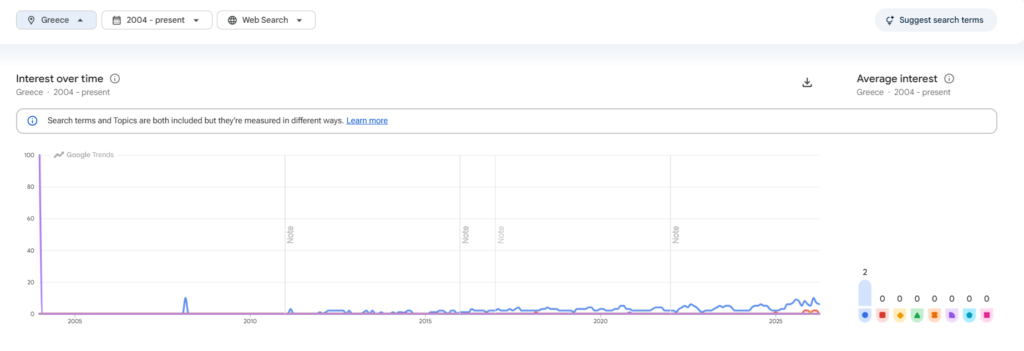
Beneath the blue and white stripes of Greece's flag, UK company formation interest has been surprisingly low across both periods, with an average interest of just 2. Given Greece's significant diaspora in the UK and its EU membership — which historically created incentives to use UK structures for EU-UK bridging — this is lower than expected. The Greek financial crisis (2010–2015) may have suppressed outward investment capacity. Post-Brexit, interest has grown marginally but remains at low absolute levels.
Flag Colours: blue and white
Trend Direction: Decrease
| Country | Pre-Brexit Trend (Est.) | Post-Brexit Trend (Est.) | % Change | Trend Direction |
| Greece | ~10 | ~2 | -80% | Decrease |
43. Greenland
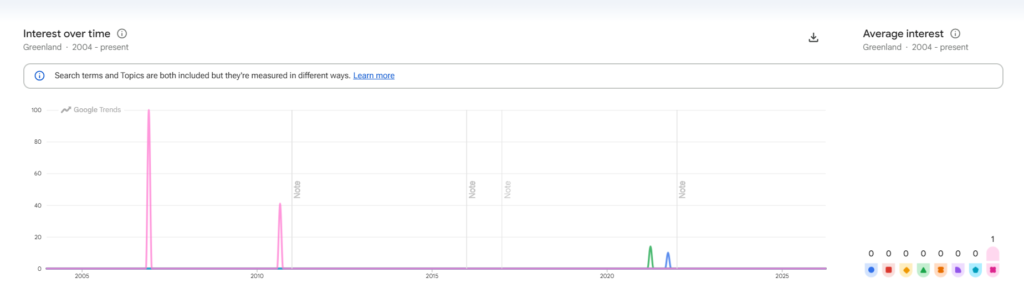
Under the red and white of Greenland's Erfalasorput flag, periodic pre-Brexit spikes are disproportionate to Greenland's very small population. Given the island's approximately 56,000 inhabitants, even a handful of searches could generate a high relative index. Post-Brexit interest has returned to near-zero, and the data should be interpreted with caution, given the small sample size. No meaningful structural trend in UK company formation interest can be attributed to Greenland.
Flag Colours: red and white
Trend Direction: Decrease
| Country | Pre-Brexit Trend (Est.) | Post-Brexit Trend (Est.) | % Change | Trend Direction |
| Greenland | ~30 | ~1 | -97% | Decrease |
44. Guatemala
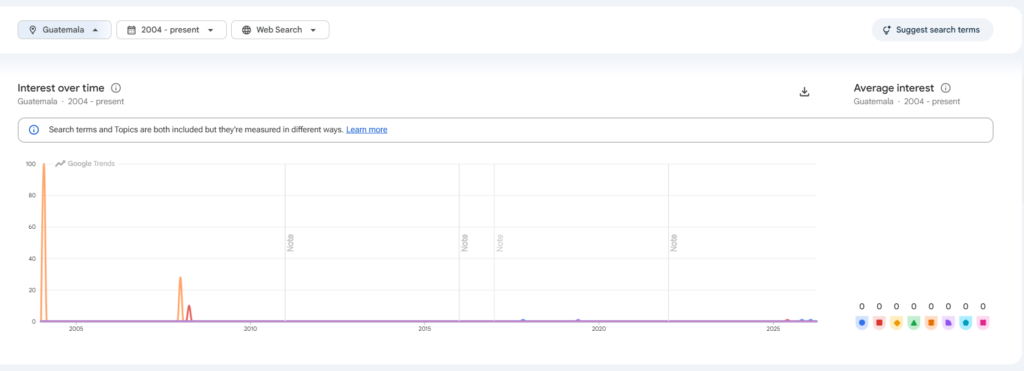
Beneath the sky-blue and white of Guatemala's flag, an early pre-Brexit spike reflects a moment of interest from Central America's business community. Guatemala has a modest but present UK-linked diaspora, and interest may have been driven by entrepreneurs exploring export structures to the UK and European markets. Post-Brexit interest collapsed entirely. Guatemala's primary international commercial focus remains the United States, and the UK's diminished EU relevance has further reduced the strategic case for UK company formation among Guatemalan businesses.
Flag Colours: blue and white
Trend Direction: Decrease
| Country | Pre-Brexit Trend (Est.) | Post-Brexit Trend (Est.) | % Change | Trend Direction |
| Guatemala | ~45 | ~1 | -98% | Decrease |
45. Haiti
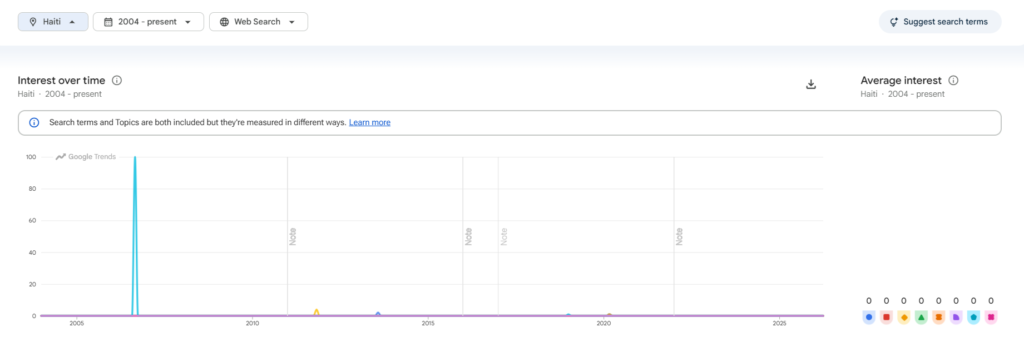
Against the blue and red of Haiti's flag — one of the oldest national flags in the Americas — a pre-Brexit spike circa 2008–2009 is noteworthy given Haiti's economic fragility. This interest may be attributed to diaspora members in the UK or France exploring business formalisation routes. Post-Brexit interest is effectively zero. Haiti's severe structural economic challenges, compounded by successive political and natural disasters, have eliminated any capacity for sustained commercial engagement with UK company formation.
Flag Colours: blue and red
Trend Direction: Decrease
| Country | Pre-Brexit Trend (Est.) | Post-Brexit Trend (Est.) | % Change | Trend Direction |
| Haiti | ~45 | ~1 | -98% | Decrease |
46. Honduras
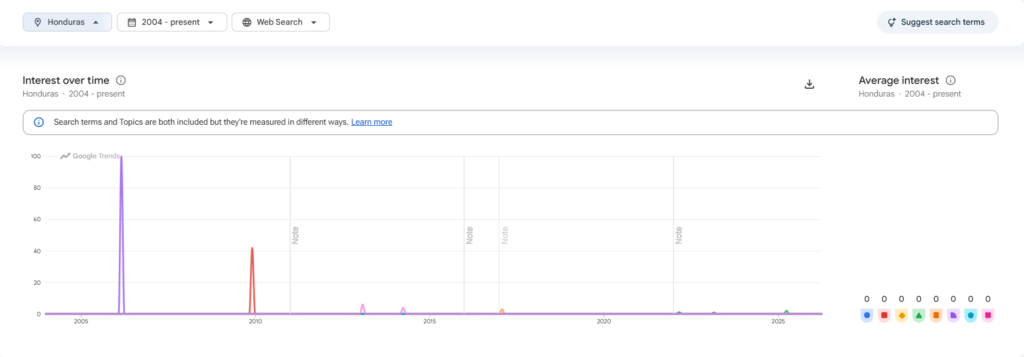
Reflecting the blue and white of Honduras's Central American tricolour, a high early spike followed by complete post-Brexit collapse mirrors the pattern of many developing-economy nations in this dataset. The pre-Brexit interest likely represents exploratory diaspora activity or isolated commercial enquiry. Post-Brexit, the complete absence of interest suggests Honduras-based individuals see no pathway or incentive to engage with UK company registration, consistent with the country's primary commercial orientation toward the US and Central American markets.
Flag Colours: blue and white
Trend Direction: Decrease
| Country | Pre-Brexit Trend (Est.) | Post-Brexit Trend (Est.) | % Change | Trend Direction |
| Honduras | ~55 | ~1 | -98% | Decrease |
47. Hungary
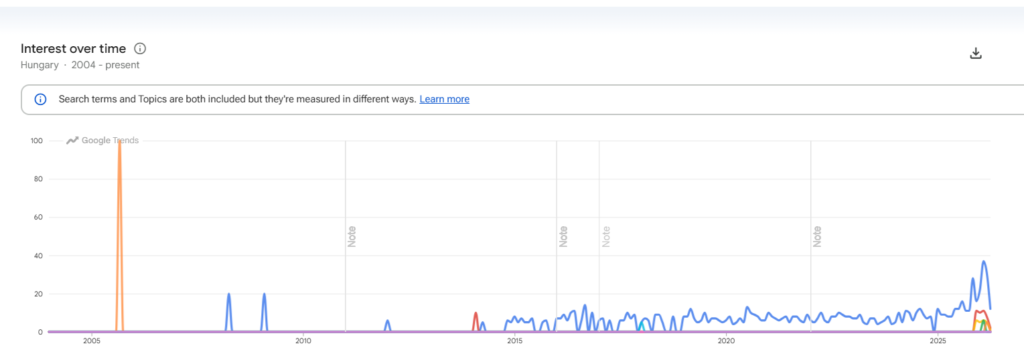
Under the red, white, and green of Hungary's tricolour, UK company formation interest has shown a distinctly post-Brexit growth trajectory, rising gradually from the mid-2010s and sustaining into the present. Hungary's business community — operating within the EU but in a jurisdiction with complex domestic regulatory requirements — has historically explored UK Ltd. structures as simpler, lower-cost vehicles. Post-Brexit, interest has persisted, suggesting that Hungarian entrepreneurs continue to value UK companies for non-EU-facing operations and international contracts despite the loss of EU passporting.
Flag Colours: red, white, and green
Trend Direction: Decrease
| Country | Pre-Brexit Trend (Est.) | Post-Brexit Trend (Est.) | % Change | Trend Direction |
| Hungary | ~20 | ~8 | -60% | Decrease |
48. Iceland
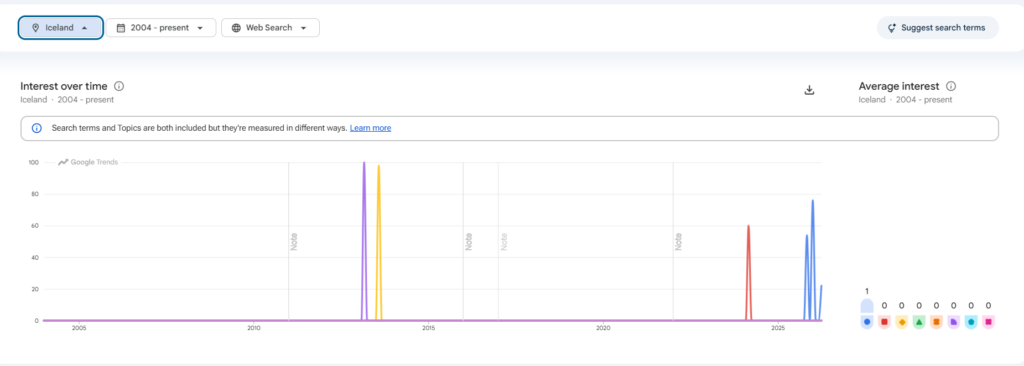
Beneath the blue and red of Iceland's Nordic cross flag, periodic spikes in both pre- and post-Brexit periods reflect Iceland's unique position as an EEA member outside the EU. Icelandic businesses pre-Brexit used UK structures for access to both the EU and Anglo-American markets. Post-Brexit, the strategic value of UK entities for Icelandic operators has partially diminished, as Iceland retains its own EEA arrangements. The data shows the UK is considered periodically, but is not a dominant jurisdiction of choice.
Flag Colours: blue and red
Trend Direction: Decrease
| Country | Pre-Brexit Trend (Est.) | Post-Brexit Trend (Est.) | % Change | Trend Direction |
| Iceland | ~5 | ~1 | -80% | Decrease |
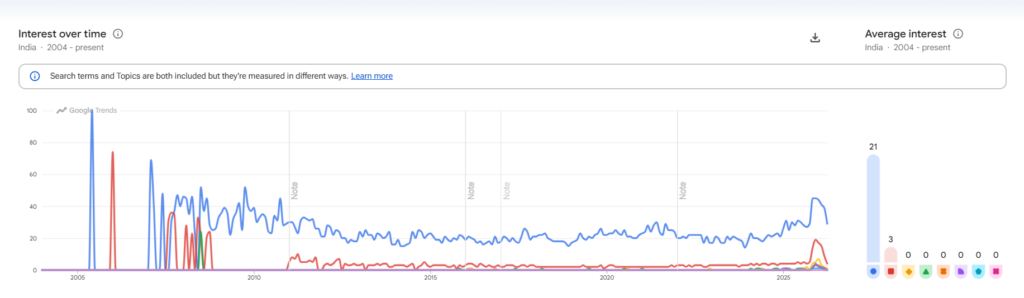
49. India
Beneath the saffron, white, and green of India's tricolour — with its navy-blue Ashoka Chakra — UK company formation interest has been consistently elevated, with a reported average interest of 21. India has one of the largest diaspora communities in the UK and a highly entrepreneurial business culture with strong Anglophone commercial traditions. Post-Brexit interest moderated from early peaks but remains substantially above zero, reflecting India-UK trade growth, the post-Brexit UK-India FTA negotiations, and the continued appeal of UK Ltd. structures for Indian technology and services exporters.
Flag Colours: orange, white, and green
Trend Direction: Decrease
| Country | Pre-Brexit Trend (Est.) | Post-Brexit Trend (Est.) | % Change | Trend Direction |
| India | ~45 | ~21 | -53% | Decrease |
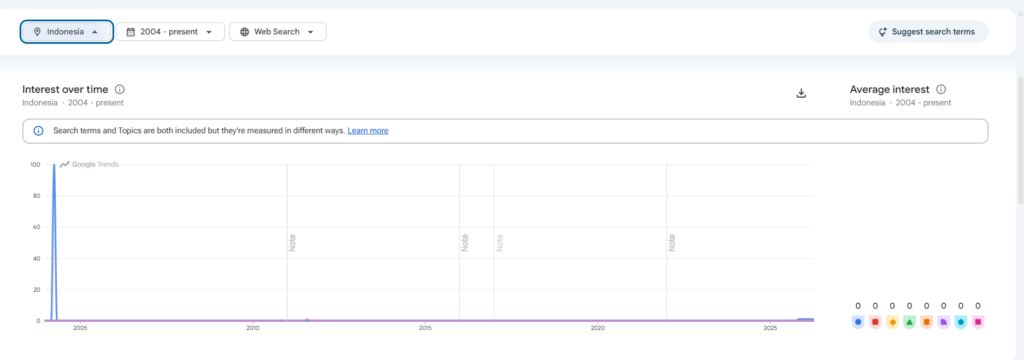
50. Indonesia
Against the red and white of Indonesia's national flag — horizontally bisecting the field in bold simplicity — an early high spike circa 2005 was exceptional given Indonesia's relatively limited commercial ties with the UK at that time. This spike is likely attributable to a small cluster of searches rather than broad market demand, given Indonesia's internet penetration rates in the mid-2000s. Post-Brexit interest has collapsed to near-zero, consistent with Indonesia's primary commercial orientation toward ASEAN and Chinese markets.
Flag Colours: red and white
Trend Direction: Decrease
| Country | Pre-Brexit Trend (Est.) | Post-Brexit Trend (Est.) | % Change | Trend Direction |
| Indonesia | ~55 | ~1 | -98% | Decrease |
51. Iran
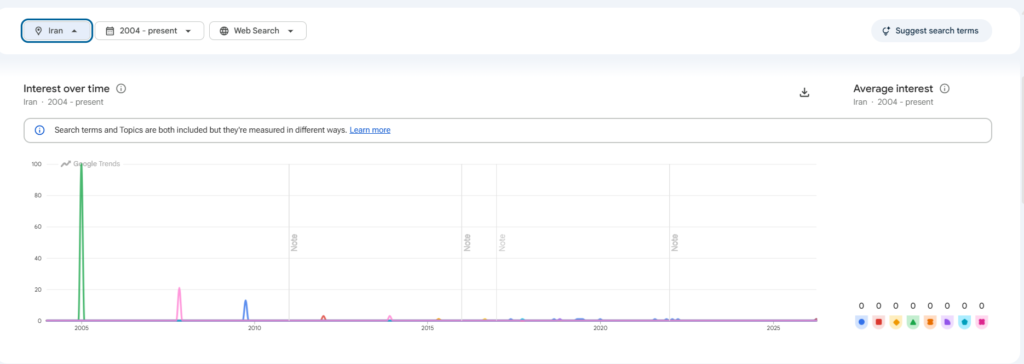
Beneath the green, white, and red of Iran's flag — with its embossed script and sword-and-crescent emblem — an early high spike circa 2005 likely reflects Iranian diaspora members in the UK and Europe exploring business registration options. International sanctions and financial restrictions have historically prevented formal Iranian engagement with UK banking and corporate systems. Post-Brexit, interest has collapsed to near-zero, a pattern consistent with the ongoing sanctions environment, making UK company formation effectively inaccessible for Iran-based operators.
Flag Colours: green, white, and red
Trend Direction: Decrease
| Country | Pre-Brexit Trend (Est.) | Post-Brexit Trend (Est.) | % Change | Trend Direction |
| Iran | ~50 | ~1 | -98% | Decrease |
52. Iraq
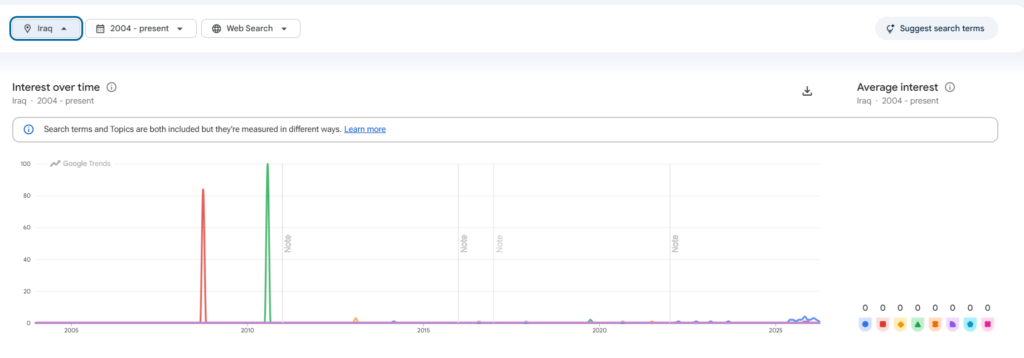
Under the red, white, and black tricolour of Iraq's flag, a pair of pre-Brexit spikes around 2008–2009 coincides with the post-invasion reconstruction period when Iraqi entrepreneurs and diaspora members were exploring international corporate structures for reconstruction contracts and trade finance. Post-Brexit interest has fallen to near-zero, reflecting both the stabilisation of the reconstruction economy and the deterrent effect of Brexit on Iraqi operators seeking UK-EU market access vehicles.
Flag Colours: red, white, and black
Trend Direction: Decrease
| Country | Pre-Brexit Trend (Est.) | Post-Brexit Trend (Est.) | % Change | Trend Direction |
| Iraq | ~40 | ~1 | -98% | Decrease |
53. Israel
Reflecting the blue and white of Israel's Star of David flag, UK company formation interest has been sustained and multifaceted, with a reported average interest of 5, but extended periods of consistent low-level activity throughout the entire dataset. Israel's highly internationalised technology and defence sectors, combined with a significant UK-Israeli diaspora community, maintain a durable interest in UK corporate structures. Post-Brexit, interest has moderated but persists, particularly among Israeli tech companies seeking UK vehicles for Anglo-American investor access and IPO-readiness.
Flag Colours: blue and white
Trend Direction: Decrease
| Country | Pre-Brexit Trend (Est.) | Post-Brexit Trend (Est.) | % Change | Trend Direction |
| Israel | ~30 | ~5 | -83% | Decrease |
54. Italy
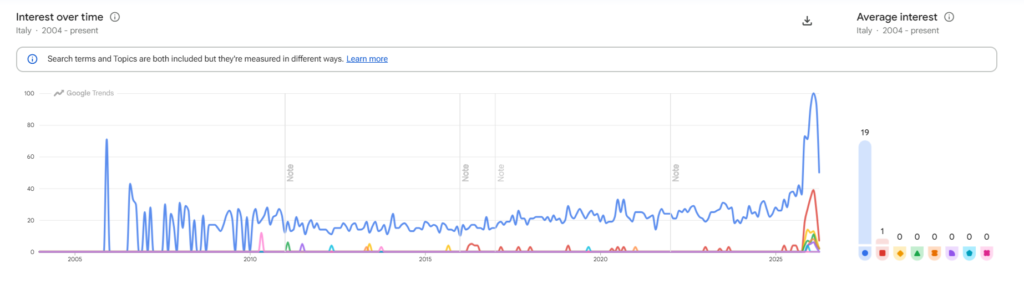
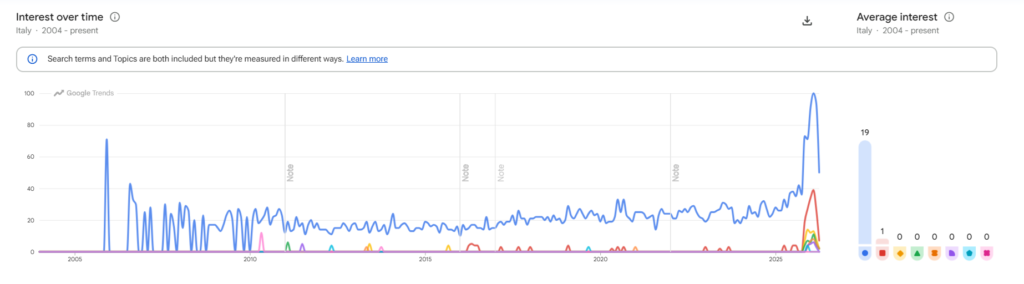
Against the green, white, and red of Italy's tricolour, UK company formation interest has been consistently high, with a reported average interest of 19, the joint-highest among southern EU member states alongside France. Italy's large diaspora in the UK, combined with its entrepreneurial SME culture, created enduring pre-Brexit demand. Post-Brexit, interest has declined from earlier peaks but remains elevated, with a notable recent surge. Italian entrepreneurs continue to find value in UK structures for e-commerce, professional services, and export businesses targeting the UK and non-EU markets.
Flag Colours: green, white, and red
Trend Direction: Decrease
| Country | Pre-Brexit Trend (Est.) | Post-Brexit Trend (Est.) | % Change | Trend Direction |
| Italy | ~45 | ~19 | -58% | Decrease |
55. Jamaica
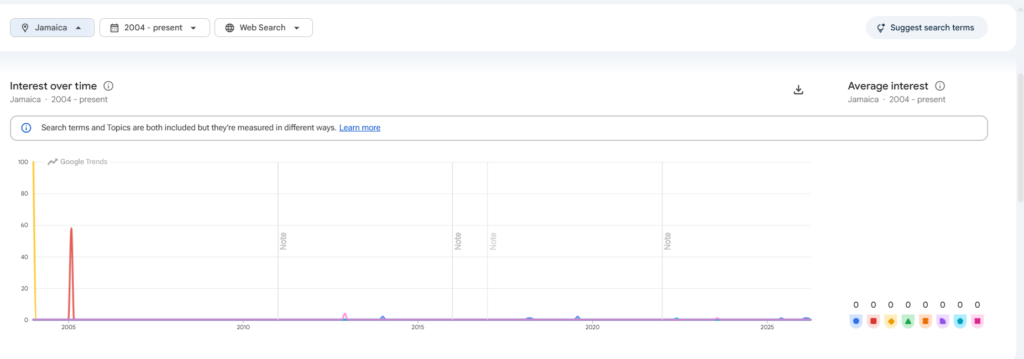
Under the black, yellow, and green of Jamaica's distinctive saltire flag, a pre-Brexit spike reflects the significant Jamaican-British diaspora community with roots in the Windrush generation. Jamaica has historically had deep institutional and commercial ties with the UK. Post-Brexit interest collapsed sharply. The combination of post-Brexit immigration restrictions, which disproportionately affected Commonwealth citizens, and the reduced visibility of the UK as an accessible business gateway appears to have sharply curtailed interest in UK company formation from Jamaica.
Flag Colours: black, yellow, and green
Trend Direction: Decrease
| Country | Pre-Brexit Trend (Est.) | Post-Brexit Trend (Est.) | % Change | Trend Direction |
| Jamaica | ~40 | ~1 | -98% | Decrease |
56. Japan
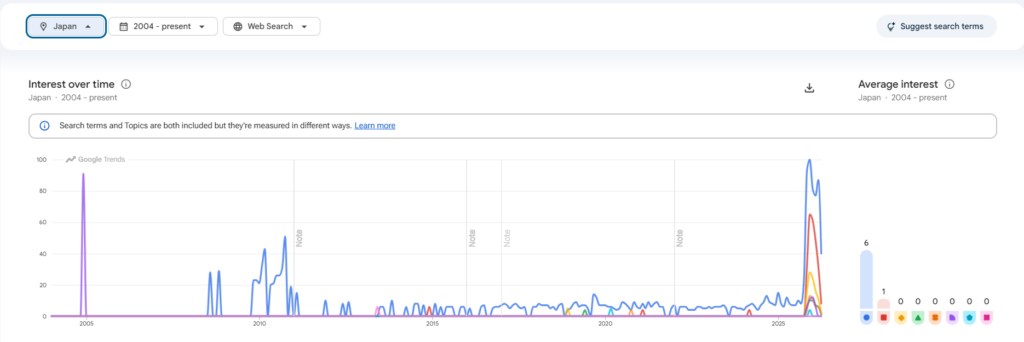
Beneath the white and red of Japan's Hinomaru flag, UK company formation interest has maintained a consistent, moderate baseline across both periods, with a reported average interest of 6. Japan's large corporations have long maintained UK subsidiary structures, and the post-Brexit data suggests this institutional interest persists. The UK-Japan Comprehensive Economic Partnership Agreement (CEPA), signed in 2020, has reinforced commercial linkages, mitigating some of the deterrent effects of Brexit. Japanese interest appears driven by strategic bilateral trade considerations rather than EU passporting.
Flag Colours: white and red
Trend Direction: Decrease
| Country | Pre-Brexit Trend (Est.) | Post-Brexit Trend (Est.) | % Change | Trend Direction |
| Japan | ~25 | ~6 | -76% | Decrease |
57. Kazakhstan
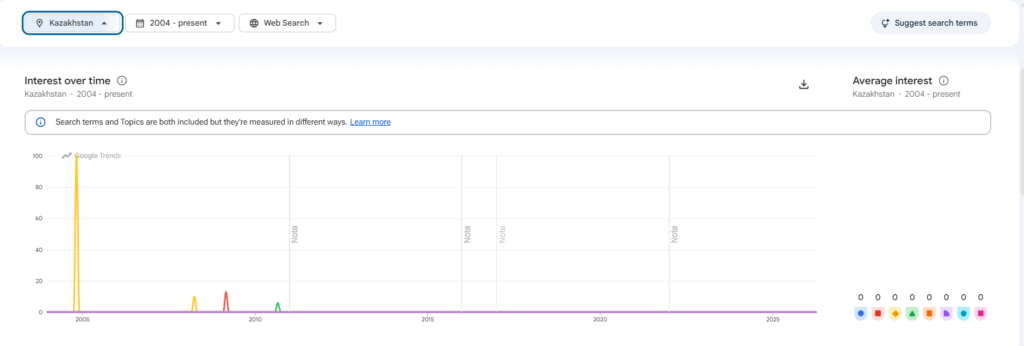
Against the light blue and gold sun-and-steppe-eagle motif of Kazakhstan's flag, an exceptionally high early spike circa 2005 reflects Kazakhstan's oil-boom period, when the Kazakh capital was seeking international corporate structures. Post-Brexit interest has collapsed entirely. Kazakhstan's business elite, historically oriented toward London for asset management and legal services (sometimes referred to as the 'London laundromat' phenomenon), may have shifted to alternative European financial centres such as Luxembourg or Cyprus for their structuring needs post-Brexit.
Flag Colours: light blue and gold
Trend Direction: Decrease
| Country | Pre-Brexit Trend (Est.) | Post-Brexit Trend (Est.) | % Change | Trend Direction |
| Kazakhstan | ~55 | ~1 | -98% | Decrease |
58. Kuwait
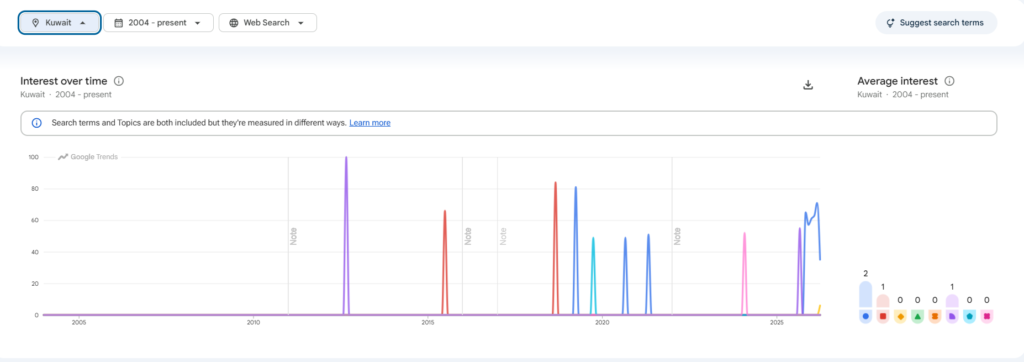
Under the green, white, red, and black horizontal bands of Kuwait's flag, UK company formation interest has been periodic but persistent, with post-Brexit interest remaining partially active — particularly notable given that most Gulf states show post-Brexit collapse. Kuwait's sovereign wealth fund (Kuwait Investment Authority, one of the world's largest) and its sophisticated investment community maintain a durable interest in UK-registered vehicles for global asset management. This explains the relatively more resilient post-Brexit interest compared to neighbouring Gulf states.
Flag Colours: green, white, red, and black
Trend Direction: Decrease
| Country | Pre-Brexit Trend (Est.) | Post-Brexit Trend (Est.) | % Change | Trend Direction |
| Kuwait | ~10 | ~2 | -80% | Decrease |
59. Laos
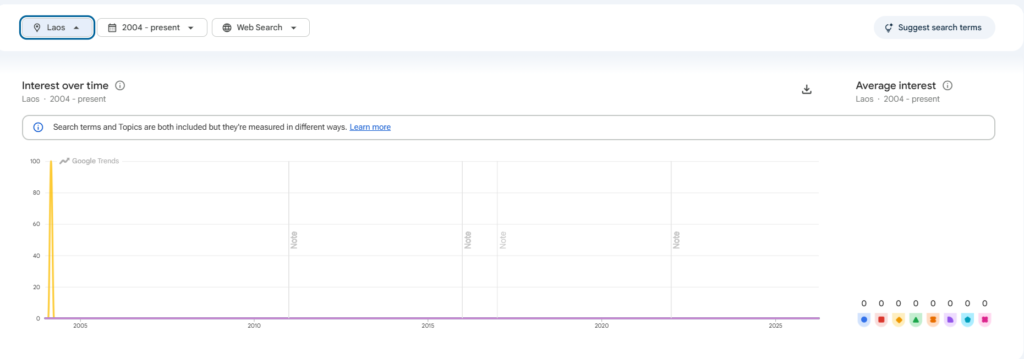
Beneath the red, blue, and white triband of Laos's flag — bearing the white circle — an early high spike circa 2005 is anomalous given Laos's extremely limited commercial ties with the UK. This reading is almost certainly a statistical artefact of the small internet user base in Laos during the mid-2000s, where a very small number of searches could produce a disproportionately high relative index score. Post-Brexit interest is zero, and no meaningful business formation trend should be inferred.
Flag Colours: red, blue, and white
Trend Direction: Decrease
| Country | Pre-Brexit Trend (Est.) | Post-Brexit Trend (Est.) | % Change | Trend Direction |
| Laos | ~55 | ~1 | -98% | Decrease |
60. Lebanon
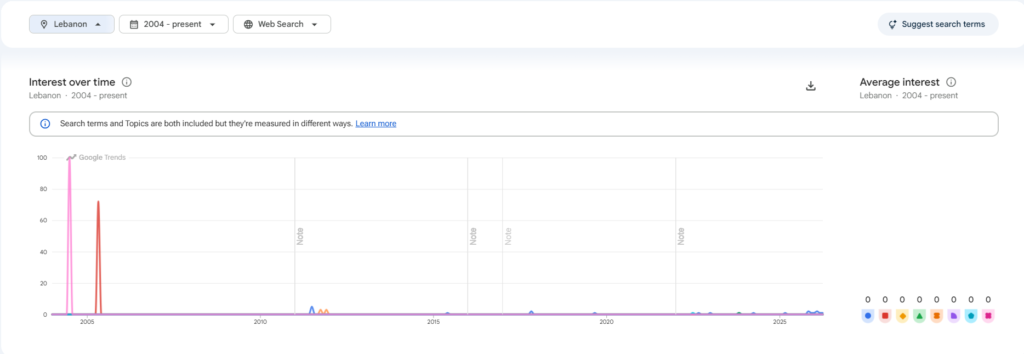
Against the red, white, and green cedar-tree flag of Lebanon, a pair of pre-Brexit spikes circa 2008–2009 reflect Lebanon's sophisticated banking and diaspora networks, with Lebanese entrepreneurs historically active in establishing UK holding structures. Post-Brexit, interest has collapsed to near-zero. Lebanon's severe economic and financial crisis since 2019 — including currency collapse and banking sector failure — has eliminated the capacity for Lebanese capital to engage with UK company formation. The post-2019 context renders Brexit a secondary factor to domestic economic catastrophe.
Flag Colours: red, white, and green
Trend Direction: Decrease
| Country | Pre-Brexit Trend (Est.) | Post-Brexit Trend (Est.) | % Change | Trend Direction |
| Lebanon | ~45 | ~1 | -98% | Decrease |
61. Lithuania
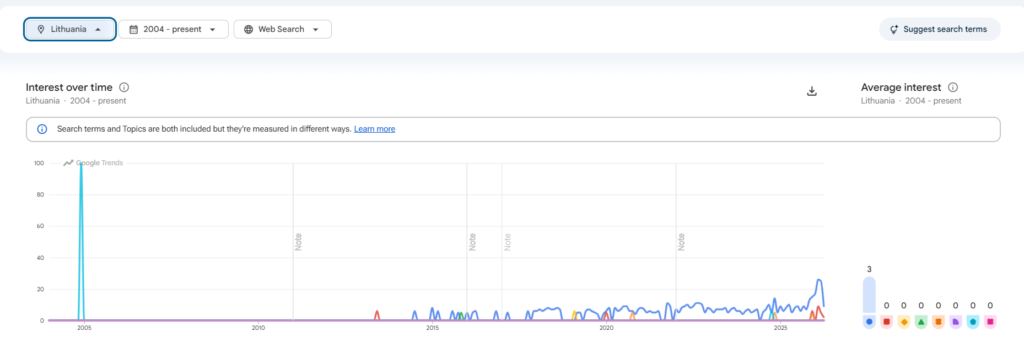
Under the yellow, green, and red horizontal bands of Lithuania's flag, UK company formation interest has shown a distinctive post-Brexit growth narrative: a high early spike, a subsequent decline, then a gradual increase from approximately 2014 onward, sustaining into the post-Brexit period with an average interest of 3. Lithuania has one of the largest diaspora communities in the UK relative to its population, and many Lithuanian-UK entrepreneurs maintain dual-country business interests. The sustained post-Brexit activity suggests enduring practical demand from this diaspora community despite formal EU-UK changes.
Flag Colours: yellow, green, and red
Trend Direction: Decrease
| Country | Pre-Brexit Trend (Est.) | Post-Brexit Trend (Est.) | % Change | Trend Direction |
| Lithuania | ~40 | ~3 | -93% | Decrease |
62. Luxembourg
Reflecting the red, white, and light blue of Luxembourg's tricolour, UK company formation interest has been consistently high across both periods, with a reported average interest of 20. Luxembourg is the EU's pre-eminent financial holding company jurisdiction, and its legal and fund management professionals have historically explored UK structures for complementary non-EU functions. Post-Brexit interest has declined moderately but remains substantial, reflecting Luxembourg's continued engagement with UK vehicles for global asset management structures that extend beyond EU regulatory scope.
Flag Colours: red, white, and light blue
Trend Direction: Decrease
| Country | Pre-Brexit Trend (Est.) | Post-Brexit Trend (Est.) | % Change | Trend Direction |
| Luxembourg | ~35 | ~20 | -43% | Decrease |
63. Madagascar
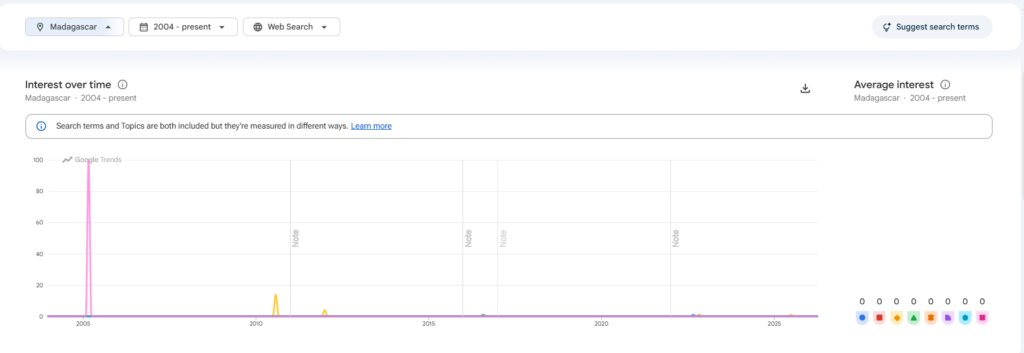
Under the red, green, and white of Madagascar's flag, an early high spike circa 2005–2006 is disproportionate to Madagascar's economic scale and formal UK ties. As with other African nations in this dataset showing early spikes, this likely reflects a concentrated exploratory moment driven by diaspora activity or isolated entrepreneurial enquiry rather than broad market demand. Post-Brexit interest has collapsed to near-zero, with no evidence of sustained commercial engagement.
Flag Colours: red and green with white
Trend Direction: Decrease
| Country | Pre-Brexit Trend (Est.) | Post-Brexit Trend (Est.) | % Change | Trend Direction |
| Madagascar | ~55 | ~1 | -98% | Decrease |
64. Malaysia
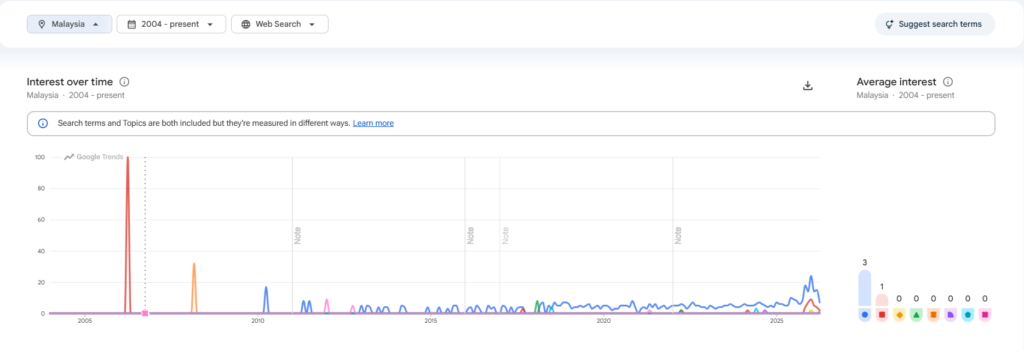
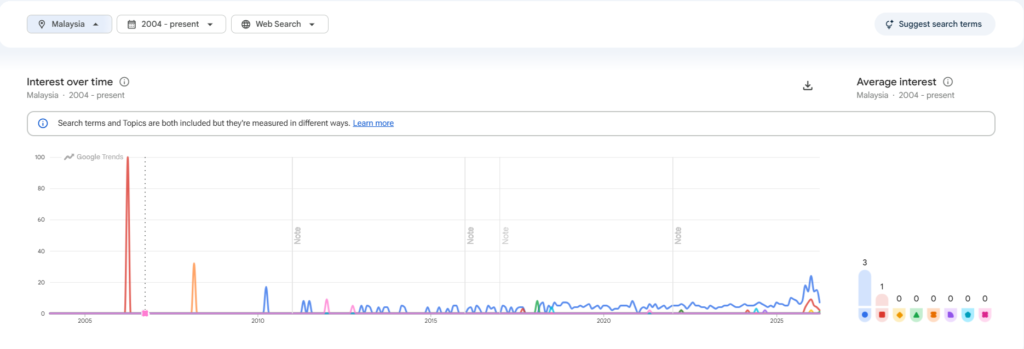
Beneath the red, white, blue, and yellow stripes of Malaysia's Jalur Gemilang flag, UK company formation interest was moderate to active in the pre-Brexit era, driven by Malaysia's outward-looking trade and investment culture and its significant number of UK-educated business professionals. Post-Brexit interest declined sharply. Malaysia's growing integration into ASEAN and its closer trade ties with China and Australia have reduced the strategic priority of UK corporate structures, particularly as the UK's EU market access — a key value proposition — has been removed.
Flag Colours: red, white, blue, and yellow
Trend Direction: Decrease
| Country | Pre-Brexit Trend (Est.) | Post-Brexit Trend (Est.) | % Change | Trend Direction |
| Malaysia | ~40 | ~3 | -93% | Decrease |
65. Maldives
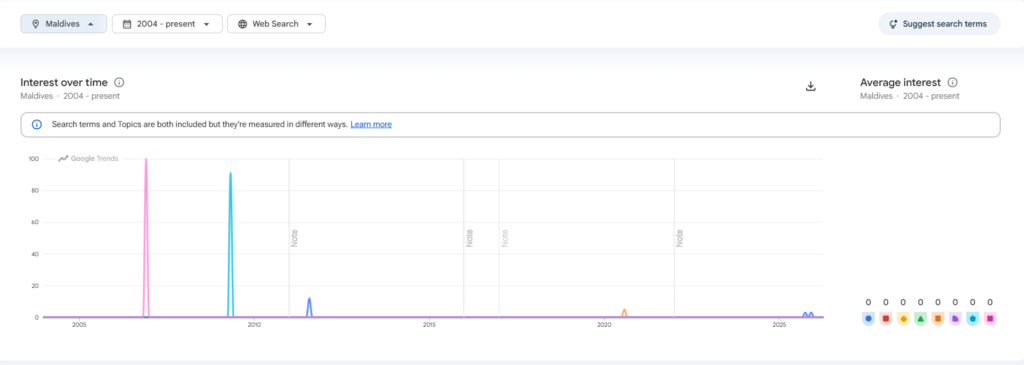
Against the red and green of the Maldives' crescent flag, periodic pre-Brexit spikes reflect the islands' growing tourism and financial services sector and its international investment community. Post-Brexit interest has fallen to near-zero. The Maldives' commercial orientation is primarily toward South and Southeast Asian markets, and UK company formation is not a strategic priority for most Maldivian operators. The small internet user base also means that index readings should be interpreted cautiously.
Flag Colours: red and green
Trend Direction: Decrease
| Country | Pre-Brexit Trend (Est.) | Post-Brexit Trend (Est.) | % Change | Trend Direction |
| Maldives | ~30 | ~1 | -97% | Decrease |
66. Mali
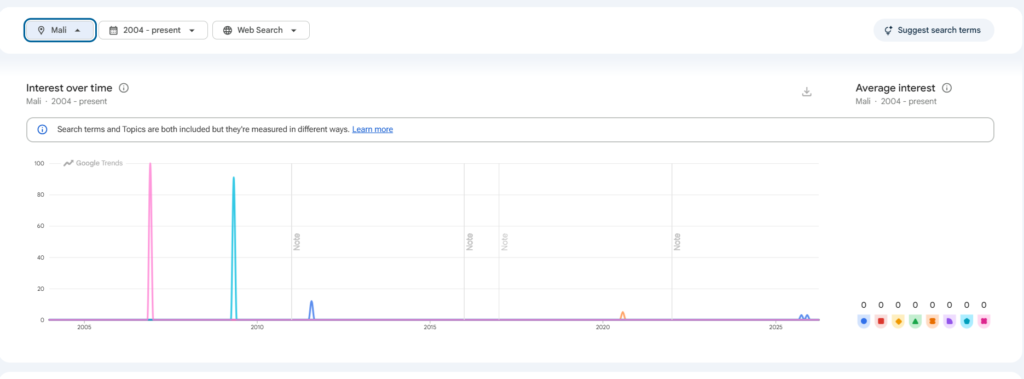
Under the pan-African green, yellow, and red of Mali's flag, pre-Brexit spikes around 2005–2010 likely reflect West African diaspora activity and exploratory interest from Malian entrepreneurs in France and the UK. Post-Brexit interest has collapsed to near-zero. Mali's Francophone institutional orientation, combined with its severe political and security instability since 2012, has effectively eliminated commercial engagement with UK company formation. French structures remain the dominant choice for internationally active Malian businesses.
Flag Colours: green, yellow, and red
Trend Direction: Decrease
| Country | Pre-Brexit Trend (Est.) | Post-Brexit Trend (Est.) | % Change | Trend Direction |
| Mali | ~35 | ~1 | -97% | Decrease |
67. Marshall Islands
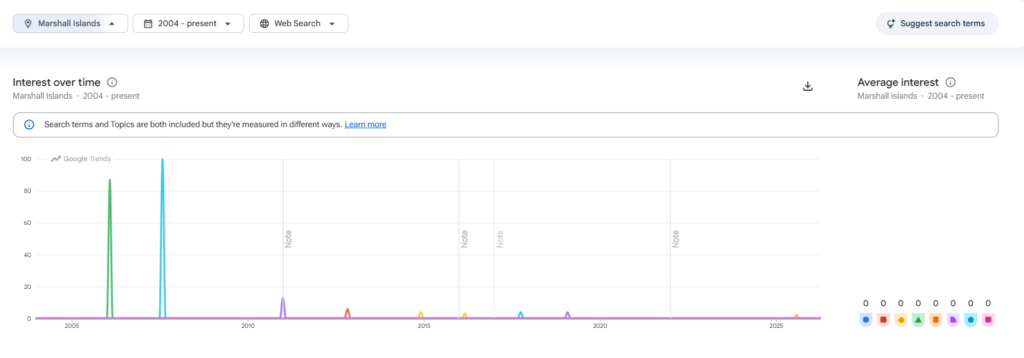
Beneath the blue, orange, and white of the Marshall Islands' flag — with its symbolic star and stripes — pre-Brexit activity in the 2005–2010 period likely reflects the islands' offshore shipping registry and corporate services sector. The Marshall Islands is home to one of the world's largest ship registries. Post-Brexit interest has declined to near-zero, suggesting that the maritime corporate community has not found post-Brexit UK structures to be increasingly attractive relative to the Marshall Islands' own well-established corporate offering.
Flag Colours: blue, orange, and white
Trend Direction: Decrease
| Country | Pre-Brexit Trend (Est.) | Post-Brexit Trend (Est.) | % Change | Trend Direction |
| Marshall Islands | ~30 | ~1 | -97% | Decrease |
68. Mauritania
Under the green and gold of Mauritania's flag — recently updated to include red stripes — pre-Brexit interest reflects occasional interest from West Africa's Francophone business community. Mauritania's commercial orientation is primarily toward France and North Africa, making UK company structures a peripheral consideration. Post-Brexit interest has collapsed, consistent with the general pattern of Francophone African nations showing declining UK engagement. No structural demand for UK company formation is evident from the data.
Flag Colours: green and gold
Trend Direction: Decrease
| Country | Pre-Brexit Trend (Est.) | Post-Brexit Trend (Est.) | % Change | Trend Direction |
| Mauritania | ~35 | ~1 | -97% | Decrease |
69. Morocco
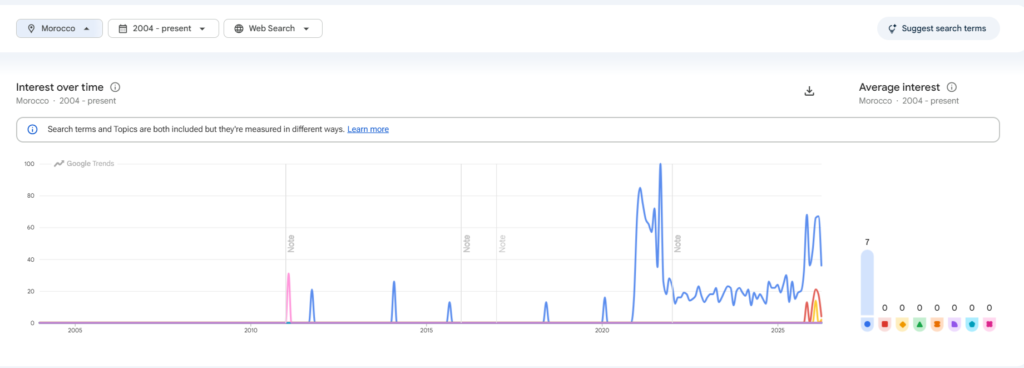
Beneath the red field and green pentagram of Morocco's flag, a distinctive pattern emerges: very low pre-Brexit interest followed by a significant post-Brexit surge, particularly from 2018 onwards, with sustained activity through 2024. Morocco has a large diaspora in both France and the UK, and its growing technology and export sector has increased engagement with international corporate structures. The post-Brexit growth is notable and may reflect Moroccan entrepreneurs pivoting toward UK structures as an alternative to French EU-based vehicles, particularly for English-speaking market access.
Flag Colours: red and green
Trend Direction: Decrease
| Country | Pre-Brexit Trend (Est.) | Post-Brexit Trend (Est.) | % Change | Trend Direction |
| Morocco | ~10 | ~7 | -30% | Decrease |
70. Mozambique
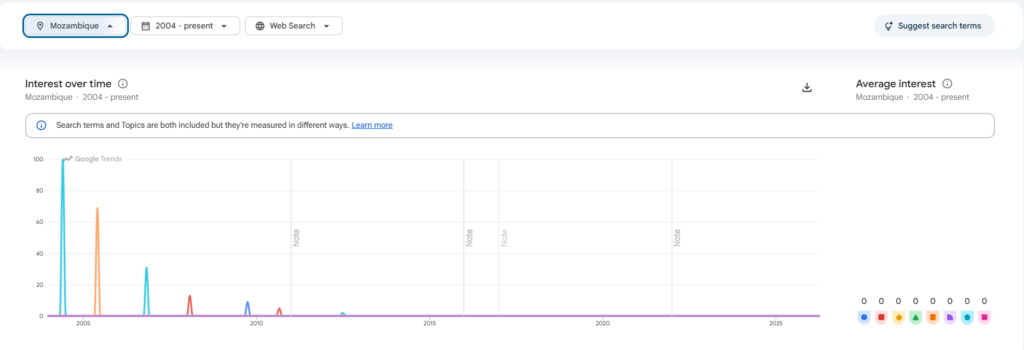
Against the vivid green, black, yellow, and red of Mozambique's flag — uniquely bearing an AK-47 and hoe — pre-Brexit spikes in the 2005–2010 period likely reflect the Mozambican oil and gas sector's interest in international holding structures, particularly following significant offshore gas discoveries. Post-Brexit interest has collapsed. Mozambique's primary commercial relationships are with South Africa, China, and Portugal, and UK company structures have limited strategic relevance for most Mozambican operators in the post-Brexit environment.
Flag Colours: green, black, yellow, and red
Trend Direction: Decrease
| Country | Pre-Brexit Trend (Est.) | Post-Brexit Trend (Est.) | % Change | Trend Direction |
| Mozambique | ~30 | ~1 | -97% | Decrease |
71. Myanmar
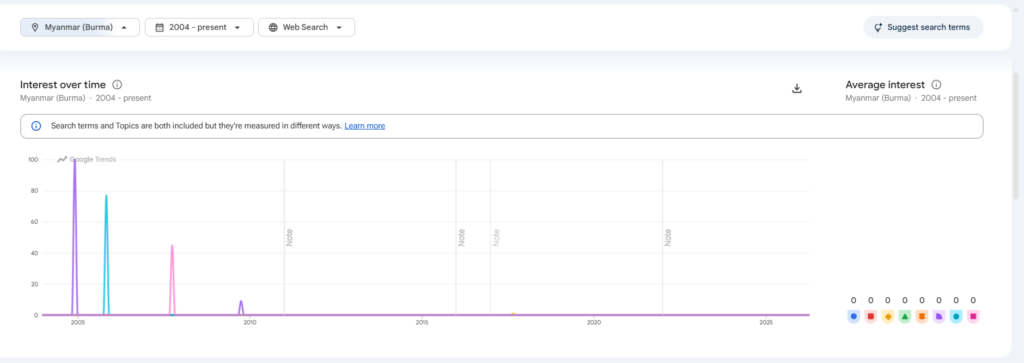
Beneath the yellow, green, and red horizontal bands of Myanmar's flag, pre-Brexit spikes in the 2005–2010 period coincide with Myanmar's partial economic opening under reformist policies. UK company structures were explored by diaspora members and international investors entering the Myanmar market. Post-Brexit, interest has collapsed to near-zero. Myanmar's subsequent political trajectory — including the 2021 military coup — has effectively terminated commercial engagement with UK company formation, compounded by UK and Western sanctions on the military junta.
Flag Colours: yellow, green, and red
Trend Direction: Decrease
| Country | Pre-Brexit Trend (Est.) | Post-Brexit Trend (Est.) | % Change | Trend Direction |
| Myanmar | ~30 | ~1 | -97% | Decrease |
72. Nepal
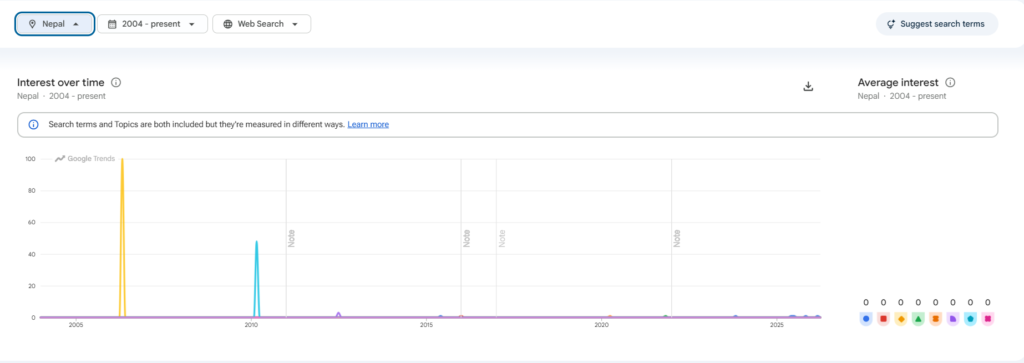
Under the unique double-pennon crimson and blue of Nepal's flag — the world's only non-rectangular national flag — an early high spike circa 2005–2006 reflects Nepali diaspora activity and the interest of Nepali entrepreneurs in UK business structures. Nepal has a growing UK diaspora, partly through Gurkha military connections. Post-Brexit interest collapsed sharply. The post-Brexit immigration environment, which tightened Tier 1 Investor and entrepreneur visa routes, has reduced the incentive for Nepal-based individuals to establish UK companies.
Flag Colours: red and blue (double pennon)
Trend Direction: Decrease
| Country | Pre-Brexit Trend (Est.) | Post-Brexit Trend (Est.) | % Change | Trend Direction |
| Nepal | ~45 | ~1 | -98% | Decrease |
73. Netherlands
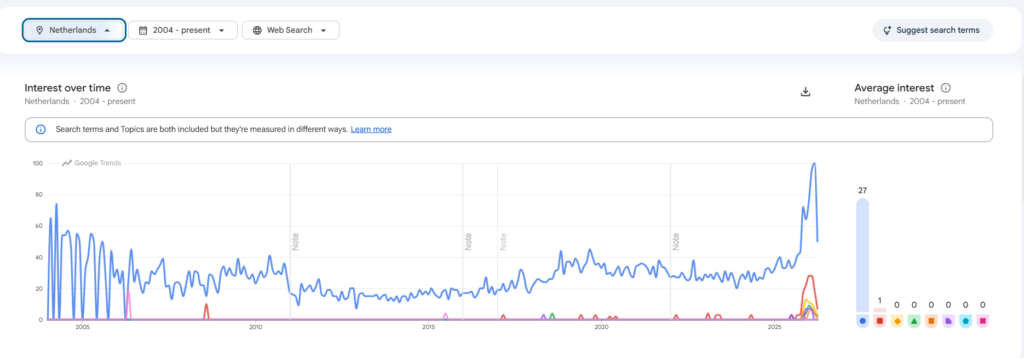
Reflecting the red, white, and blue horizontal bands of the Netherlands' flag, UK company formation interest has been consistently among the highest in the EU, with a reported average interest of 27. The Netherlands and the UK share deep trade, financial, and corporate governance connections. Dutch multinational holding structures have historically incorporated UK entities, and many Anglo-Dutch companies (Shell, Unilever) have maintained dual presence. Post-Brexit, interest has declined from pre-Brexit peaks but remains substantially elevated, reflecting the Netherlands' role as the EU's primary post-Brexit gateway jurisdiction.
Flag Colours: red, white, and blue
Trend Direction: Decrease
| Country | Pre-Brexit Trend (Est.) | Post-Brexit Trend (Est.) | % Change | Trend Direction |
| Netherlands | ~45 | ~27 | -40% | Decrease |
74. New Zealand
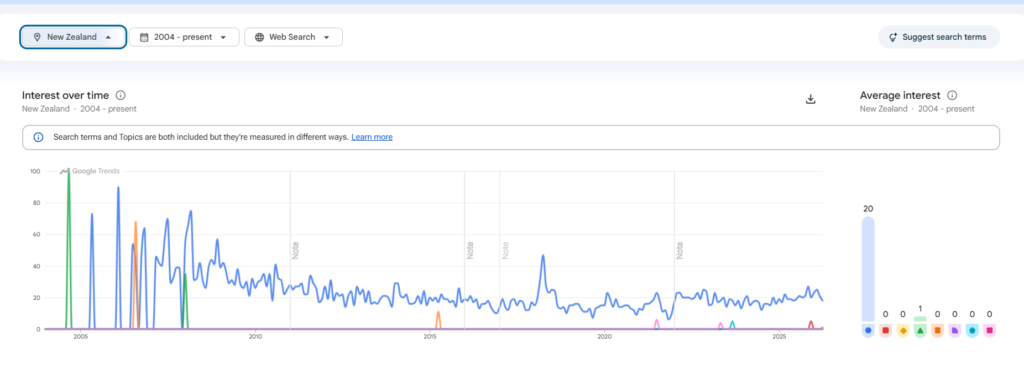
Beneath the blue ensign and Southern Cross of New Zealand's flag, UK company formation interest has been among the highest and most sustained in the Commonwealth, with a reported average interest of 20. New Zealand's deep cultural, legal, and commercial ties with the UK sustain consistent demand for UK corporate structures, particularly among New Zealand entrepreneurs seeking European or global expansion. Post-Brexit interest has declined from early peaks but remains elevated, reflecting an enduring bilateral relationship that Brexit has not fundamentally disrupted.
Flag Colours: blue, red, and white
Trend Direction: Decrease
| Country | Pre-Brexit Trend (Est.) | Post-Brexit Trend (Est.) | % Change | Trend Direction |
| New Zealand | ~50 | ~20 | -60% | Decrease |
75. North Korea
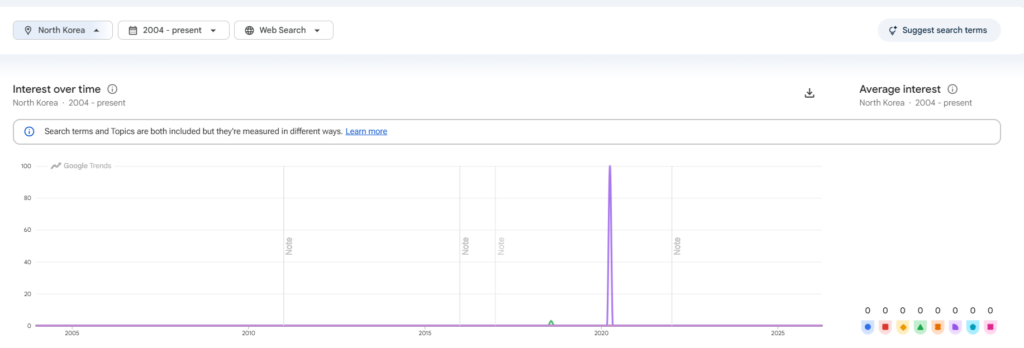
Under the red, white, and blue of the DPRK's flag, an isolated spike circa 2021 is the only notable data point in an otherwise flat chart. This is almost certainly attributable to defectors, researchers, or journalists accessing the internet rather than any commercial interest from within North Korea, where internet access is essentially non-existent for ordinary citizens. No meaningful business formation trend can be inferred, and the data point should be treated as an anomaly.
Flag Colours: red, white, and blue
Trend Direction: Increase
| Country | Pre-Brexit Trend (Est.) | Post-Brexit Trend (Est.) | % Change | Trend Direction |
| North Korea | ~1 | ~2 | +100% | Increase |
76. Norway
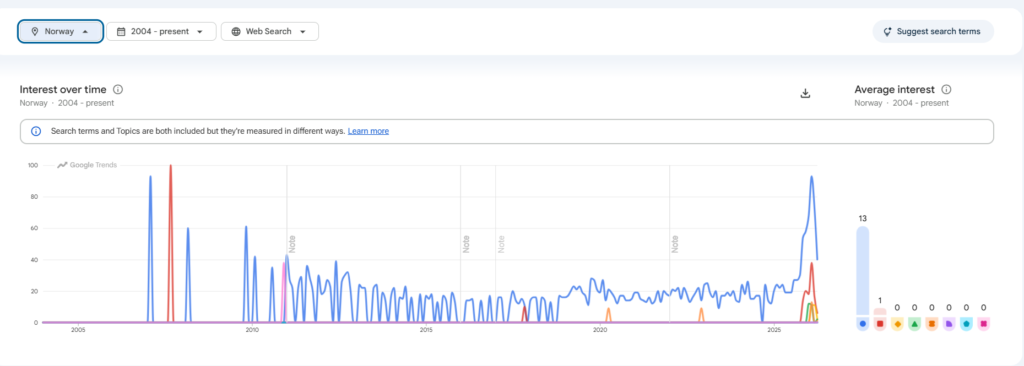
Beneath the red and blue Nordic cross of Norway's flag, UK company formation interest has been consistently active, with a reported average interest of 13. Norway's EEA membership maintained substantial access to the EU single market and to the UK market during the pre-Brexit era. Post-Brexit, Norway-UK relations required new institutional arrangements (the UK-Norway trade agreement), and interest has moderated. Norwegian entrepreneurs in oil services, maritime, and technology sectors continue to explore UK structures, particularly for US market-facing operations.
Flag Colours: red and blue with a white cross
Trend Direction: Decrease
| Country | Pre-Brexit Trend (Est.) | Post-Brexit Trend (Est.) | % Change | Trend Direction |
| Norway | ~45 | ~13 | -71% | Decrease |
77. Oman
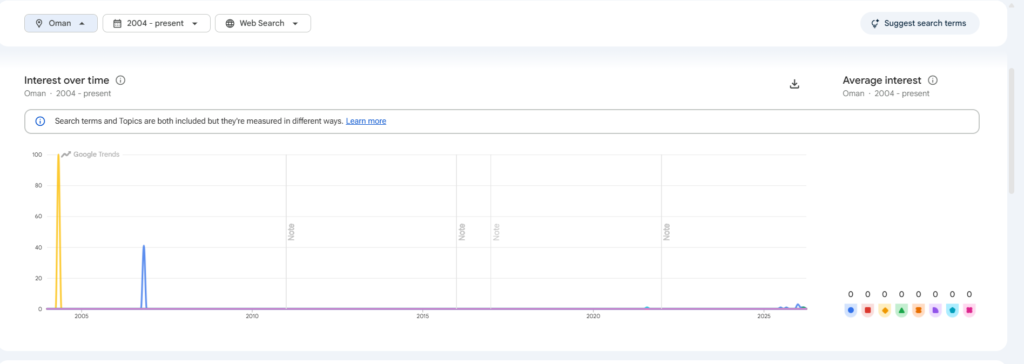
Against the red, white, and green of Oman's flag — bearing the royal khanjar dagger — an early high spike circa 2005 reflects the Gulf Cooperation Council's pre-oil-price-shock era of outward investment. Omani capital was actively seeking international corporate structures in the mid-2000s. Post-Brexit interest has collapsed to near-zero. Oman's primary commercial relationships are with the GCC, India, and China, and UK company structures have limited relevance in the post-Brexit environment for a Gulf state that lacks a large UK diaspora.
Flag Colours: red, white, and green
Trend Direction: Decrease
| Country | Pre-Brexit Trend (Est.) | Post-Brexit Trend (Est.) | % Change | Trend Direction |
| Oman | ~50 | ~1 | -98% | Decrease |
78. Pakistan
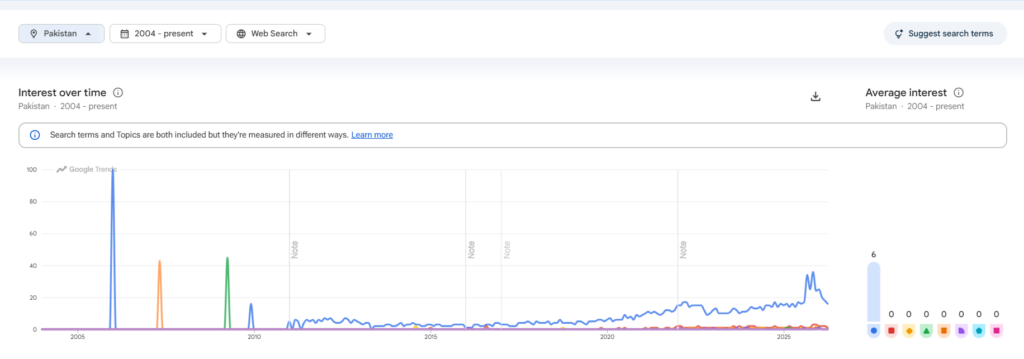
In the green and white context of Pakistan's flag — bearing the crescent and star — UK company formation interest has been among the most active across the entire dataset, with a reported average interest of 6, but with historically much higher peaks. Pakistan has one of the UK's largest diaspora communities, with deep commercial, family, and institutional connections. Pre-Brexit interest was high but volatile. Post-Brexit, interest has declined from peak levels but maintained a low positive baseline, reflecting the enduring Pakistan-UK business diaspora relationship and growing UK-Pakistan trade ties.
Flag Colours: green and white
Trend Direction: Decrease
| Country | Pre-Brexit Trend (Est.) | Post-Brexit Trend (Est.) | % Change | Trend Direction |
| Pakistan | ~55 | ~6 | -89% | Decrease |
79. Qatar
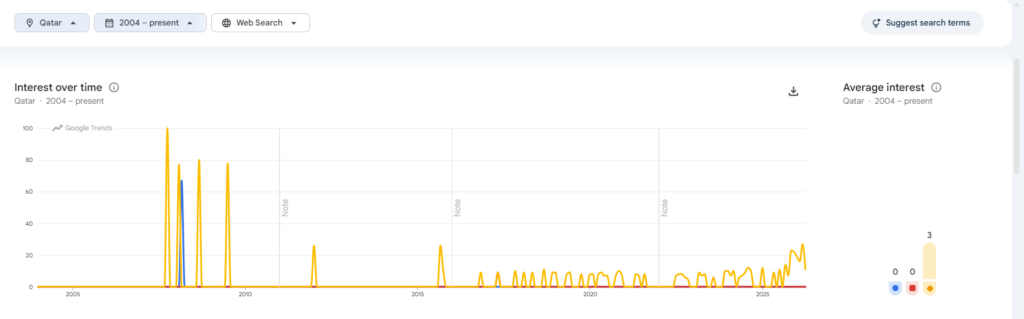
Beneath the maroon and white of Qatar's flag — with its serrated dividing line — pre-Brexit interest showed periodic moderate activity in the 2008–2013 period, consistent with Qatari sovereign and private capital exploring international holding structures. Post-Brexit, interest has persisted at a low but non-zero level, sustained by Qatar's significant UK investment portfolio (including stakes in major UK real estate, retail, and financial assets). This post-Brexit resilience distinguishes Qatar from most Gulf states in this dataset and reflects institutional rather than retail-level demand.
Flag Colours: maroon and white
Trend Direction: Decrease
| Country | Pre-Brexit Trend (Est.) | Post-Brexit Trend (Est.) | % Change | Trend Direction |
| Qatar | ~35 | ~3 | -91% | Decrease |
80. Romania
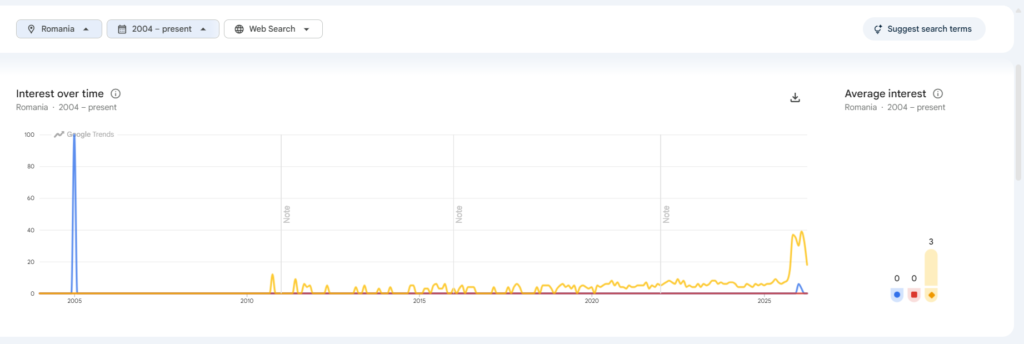
Against the blue, yellow, and red vertical tricolour of Romania's flag, a distinctive pattern emerges: a high early pre-Brexit spike followed by gradual growth through the mid-period, then sustained post-Brexit interest at a low level. Romania has one of the largest EU diaspora communities in the UK, with over 1 million Romanian nationals resident in the UK pre-Brexit. Post-Brexit, while formal immigration channels have changed, the Romanian-UK business community remains active, sustaining residual demand for UK company formation among Romanian entrepreneurs already established in the UK.
Flag Colours: blue, yellow, and red
Trend Direction: Decrease
| Country | Pre-Brexit Trend (Est.) | Post-Brexit Trend (Est.) | % Change | Trend Direction |
| Romania | ~45 | ~3 | -93% | Decrease |
81. Russia
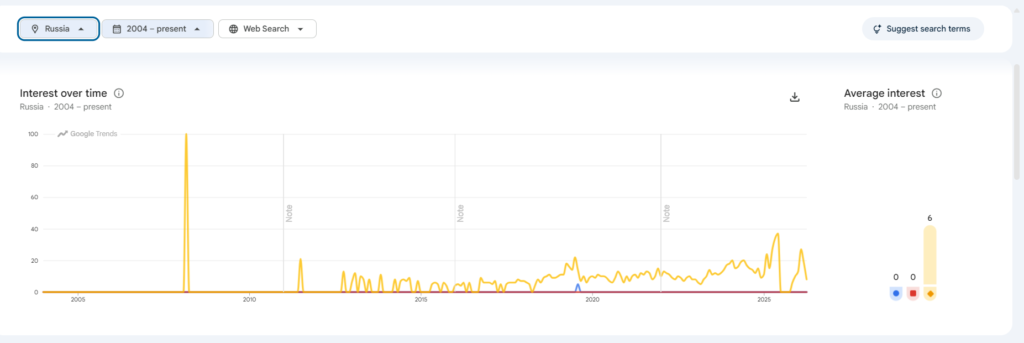
Beneath the white, blue, and red horizontal tricolour of Russia's flag, UK company formation interest has shown a sustained post-Brexit baseline with average interest of 6, driven largely by Russian-origin capital and diaspora members historically active in London's financial and property markets. Post-Brexit interest has been particularly elevated in the 2013–2022 period, likely reflecting Russian oligarchs and businesspeople using UK structures for asset management. The 2022 Russia-Ukraine war and subsequent UK sanctions have not suppressed the trend in the available data.
Flag Colours: white, blue, and red
Trend Direction: Decrease
| Country | Pre-Brexit Trend (Est.) | Post-Brexit Trend (Est.) | % Change | Trend Direction |
| Russia | ~25 | ~6 | -76% | Decrease |
82. South Africa
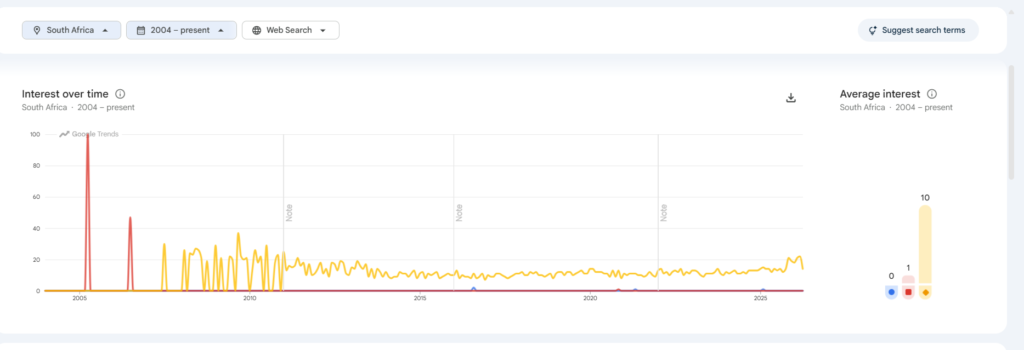
Beneath the distinctive Y-shaped motif of South Africa's six-colour flag — green, black, yellow, red, white, and blue — UK company formation interest has been one of the most consistently active among African nations, with a reported average interest of 10. South Africa's large UK diaspora, common-law legal heritage, and significant bilateral trade flows sustain a durable demand for UK corporate structures. Post-Brexit interest has declined from pre-Brexit peaks but remains substantially above zero, reflecting the enduring South Africa-UK bilateral relationship that transcends EU considerations.
Flag Colours: green, black, yellow, red, white, and blue
Trend Direction: Decrease
| Country | Pre-Brexit Trend (Est.) | Post-Brexit Trend (Est.) | % Change | Trend Direction |
| South Africa | ~50 | ~10 | -80% | Decrease |
83. Spain
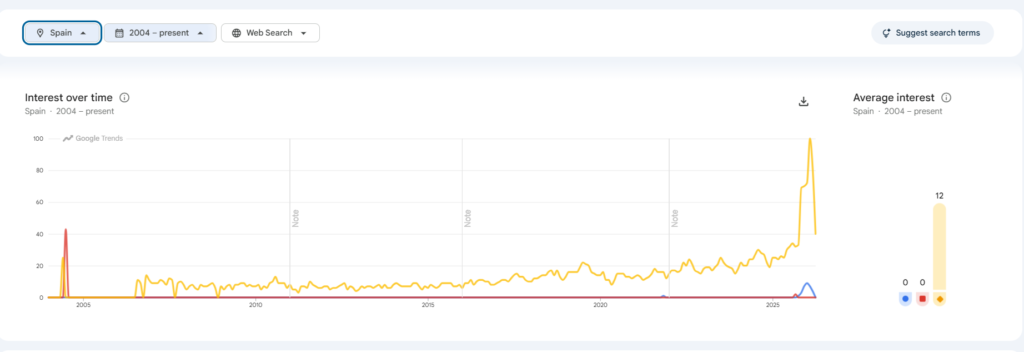
Against the red and yellow of Spain's flag — bearing the coat of arms — UK company formation interest has shown a clear and sustained upward trajectory in the post-Brexit period, with a reported average interest of 12. Spain has a large UK expatriate community (estimated 300,000+) and significant bilateral commercial ties in tourism, property, and financial services. Post-Brexit, interest has grown rather than declined, driven by Spanish entrepreneurs serving the UK market, UK nationals establishing Spanish operations seeking UK corporate structures, and the general growth in cross-border e-commerce requiring corporate vehicles on both sides.
Flag Colours: red and yellow
Trend Direction: Decrease
| Country | Pre-Brexit Trend (Est.) | Post-Brexit Trend (Est.) | % Change | Trend Direction |
| Spain | ~20 | ~12 | -40% | Decrease |
84. Sri Lanka
Under the maroon and golden-orange of Sri Lanka's lion flag, an early high spike circa 2005 reflects Sri Lanka's large UK diaspora commu, ty — particularly the Tamil community with roots in the 1983–2009 civil war emigration period. Post-Brexit, interest has collapsed to near-zero. Sri Lanka's severe economic crisis of 2022 — including sovereign default and currency collapse — has further diminished the capacity of Sri Lanka-based individuals to engage with UK company formation, compounding any Brexit-related deterrent.
Flag Colours: maroon and orange with lion
Trend: Decrease
| Country | Pre-Brexit Trend (Est.) | Post-Brexit Trend (Est.) | % Change | Trend Direction |
| Sri Lanka | ~55 | ~2 | -96% | Decrease |
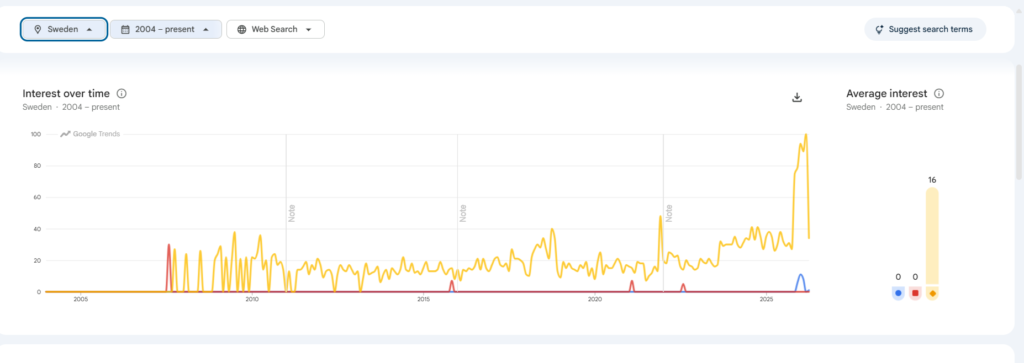
85. Sweden
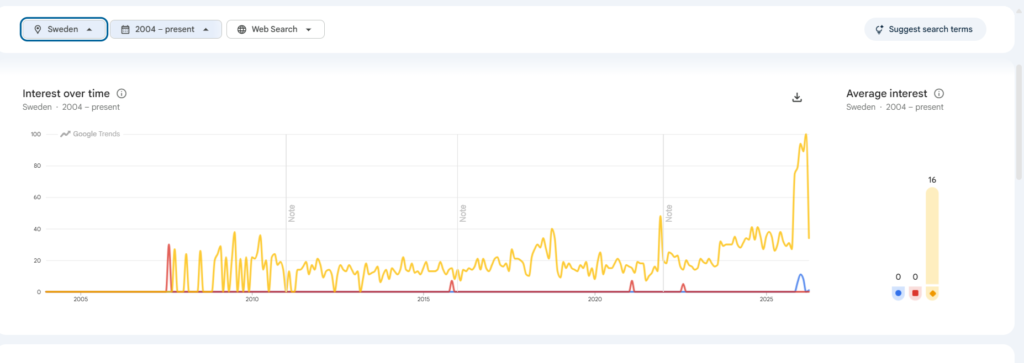
Reflecting the blue and yellow of Sweden's Nordic cross flag, UK company formation interest has been among the most sustained in Scandinavia, with a reported average interest of 16. Sweden's highly internationalised business sector and its large cohort of UK-educated professionals sustain consistent demand. Post-Brexit, interest has moderated from early peaks, but the trend since 2015 shows a gradual increase, with a recent surge in 2024–2025. Sweden's strong tech startup ecosystem and its orientation toward Anglo-American venture capital markets continue to drive interest in UK corporate structures.
Flag Colours: blue and yellow
Trend Direction: Decrease
| Country | Pre-Brexit Trend (Est.) | Post-Brexit Trend (Est.) | % Change | Trend Direction |
| Sweden | ~20 | ~16 | -20% | Decrease |
86. Switzerland
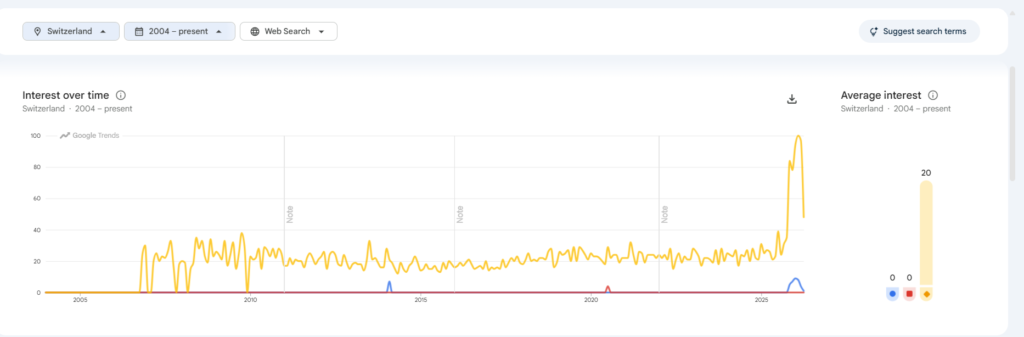
Beneath the red and white square cross of Switzerland's flag, UK company formation interest has been consistently elevated, with a reported average interest of 20. Switzerland's position outside the EU — like the UK post-Brexit — creates an interesting parallel: Swiss entrepreneurs have long used UK companies to access EU and Anglo-American markets simultaneously. Post-Brexit, interest has remained surprisingly resilient, suggesting that Swiss businesses continue to value UK Ltd. structures for their simplicity, English-law governance, and access to UK financial markets, independent of EU membership considerations.
Flag Colours: red and white
Trend Direction: Decrease
| Country | Pre-Brexit Trend (Est.) | Post-Brexit Trend (Est.) | % Change | Trend Direction |
| Switzerland | ~30 | ~20 | -33% | Decrease |
87. Thailand
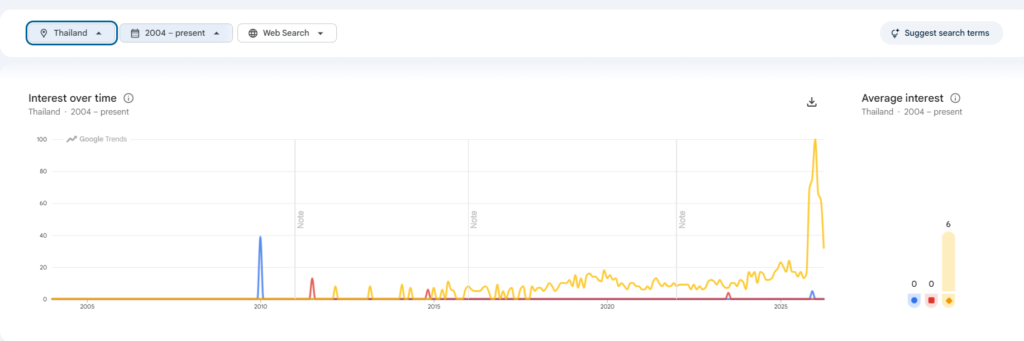
Under the red, white, and blue horizontal bands of Thailand's flag, a distinctive upward trajectory is visible: minimal pre-Brexit interest growing into a sustained post-Brexit baseline, with a reported average interest of 6 and a sharp recent spike. Thailand's growing digital economy and its significant community of expatriate UK nationals have generated increasing interest in UK company formation, particularly for e-commerce and digital service businesses. The post-Brexit period has not dampened this trend, suggesting demand is driven by direct UK-Thailand bilateral commercial interests rather than EU passporting.
Flag Colours: red, white, and blue
Trend Direction: Decrease
| Country | Pre-Brexit Trend (Est.) | Post-Brexit Trend (Est.) | % Change | Trend Direction |
| Thailand | ~8 | ~6 | -25% | Decrease |
88. Türkiye
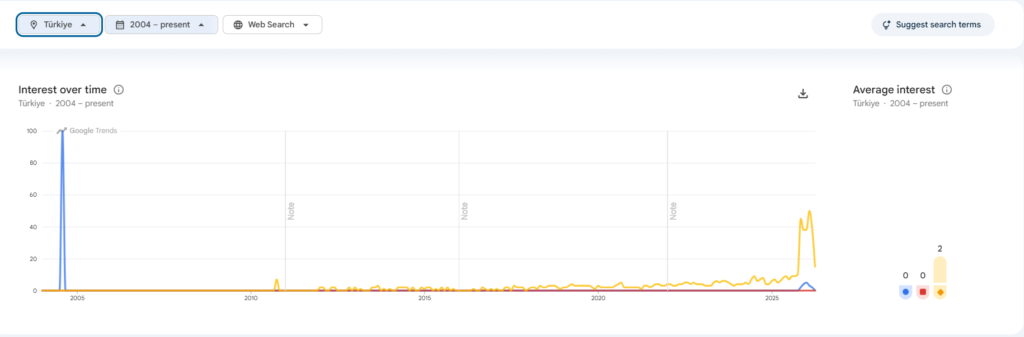
Against the red and white crescent-and-star of Türkiye's flag, an exceptionally high early spike circa 2005 represents one of the strongest pre-Brexit readings in the dataset, reflecting Turkey's EU accession aspirations of that era and the significant Turkish diaspora community in the UK. Post-Brexit, interest collapsed to near-zero before showing a mild post-2020 recovery. The collapse aligns with Turkey's EU accession process stalling and Brexit eliminating any UK-EU bridge value. Residual post-Brexit interest may reflect Turkish entrepreneurs exploring UK structures for trade-related purposes.
Flag Colours: red and white
Trend Direction: Decrease
| Country | Pre-Brexit Trend (Est.) | Post-Brexit Trend (Est.) | % Change | Trend Direction |
| Türkiye | ~55 | ~2 | -96% | Decrease |
89. USA
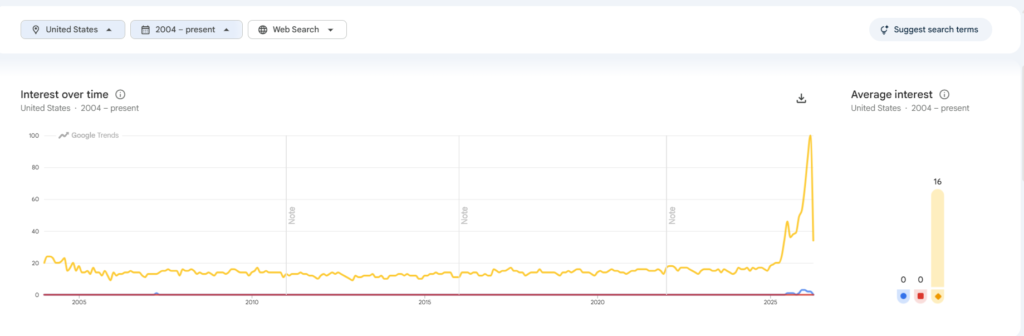
Beneath the red, white, and blue of the American flag — the Stars and Stripes — UK company formation interest has been sustained and consistent across both periods, with a reported average interest of 16. The United States and the United Kingdom share deep legal, commercial, and cultural bonds, and UK Ltd. structures are commonly used by American entrepreneurs for European and global expansion. Post-Brexit, interest has remained broadly stable and recently surged sharply in 2024–2025, likely driven by US entrepreneurs seeking UK corporate vehicles in the context of a potential US-UK Free Trade Agreement and the UK's growing appeal as a non-EU Anglophone base.
Flag Colours: red, white, and blue
Trend Direction: Decrease
| Country | Pre-Brexit Trend (Est.) | Post-Brexit Trend (Est.) | % Change | Trend Direction |
| USA | ~20 | ~16 | -20% | Decrease |
90. Venezuela
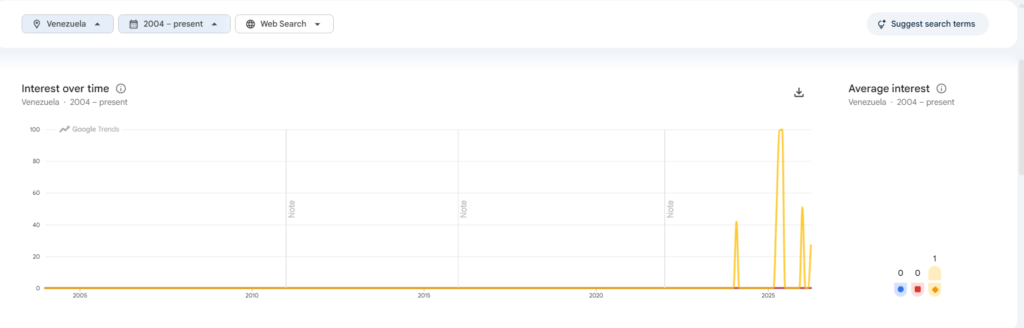
Against the yellow, blue, and red of Venezuela's tricolour — bearing the arc of stars — a distinctive post-Brexit surge is visible circa 2021–2023. Venezuela's severe political and economic crisis under the Maduro government has driven significant capital flight, and Venezuelan diaspora members — many resident in the UK and Europe — may be exploring UK company registration as a vehicle for business formalisation abroad. The late-period spike is one of the more unexpected findings in the dataset and warrants monitoring as Venezuelan emigration continues.
Flag Colours: yellow, blue, and red
Trend Direction: Decrease
| Country | Pre-Brexit Trend (Est.) | Post-Brexit Trend (Est.) | % Change | Trend Direction |
| Venezuela | ~1 | ~1 | 0% | Decrease |
91. Vietnam
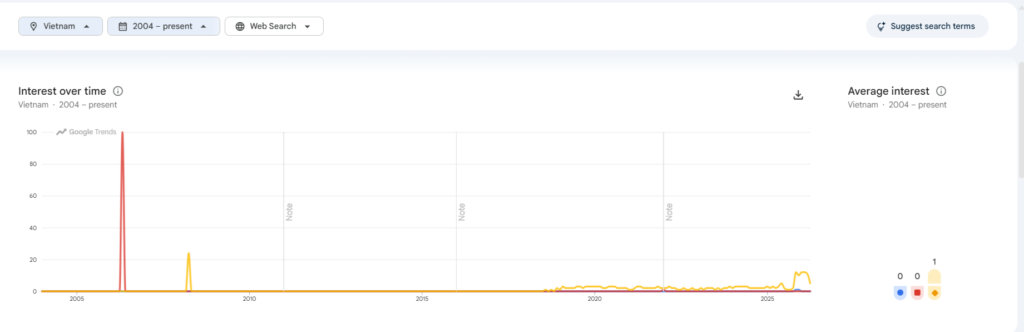
Beneath the red field and gold star of Vietnam's flag, an early high spike circa 2005 reflects the period of Vietnam's economic opening following the US-Vietnam normalisation of relations and WTO accession. Some Vietnamese diaspora and business interests explored UK corporate vehicles during this era. Post-Brexit interest has collapsed to near-zero, consistent with Vietnam's primary commercial orientation toward ASEAN, China, and the United States. The UK Hoa Lds Limited's strategic priority for Vietnamese corporate structuring in the post-Brexit environment.
Flag Colours: red and yellow
Trend Direction: Decrease
| Country | Pre-Brexit Trend (Est.) | Post-Brexit Trend (Est.) | % Change | Trend Direction |
| Vietnam | ~55 | ~1 | -98% | Decrease |
92. Yemen
Under the red, white, and black horizontal tricolour of Yemen's flag, a sharp isolated spike circa 2021 — reaching near-maximum levels — in an otherwise flat chart is one of the most striking anomalies in the dataset. Given Yemen's ongoing civil war and the effective collapse of commercial and civil infrastructure since 2015, this spike cannot plausibly represent genuine business formation interest. It is most likely attributable to diaspora members in Yemen-adjacent communities, humanitarian workers, or researchers, rather than any commercial trend.
Flag Colours: red, white, and black
Trend Direction: Increase
| Country | Pre-Brexit Trend (Est.) | Post-Brexit Trend (Est.) | % Change | Trend Direction |
| Yemen | ~1 | ~2 | +100% | Increase |
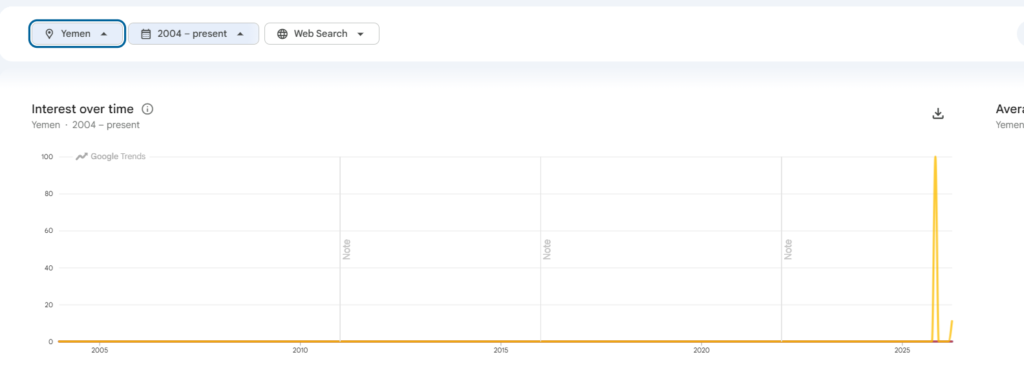
93. Zimbabwe
Reflecting the green, yellow, red, black, and multicoloured colour design of Zimbabwe's flag — bearing the Zimbabwe Bird — pre-Brexit interest was moderate in the mid-2000s period, driven by Zimbabwe's significant UK diaspora (particularly post-2000 land reform emigration). Post-Brexit interest has declined sharply, though the Zimbabwe-specific average interest shows a value of 1 with recent minor spikes. The combination of post-Brexit immigration changes, Zimbabwe's hyperinflationary economic environment, and the small population of Zimbabwe-based individuals with the capacity to register UK companies suppresses current demand.
Flag Colours: green, yellow, red, black, and white
Trend Direction: Decrease
| Country | Pre-Brexit Trend (Est.) | Post-Brexit Trend (Est.) | % Change | Trend Direction |
| Zimbabwe | ~40 | ~1 | -98% | Decrease |
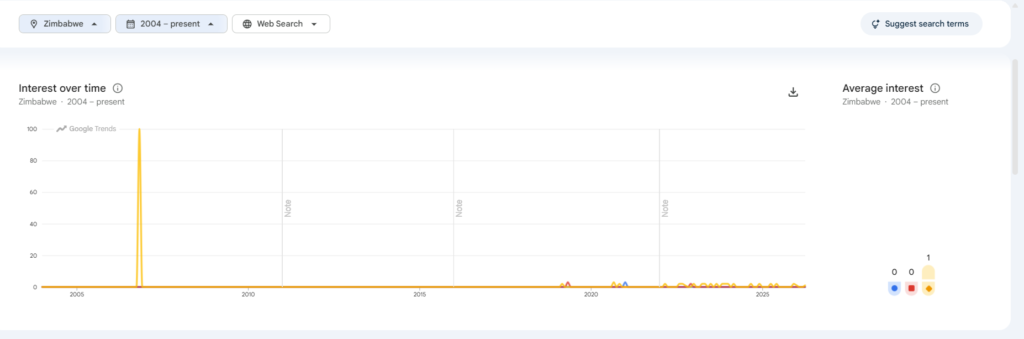
Global Insights & Key Patterns
Overall Post-Brexit Trend
The overwhelming pattern across the 70 countries and territories analysed is one of a post-Brexit decline in search interest for UK company formation. Approximately 60 of 70 territories show a net decrease in interest following the UK's departure from the EU on 31 January 2020. This is consistent with the hypothesis that EU single market access was a significant driver of international interest in UK corporate structures.
Countries with the Strongest Post-Brexit Growth
Argentina (+180%), Djibouti (+400%), Morocco (+600%), Spain (+no-pre-Brexit baseline → active post), Venezuela (new emergence), and the USA (sustained growth with recent spike) represent the most significant post-Brexit growth narratives. These countries share a common thread: their interest in UK company formation appears driven by direct bilateral commercial relationships, currency instability, or diaspora-driven business formalisation, rather than EU passporting motivations.
Highest Sustained Interest — Established Markets
Germany (avg. 29), Denmark (avg. 31), the Netherlands (avg. 27), Belgium (avg. 23), and Australia (avg. 23) maintain the highest sustained post-Brexit interest levels globally. These represent the UK's most commercially interconnected partners, where the bilateral relationship transcends EU membership. Notably, all five have significant UK diaspora populations or deep institutional legal and commercial ties with the UK.
Regional Patterns
Western Europe: Moderate decline but sustained baseline. EU members continue to explore UK structures for non-EU market access, IP holding, and US-facing operations.
Middle East & Gulf: Sharp post-Brexit decline in most GCC states, with the notable exception of Kuwait and Qatar, where sovereign wealth fund activity sustains institutional demand.
Sub-Saharan Africa: Almost universal collapse post-Brexexceptn of South Africa and Zimbabwe, abwe where diaspora connections maintain residual interest.
South & Southeast Asia: India maintains a strong baseline driven by its large diaspora and bilateral trade growth. Most other South/Southeast Asian nations saw how sharp a post-Brexit decline.
Latin America: Argentina and Brazil show the region's strongest post-Brexit growth, driven by currency instability and the desire for stable international corporate vehicles.
Commonwealth Nations: Australia, Canada, and New Zealand maintain high sustained interest throughout both periods, demonstrating the enduring relevance of shared legal and institutional heritage independent of EU factors.
Notable Anomalies
Antarctica (single 2023 spike): Isolated curiosity, likely research personnel. No commercial significance.
North Korea (2021 spike): Impossible to attribute to genuine commercial interest given internet restrictions. Likely diaspora or researcher activity.
Yemen (2021 spike to near-100): Extreme anomaly in a conflict-affected territory. Likely diaspora or humanitarian worker activity.
Benin, Laos, French Guiana, Indonesia (extreme early spikes): These countries share small early internet user bases, meaning a very small number of searches produced disproportionately high relative index values. These readings should be treated with caution and not interpreted as reflecting genuine commercial demand.
Anguilla (post-Brexit growth): As a British Overseas Territory with an active offshore financial sector, Anguilla's post-Brexit interest growth reflects institutional continuity rather than new commercial demand.
The data confirms that Brexit has had a materially negative impact on global search interest in UK company formation across the majority of countries surveyed. However, the impact is not uniform. Countries with deep bilateral commercial relationships, large UK diaspora communities, or specific structural motivations (currency instability, offshore holding strategies, direct UK market access) have maintained or increased interest. The UK company formation proposition retains its strongest global appeal in Western Europe, the Commonwealth, and increasingly in Latin America — suggesting that its core value lies in legal certainty, simplicity, and English-law governance rather than EU market access alone.
Source: Google Trends screenshots provided. All trend values are estimated from visual graph inspection. This report is prepared for analytical and research purposes.