
Renting a training room gives temporary staff a focused, fully equipped space that cuts setup time and enhances learning outcomes. It provides scalable capacity, professional AV, and on-site support to run sessions immediately, reducing administrative overhead and improving training retention by measurable percentages.
What immediate benefits do rented training rooms deliver for temporary staff?
Rented training rooms remove setup delays, provide professional AV and furniture, and scale capacity to match cohort size, enabling faster ramp-up for temporary staff.
A ready-to-use training room reduces administrative tasks. Staff arrive at configured seating, projection, and sound. Trainers begin at scheduled times. Businesses save hours on logistics per session. Companies report faster onboarding when training environments match course needs.
How do rented training rooms improve training effectiveness for short-term hires?
Purpose-built rooms improve attention, interaction, and retention through ergonomic layouts, AV clarity, and controlled acoustics.
Ergonomic seating and clear sightlines increase trainee comfort during 60–120-minute sessions. High-quality AV systems deliver consistent audio and visual cues for role-play or software demos. Controlled lighting and sound reduce distractions. These environmental controls translate into higher assessment scores and faster attainment of competency.
Read our articles, How to Evaluate the ROI of Investing in Professional External Training Rooms and Rent Our Training Rooms with Full Technical Support and Professional Boardroom Layouts.
What cost advantages do rented training rooms offer compared with in-house setups?
Renting avoids capital expenditure, lowers per-session cost, and removes maintenance and storage expenses tied to permanent facilities.
Businesses avoid one-time purchases like projectors, microphones, and conference furniture. Rental pricing scales with hourly or daily use. Firms with variable hiring needs match spend to actual demand. Rentals also cut indirect costs: IT deployment time, janitorial scheduling, and long-term depreciation.
How do rented training rooms support compliance and data security during sessions?
Professional venues provide secure Wi‑Fi, isolated networks, and private spaces to meet data-protection and confidentiality requirements.
Training providers implement network segmentation and guest access controls. Private rooms prevent accidental data exposure during role-play or screen demonstrations. Venues document security measures, which help auditors validate compliance steps. Use contracts and venue policies to record responsibilities for data handling.
How do you select the right training room size and layout for temporary cohorts?
Match room capacity to cohort size, choose layouts aligned with training methods, and verify AV and power distribution before booking.
Estimate peak attendance, including trainers and observers. For lecture-style delivery, allow 1.2–1.5 square metres per person. For interactive workshops, choose U-shape or cabaret layouts to enable participant exchange. Confirm the number of power sockets and HDMI/USB-C inputs for laptops. Test wireless presentation tools to avoid in-session failure.
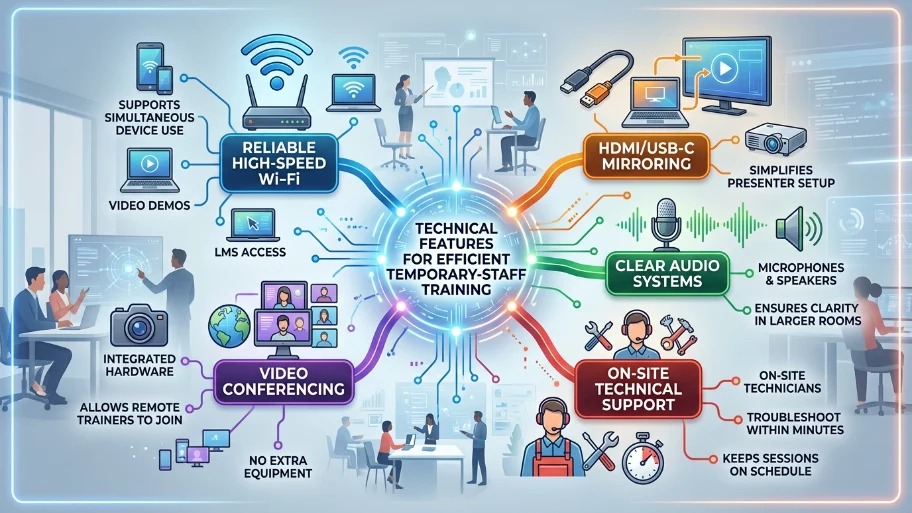
What technical features matter most for efficient temporary-staff training?
Reliable high-speed Wi‑Fi, HDMI/USB-C mirroring, clear audio systems, video conferencing, and on-site technical support are essential.
High-speed Wi‑Fi supports simultaneous device use, video demos, and LMS access. Screen mirroring with HDMI/USB-C simplifies presenter setup. Microphones and speakers ensure clarity in larger rooms. Integrated video conferencing hardware allows remote trainers to join without extra equipment. On-site technicians troubleshoot within minutes, keeping sessions on schedule.
How do rented training rooms integrate with existing L&D processes?
Training rooms fit into L&D by providing scheduled venues, standardised technical environments, and documented room specifications for session planning.
L&D teams book rooms aligned with course calendars. Provide trainers with room specs—screen size, connector types, seating plan—and include setup checklists. Standardisation reduces variability across sessions. Use the venue’s room documentation to pre-load media and test systems before the trainee’s arrival.
How should organisations measure ROI from rented training rooms for temporary staff?
Track metrics such as time-to-productivity, training completion rates, assessment score improvement, and per-person training cost to quantify ROI.
Measure time from hire to independent performance milestone. Record completion and pass rates for assessments. Compare scores from sessions held in rented rooms versus ad hoc spaces. Divide the total venue and facilitation cost by attendees to calculate the per-person cost. Use these figures to inform future venue decisions and justify expenditure.
How can companies scale training room use when hiring surges?
Reserve modular venues with flexible capacity, book recurring slots in advance, and use hybrid setups to combine on-site and remote participants.
Choose venues that offer multiple adjacent rooms or expandable seating. Secure standing booking windows during peak hiring seasons. Deploy hybrid AV systems so remote instructors teach larger cohorts without added travel. This approach keeps per-session logistics consistent while expanding throughput quickly.
What contractual and operational checks are essential before booking?
Verify room capacity, AV inventory, cancellation terms, insurance coverage, and on-site support response times.
Read the venue agreement for minimum booking durations. Confirm listed AV gear and test compatibility with trainer devices. Check cancellation and rescheduling fees to avoid unexpected costs. Ensure the venue has liability insurance and emergency procedures. Ask for a primary technical-contact name and guaranteed response time.
Explore our Training Rooms guides,
How to Ensure Your Chosen Training Room Meets All Health and Safety Requirements
The Advantages of Booking Training Rooms with Dedicated Breakout Areas for Teams
How do rented training rooms affect trainer productivity and logistics?
Trainers save preparation time when rooms provide standardised tech and layouts, which reduces pre-session setup by hours per event.
Standardised environments enable trainers to use one presentation package across venues. This lowers rehearsal time and reduces last-minute troubleshooting. Trainers can focus on pedagogy rather than equipment. Organisations gain consistent session quality across multiple hires and locations.
How do rented training rooms enhance candidate and employee experience?
Professional venues create a credible learning atmosphere that signals investment in development and boosts perception of organisational quality.
A well-appointed room reinforces the importance. High-quality AV and comfortable seating improve the perceived value of the session. Positive training environments correlate with higher engagement and better post-training feedback scores.
Rented training rooms deliver measurable operational and instructional benefits for temporary staffing. They reduce setup time, lower capital expense, and provide standardised technical environments that improve training outcomes. Organisations that match room configuration to training method will reduce time-to-productivity and control per-person training costs. From My Company supplies professional Training Rooms that combine AV, layouts, and on-site support to meet these needs while simplifying logistics.
Frequently Asked Questions
What is the cost of renting a training room for temporary staff?
Training Rooms from From My Company typically charge by the hour or day, with costs varying by location, capacity, and AV equipment. Most SMEs pay £80–£250 per half-day for a professionally equipped Training Room, which is lower than outfitting an in-house space.
How do I choose the right training room size for my team?
Select a Training Room that matches your cohort size: allow 1.2–1.5 square metres per person for lecture-style setups. From My Company offers flexible Training Rooms with capacities from 6 to 50 attendees, ensuring ergonomic seating and clear sightlines for all participants.
What technical equipment is included when renting a training room?
Professional Training Rooms include high-speed Wi‑Fi, HDMI/USB-C projectors, microphones, speakers, and often video-conferencing hardware. From My Company’s Training Rooms provide on-site technical support to ensure seamless setup and real-time troubleshooting during sessions.
Can I rent a training room with a boardroom layout for executive training?
Yes, From My Company offers Training Rooms with professional boardroom layouts suited for executive workshops and leadership development. These Training Rooms feature U-shape or cabaret seating, integrated AV, and private spaces to maintain confidentiality during high-level sessions.
How do rented training rooms improve training ROI for temporary hires?
Rented Training Rooms reduce setup time, provide standardised AV environments, and boost trainee retention through controlled acoustics and lighting. From My Company’s Training Rooms help organisations lower per-person training costs and accelerate time-to-productivity for temporary staff.