

Offsite training rooms boost creativity and morale by removing workplace distractions, introducing new environments, and encouraging open collaboration. Employees engage more actively, generate diverse ideas, and feel valued, which improves motivation, team cohesion, and overall performance across departments.
How do off-site training rooms improve employee focus and engagement?
Offsite training rooms improve focus and engagement by separating employees from routine distractions and operational interruptions. This controlled environment increases attention span, enhances participation rates, and allows structured learning sessions to deliver measurable outcomes more effectively.
Workplace environments contain constant interruptions. Emails, internal messages, and unscheduled meetings break concentration every 11 minutes on average in UK office settings. Offsite training removes these triggers entirely.
A dedicated training space enforces structured learning. Employees enter with a clear purpose. Trainers maintain agenda discipline without operational spillovers. This results in higher retention rates and stronger knowledge application.
Physical separation also signals importance. When organisations invest in external spaces, employees recognise training as a priority. This perception increases attentiveness and reduces passive participation.
Why does a change of environment stimulate creative thinking?
A change of environment stimulates creative thinking by exposing employees to unfamiliar settings, which activates cognitive flexibility. This shift encourages new perspectives, breaks habitual thinking patterns, and leads to more innovative problem-solving during structured sessions.
Environmental psychology research shows that novel surroundings increase idea generation by up to 15%. Offices create mental routines. Employees associate desks with execution, not exploration.
Off-site training rooms disrupt these associations. Neutral spaces reduce hierarchy signals. Employees contribute ideas more freely when they are not seated within usual reporting structures.
Design also plays a role. Professional training venues often include:
- Natural lighting setups that improve cognitive function
- Flexible seating arrangements that support group interaction
- Acoustic optimisation that reduces background noise
These elements directly support brainstorming sessions, workshops, and innovation exercises.
How do off-site training rooms enhance team collaboration?
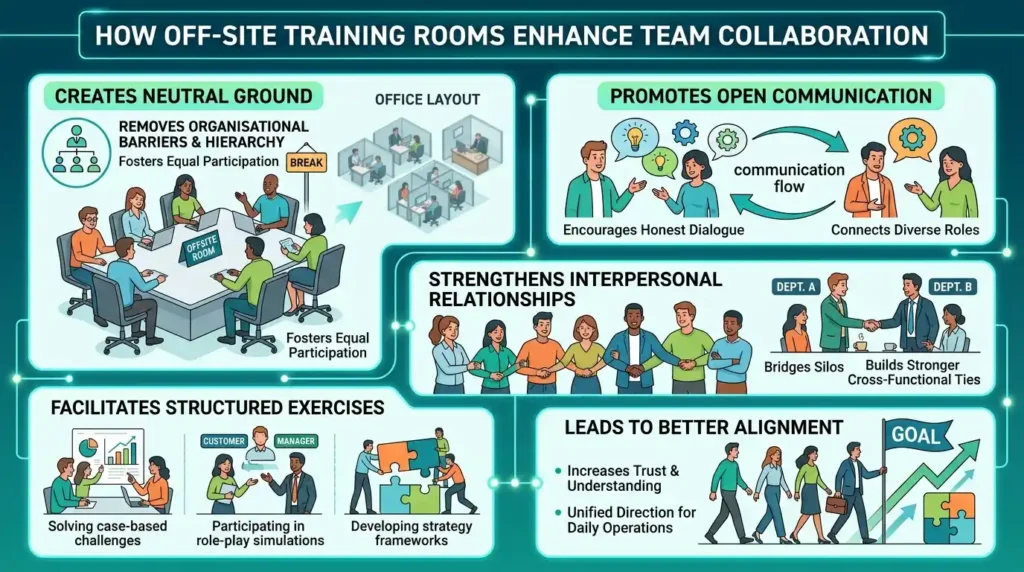
Offsite training rooms enhance collaboration by creating neutral ground where team members interact without organisational barriers. This setting promotes open communication, equal participation, and stronger interpersonal relationships across departments and roles.
Office layouts often reinforce hierarchy. Managers sit separately. Teams operate in silos. This structure limits cross-functional collaboration. Offsite spaces remove these divisions. Employees sit together based on activity, not rank. This shift improves communication flow and encourages shared problem-solving.
Structured group exercises become more effective in these settings. Teams engage in collaborative tasks such as:
- Solving case-based challenges
- Participating in role-play simulations
- Developing strategy frameworks
These activities strengthen trust. Employees gain visibility into different perspectives. This leads to better alignment when they return to daily operations.
Can off-site training rooms increase employee morale?
Offsite training rooms increase employee morale by demonstrating organisational investment in development and well-being. Employees feel valued when given access to professional environments, which improves job satisfaction, motivation, and retention rates.
Employee morale links directly to perceived investment. A 2024 UK workforce study showed that 72% of employees feel more motivated when companies provide structured development opportunities.
Offsite training reinforces this commitment. It signals that learning is not an afterthought. Employees receive time, space, and resources to grow. The experience itself contributes to morale. Leaving the office reduces monotony. Engaging in interactive sessions creates positive associations with work.
Recognition also increases. When employees attend external training, they often see it as a reward or milestone. This perception strengthens loyalty and long-term engagement.
What role does structured space play in learning outcomes?
Structured training spaces improve learning outcomes by providing purpose-built facilities designed for instruction, interaction, and knowledge retention. These environments support various training formats and ensure consistent delivery across sessions.
Standard office meeting rooms lack specialised features. Poor acoustics, limited seating flexibility, and inadequate presentation tools reduce training effectiveness.
Professional training rooms address these limitations. They include:
- High-definition display systems for visual clarity
- Modular furniture for different session formats
- Integrated technology for hybrid or digital training delivery
These features allow trainers to deliver content with precision. Participants engage through multiple formats, including visual, auditory, and interactive methods. Consistency also improves measurement. When training occurs in a controlled environment, organisations can track outcomes more accurately. This includes attendance rates, participation levels, and post-training performance metrics.
Businesses seeking these benefits often rely on dedicated professional training rooms for business learning that are designed specifically for structured development programmes.
How do off-site training rooms support leadership development?
Offsite training rooms support leadership development by creating focused environments where emerging leaders practice decision-making, communication, and strategic thinking without operational pressure. This setting allows real-time feedback and skill refinement.
Leadership training requires reflection and discussion. Office environments limit both. Managers remain connected to daily responsibilities, which reduces engagement in development sessions.
Offsite venues eliminate this conflict. Leaders participate fully in exercises such as:
- Strategic planning simulations
- Conflict resolution workshops
- Performance coaching sessions
These activities demand concentration. External environments provide that clarity. Peer learning also improves. Leaders interact with colleagues from different departments. This exposure broadens understanding and enhances decision-making capabilities.
Organisations that invest in leadership training see measurable results. Data shows a 23% increase in team productivity when managers receive structured development in dedicated environments.
Do off-site training rooms improve knowledge retention?
Offsite training rooms improve knowledge retention by creating distraction-free environments that enhance concentration and reinforce learning through structured delivery methods. Employees absorb and recall information more effectively when training occurs outside routine workspaces.
Retention depends on focus and repetition. Office-based training often fails due to interruptions and multitasking.
Offsite sessions eliminate these barriers. Employees engage fully with content. Trainers can apply reinforcement techniques such as:
- Interactive discussions
- Scenario-based learning
- Immediate feedback loops
These methods strengthen memory encoding. Participants retain information longer and apply it more accurately. The environment also influences recall. When learning occurs in a distinct setting, employees associate knowledge with that experience. This improves retrieval during real-world applications.
Why is location and accessibility important for off-site training success?
Location and accessibility are critical because they determine attendance rates, punctuality, and overall participant experience. Easily accessible training venues reduce logistical barriers and ensure employees arrive prepared and engaged.
Travel complexity reduces participation. Employees facing long commutes or unclear directions arrive late or distracted. Accessible venues solve this issue. Locations near transport hubs improve punctuality. Clear access routes reduce stress before sessions begin.
Facility design also matters. Training rooms located in professional centres often provide additional services such as reception support and on-site amenities. A deeper evaluation of this factor is covered in Why Location and accessibility impact training venue selection, which explains how accessibility directly influences training outcomes.
How do off-site training rooms contribute to organisational culture?
Offsite training rooms contribute to organisational culture by reinforcing values such as learning, collaboration, and continuous improvement. These environments create shared experiences that strengthen alignment and internal communication.
Culture develops through consistent behaviour and shared experiences. Offsite training creates structured opportunities for both. Employees engage in sessions that reflect company priorities. Topics such as innovation, leadership, and teamwork become embedded through practice.
Shared experiences build cohesion. Teams participate in activities outside of daily routines. This strengthens relationships and improves communication across departments. Cultural alignment also improves onboarding. New employees attending offsite training gain a clearer understanding of expectations and organisational values.
Explore our training rooms guides,
How to Create an Inclusive and Collaborative Environment for Your Business Training
Why Natural Light and Ergonomic Furniture Matter in a Modern Training Room
Are off-site training rooms cost-effective for businesses?
Offsite training rooms are cost-effective because they deliver higher engagement, better retention, and improved performance outcomes, which offset the initial investment. Businesses achieve measurable returns through increased productivity and reduced training inefficiencies.
Cost evaluation must consider outcomes, not just expenses. Office-based training often results in low engagement and limited retention, which reduces return on investment. Offsite training increases effectiveness. Higher engagement leads to faster skill acquisition. Employees apply knowledge more accurately, reducing errors and inefficiencies.
Time efficiency also improves. Structured sessions minimise delays and interruptions. This ensures training objectives are met within planned schedules. Businesses that optimise training environments report up to 30% improvement in post-training performance metrics. This directly impacts operational efficiency and revenue generation.
For organisations ready to implement structured learning environments, options like Secure your corporate training venue with fast booking access Provide streamlined solutions for immediate deployment.
Offsite training rooms provide measurable benefits across creativity, morale, collaboration, and performance. They remove workplace distractions, introduce cognitive variety, and create structured environments that enhance learning outcomes. These factors directly impact employee engagement and organisational efficiency.
From My Company delivers professional Training Rooms designed to support focused learning, accessible locations, and consistent training outcomes. These environments align with modern workforce expectations and enable organisations to implement effective development strategies with clarity and precision.
Frequently Asked Questions
What makes a training room different from a regular meeting room?
Training rooms are purpose-built for learning, featuring flexible layouts, integrated AV technology, and seating for 10–40+ participants over 3–8 hour sessions. From My Company provides professional training rooms optimised for knowledge retention, while meeting rooms suit shorter decision-making sessions with 2–12 people.
What features should I look for when booking training rooms?
Essential features include reliable AV technology, flexible seating arrangements, natural lighting, and acoustic optimisation. From My Company offers training rooms with high-definition displays, modular furniture, and integrated hybrid learning technology to support diverse training formats.
How much does it cost to rent corporate training rooms?
Costs vary by location and capacity, with average hourly rates ranging from £35–£50 and daily rates from £250–£450. From My Company provides transparent pricing for training rooms with flexible booking options by the hour or full day, depending on your organisational needs.
Can training rooms accommodate hybrid or remote participants?
Yes, modern training rooms include integrated video conferencing, high-quality audio systems, and large displays for seamless hybrid delivery. From My Company’s training rooms support hybrid learning with reliable technology that ensures remote and in-person participants engage equally.
Why choose an offsite training room over an in-house space?
Offsite training rooms eliminate workplace distractions, provide purpose-built learning environments, and improve focus and knowledge retention by up to 30%. From My Company offers professionally managed training rooms designed specifically for structured learning, outperforming generic office meeting spaces.