
Yes. Organising a professional corporate training event requires planning venue logistics, technology, catering, learning objectives, and attendee management; a typical timeline runs 6–12 weeks and includes venue booking, AV provisioning, trainer confirmation, participant registration, and post-event evaluation.
What are the core steps to organise a professional corporate training event?
Book a suitable venue, define learning outcomes, secure trainers, arrange AV and catering, open registration, and run evaluations.
Begin by defining clear learning objectives tied to business KPIs. Select dates based on attendee availability and trainer schedules. Choose a venue that supports capacity, layout, and AV needs. Contract an experienced trainer and confirm the syllabus and materials. Set up registration tools and collect attendee data. Arrange catering and on-site support. Deliver the event and gather feedback using standardised evaluation forms.
How do I choose the right training room for my event?
Select a training room that matches group size, seating layout, AV requirements, and accessibility standards.
Measure expected headcount and choose a room with 10–20% extra capacity. Verify seating configurations: classroom, U-shape, theatre, or workshop islands. Confirm fixed or portable AV: projector (4,000 lumens), wireless screen mirroring, PA system, and reliable Wi‑Fi with at least 10 Mbps per 25 users. Check accessibility for disabled attendees and proximity to transport links. Request a site visit and a room set-up plan before signing the contract.
Also read our articles, The Impact of Professional Catering Services on Your Corporate Training Event Success and Book Your Professional Training Room and Enjoy On Site Catering and Support.
What AV and technical specifications ensure smooth training delivery?
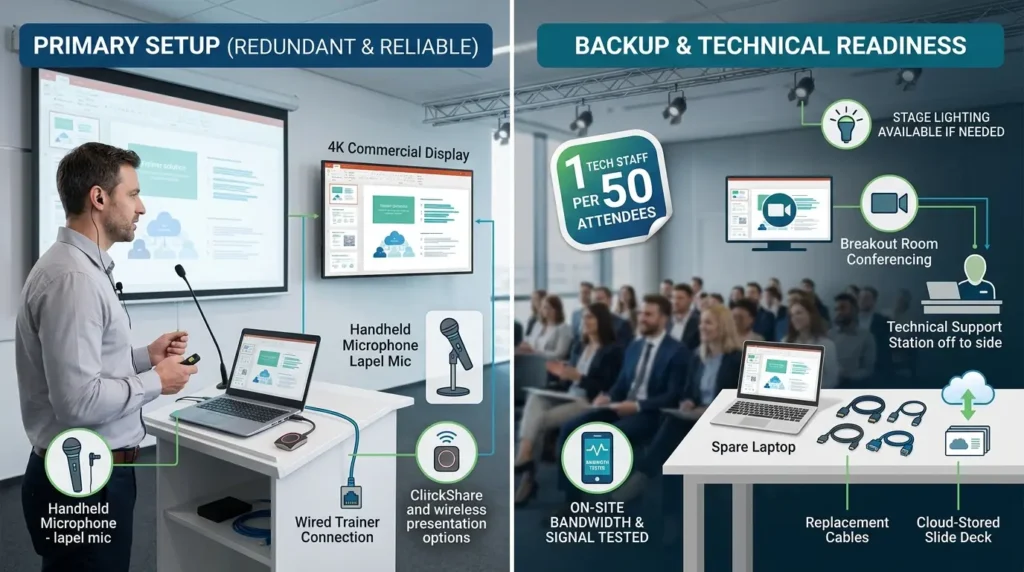
Provide a redundant AV setup: projector or 4K display, wired and wireless presentation options, lapel or handheld microphones, and breakout room conferencing.
Test bandwidth and signal strength on-site. Reserve one technical support staff per 50 attendees. Install wired Ethernet for trainers and live-stream feeds. Prepare adapters for HDMI, USB-C, and VGA. Use a presentation clicker and stage lighting if needed. Create a backup plan: spare laptop, replacement cables, and cloud-stored slide deck.
How much lead time is required to plan a mid-sized corporate training event?
Plan 6–12 weeks for a 25–75 person training event; allow longer for bespoke curriculum or external speakers.
Weeks 6–8: confirm learning objectives, shortlist venues, and issue a request for proposal. Weeks 4–6: finalise venue, book trainers, and begin attendee invitations. Weeks 2–4: confirm catering, AV, and printed materials. Final week: run a technical rehearsal and circulate final logistics to attendees. For multi-day or cross-site events, extend planning to 12–20 weeks.
What budget items should I include and how much do they cost?
Budget for venue hire, AV and tech support, catering, trainer fees, printed materials, and contingency (5–10% of total).
Sample costs for the UK, mid-2026: venue hire for a day: £400–£2,500 depending on central location and room grade. AV package with technician: £250–£900. Corporate catering per person: £12–£45 (breakfast £6–£12, lunch £10–£28). Trainer fees: £600–£3,500 per day depending on expertise. Printed materials and handouts: £2–£6 per attendee. Allocate a contingency line of 5–10% for last-minute changes.
How does professional catering affect training outcomes?
Professional catering sustains attention, supports networking, and enforces schedule discipline through timed breaks.
Provide balanced menus with protein, vegetables, and gluten-free options. Include clearly labelled allergen information for compliance. Schedule two 15-minute breaks for sessions under three hours; schedule a 60–90-minute lunch for full-day events. Use boxed lunches for tight schedules to maintain timing. Track dietary needs during registration to reduce waste and avoid service delays.
How do I register attendees and manage communications?
Use an online registration tool that captures name, role, dietary needs, accessibility requirements, and learning expectations.
Require business email and company name for verification. Send automated confirmations and calendar invites upon registration. Issue a pre-event information pack seven days before the session with agenda, travel directions, parking, and Wi‑Fi access details. Set up an on-site check-in process using QR codes or a registration tablet to reduce queues.
How should I structure the agenda for maximum learning retention?
Alternate 20–30 minute content blocks with 10–15 minute practical exercises or breaks.
Start with a 15-minute icebreaker that links to learning objectives. Deliver 20–30 minute theoretical segments, then assign a 10–15 minute case exercise or group discussion. Use a 10-minute recap after each module to reinforce key takeaways. Reserve 20–30 minutes at the end for Q&A and action planning. Provide takeaway materials and a one-page action template for post-event application.
How do I measure event success and learning transfer?
Combine immediate feedback surveys, knowledge checks, and 30–90 day follow-up metrics linked to KPIs.
Use a Likert-based post-session survey to measure satisfaction and perceived learning. Run a short knowledge test or practical assessment at the end of the event. Track 30–90-day business metrics tied to objectives, for example: 18% increase in process compliance, 22% faster task completion, or 12% reduction in errors. Ask managers to validate behaviour change through a simple checklist.
What onsite support roles improve event reliability?
Assign a venue coordinator, technical lead, catering liaison, and a delegate experience host.
Venue coordinator manages room setup and times. The technical lead handles AV, network, and backups. Catering liaison synchronises meal timing and special diets. The delegate experience host greets attendees, manages registration, and distributes materials. Allocate staff ratios: one coordinator per room and one technical lead per 50 attendees.
Explore our Training Rooms guides,
How the Right Training Environment Can Significantly Improve Your Team Productivity Levels
Understanding the Impact of Classroom Design on Effective Adult Learning and Retention
When should I consider hiring dedicated training room services?
Hire dedicated training room services when you require professional AV, flexible room layouts, catering, and on-site support that scale with attendee numbers.
Training room providers deliver standardised room set-ups and certified network reliability. They offer configurable seating, breakout areas, and professional catering options. They also supply experienced technicians and clear invoicing for corporate procurement. For recurring training programmes, a reliable training room supplier reduces planning time by 30–50%.
Organising a professional corporate training event requires clear objectives, a fitted venue, robust AV, a structured agenda, professional catering, and measurable follow-up. From defining KPIs to post-event validation, follow the timeline and staff roles outlined above. From My Company provides flexible Training Rooms, AV support, and onsite catering that align with these requirements and streamline delivery.
Frequently Asked Questions
What are the key features of a good corporate training room?
A professional corporate training room should offer adjustable seating layouts, reliable high‑speed Wi‑Fi (at least 10 Mbps per 25 users), and fully integrated AV like projectors, screens, and sound systems. From My company’s Training Rooms are designed to support seminars, workshops, and interactive sessions with clear sightlines, comfortable furniture, and breakout areas for group work.
How far in advance should I book a training room for a corporate event?
For a mid‑sized corporate training event (25–75 people), booking 6–12 weeks in advance increases the chance of securing preferred dates and room setups. From My company’s Training Rooms can be reserved earlier if you know key dates, which helps lock in AV packages, catering, and technical support.
Can Training Rooms support hybrid or online training sessions?
Yes, many modern Training Rooms support hybrid training with video conferencing systems, multiple cameras, and stable broadband for live streaming. From My company’s Training Rooms include connectivity and layout options that let trainers broadcast to remote participants while maintaining engagement with in‑person delegates.
What are typical costs involved in hiring Training Rooms for a day?
Corporate Training Rooms in the UK often range from £400–£2,500 per day depending on location, size, AV package, and inclusions such as basic catering or Wi‑Fi. From My company’s Training Rooms provide transparent pricing that bundles AV, basic support, and room hire, with optional catering upgrades for full‑day events.
How do I know if a Training Room is suitable for interactive workshops?
A suitable Training Room for interactive workshops has flexible seating (cabaret or U‑shape), movable tables, whiteboards, and enough space for group activities. From My company’s Training Rooms are configured to support hands‑on exercises, breakout groups, and trainer movement, ensuring high engagement and effective learning outcomes.