
Yes. For companies with multiple corporate shareholders, appoint the correct individual as director, obtain board and shareholder resolutions, verify the corporate shareholder’s authorised signatory, update Companies House filings, and record the new director on the PSC register.
How do you prepare for a director appointment when shareholders are corporate entities?
Prepare by confirming each corporate shareholder’s board resolution, identifying its authorised signatory, and collecting verified identity and authority documents for the individual who will act as director.
Begin by requesting the corporate shareholder’s board minutes or shareholder resolution that authorises the appointment of a director representative. Verify the authorised signatory’s identity with government-issued ID and a corporate extract (e.g., Companies House filing or foreign equivalent). Confirm the individual’s capacity to act as a director under the corporate shareholder’s constitution and local law. Record the authority date and resolution reference for audit trails. Keep copies for Companies House submission and the company’s internal minute book.
Who can be appointed when a shareholder is a corporate body?
Appoint an individual nominated by the corporate shareholder who holds formal authority via a board minute or written resolution.
The corporate shareholder cannot itself act as a natural-person director. The shareholder must nominate a natural person to occupy the director role. That person must meet statutory eligibility: be at least 16 years old, not disqualified under the Company Directors Disqualification Act 1986, and not otherwise barred by law. Ask the corporate shareholder for a clear nomination letter or minute naming the individual, plus a corporate extract showing authorised signatories. Verify any foreign corporate shareholder’s governance documents and, when necessary, obtain certified translations. Read our articles, The Importance of Having an Alternate Director for Your UK Limited Company and Let Us Manage Your Director Appointment Filings and Maintain Your PSC Register.
What documents prove a corporate shareholder’s authority to appoint a director?
Provide a board minute or written resolution, a corporate extract (e.g., Companies House record), and proof of the authorised signatory’s identity.
The essential records are:
- Board minute or written resolution authorising the appointment, signed per the corporate shareholder’s articles.
- Corporate extract or certificate of incumbency showing directors or authorised signatories.
- Government-issued photo ID for the authorised signatory (passport or driving licence).
- Proof of address for the individual nominee (utility bill or bank statement dated within 3 months).
Collect certified copies when the shareholder is overseas. Retain originals or certified copies for the company minute book and for Companies House audit requests.
How do you verify the nominee’s suitability and identity?
Verify identity using a passport or a photocard driving licence, confirm residential address with a recent utility or bank statement, and check disqualification registers and sanctions lists.
Run three checks: identity, eligibility, and reputation. Identity: verify passport or photocard driving licence details against an original document. Address: validate with a dated utility or bank statement. Eligibility: search Companies House for prior disqualifications, check the Insolvency Service disqualification register, and screen UK/HM Treasury sanctions lists. For overseas nominees, use equivalent national ID systems and a corporate due diligence provider. Document verification results and date-stamp evidence in the company records.
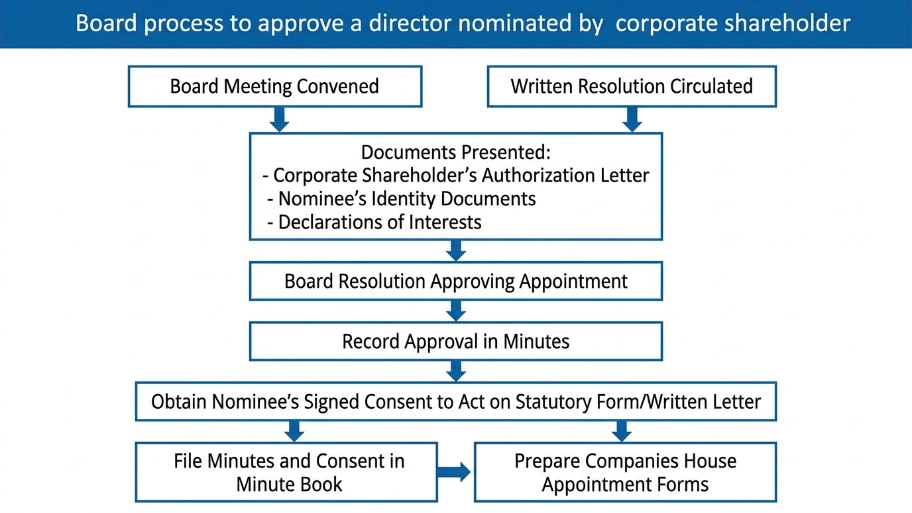
What is the board process to approve a director nominated by a corporate shareholder?
Convene a board meeting or circulate a written board resolution, record the approval in minutes, and document the nominee’s consent to act as director.
Follow these steps: call a board meeting or circulate a written resolution per the company’s articles. Present the corporate shareholder’s authorisation, the nominee’s identity documents, and any declarations of interests. Record the board’s resolution approving the appointment. Obtain the nominee’s signed consent to act on the statutory form or a written letter. File the board minutes and consent in the minute book and prepare the Companies House appointment forms.
How do you file the appointment with Companies House and update statutory registers?
File the appointment electronically within 14 days using form AP01 (individual) or AP02 if an alternate route applies, update the director register, and amend the PSC register if ownership changes.
Submit form AP01 with the new director’s details via WebFiling or the company’s authorised agent service. Include the date of appointment and the director’s service address if different from usual. Update the company’s internal director register and the statutory books immediately. Review the PSC register: if the corporate shareholder’s ownership or control changes because of the appointment, record that change and notify Companies House using the appropriate PSC submission. Keep electronic and hard-copy confirmations of filing for compliance audits.
How should conflicts of interest and related-party transactions be handled?
Identify related-party status, require directors to declare interests, and have the board approve any material related-party transactions in advance.
Treat a director nominated by a shareholder as a related party when the shareholder holds significant control. Require an immediate written declaration of interests from the new director. For any transaction between the company and the corporate shareholder, obtain board approval recorded in minutes. For substantial transactions, secure independent valuation or shareholder approval, depending on the articles and the Companies Act 2006. Keep conflict-management records for auditors and regulators.
What are the tax, immigration, and regulatory checks to run?
Check right-to-work if the director will perform UK work, run tax residence queries for remuneration planning, and confirm sector-specific regulatory permissions.
Right-to-work: confirm the nominee’s legal ability to work in the UK if they will perform duties onshore. Tax: determine UK tax residency and National Insurance obligations for salary or benefits. Regulatory: verify whether regulated sectors (financial services, regulated legal entities) require approvals from bodies like the FCA or SRA. Record all checks and dates; non-compliance can trigger penalties for the company and the director.
How do you structure the appointment documents to reduce future disputes?
Use clear board minutes, a written consent to act, a formal appointment letter, and a documented delegation of authority from the corporate shareholder.
Issue an appointment letter specifying duties, start date, service address, remuneration (if any), and grounds for termination. Archive the corporate shareholder’s delegation document that names the authorised signatory and the scope of authority. Include confidentiality and conflict-of-interest clauses where appropriate. Keep all documents in the company minute book and share registers for 6 years as standard evidence for dispute resolution.
Explore our Director Appointment guides,
The Impact of Accurate Director Appointment Records on Potential Investor Due Diligence
Why Your Growing Business Needs a Managed Director Appointment and Resignation Strategy
What practical timeline and checklist ensure a compliant appointment?
Complete verification, board approval, nominee consent, Companies House filing, and register updates within 14 calendar days of appointment.
Checklist:
- Obtain shareholder board resolution and corporate extract.
- Verify authorised signatory identity; collect nominee ID and address.
- Obtain the nominee’s signed consent to act.
- Convene board resolution approving appointment.
- File AP01 with Companies House within 14 days.
- Update the director and PSC registers.
- Record appointment letter and minute book entries.
Companies with multiple corporate shareholders must follow formal authority verification, board approval, identity checks, and timely Companies House filings to appoint a director lawfully. From My Company provides managed director appointment services to verify corporate authority, prepare board minutes, file AP01 forms, and maintain the PSC register to ensure compliance and clear audit trails.
Frequently Asked Questions
What is a Director Appointment in a UK company?
A Director Appointment is the formal process of adding a new director to a company record and updating Companies House. From My company handles the filing, identity checks, and statutory updates needed to keep the appointment compliant.
What documents are required for a Director Appointment?
A Director Appointment usually requires proof of identity, proof of address, and completed appointment details for the new director. From My company also checks the company’s articles and any internal approvals before filing.
How long does a Director Appointment take in the UK?
A Director Appointment can often be completed quickly once the documents and approvals are ready. The Companies House filing must be submitted within the required statutory timeframe after the appointment is made.
Can a company with multiple shareholders appoint a director?
Yes, a company with multiple shareholders can appoint a director if its articles and shareholder approvals allow it. From My company reviews the approval structure and prepares the Director Appointment filing in line with the company’s governance rules.
Does a Director Appointment affect the PSC register?
A Director Appointment can affect the PSC register if the new director changes who has significant control. The company must review the PSC position and update the register or file any required changes after the appointment.