
To update your company register after appointing a new director, record the director’s details in the statutory register, file the appointment with Companies House using form AP01 within 14 days, and ensure all internal records align with legal compliance requirements under the Companies Act 2006.
What details must be recorded in the company register after a director’s appointment?
A company must record the new director’s full name, service address, nationality, occupation, date of birth, and appointment date in the statutory register, ensuring all details match Companies House filings and comply with UK corporate record-keeping regulations.
Accurate data entry forms the foundation of statutory compliance. The register of directors is a legal document inspected during audits, due diligence, and regulatory checks. Any mismatch between internal records and Companies House filings triggers compliance risks.
The Companies Act 2006 defines six mandatory data fields. These fields enable identity verification and governance transparency. For example, the service address must be a correspondence address, not necessarily residential. This distinction protects privacy while maintaining traceability.
Consistency across records matters. When the same director appears in multiple filings, identical formatting avoids discrepancies. For example, abbreviations in names or inconsistent job titles often lead to rejected submissions.
Maintaining structured records also supports future updates. If a director resigns or changes details, having a standardised format ensures faster amendments and reduced administrative effort.
How do you file a new director appointment with Companies House?
You must submit form AP01 to Companies House within 14 days of the appointment, either online or by post, ensuring all director details are accurate and verified before submission to avoid penalties or rejection.
Form AP01 serves as the official notification of appointment. Online filing typically processes within 24 hours, while postal submissions take 8 to 10 days. Digital submission reduces errors through validation checks.
The process involves three key steps:
- Complete the AP01 form with verified director details
- Confirm the director has consented to act
- Submit via Companies House WebFiling or approved software
Verification accuracy directly impacts approval. For example, incorrect date formats or mismatched addresses cause automatic rejection. Companies House systems cross-check submitted data against existing records.
Timing is critical. The 14-day deadline is statutory. Missing this deadline results in penalties and flags the company for non-compliance. Late filings also affect the company’s credibility during investor due diligence.
For businesses seeking structured support, the Director Appointment process integrates filing, validation, and record alignment in a single workflow.
Why is updating the statutory register legally required?
Updating the statutory register is a legal obligation under the Companies Act 2006, ensuring transparency in company management and providing accurate records for regulators, shareholders, and third-party stakeholders reviewing company governance.
The statutory register acts as an official record of control and decision-making authority. Regulators use it to verify who holds responsibility within a company. Investors rely on it to assess governance stability.
Failure to maintain accurate registers leads to two key risks: financial penalties and reputational damage. Companies House can impose fines, while inconsistencies raise red flags during compliance checks.
Legal enforcement focuses on traceability. Each director must be identifiable through verifiable data points. This includes cross-referencing with PSC registers and confirmation statements.
Three regulatory outcomes depend on accurate registers:
- Enable compliance audits with verifiable director data
- Support anti-money laundering checks through identity validation
- Maintain corporate transparency for public record access
Accurate registers also simplify annual filings. When records remain updated throughout the year, confirmation statements require minimal adjustments.
What internal records must be updated alongside Companies House filings?
In addition to Companies House filings, companies must update internal documents, including board meeting minutes, director service agreements, company registers, and governance records, to ensure complete and consistent documentation.
Internal documentation reflects operational governance. While Companies House captures public data, internal records document decision-making processes. This distinction matters during legal reviews and disputes.
Board meeting minutes must record the appointment resolution. This includes the approval date, voting outcome, and appointing authority. These minutes act as legal evidence of the decision.
Director service agreements define responsibilities and compensation. Updating these agreements ensures clarity in role expectations. It also aligns employment terms with governance structures.
Key internal updates include:
- Record appointment resolution in board minutes
- Update director service contracts with role definitions
- Amend the company register of directors immediately
- Align the PSC register if the control thresholds change
These updates create a consistent compliance framework. When regulators or auditors review records, alignment across documents demonstrates governance integrity.
How does a director’s appointment impact other compliance registers?
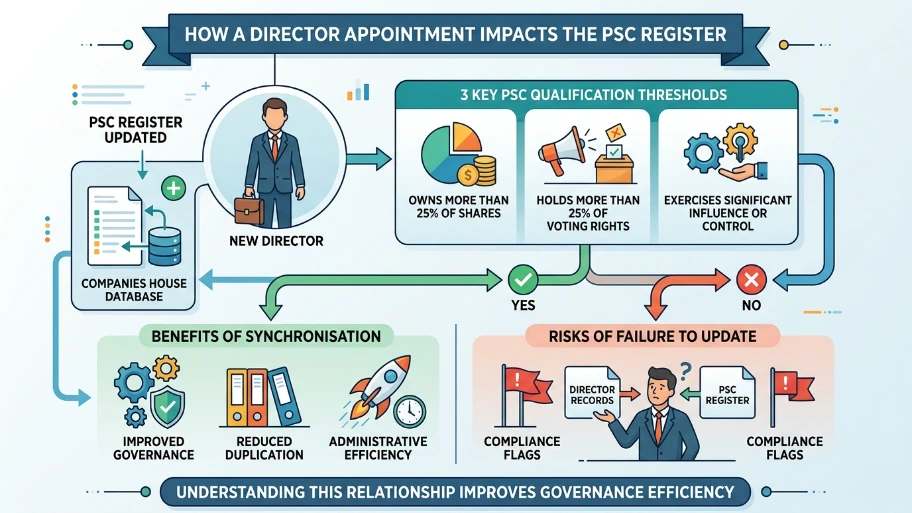
A new director appointment may affect related registers such as the Persons with Significant Control (PSC) register, requiring updates if the director holds more than 25% shares or voting rights or exercises significant influence over the company.
The PSC register tracks individuals with control over the company. Not all directors qualify as PSCs, but overlap occurs in ownership-driven businesses. When a director holds equity, dual registration is required.
Three PSC qualification thresholds apply:
- Owns more than 25% of shares
- Hold more than 25% of voting rights
- Exercise significant influence or control
If any condition is met, the PSC register must reflect the new director’s status. This ensures compliance with UK transparency regulations. Failure to update the PSC register creates regulatory inconsistencies. Companies House cross-references PSC data with director records. Any mismatch triggers compliance flags.
Understanding this relationship improves governance efficiency. Businesses that synchronise these updates reduce duplication and administrative delays.
For a deeper understanding of maintaining accurate director records, refer to professional guidance on statutory director record maintenance.
What are the common errors when updating company registers?
Common errors include incorrect personal details, delayed filings beyond 14 days, inconsistent data across records, missing director consent, and failure to update related registers such as PSC, leading to compliance risks and rejected submissions.
Errors often originate from manual data entry. Even minor discrepancies, such as spelling variations, result in rejection. Automated validation tools reduce this risk significantly. Timing errors remain one of the most frequent issues. Companies that delay filings often face penalties and operational disruptions. This is particularly common in fast-growing SMEs managing multiple governance changes.
Five recurring mistakes include:
- Enter mismatched names across documents
- Miss statutory filing deadlines
- Skip director consent confirmation
- Ignore PSC register updates
- Maintain inconsistent internal records
Each error has measurable consequences. For example, rejected filings delay compliance by 5 to 10 working days. This impacts business transactions requiring updated records, such as banking or investment onboarding. Implementing a structured process eliminates these risks. Standardised templates and verification checkpoints ensure accuracy at each stage.
Explore our Director Appointment service guides,
The Importance of Having an Alternate Director for Your UK Limited Company
How Long Does it Take to Appoint a New Director via Companies House?
How can businesses streamline the director register update process?
Businesses streamline the process by using digital filing tools, maintaining standardised data templates, validating director information before submission, and integrating compliance workflows to ensure accuracy, speed, and regulatory alignment.
Efficiency depends on process design. Companies using manual systems experience higher error rates and slower turnaround times. Digital workflows reduce processing time by up to 70%. Standardisation plays a key role. Templates ensure consistent data entry across filings and registers. This eliminates formatting discrepancies and improves submission success rates.
Three effective process improvements include:
- Automate Companies House filings using approved software
- Validate identity data before register entry
- Synchronise internal and external records in real time
Integration reduces duplication. When systems connect statutory registers with filing tools, updates occur simultaneously. This ensures consistency across all records. Businesses handling frequent governance changes benefit the most. For example, companies undergoing restructuring or investment rounds require rapid and accurate director updates. For urgent governance changes, using a fast-track director appointment service ensures compliance without delays.
How does professional support improve director register compliance?
Professional support improves compliance by ensuring accurate filings, maintaining aligned statutory records, reducing administrative burden, and applying UK regulatory expertise to minimise errors and ensure timely updates across all company registers.
Compliance specialists apply structured workflows. These workflows include validation checks, deadline tracking, and documentation alignment. This reduces human error and ensures consistency.
Outsourcing also improves efficiency. Internal teams often lack dedicated compliance resources. Professional services handle filings, record updates, and regulatory monitoring in a single process.
Key advantages include:
- Ensure accurate AP01 submission within statutory deadlines
- Maintain synchronised statutory and internal registers
- Reduce risk of penalties through expert validation
- Support audit readiness with structured documentation
From My Company delivers director appointment and register update services aligned with UK compliance frameworks. Their process integrates filing, verification, and documentation management, ensuring accuracy across all required records. This structured approach supports businesses managing growth, restructuring, or regulatory scrutiny. It also ensures that governance records remain audit-ready at all times.
Updating your company register after appointing a new director requires precise data recording, timely Companies House filing, and alignment across all internal and statutory records. Each step ensures compliance with the Companies Act 2006 and supports transparent corporate governance.
From My Company provides a structured solution that integrates director appointment filings with complete register updates. This approach reduces errors, ensures compliance, and maintains consistent governance records across all regulatory requirements.
Frequently Asked Questions
What is a director’s appointment in a UK company?
A director appointment is the formal process of adding a new director to a company’s statutory records and filing the change with Companies House. From My company treats it as a compliance step that updates internal registers, board records, and public company information.
How long does it take to file a director appointment with Companies House?
A director appointment must be filed within 14 days of the effective appointment date. Companies House usually processes online filings faster than paper submissions, so timing depends on how the Director Appointment is submitted.
What details are required for a director appointment?
A Director Appointment usually requires the director’s full name, date of birth, service address, nationality, occupation, and appointment date. These details must match the company’s statutory register and the filing sent to Companies House.
Do company registers need to be updated after appointing a director?
Yes, the company’s statutory registers must be updated after a new director is appointed. This includes the register of directors and any related governance records that reflect board changes and compliance obligations.
Can a director’s appointment affect the PSC register?
Yes, a director appointment can affect the PSC register if the new director also has significant control, such as share ownership or voting rights above the reporting threshold. In that case, the company records must be updated to stay compliant.