
Yes. Director appointments must comply with your company’s Articles of Association because those articles set appointment procedures, board composition limits, and any director qualification or removal rules that legally bind the company and Companies House filings.
What are the Articles of Association, and why does it matter for director appointments?
The Articles of Association are the company’s constitutional rules, and they determine how directors are appointed, removed, and what powers they hold.
The Articles set appointment methods, voting thresholds, and any special qualifications. They may require board resolutions, shareholder approval, or director consent forms. Companies House filings reflect appointments only after internal procedures comply with the Articles. Non-compliance creates invalid appointments and legal exposure.
How do the Articles affect the formal process of appointing a director?
The Articles specify required authorisations, such as board resolution, shareholder resolution, or written consent, that must precede registration at Companies House.
If the Articles require a board resolution, you must pass the resolution and record it in minutes before filing. If they require shareholder approval, the company must call a general meeting or use written resolution procedures. Some Articles include bespoke eligibility rules, for example, age limits, professional qualifications, or disqualification clauses, that block appointment until satisfied. Filing forms at Companies House does not override missing internal approvals.
Read our articles, How to Avoid Common Filing Errors During the New Director Appointment Process and Sign Up Now for Expert Director Appointment Assistance and Professional Record Management.
What steps must be completed internally before filing a director appointment?
Obtain the required authorisation, secure the director’s written consent, verify identity, and update statutory registers.
Authorisation varies by Articles: a simple board vote, a special resolution, or unanimous written consent. The prospective director must give written consent to act. Companies must verify identity under internal compliance policies and update the Register of Directors and Persons with Significant Control if applicable. Accurate internal records prevent Companies House rejections and future disputes.
How does Companies House filing interact with Articles-compliant appointments?
Companies House accepts appointment filings but does not check internal compliance with the Articles; the company remains responsible for lawful appointment.
Companies House validates form completion and statutory data. It does not require proof of a board minute or shareholder resolution matching the Articles’ requirements. Therefore, the company must maintain evidence of compliance: minutes, written consents, and updated registers. Failure to retain proof risks internal challenges or regulator scrutiny.
What are the common Articles-related pitfalls during director appointments?
Common errors include missing required shareholder approval, appointing directors who lack consent, and failing to update statutory registers promptly.
Another frequent issue is appointing a director who is contractually barred by Article provisions, such as employment-related restrictions. Companies sometimes neglect director eligibility checks (bankruptcy, disqualification). Delayed filings also cause non-compliance with Companies Act timelines and create discrepancies between internal records and public filings.
How long after an appointment must Companies House be notified?
Companies must file the appointment within 14 days of the appointment taking effect.
The 14-day rule applies to appointments and terminations of directors. Companies must complete form AP01 (appointment) or TM01 (termination) accurately. Late filings attract potential penalties and complicate the accuracy of the public record used by third parties and regulators.
What documentation should a company retain to prove Articles-compliant appointments?
Retain board minutes, shareholder resolutions or written consents, the director’s written consent, identity verification records, and updated statutory registers.
Minutes must record the resolution wording and voting outcome. Written consents must be signed and dated. Identity verification should include the method used: passport checks, electoral roll checks, and address verification. Statutory registers must reflect the appointment with dates and details. Store these documents for at least six years for governance and audit purposes.
How do specific Article clauses influence appointment mechanics?
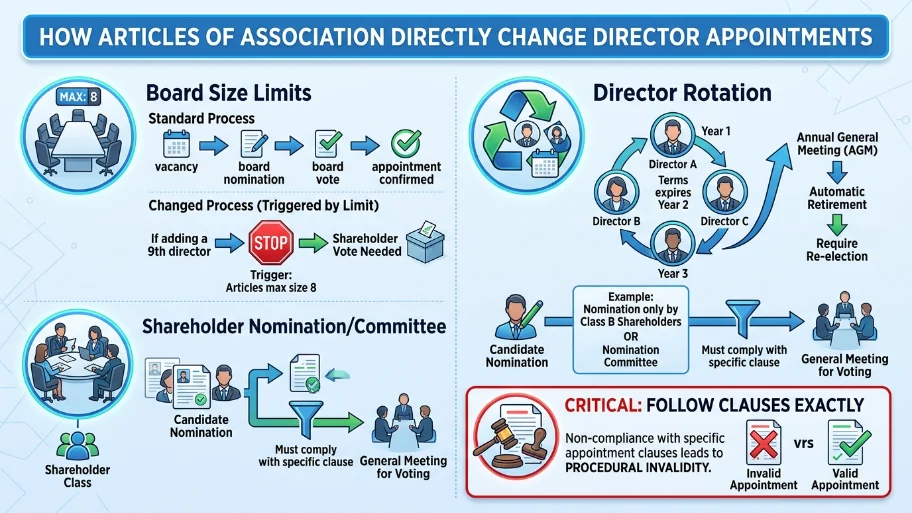
Clauses may require qualification, limit board size, impose rotation, or require shareholder nomination that directly change appointment steps.
For example, Articles may set a maximum of eight directors, triggering a shareholder vote if adding a ninth director. Articles can impose rotation so certain directors retire at the annual general meeting and require re-election. Some Articles require candidate nomination by a committee or specific shareholder class. Follow the clause exactly to avoid procedural invalidity.
When does a director’s appointment become legally effective?
An appointment becomes effective internally when the required authorisation is completed, and the director gives written consent; public effect follows Companies House filing.
Internal effectiveness requires compliance with the Articles and company law. Companies House entry makes the appointment publicly visible. Both stages matter: internal legality creates authority to act; public filing ensures transparency to creditors, banks, and third parties.
What are the governance risks of ignoring Articles during appointments?
Ignoring Articles risks invalid appointments, director liability, shareholder disputes, and regulator action.
An invalid appointment can lead to challenged board decisions and nullified contracts. Directors appointed improperly may face personal liability for actions taken without lawful authority. Shareholders can sue for breach of duty or seek injunctions. Regulators may investigate systemic failures in governance practices.
How does the appointment process differ for corporate directors or nominee directors?
Corporate directors require a corporate resolution from the appointing company; nominee directors require clear declarations of roles and conflicts.
A corporate entity acting as a director must pass its own board resolution and record an authorised representative. Nominee directors must provide written consent and disclose the appointing party and any conflicts. Articles sometimes prohibit corporate directors or set special procedures; check and comply with those clauses.
What practical checks should you run before proposing a director for appointment?
Verify eligibility using official records, confirm written consent, check Article clauses, ensure quorum for approvals, and prepare Companies House form.
Eligibility checks include bankruptcy registers, director disqualification lists, and criminal convictions where relevant. Confirm that the Articles do not impose prohibitions or prerequisites. Ensure the board or shareholders meet quorum requirements specified in the Articles. Prepare AP01 with accurate personal details and the date of appointment.
How can companies update Articles to simplify director appointments?
Companies can amend the Articles by passing a special resolution at a general meeting requiring 75% shareholder approval.
A special resolution changes constitutional rules. Draft precise wording to permit desired appointment methods, for example, enabling written board consents or increasing board size. File a copy of the amended Articles at Companies House within 15 days. Use this route to align governance with operational needs.
Explore our Director Appointment guides,
Can a Corporate Entity Be Appointed as a Director of a UK Company?
The Importance of Having an Alternate Director for Your UK Limited Company
How does From My Company help with director appointments and Articles compliance?
From My Company assists by reviewing Articles, preparing resolutions, handling filings, and maintaining statutory registers for compliant appointments.
The service validates Article clauses, drafts required minutes or written resolutions, collects director consents, and completes Companies House filings. From My Company reduces the risk of delayed filings and governance errors by managing the end-to-end process.
Follow your Articles precisely before registering any director with Companies House. Maintain written consents, minutes, identity checks, and updated registers. From My Company provides structured support to verify Articles compliance, prepare required documentation, and file accurate appointment records.
Frequently Asked Questions
What is a director appointment and why is it important for a UK company?
A director appointment is the formal process of adding a person to a company’s board of directors, giving them legal authority to manage the company on behalf of shareholders. It matters because every director must be properly appointed and registered at Companies House to ensure compliance with the Companies Act and the company’s Articles of Association.
How long do I have to file a new director appointment with Companies House?
You must file a new director appointment within 14 days of the appointment taking effect, using the correct Companies House form, such as AP01. Late filings can create discrepancies in the public record and increase the risk of compliance issues during audits or due diligence checks.
Can From My Company help with director appointment paperwork and Companies House filing?
Yes, From My Company supports director appointment by preparing the necessary resolutions, obtaining written consents, and submitting accurate filings to Companies House. This service helps ensure the appointment complies with the company’s Articles of Association and current UK company law requirements.
What documents are needed to appoint a new director in the UK?
To appoint a new director, you typically need a board or shareholder resolution, the director’s written consent to act, and identity and address verification records. You must also update the Register of Directors and, where applicable, the Register of Persons with Significant Control before filing the appointment with Companies House.
What happens if a director appointment does not follow the Articles of Association?
If a director’s appointment does not follow the Articles of Association, the appointment may be legally invalid, and board decisions taken by that director can be challenged. From My Company’s director appointment support includes reviewing the Articles to ensure the process aligns with the company’s internal rules and statutory obligations.