
Yes. Large enterprises prefer outsourcing meeting rooms because outsourced centres cut occupancy costs by up to 40%, deliver flexible capacity, and provide professional facilities and security that internal office spaces rarely match.
Why do large enterprises prefer outsourcing meeting rooms over maintaining internal office spaces?
Enterprises outsource meeting rooms to reduce fixed occupancy costs, scale capacity quickly, and access professional amenities and security without long-term property commitments.
Outsourcing converts capital expenditure into operating expenditure. Enterprises avoid lease renewals, fit-out costs, and maintenance contracts. This saves an average of 30–40% on per-meeting occupancy costs compared with holding dedicated internal rooms in central business districts. Outsourcing also lets firms allocate meeting spend to projects and teams selectively, improving budget transparency.
Enterprises scale room capacity immediately. When project teams expand for acquisitions or client bids, outsourced centres add rooms within 24–48 hours. When headcount falls, enterprises stop booking without bearing idle-space costs. This operational flexibility supports agile resourcing and short-term engagements.
Outsourced meeting venues provide consistent facility standards across locations. Providers maintain AV suites, secure reception, and professional front-of-house services to a repeatable specification. That standardisation reduces variability in client experience and saves internal operations teams time on logistics and setup.
How do cost savings compare between outsourcing and maintaining in-house meeting rooms?
Outsourcing meeting rooms typically lowers annual per-meeting costs by 25–40% versus in-house rooms after accounting for rent, utilities, and staff overhead.
Calculate total cost of ownership for internal rooms: prorated rent, utilities, cleaning, AV depreciation, booking admin, and security. For example, a 1,500 sq ft meeting area in central London can generate £120,000–£180,000 annual fixed costs. Divided across 1,200 meetings per year, the per-meeting cost reaches £100–£150.
Outsourced providers offer hourly or day rates, packages, and flexible subscriptions. A comparable professional meeting room hire in central London ranges £40 to £90 per hour, with package discounts for recurring use. Enterprises that run fewer than 2,000 meetings annually find outsourcing cheaper after comparing fixed versus variable costs.
Read our articles, Why Professional Centres Offer Better Privacy for Sensitive Business Legal Consultations Today and Reserve Our Affordable Meeting Rooms and Improve Your Next Client Pitch Outcome.
Enterprises also reduce indirect costs. Third-party centres lower administrative overhead by handling room scheduling, reception, and post-meeting invoicing. Outsourcing shortens transaction times for room provisioning and reduces hidden costs from underused space.
What operational benefits do outsourced meeting rooms provide?
Outsourced meeting rooms streamline logistics, centralise vendor management, and free internal teams from facilities administration.
Providers offer staffed reception, visitor management, secure access control, and standardised AV. This reduces time spent on booking, setup, and troubleshooting. Enterprises centralise facility contracts with a few providers rather than managing multiple landlord relationships and internal maintenance vendors.
Providers often integrate with enterprise calendars and booking platforms. This integration automates billing, attendance records, and resource allocation. Enterprises gain analytics on room usage, allowing data-driven decisions on hiring patterns, preferred locations, and cost centres.
Outsourced centres offer consistent service levels across cities and countries. For global firms, this means predictable experiences when teams travel, reducing the variability and risk of poor client impressions. Consistency supports brand standards and client-facing professionalism.
How do outsourced meeting rooms address privacy and security requirements?
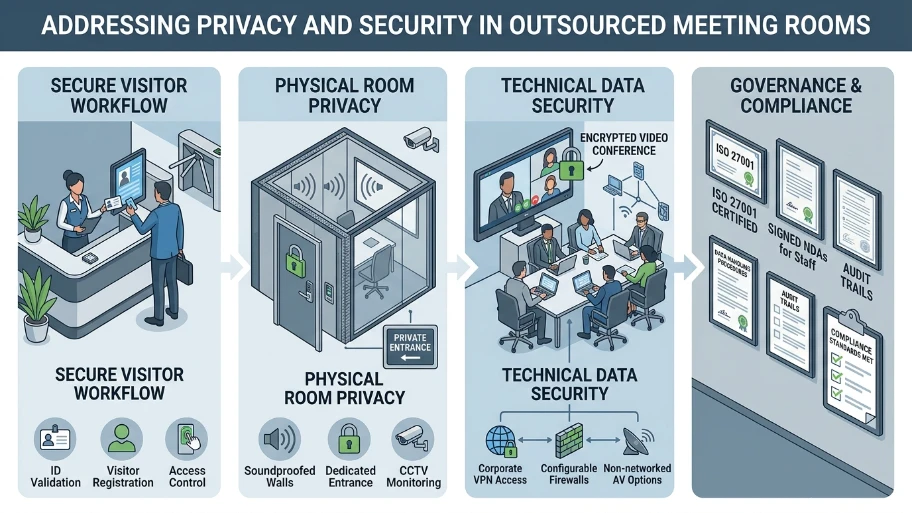
Professional centres implement secure visitor workflows, dedicated private suites, and encrypted AV systems that meet common corporate and legal privacy standards.
Secure reception registers visitors and validates IDs. Many centres provide private executive suites with separate entrances, soundproofing, and non-networked AV options for confidential sessions. Some providers supply SCIF-like spaces for sensitive matters or legal consultations.
Technical security includes encrypted video-conferencing platforms, corporate VPN access, and configurable network firewalls. Hosts can request local-only AV setups to avoid cloud recording. These configurations comply with data protection frameworks and audit trails required by corporate governance teams.
Legal and compliance teams prefer centres that provide signed NDAs for staff, CCTV policies, and documented data-handling procedures. Enterprises select suppliers with clear security certifications and documented incident response plans.
When does outsourcing meeting rooms make strategic sense for enterprises?
Enterprises outsource when utilisation falls below full capacity, when projects demand short-term capacity spikes, or when geographic mobility and client-facing consistency matter.
Enterprises with distributed teams or frequent travel needs benefit from a network of professional centres. If average room occupancy is under 60% across the office portfolio, outsourcing lowers fixed overheads. Companies engaged in M&A, rapid hiring, or cyclical project work find outsourced rooms align with variable demand.
Enterprises that prioritise client perception outsource to secure premium locations and professional front-of-house services. Marketing and client-facing teams prefer venues near clients, which reduces travel friction and reinforces brand position.
Legal, HR, and executive teams outsource for discrete reasons: privacy for sensitive meetings, neutral third-party locations for negotiations, and documented visitor management for compliance audits.
What service features matter most when selecting an outsourced meeting-room provider?
Enterprises prioritise availability, standardised AV, security controls, professional reception, and flexible billing models.
Availability means guaranteed room readiness within hours and reserved time slots across locations. Standardised AV includes high-resolution displays, wired and wireless presentation, and video-conference interoperability with major platforms. Security controls cover visitor ID capture, room-level access management, and configurable network isolation.
Reception services must support guest check-in, badge issuance, and hospitality. Flexible billing models include hourly rates, monthly subscriptions, and credit-based packages that allocate capacity to teams or cost centres. Enterprises also value analytics dashboards showing utilisation, spend by team, and booking patterns. Ask providers for service-level agreements (SLAs) on AV uptime, room cleanliness, and incident response times. Review certification evidence for cybersecurity and physical-security procedures.
How should enterprises integrate outsourced meeting rooms into procurement and compliance frameworks?
Enterprises integrate providers via supplier contracts with clear SLAs, privacy addenda, and billing controls linked to cost centres.
Procurement should evaluate providers on price, location, security posture, and scalability. Legal teams add data-processing addenda and NDAs. Finance teams direct-bill or use cost-centre chargebacks tied to booking metadata.
Operations teams should standardise booking workflows and ensure calendar integration. Security operations must verify encryption standards and access logs. Compliance teams should require audits and right-to-inspect clauses in enterprise agreements. Enterprises can pilot suppliers on a 3–6 month trial to measure utilisation, user satisfaction, and cost savings. Use pilot data to expand supplier coverage or negotiate volume discounts.
Explore our Meeting rooms guides,
How to Minimise External Distractions During Your Important Business Strategy Sessions Today
The Role of Proper Meeting Etiquette in Maintaining a Professional Corporate Image
What measurable outcomes do enterprises achieve after outsourcing meeting rooms?
Enterprises report 20–40% lower meeting-related occupancy costs, 15–25% faster room provisioning, and improved client satisfaction scores.
Cost reductions arise from shifting fixed costs to variable spend and avoiding capital fit-outs. Faster provisioning follows from provider readiness and simplified booking. Client satisfaction improves because of consistent venue quality, professional reception, and reliable AV.
Enterprises also see operational gains: facilities teams reallocate hours from room maintenance to strategic workplace planning. Procurement reduces landlord and facilities vendor complexity by consolidating room needs with a few providers. Internal adoption metrics show higher use of external rooms for client meetings and confidential sessions, freeing internal spaces for collaborative work and team hubs.
Outsourcing meeting rooms delivers concrete financial, operational, and security advantages for large enterprises. It reduces fixed occupancy costs, provides rapid capacity scaling, enforces consistent facility standards, and strengthens privacy for sensitive meetings. When enterprises integrate supplier SLAs, privacy clauses, and calendar automation, they gain measurable improvements in cost, efficiency, and client experience. From My Company helps enterprises reserve professional meeting rooms with secure amenities and flexible billing, supporting better client engagements and lower space overheads.
Frequently Asked Questions
What are meeting rooms used for in a business?
Meeting rooms support client meetings, team discussions, interviews, and presentations. From My company provides meeting rooms that help businesses host focused conversations in a professional setting.
Why do businesses book meeting rooms instead of using office space?
Businesses book meeting rooms to get a private, ready-to-use space without disrupting daily office activity. Meeting rooms also help control costs when teams only need space for specific sessions.
What features should I look for in meeting rooms?
Look for reliable Wi-Fi, presentation equipment, comfortable seating, and privacy. From My company meeting rooms are designed for practical business use, including client calls and small team meetings.
How do meeting rooms help with client meetings?
Meeting rooms create a more professional environment for client meetings and sales discussions. They also help businesses present a polished image with a quiet, structured space.
Can meeting rooms be booked for short business sessions?
Yes, meeting rooms are often booked by the hour or for a half-day. This makes them useful for quick interviews, catch-ups, and small project meetings.