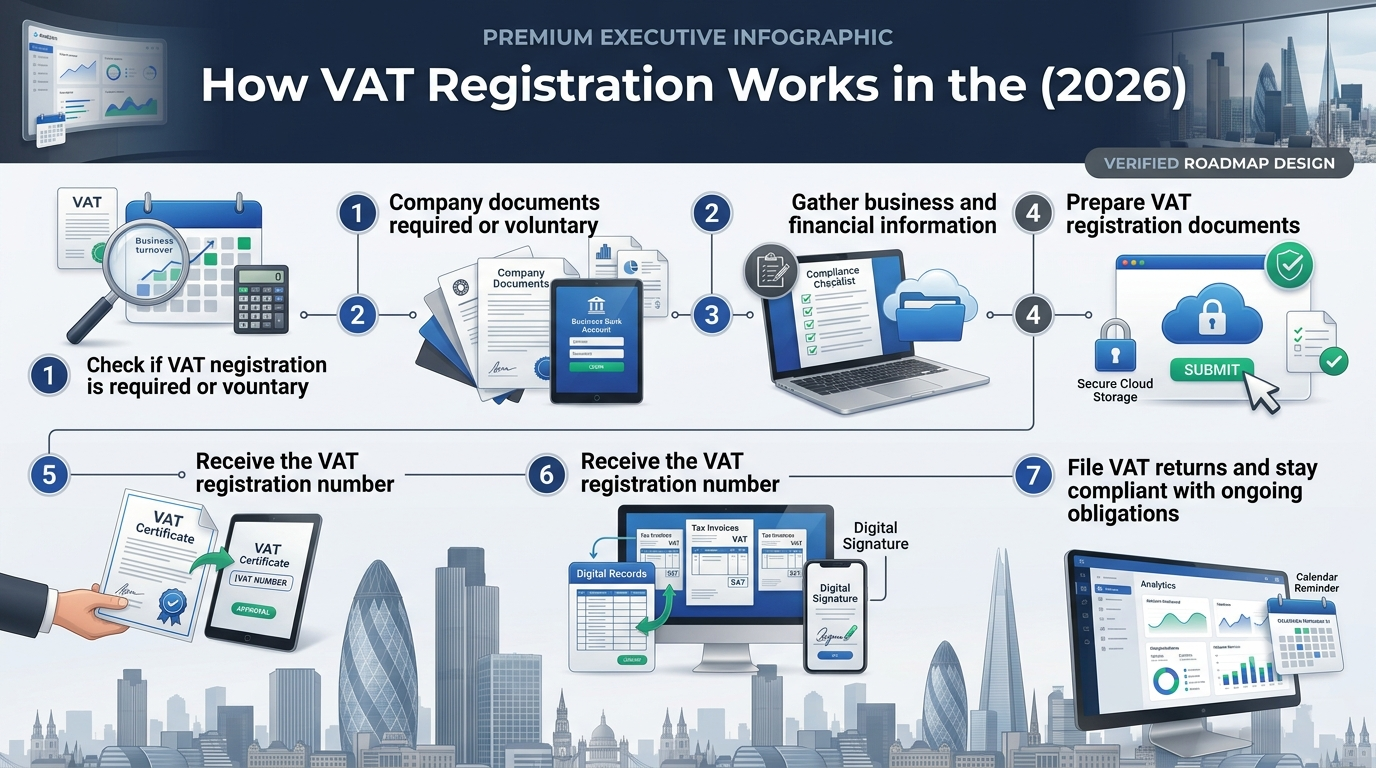
VAT Registration Service
VAT registration is one of the most important tax steps for many UK businesses, and getting it right matters. Register when you’re required to, avoid penalties. Register voluntarily when it makes sense, and enjoy the benefits. Register in a specific scheme, and manage your cash flow better. The process itself is done through HMRC, and while you can handle it yourself, a VAT registration service takes the complexity off your plate and reduces the risk of errors. At Form My Company, we help UK businesses register for VAT as part of our compliance support. This guide explains everything you need to know about UK VAT registration services in 2026.
What Is VAT and Why Does It Matter?
Value Added Tax (VAT) is a consumption tax charged on most goods and services sold in the UK. VAT-registered businesses:
- Charge VAT on their sales. At the standard rate (currently 20%), a reduced rate (5%), or zero rate depending on the goods or services.
- Reclaim VAT on their purchases. VAT paid on business expenses can typically be reclaimed, offsetting the VAT charged on sales.
- Submit VAT returns to HMRC. Usually quarterly, showing VAT charged and reclaimed.
- Follow Making Tax Digital rules. All VAT-registered businesses must keep digital records and file returns through Making Tax Digital-compatible software.
For many businesses, VAT registration is a legal requirement based on turnover. For others, it’s a strategic choice that improves credibility and enables reclaiming VAT on expenses.
Who Needs to Register for VAT?
There are two main paths to VAT registration:
- Mandatory registration. You must register for VAT if your VAT taxable turnover exceeds the current threshold. As of April 2024, the threshold is £90,000 over any rolling 12-month period. If your turnover exceeds this, or if you expect it to in the next 30 days, you must register within 30 days.
- Voluntary registration. You can choose to register for VAT before your turnover reaches the threshold. Many businesses do this because it lets them reclaim VAT on expenses, appears more established to clients and suppliers, and prepares them for growth.
- Specific circumstances. Certain businesses must register regardless of turnover, such as businesses established outside the UK selling goods to UK consumers, or businesses distance selling into the UK.
For most UK-based businesses, mandatory registration applies once turnover hits £90,000. For non-resident sellers (including many e-commerce sellers), different rules can apply based on the type of goods and where they’re stored.
What Does a VAT Registration Service Actually Do?
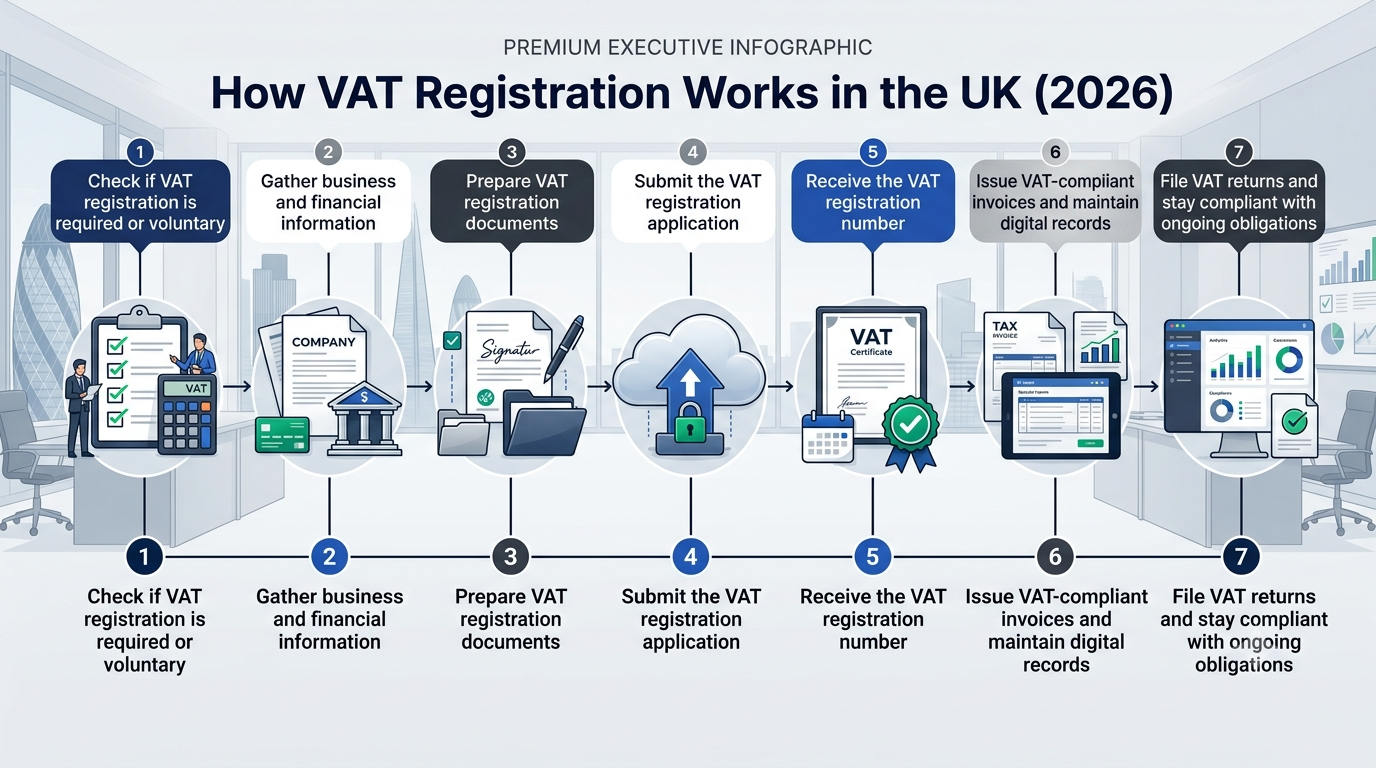
A VAT registration service handles the application process with HMRC on your behalf. A good service goes beyond just submitting a form. Here’s what to expect:
- Assessing your situation. Understanding your business, turnover, activities, and whether registration is mandatory, voluntary, or a specific case.
- Advising on the right approach. Whether to register standard, use a specific scheme (like the Flat Rate Scheme, Annual Accounting Scheme, or Cash Accounting Scheme), or wait based on your situation.
- Preparing the application. Gathering the information HMRC needs, including business details, expected turnover, business activity descriptions, and bank account information.
- Submitting to HMRC. Filing the VAT registration application through the appropriate HMRC channel.
- Tracking the application. Following up if HMRC has queries or needs additional information.
- Receiving the VAT number. Confirming your VAT registration and passing on your VAT registration number.
- Guidance on next steps. Helping you understand VAT invoicing, Making Tax Digital requirements, and your first return.
- Coordination with wider compliance. Making sure VAT registration fits with your other tax and Companies House obligations.
For business owners who’d rather focus on the business than the paperwork, a VAT registration service handles the whole process efficiently.
VAT Schemes to Consider
VAT registration isn’t one-size-fits-all. HMRC offers several schemes designed for different business situations:
- Standard VAT accounting. The default scheme. You charge VAT on sales, reclaim VAT on purchases, and file quarterly returns based on invoices raised and received.
- Flat Rate Scheme. Designed for smaller businesses. You charge VAT at the standard rate but pay HMRC a fixed percentage of your turnover based on your business type. Simpler bookkeeping, but you can’t reclaim VAT on most purchases.
- Cash Accounting Scheme. You account for VAT based on payments received and made rather than invoices raised. Better for cash flow if customers pay slowly.
- Annual Accounting Scheme. File one annual VAT return instead of quarterly, with monthly or quarterly instalments. Reduces admin but requires monitoring.
- Retail Schemes. Various schemes for retail businesses that can simplify VAT calculations for shops and other high-transaction-volume businesses.
Choosing the right scheme depends on your business type, turnover, cash flow, and how much admin you want. A good VAT registration service can advise on which scheme fits your situation.
The Timeline for VAT Registration
The VAT registration process typically takes:
- Preparation and application submission. A day or two once you have the information gathered.
- HMRC processing. Usually 2 to 4 weeks, though this can vary and complex cases can take longer.
- Receiving your VAT number. Once approved, HMRC issues your VAT registration number, which you’ll use on invoices and returns.
- Your effective registration date. This is the date from which you’re VAT registered. It can be backdated in some circumstances if you were required to register earlier and didn’t.
Once registered, you’ll need to:
- Update your invoices and website. To show your VAT number and charge VAT correctly.
- Set up Making Tax Digital-compatible software. For record-keeping and filing.
- Prepare for your first VAT return. Typically due one calendar month plus 7 days after the end of your first VAT period.
- Register for VAT online services. With HMRC, to manage your VAT account.
Planning ahead for these steps ensures a smooth transition into being VAT registered.
VAT Registration for Non-Residents
For non-resident owners of UK companies, VAT registration rules can be more complex. Common scenarios include:
- UK company owned by non-resident, trading in the UK. Standard UK VAT rules apply. Registration is required if turnover exceeds £90,000, or voluntary below that.
- Non-resident selling goods to UK consumers through their own website. May need to register regardless of turnover, particularly if goods are stored in the UK.
- Non-resident selling on UK marketplaces (Amazon, eBay). Marketplace facilitator rules can affect VAT obligations. Marketplaces often collect and account for VAT on some sales, but not all.
- Non-resident selling services to UK businesses. Different rules apply for B2B services (reverse charge often applies).
- Non-resident selling services to UK consumers. May need to register for VAT if providing certain types of services.
Cross-border VAT is genuinely complex, and getting it wrong can lead to significant back tax, penalties, and reputational issues. For non-resident owners, professional VAT advice alongside registration is usually well worth it.
Common Mistakes to Avoid
A few issues come up regularly with VAT registration:
- Missing the mandatory registration deadline. If your turnover exceeds £90,000 and you don’t register within 30 days, HMRC can impose penalties and require back VAT.
- Choosing the wrong scheme. Signing up for the Flat Rate Scheme without checking whether it actually suits your business can cost you money.
- Not planning for cash flow impact. Registering means charging VAT on sales, which can affect prices for B2C customers. Plan how you’ll handle the change.
- Missing Making Tax Digital requirements. All VAT-registered businesses must use MTD-compatible software. Not being set up can cause filing problems.
- Poor record-keeping from day one. VAT records need to be accurate from the effective registration date. Set up bookkeeping properly before you start.
- Overlooking backdated obligations. If you should have registered earlier but didn’t, you may owe back VAT. Address this promptly.
- Not understanding your first return timing. Your first VAT period may not be a full quarter. Know your dates.
- Assuming voluntary registration is always beneficial. It isn’t always. If your customers are mostly consumers who can’t reclaim VAT, adding 20% to your prices may make you less competitive.
A VAT registration service that includes advice, not just filing, helps avoid these issues.
When to Use a Service vs Register Yourself
You can register for VAT yourself through HMRC’s online service. A service is worth considering when:
- Your situation is complex. Cross-border activity, multiple business types, or unusual circumstances benefit from professional handling.
- You’re unsure which scheme suits you. Advice on the right scheme can save you money over time.
- You need to register quickly. Providers with HMRC experience can typically move faster than a first-time user of the online service.
- You want ongoing tax support. A VAT registration service often leads into ongoing VAT return filing, which needs regular attention.
- You’re a non-resident. Cross-border VAT rules are genuinely complex, and getting local professional help matters.
- You want everything coordinated. If VAT registration is happening alongside formation, HMRC PAYE registration, or Companies House filings, a coordinated approach saves time.
- Peace of mind matters. Knowing VAT registration is being handled correctly by someone experienced.
For simple UK-based businesses with straightforward operations, self-registration through HMRC’s online service is manageable. For more complex situations or when time and expertise matter, a service delivers real value.
VAT Registration for E-Commerce and Marketplace Sellers
E-commerce and marketplace sellers often have specific VAT considerations:
- Overseas sellers selling into the UK. The Overseas Goods Rules can require VAT registration regardless of turnover, particularly for goods £135 or less shipped to UK consumers.
- Sellers holding stock in the UK. Storage in the UK (like Amazon FBA warehouses) can trigger VAT registration obligations.
- Marketplace facilitator rules. Marketplaces like Amazon collect VAT on certain sales, but not all. Understanding what the marketplace covers and what you’re responsible for matters.
- Distance selling to the EU from the UK. Different rules apply for cross-border EU sales after Brexit.
For e-commerce sellers especially, VAT registration should be one part of a broader tax planning conversation with someone who understands online selling. Marketplaces publish guidance, but the details matter and mistakes can be costly.
What Happens After VAT Registration
Once you’re VAT registered, ongoing compliance includes:
- Submitting VAT returns. Usually quarterly, though annual accounting is an option. Returns must be filed through Making Tax Digital-compatible software.
- Paying VAT owed to HMRC. By the return deadline, typically one month plus 7 days after the period ends.
- Reclaiming VAT paid on business expenses. Track VAT on eligible expenses to offset against VAT owed.
- Keeping digital records. Under Making Tax Digital rules.
- Issuing VAT invoices. With your VAT number, correct rates, and required information.
- Updating for scheme changes. If your business grows or changes, review whether you’re still in the right scheme.
- Filing changes with HMRC. If your business details, activities, or address change.
- Managing cross-border VAT if applicable. For imports, exports, and non-UK trade.
Ongoing VAT compliance is a real workload for most businesses, which is why many use ongoing accounting and VAT services alongside registration.
How Form My Company Helps
We support UK businesses with VAT registration as part of our compliance services. We can:
- Assess your VAT position. Whether registration is mandatory or voluntary based on your situation.
- Prepare and submit your VAT registration application to HMRC on your behalf.
- Advise on the right VAT scheme. For your business type, turnover, and cash flow.
- Coordinate VAT registration with formation. For new UK companies, so everything’s set up together.
- Support non-resident sellers. With the specific rules that apply to overseas businesses trading in the UK.
- Coordinate with Companies House compliance. So VAT registration fits with your wider UK compliance picture.
- Point you toward specialist support where ongoing accounting and VAT return filing is needed.
For businesses that want VAT registration handled efficiently and correctly, a service takes the complexity off your plate.
Register for VAT Correctly Today
VAT registration is a foundational step for many UK businesses, and getting it right matters. Whether registration is mandatory or a strategic choice, working with a service that handles the process professionally saves time and reduces the risk of costly mistakes. With Form My Company, VAT registration is straightforward and fully supported. Get in touch today and let us handle the process while you focus on your business.
Frequently Asked Questions
When do I have to register for VAT?
You must register for VAT if your VAT taxable turnover exceeds £90,000 over any rolling 12-month period, or if you expect it to in the next 30 days. Certain non-resident sellers and specific business types must register regardless of turnover.
Can I register for VAT voluntarily below the threshold?
Yes. Voluntary registration is common. Benefits include being able to reclaim VAT on business expenses, appearing more established to clients and suppliers, and preparing for growth. It’s not always the right choice for consumer-facing businesses, though.
How long does VAT registration take?
Typically 2 to 4 weeks from application submission, though this can vary. Complex cases or those requiring HMRC follow-up can take longer. Planning ahead makes sense, particularly if you know you’ll cross the threshold soon.
What is Making Tax Digital and does it affect me?
Making Tax Digital (MTD) is HMRC’s programme requiring all VAT-registered businesses to keep digital records and file VAT returns through MTD-compatible software. It applies to all VAT-registered businesses regardless of turnover.
Which VAT scheme should I choose?
It depends on your business. Standard accounting suits most. The Flat Rate Scheme can simplify bookkeeping for smaller businesses. Cash Accounting helps cash flow. Annual Accounting reduces filing frequency. A service can advise on what fits your situation.
Do non-resident sellers need to register for UK VAT?
Often yes, particularly for sellers holding stock in the UK or selling goods £135 or less to UK consumers. Rules are complex, and marketplace facilitator arrangements affect what you’re responsible for. Professional advice matters for cross-border e-commerce.
Can Form My Company handle VAT registration for me?
Yes. We handle VAT registration applications on your behalf, advise on the right scheme, coordinate with your wider UK compliance, and support both UK-based and non-resident owners. Get in touch to discuss your situation.