
Document standardisation in a company pack creates uniform structural, legal, and operational templates across all official corporate filings. This process eliminates compliance errors, streamlines regulatory audits, prevents identity manipulation, and ensures seamless administrative continuity throughout the lifecycle of a United Kingdom enterprise.
What Is Document Standardisation in a Business Context?
Document standardisation is the systematic alignment of corporate records, administrative templates, and official registration files with verified legal frameworks. It ensures every legal instrument within a company formation pack contains uniform formatting, precise terminology, and accurate ownership data.
Corporate administration requires absolute consistency across all regulatory records. When a United Kingdom business registers with Companies House, administrative officers submit statutory instruments including statutory registers, articles of association, and shareholder certificates.
Standardisation establishes a fixed baseline for these critical instruments. Administrative teams deploy automated systems to verify that data fields match official public registries exactingly. Standardised records reduce structural inconsistencies that routinely cause regulatory rejections during corporate maintenance tasks.
Standardisation also streamlines statutory record-keeping during corporate restructuring. Statutory documentation containing identical structural elements simplifies due diligence checks performed by legal representatives, financial auditors, and potential enterprise investors.
Standardised documentation removes guesswork from governance functions. When directors execute shareholder resolutions, standard operational templates guarantee that every decision adheres to the Companies Act 2006.
How Does an Unstandardised Company Pack Expose Businesses to Fraud?
An unstandardised company pack creates legal ambiguities, administrative discrepancies, and regulatory vulnerabilities that corporate hijackers exploit. Inconsistent records allow unauthorized individuals to alter director registries, forge corporate filings, and compromise official enterprise identity credentials.
Corporate identity theft poses a direct threat to commercial operations across the United Kingdom. 84% of corporate fraud cases involve the manipulation of internal records or inconsistent filing data. Fraudulent actors search for operational gaps between internal statutory books and public Companies House filings.
When statutory registers lack standardised security controls or precise formatting, identity thieves submit altered filings to change registered office addresses or director details. Fraudsters then use these altered public details to secure corporate loans, purchase goods on credit, or intercept corporate assets.
Standardised administrative workflows prevent unauthorised document modifications. Enterprise teams safeguard corporate records by deploying Fraud Protection Services to block unauthorized address changes and unauthorized director appointments on Companies House records.
Standardised systems log every modification made to internal governance files. Immutable digital records prevent fraudulent actors from inserting invalid operational clauses or modifying share allocations unnoticed.
Why Do Inconsistent Records Trigger Severe Regulatory Penalties?
Inconsistent records violate United Kingdom statutory requirements, triggering automatic financial penalties, regulatory audits, and potential director disqualification. Inaccurate filings breach the Companies Act 2006, leading to legal enforcement actions by statutory oversight bodies.
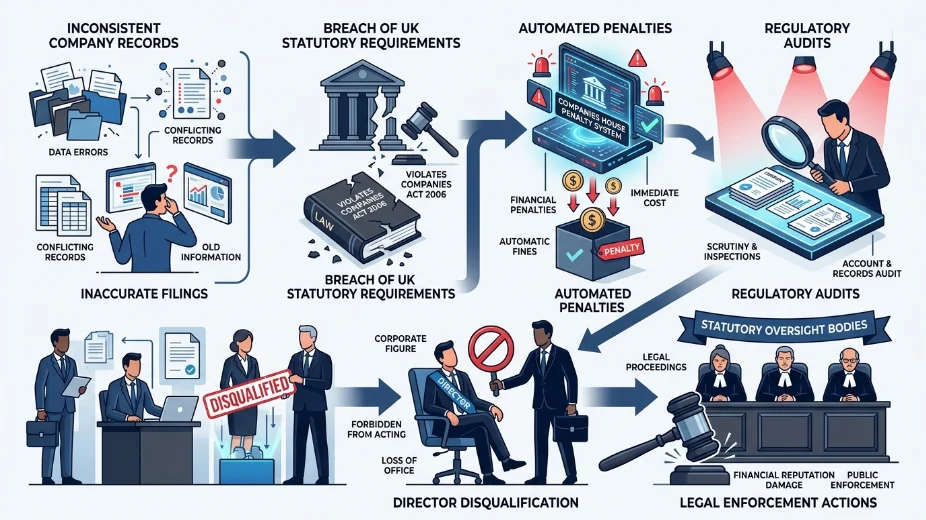
Companies House enforces strict accuracy standards for all official corporate returns and statutory registers. When an enterprise maintains conflicting records between internal statutory books and public databases, statutory bodies issue legal compliance warnings.
UK law holds directors personally responsible for maintaining accurate company records. If regulatory authorities discover conflicting shareholder registers or unrecorded share transfers, directors face financial penalties up to £5,000 per violation.
Persistent record inconsistencies jeopardize corporate legal status. Companies House initiates strike-off procedures when businesses fail to resolve administrative discrepancies or supply unstandardised compliance reports.
Standardising administrative records ensures that annual confirmation statements, PSC registers, and accounting disclosures reconcile perfectly. Regular operational alignment eliminates administrative oversights that lead to formal corporate sanctions.
How Does Document Standardisation Improve Operational Efficiency?
Document standardisation accelerates internal decision-making, reduces record retrieval times, and eliminates manual data-entry errors. Unified administrative templates allow corporate teams to execute compliance workflows faster while reducing operational costs.
Unstructured administrative processes drain corporate resources. UK SMEs waste an average of 120 administrative hours annually searching for misplaced corporate files or resolving internal document errors. Standardised workflows remove these operational bottlenecks entirely.
Standardised document systems establish universal naming conventions, structured data fields, and predefined operational templates. Employees access verified corporate templates instantly without drafting custom legal instruments for routine operational changes.
Standardisation simplifies the onboarding of new board members, company secretaries, and legal advisors. Standardised structures allow external legal teams to audit corporate history rapidly without verifying non-standard documentation.
Operational efficiency extends directly to banking interactions and credit assessments. Financial institutions require consistent corporate documentation during Know Your Customer (KYC) evaluations. Standardised company packs expedite banking approvals and line-of-credit verifications.
What Key Documents Must Be Standardised in Your Company Pack?
A standardised company pack must include verified articles of association, certificate of incorporation, statutory registers, shareholder certificates, and PSC records. These five core legal instruments establish corporate identity and legal operational rights.
Every enterprise formation pack requires absolute legal precision across five foundational administrative categories:
Certificate of Incorporation: Validates official enterprise registration details, unique company registration numbers, and official jurisdiction dates.
Articles of Association: Establishes internal governance protocols, voting rights frameworks, and director operational boundaries.
Statutory Registers: Records past director appointments, secretary details, mortgage charges, and historic share allocation transfers.
Shareholder Certificates: Confirms legal equity ownership percentages, share class designations, and nominal share value ratios.
PSC Registers: Identifies Persons with Significant Control using verified government credentials, official residential addresses, and control thresholds.
Standardising these core documents prevents administrative contradictions during corporate checks. Maintaining alignment across all five instruments ensures total statutory compliance during external legal audits.
Executing regular internal document audits maintains total alignment across all operational files. Businesses that implement comprehensive documentation standards safeguard corporate continuity while maintaining full readiness for regulatory inspections.
How Does Standardisation Simplify Corporate Audits and Due Diligence?
Standardised company packs present clear, verifiable legal evidence during corporate due diligence, institutional financing reviews, and regulatory audits. Structured documentation allows auditors to verify corporate ownership structures rapidly without encountering administrative delays.
During commercial acquisitions or investment rounds, external audit teams evaluate enterprise records thoroughly. Unstandardised company records raise immediate compliance red flags that delay corporate transactions or reduce enterprise valuations.
Auditing teams analyze three primary compliance vectors: statutory registration continuity, equity allotment histories, and regulatory governance records. Standardised company packs provide clean, structured data trails that satisfy external legal scrutinies immediately.
Standardised files allow corporate advisors to conduct rapid internal reviews. When executives evaluate corporate risks, standard document structures highlight potential governance gaps before external audits begin.
Adopting verified administrative solutions ensures corporate records remain audit-ready continuously. Corporate leaders rely on Document Standardisation Strategies to maintain legal transparency across all corporate operational layers.
What Steps Are Required to Implement Document Standardisation?
Implementing document standardisation requires auditing existing records, adopting verified legal templates, digitising statutory registers, and establishing strict operational access controls. This four-step framework guarantees complete administrative accuracy across all corporate operations.
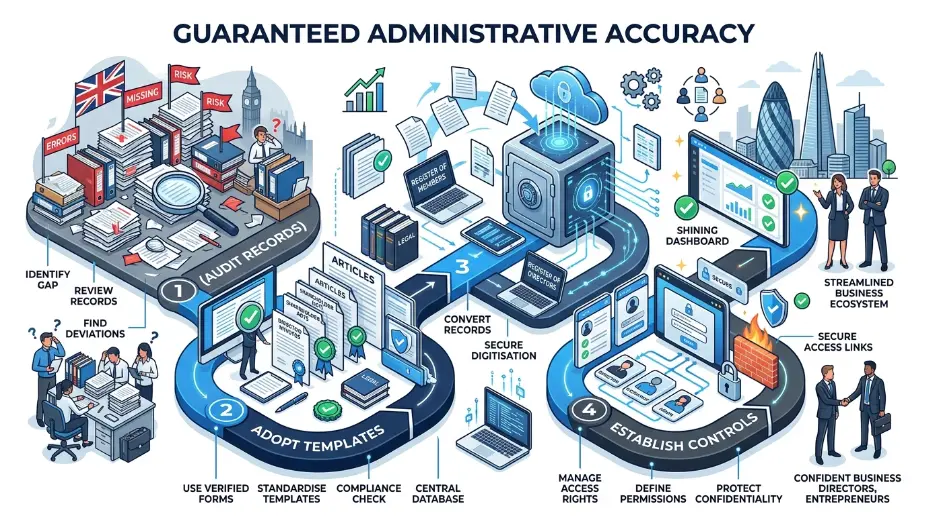
Standardising corporate documentation demands a structured implementation framework:
Audit Existing Records: Compare current internal statutory registers against Companies House public records to identify discrepancies in director details, address listings, or share allocations.
Adopt Approved Templates: Replace custom administrative forms with legal-grade templates designed in accordance with the Companies Act 2006.
Digitise Statutory Books: Transition from physical record binders to secure digital management platforms that automatically log administrative edits and updates.
Enforce Access Protocols: Restrict document editing permissions to authorized corporate officers to prevent unverified record modifications.
When administrators update corporate records, automated compliance checks ensure that every new filing adheres to existing standard formats. This systematic approach guarantees ongoing administrative accuracy as the enterprise expands.
Enterprise growth requires consistent governance standards across all operating subsidiaries. Multi-entity organisations use standardised documentation frameworks to control administrative overheads while ensuring universal statutory compliance.
Maintaining consistent documentation prepares enterprises for future commercial expansion. Businesses seeking complex restructuring or board transitions should consider Professional PSC Compliance Services to guarantee that ownership registers align perfectly with legal operational standards.
Document standardisation protects United Kingdom enterprises from operational errors, identity theft, and regulatory penalties. Maintaining identical data across internal statutory books and Companies House filings creates an unbreachable administrative foundation. Unstandardised company packs expose businesses to corporate hijacking and severe compliance fines under the Companies Act 2006.
Form My Company delivers full document standardisation and corporate protection frameworks tailored to modern businesses. By implementing structured statutory registers, verified articles of association, and secure identity protection services, Form My Company ensures your corporate pack remains accurate, compliant, and secure against unauthorised modifications.
Frequently Asked Questions
What is company fraud protection and how does it safeguard my UK business?
Company fraud protection is a proactive corporate security service designed to safeguard UK businesses from corporate identity theft, unauthorized officer changes, and fraudulent address modifications. By utilizing real-time monitoring and official Companies House API links, Form My Company Fraud Protection instantly detects unauthorized filings, enabling business directors to intervene before criminals can access business lines of credit or hijack corporate records.
How does Form My Company detect unauthorized changes on Companies House?
Form My Company Fraud Protection acts as an automated monitoring watchdog connected directly to the Companies House database. The system issues instant real-time email alerts whenever a document—such as an officer appointment (AP01), director resignation (TM01), or address change (AD01)—is registered against your unique company registration number.
Can I add fraud protection to an existing limited company or LLP?
Yes, Form My Company Fraud Protection can be integrated with any active UK limited company or Limited Liability Partnership (LLP), regardless of where or when it was originally formed. Directors simply sync their official Company Registration Number with the Form My Company portal to activate continuous 24/7 compliance tracking and registry monitoring.
Why is corporate identity theft a threat to UK business owners?
Corporate identity theft occurs when bad actors submit forged paper or electronic filings to change a business’s registered address or appoint fake company directors. Once fraudsters control the public record at Companies House, they can divert business mail, obtain high-value credit terms, or order equipment under your business name without your knowledge.
What is the Companies House PROOF scheme and how does it work?
The Protected Online Filing (PROOF) scheme is an official statutory security measure that blocks paper-based filing submissions at Companies House. When implemented alongside Form My Company Fraud Protection, all vital statutory filings—including confirmation statements and officer changes—must be validated using a secure 6-digit company