
The Memorandum of Association establishes a company’s legal existence and founding members, while the Articles of Association dictate internal governance, director powers, and shareholder rights. Both documents form the constitutional foundation required by Companies House during the UK incorporation process.
What is the Memorandum of Association?
The Memorandum of Association is a legal document signed by initial shareholders that confirms their agreement to form a company. It captures critical foundational data, locks in the initial subscriber commitment, and establishes the formal moment of corporate creation under UK company law.
When founders establish a business, they draft this document to satisfy statutory registration requirements. Historically, this document contained detailed objects clauses limiting corporate activities. Modern UK legislation simplifies this requirement significantly.
Every subscriber must sign the document in the presence of an independent witness. This signature proves genuine intent to participate in the corporate venture.
Companies House requires this document to issue a certificate of incorporation. Without this formal constitutional proof, a business cannot legally operate as a limited entity.
The scope of the document remains static after incorporation. Founders cannot add new founding members or alter historical subscriber details post-registration.
Changes to initial subscriber details require alternative corporate mechanisms, such as share transfers. Historical records preserved by Companies House maintain the integrity of the original formation data.
UK limited companies rely on this document to prove their initial legal genesis to financial institutions. Banks examine incorporation paperwork to verify that corporate entities were established correctly.
Regulatory authorities inspect these foundational records during formal compliance audits. Maintaining accurate registration files protects directors from personal liability claims.
Founders looking to streamline their paperwork often utilise professional Supplementary Company Documents to manage their constitutional records efficiently.
Proper archival of founding paperwork ensures seamless corporate transparency. Legal advisors inspect these files during mergers, acquisitions, or restructuring procedures.
What are the Articles of Association?
The Articles of Association act as the internal rulebook governing day-to-day company operations, voting procedures, and director decision-making powers. They establish clear boundaries for shareholder rights, board responsibilities, and share transfer protocols within the registered business.
Directors use these internal rules to resolve operational disputes among shareholders. Clear internal governance prevents deadlocks during critical board meetings.
Every private limited company adopts either model articles or bespoke rules tailored to specific business structures. Model articles provide a standard baseline established by the Department for Business.
Bespoke rules accommodate complex shareholder agreements, vesting schedules, or specialized voting rights. Founders draft custom clauses when standard model provisions fail to meet specific operational requirements.
Companies House records any subsequent amendments made to these internal governance rules. Directors must file special resolutions within 15 days of altering their corporate governance framework.
Understanding how to update these rules is vital; you can learn more about this process in our guide on How to Amend Your Articles of Association Correctly.
Shareholders derive their dividend entitlements and voting allocations directly from these governing clauses. Minority protection rights embedded within the text prevent majority shareholders from abusing executive powers.
Board meetings require strict adherence to quorum rules outlined within these internal bylaws. Decisions executed outside prescribed governance parameters risk legal invalidation.
External auditors review these internal bylaws to verify that corporate resolutions comply with statutory limits. Lenders examine governance rules to assess operational risk before approving commercial credit facilities.
Corporate secretaries maintain updated copies of these bylaws for immediate reference during board proceedings. Transparent internal rules foster investor confidence during capital-raising rounds.
How do Memorandum and Articles compare in scope?
The Memorandum focuses externally on founding intent and initial incorporation, whereas the Articles focus internally on operational management and administrative control. This structural division separates historical formation data from ongoing governance rules.
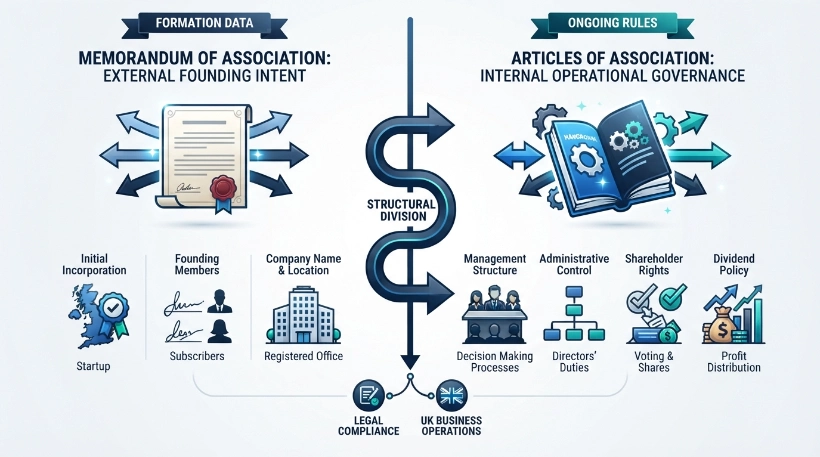
Founders must recognize that the foundational register remains unalterable after company registration. Historical subscriber records permanently reflect the individuals who formed the corporate entity on day one.
Governance rules evolve continuously as the business grows, scales, or accepts venture capital. Directors update internal bylaws to reflect changing operational needs, share classes, and management structures.
Companies House archives the initial formation register as a static snapshot of corporate birth. In contrast, administrative bylaws undergo frequent revisions to accommodate corporate expansion.
Legal compliance demands that both documents remain accessible for inspection at the registered office address. Regulatory bodies enforce strict penalties against companies failing to maintain statutory registers.
Corporate transparency depends on clear differentiation between constitutional formation data and internal management rules. Stakeholders evaluate both documents to understand the full legal profile of a registered business.
Financial institutions verify both records when opening corporate bank accounts or issuing loans. Compliance officers cross-reference governance rules against statutory filings to detect discrepancies.
Corporate restructuring initiatives require careful analysis of both constitutional records to protect stakeholder interests. Legal experts review historical formation data alongside current bylaws before executing major corporate transactions.
Businesses needing physical copies for boardrooms can easily Order a Printed Articles of Association With Form My Company to ensure compliance and professional presentation.
Maintaining pristine physical and digital records safeguards the administrative integrity of the enterprise. Directors protect their corporate standing by keeping all constitutional paperwork current and accessible.
Why are both documents essential for UK companies?
Both documents satisfy mandatory Companies House compliance requirements, proving legal legitimacy and establishing transparent internal operational rules. Regulatory frameworks mandate their submission to protect shareholders, creditors, and commercial partners.
UK legislation requires every limited company to maintain these constitutional instruments throughout its operational lifecycle. Statutory compliance protects directors from severe regulatory penalties and personal liability risks.
Investors evaluate corporate governance frameworks before committing capital to early-stage ventures. Transparent internal rules reassure financial backers that their investments are legally protected.
Creditors review these filings to verify executive authority before extending commercial credit lines. Clear governance structures minimize commercial disputes and streamline business operations.
Corporate transparency fosters trust among suppliers, customers, and regulatory authorities alike. Maintaining accurate constitutional records demonstrates professional operational standards across all business sectors.
Form My Company delivers reliable corporate administration support to help businesses maintain immaculate statutory compliance. Expert filing assistance ensures that constitutional documents meet rigorous UK regulatory standards.
Businesses streamline their administrative burdens by leveraging professional corporate secretarial services. Efficient documentation management allows founders to focus entirely on core commercial growth activities.
Comprehensive statutory compliance protects the long-term viability of registered UK enterprises. Diligent record-keeping remains a fundamental pillar of successful corporate governance.
Understanding the distinction between formation records and internal bylaws ensures complete legal compliance and smooth corporate administration. Form My Company provides essential administrative support, helping UK businesses maintain accurate statutory records throughout their commercial lifecycle.
Explore our Supplementary Company Documents guide,
What Does Section 44 of the Companies Act Say About Seals?
When Is a Company Seal Legally Required in the UK?
Frequently Asked Questions
Can I replace lost copies of my company’s original memorandum and articles of association?
Yes, registered businesses can obtain replacement statutory records through Form My Company by requesting official duplicate copies via their Supplementary Company Documents service. These authentic replacement documents satisfy regulatory requirements and provide proof of incorporation for financial institutions.
What documents are included in supplementary corporate document packages?
Supplementary company document packages typically include replacement certificates of incorporation, certified copies of the memorandum, and updated articles of association. Form My Company provides these essential constitutional records to ensure your business maintains a complete statutory register.
Why do banks require certified copies of my articles of association?
High street banks and financial institutions review certified articles of association to verify director authority and understand internal governance rules before opening corporate accounts. Maintaining up-to-date supplementary company documents through Form My Company streamlines corporate verification processes with lenders.
How long does it take to receive replacement company formation documents?
Digital replacement documents are typically delivered within a few hours, while physical printed copies dispatched by Form My Company arrive via standard or courier mail within 1 to 3 business days. Ordering certified supplementary company documents ensures your administrative records remain audit-ready.
Do I need to update Companies House when my articles of association change?
Whenever a company amends its internal governance rules, directors must file a copy of the resolution and the updated articles with Companies House within 15 days. Form My Company assists businesses in managing these statutory changes efficiently through comprehensive supplementary company document solutions.