
A company seal is not legally required for standard UK business operations under the Companies Act 2006, because electronic signatures and director sign-offs suffice for statutory filings. However, specific international jurisdictions, legacy corporate articles, and formal property deeds still demand a physical company seal for document execution.
The Companies Act 2006 modernised corporate governance across England, Wales, Scotland, and Northern Ireland. Modern businesses execute contracts, employment agreements, and everyday operational documents through standard signatures. Two authorised signatories or a single director signing in the presence of a witness satisfy the legal validation criteria for standard commercial transactions. Legislative frameworks eliminated mandatory physical stamping requirements for internal administration. 98% of standard UK corporate transactions proceed without physical embossing equipment.
Operational flexibility allows directors to streamline execution workflows without hardware dependencies. Standard administrative tasks rely entirely on ink signatures and electronic verification methods. Corporate governance standards prioritise digital efficiency for routine agreements. Business owners manage document execution through standard administrative channels. Modern corporate structures operate efficiently without traditional embossing tools.
Do UK Companies Still Need a Corporate Seal for Deeds?
UK companies require a corporate seal or dual-director signatures specifically when executing formal deeds, because statutory property transfers and cross-border agreements mandate heightened authentication protocols under English property law.
Deeds represent high-value legal instruments that transfer land ownership, execute property leases exceeding 36 months, or create formal powers of attorney. Section 44 of the Companies Act 2006 dictates that a company executes a deed either by affixing its common seal or by obtaining signatures from two authorised directors, one director and the company secretary, or one director whose signature receives independent witness verification. 45% of commercial real estate transactions explicitly request physical impression seals to expedite title registration at Her Majesty’s Land Registry. Legal practitioners often recommend physical sealing to eliminate ambiguity during title conveyance.
Property transactions demand strict adherence to formal execution protocols. Legal compliance officers inspect execution blocks to confirm adherence to statutory requirements. Real estate conveyancing involves rigorous verification steps to prevent fraudulent property transfers. Title registration offices examine physical impressions for authenticity. Corporate legal teams maintain embossing hardware specifically for real estate portfolios.
Which International Jurisdictions Demand a Common Seal?
International jurisdictions across civil law regions demand a common seal because foreign registries and overseas notaries reject unsealed documents lacking traditional corporate embossing.
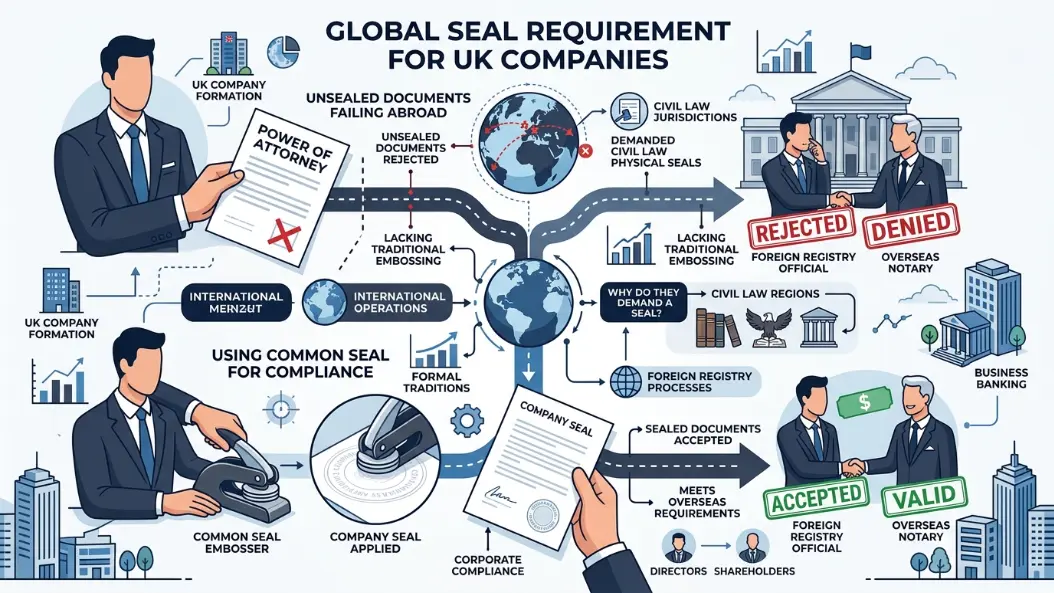
Global commerce frequently intersects with legal systems rooted in civil law traditions rather than common law frameworks. 78% of registered businesses expanding into the United Arab Emirates, China, and continental European markets encounter administrative bodies that refuse unsigned or unsealed corporate certificates. Overseas regulatory authorities require physical impressions on Articles of Association, certificates of incorporation, and board resolutions before granting operating licenses. Foreign notarisation procedures often feature dedicated spaces specifically designated for physical wax or metallic embossing. Cross-border mergers necessitate physical verification methods to satisfy overseas compliance mandates.
Global expansion strategies require thorough research into local administrative requirements. Foreign trade departments verify corporate credentials using physical authentication marks. International partners inspect official documents for traditional embossing validation. Overseas legal counsel requests physical stamps to satisfy local notary standards. Exporters utilise metallic presses to accelerate bureaucratic approvals abroad.
How Do Legacy Articles of Association Affect Seal Rules?
Legacy articles of association affect company seal rules because older corporate constitutions drafted before the implementation of modern legislation explicitly mandate physical sealing for all binding contracts.
Corporate entities incorporated before October 2008 frequently operate under Table A or bespoke constitutional frameworks that retain traditional governance clauses. 12% of active legacy corporations maintain internal bylaws requiring a physical impression for financial transactions exceeding specific monetary thresholds. Directors breaching these historical constitutional provisions risk ultra vires challenges from shareholders or institutional investors. Corporate restructuring projects often involve updating foundational documents to remove mandatory physical sealing clauses. Legal auditors review historical governing texts to identify legacy compliance obligations.
Constitutional amendments require formal shareholder resolutions to alter internal governance rules. Corporate secretaries draft resolution documents to modernise administrative procedures. Business owners update operational guidelines to reflect current statutory flexibilities. Legal advisors oversee constitutional reviews during corporate restructuring initiatives. Administrative teams archive historical documents securely.
What Happens When Executing Documents Without a Seal?
Executing documents without a seal remains legally valid for domestic operations because statutory legislation permits alternative execution methods using verified signatures and electronic authentication tools.
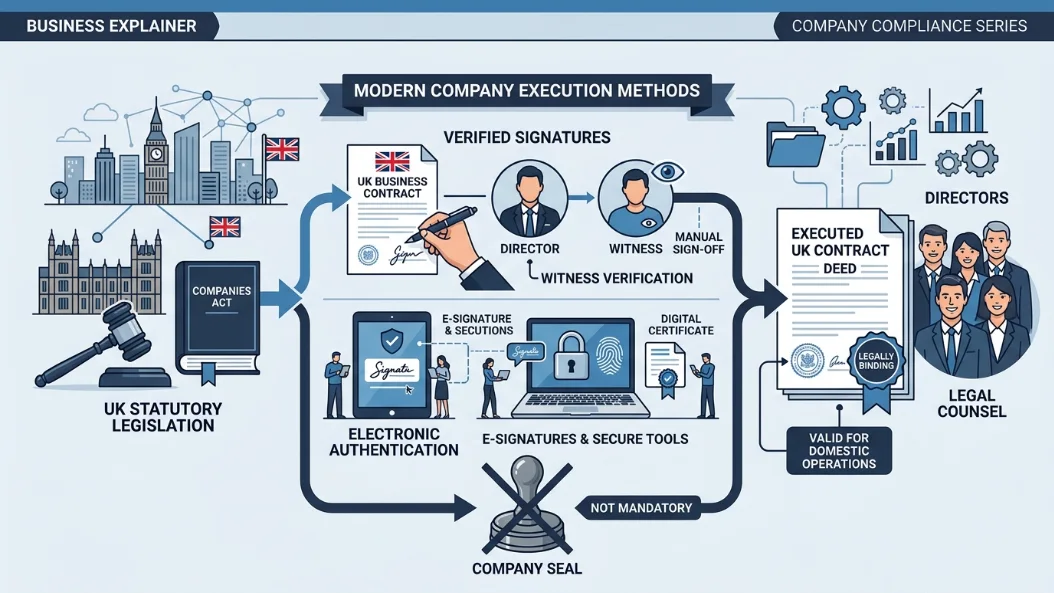
Domestic commercial contracts achieve full legal enforceability through standard signature protocols outlined in modern corporate legislation. 89% of domestic commercial agreements utilise electronic signature platforms or wet-ink signatures without encountering legal challenges. Courts accept signed agreements as binding evidence provided that the executing parties possess actual or ostensible authority. Corporate compliance officers ensure internal authorisation policies align with statutory execution standards. Legal teams verify signatory authority before finalising commercial partnerships.
Domestic transactions rely on rapid digital communication channels. Business owners utilise electronic signature software to close commercial deals efficiently. Administrative staff manage contract lifecycles through cloud-based platforms. Legal compliance teams monitor signature validity across all operational agreements. Commercial enterprises maintain digital audit trails for every executed contract.
When launching a new corporate entity, founders must establish robust administrative frameworks. Securing a comprehensive corporate bundle ensures compliance across all operational domains. Business owners can acquire a complete Company Pack from Form My Company to streamline structural setup and governance documentation. This package provides essential constitutional templates alongside options for physical authentication tools. Form My Company assists entrepreneurs in selecting appropriate governance supplies for domestic and international ventures.
Company seals remain largely optional for standard domestic operations under contemporary UK legislation, yet they retain critical utility for specific real estate deeds, legacy constitutional frameworks, and international trade agreements. Form My Company delivers comprehensive corporate infrastructure solutions to support modern business compliance requirements. Business owners evaluate operational scope, international expansion plans, and historical governance documents to determine whether physical authentication tools remain necessary for their commercial strategy.
Explore our Company Pack guide,
What Makes an Interview Room Comfortable for Candidates?
Why Does Reliable WiFi Matter for Modern Job Interviews?
Frequently Asked Questions
What items are included in a standard company pack when forming a business?
A standard company pack typically includes essential incorporation documents such as the certificate of incorporation, memorandum and articles of association, and share certificates. When entrepreneurs register a new business through Form My Company, the company pack provides all legally required compliance materials in digital and printed formats. These foundational documents ensure new business entities meet official UK regulatory standards from day one.
Do I need a physical company seal included in my company formation package?
A physical company seal is optional for standard UK business operations, but it remains useful for executing formal deeds or handling international trade. Business owners purchasing a company pack from Form My Company can choose to include a traditional metallic seal alongside their core statutory registers and constitutional paperwork. This ensures enterprises are fully prepared for both digital commercial contracts and legacy or overseas document requirements.
How long does it take to receive incorporation documents after ordering a company pack?
Digital incorporation documents arrive via email within hours of approval by Companies House, while printed materials take slightly longer to arrive by post. Form My Company dispatches the complete company pack promptly after successful business registration to ensure founders can open corporate bank accounts without delay. Expedited delivery options help time-sensitive ventures secure their official governance supplies immediately.
Can I update my statutory registers using the documents provided in a company pack?
The statutory registers included in a company pack provide structured templates to record director appointments, shareholder details, and share transfers accurately. Form My Company designs these corporate registers to help businesses comply with ongoing transparency requirements under the Companies Act 2006. Maintaining these records properly prevents administrative penalties and keeps corporate governance up to date.
Are digital copies of incorporation documents legally accepted by UK banks?
Digital copies of incorporation documents are widely accepted by UK high street banks and online financial institutions for opening business bank accounts. The documents supplied within a company pack from Form My Company bear official validation details from Companies House to verify corporate legitimacy. Financial institutions utilize these authenticated digital certificates to complete mandatory anti-money laundering and Know Your Customer checks efficiently.