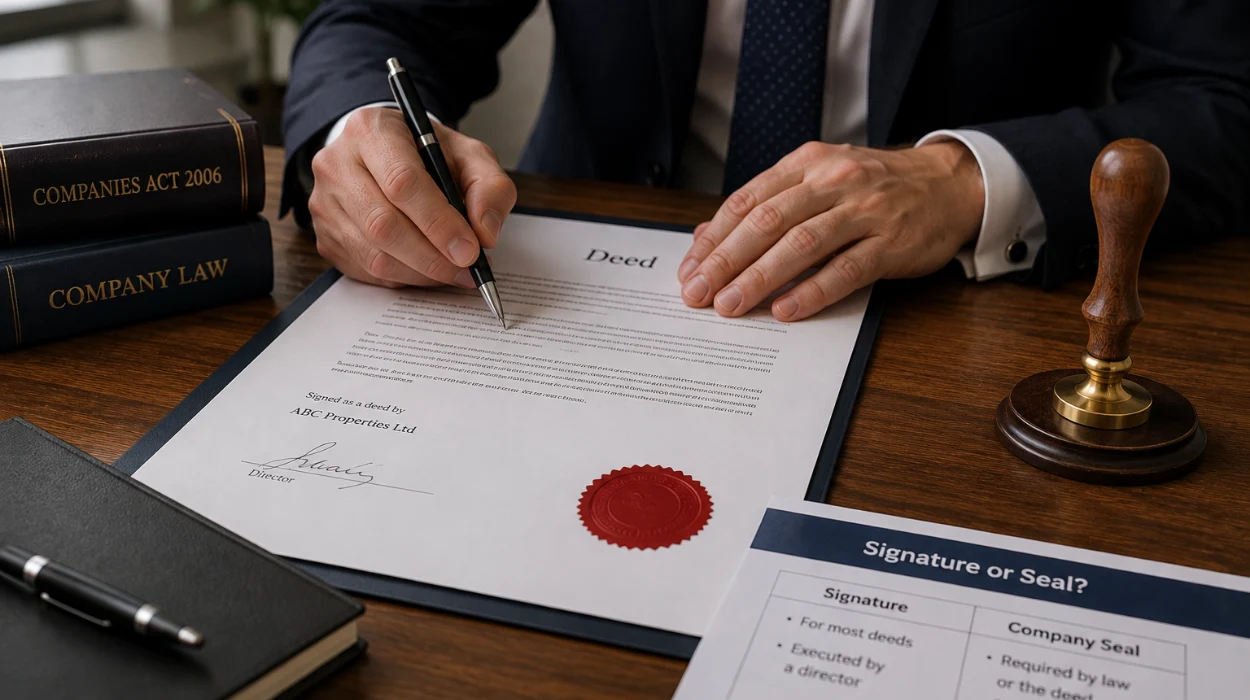
UK companies can generally execute documents without using a company seal. Under Section 44 of the Companies Act 2006, a company can execute documents through two authorised signatories or one director signing in the presence of a witness who attests the signature. A common seal is an alternative method rather than a compulsory requirement for most UK companies.
Understanding the difference between a company seal and a signature is important when executing contracts, deeds and other corporate documents. Choosing the correct execution method helps businesses maintain proper corporate records, meet legal requirements and avoid problems when documents are presented to banks, property registries or overseas authorities.
This guide explains when a company can sign without a company seal, how signatures and deeds should be executed, and when an official seal may still be useful.
Signature Without Company Seal: Is It Legally Valid?
Yes. A UK company can generally execute documents using authorised signatures without applying a company seal. Section 44 of the Companies Act 2006 recognises two authorised signatories or one director signing in the presence of an attesting witness as valid methods of execution under the law of England and Wales and Northern Ireland.
A company does not need to purchase or maintain a common seal simply to execute its ordinary corporate documents. However, the appropriate signing method depends on the type of document, the company’s governing documents and any specific requirements imposed by the receiving authority.
For most routine business transactions, authorised signatures provide a practical alternative to physical sealing.
Is a Company Seal Legally Required in the UK?
A company seal is not generally compulsory for a UK company. Section 45 of the Companies Act 2006 expressly states that a company may have a common seal but does not have to maintain one.
Businesses can therefore operate without an embossing seal and use the statutory signature methods available under company law. This applies to many routine corporate transactions, provided the document is executed correctly.
There are, however, situations where a company may choose to maintain a seal or where a receiving organisation or overseas jurisdiction requests additional formalities.
When Can a Company Use a Signature Instead?
A company can generally use authorised signatures instead of a common seal when executing documents under Section 44 of the Companies Act 2006.
The two recognised signature methods are:
Two authorised signatories: Two directors can sign on behalf of the company. Alternatively, a director and the company secretary can sign where the company has a secretary.
One director and a witness: A single director can sign in the presence of a witness who independently attests the signature.
These methods provide a statutory alternative to using an embossed company seal. The document must also satisfy any other applicable execution requirements.
When Might a Company Still Need a Seal?
A company may choose to use a common seal for particular corporate or administrative purposes. It may also be useful when dealing with overseas authorities, counterparties or institutions that request a sealed document.
The requirements of the receiving jurisdiction should always be checked before signing. A foreign authority may require a particular execution format, authentication or supporting documentation. A company should not assume that every international transaction requires an embossed seal.
How to Sign Company Documents Without a Company Seal
Signing corporate documents without a company seal requires the correct authorised individuals and an appropriate execution procedure.
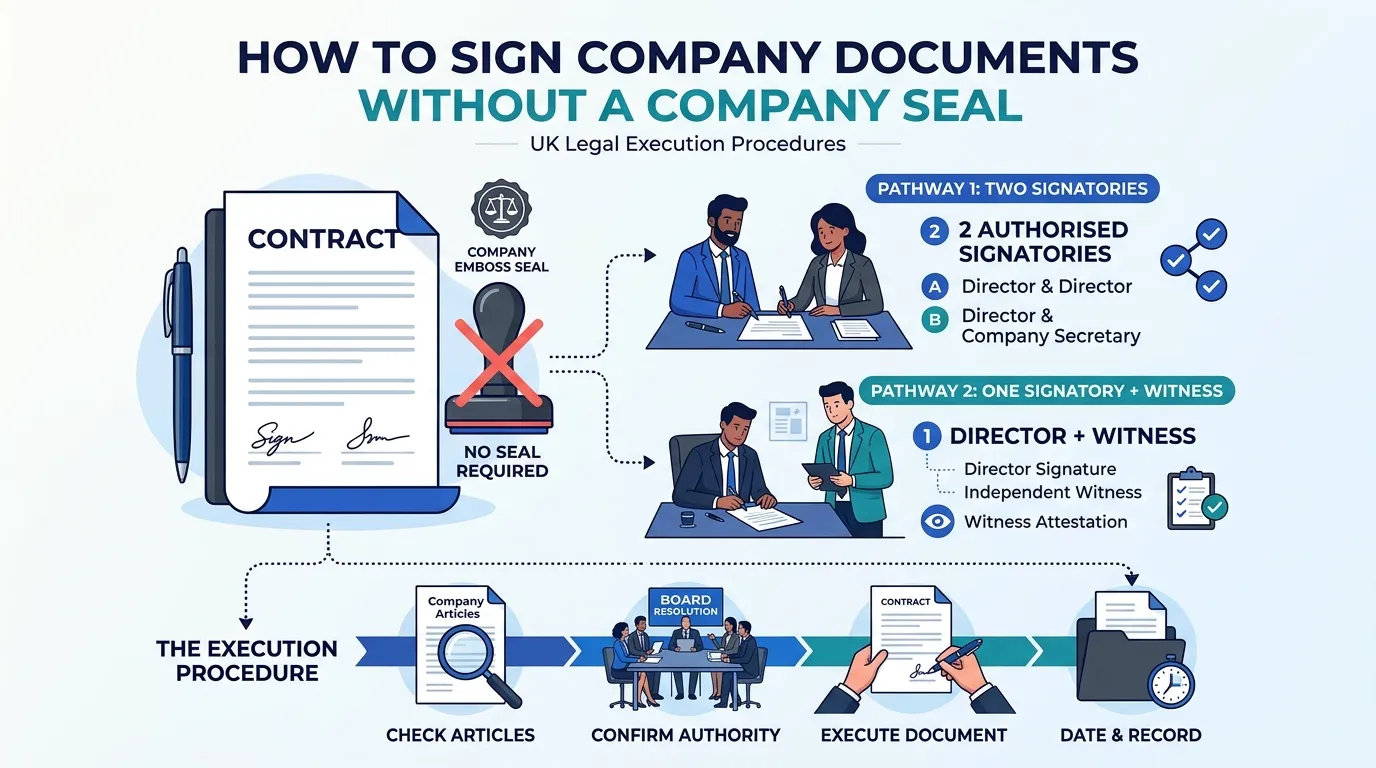
Two Directors Signing a Document
Where two directors sign on behalf of a company, they act as authorised signatories under Section 44 of the Companies Act 2006.
Both individuals should sign in the execution section of the document, with their positions clearly identified. The wording should make clear that the document is being executed on behalf of the company.
One Director Signing in Front of a Witness
A company can also execute a document through one director whose signature is witnessed and attested by another individual.
The witness should be present when the director signs and should complete the required attestation details. The execution wording should identify the company and make clear that the director is signing on its behalf.
Checking the Articles of Association
Before executing important corporate documents, businesses should review their articles of association and any relevant internal authorisation procedures.
The articles establish the company’s governance arrangements and may contain provisions affecting the use of a common seal and the authority of individuals acting for the company.
For a fuller explanation, read our guide to what articles of association are and why they matter.
How to Execute a Deed Without a Company Seal
A company can execute a deed without a common seal, provided it follows the applicable statutory requirements.
Under Section 44 of the Companies Act 2006, a company can execute a deed through two authorised signatories or one director signing in the presence of a witness who attests the signature. Section 46 also requires the document to be delivered as a deed.
What Makes a Deed Different from an Ordinary Contract?
A deed is a formal legal document that must satisfy specific execution requirements. Unlike an ordinary contract, a deed must meet the relevant formalities, including being expressed to be a deed and being properly executed and delivered.
Examples of documents that may be executed as deeds include certain property transfers, guarantees, powers of attorney and formal corporate agreements. The correct execution method depends on the particular transaction and applicable law.
Deed Execution Checklist Without a Company Seal
Before completing a deed, businesses should check the following:
- The document clearly identifies the company as the executing party.
- The wording makes clear that the document is intended to be executed as a deed.
- Two authorised signatories sign, or one director signs in the presence of an attesting witness.
- The witness completes the required attestation.
- The document is delivered as a deed.
- Any additional requirements in the company’s articles or the relevant transaction are satisfied.
Correct execution helps establish the legal validity of the deed and provides an appropriate record of the company’s commitment.
Company Seal vs Signature: Which Execution Method Should Businesses Choose?
Both a common seal and authorised signatures are recognised methods of company execution under Section 44 of the Companies Act 2006. The appropriate option depends on the company’s administrative arrangements and the requirements of the document or receiving authority.
| Consideration | Company seal | Authorised signature |
|---|---|---|
| Legal status | Recognised statutory execution method | Recognised statutory execution method |
| Physical requirements | Requires an appropriate common seal | Requires authorised signatories |
| Administration | Requires secure storage and controlled use | Requires signing and any necessary witness attestation |
| Routine UK documents | Can be used | Commonly used |
| Deed execution | Permitted when statutory requirements are followed | Permitted through the statutory signing methods |
| International transactions | May be requested by some overseas authorities | Acceptance depends on the receiving jurisdiction |
| Record keeping | Sealing should be properly documented | Signed execution documents should be retained |
For most UK companies, signatures provide a straightforward way to execute documents without maintaining a physical seal. Companies involved in international transactions should assess the requirements of each destination jurisdiction before deciding whether to use a common seal.
When Are Company Seals Useful for International Transactions?
Although UK companies do not generally need a common seal, international transactions can involve additional formalities.
Foreign registries, banks, notaries and legal authorities may request documents in a particular format. Some may ask for a company seal, while others may accept authorised signatures supported by authentication or certification.
The requirements depend on the country, the type of transaction and the receiving institution.
Overseas Property and Corporate Transactions
Companies purchasing property abroad, establishing subsidiaries or entering formal agreements with overseas organisations should confirm the required execution method before completing documents.
Some jurisdictions require notarisation, legalisation, apostilles or other supporting evidence of corporate authority. An embossed company seal alone does not automatically satisfy these requirements.
Official Seal for Use Abroad
The Companies Act 2006 also recognises an official seal for use outside the United Kingdom under Section 49. This is distinct from the ordinary common seal and can be relevant to companies conducting business overseas.
Businesses should establish whether an overseas authority specifically requires this type of seal or whether another accepted execution and authentication method is available.
Explore our Company Pack guide,
Step-Free vs Assisted Access Venues: What to Check Before Booking
Interview Room Amenity Checklist Before You Book
Corporate Governance and Document Execution Procedures
Proper document execution is part of effective corporate governance. Companies should establish clear procedures for authorising signatures, maintaining records and controlling the use of corporate seals.
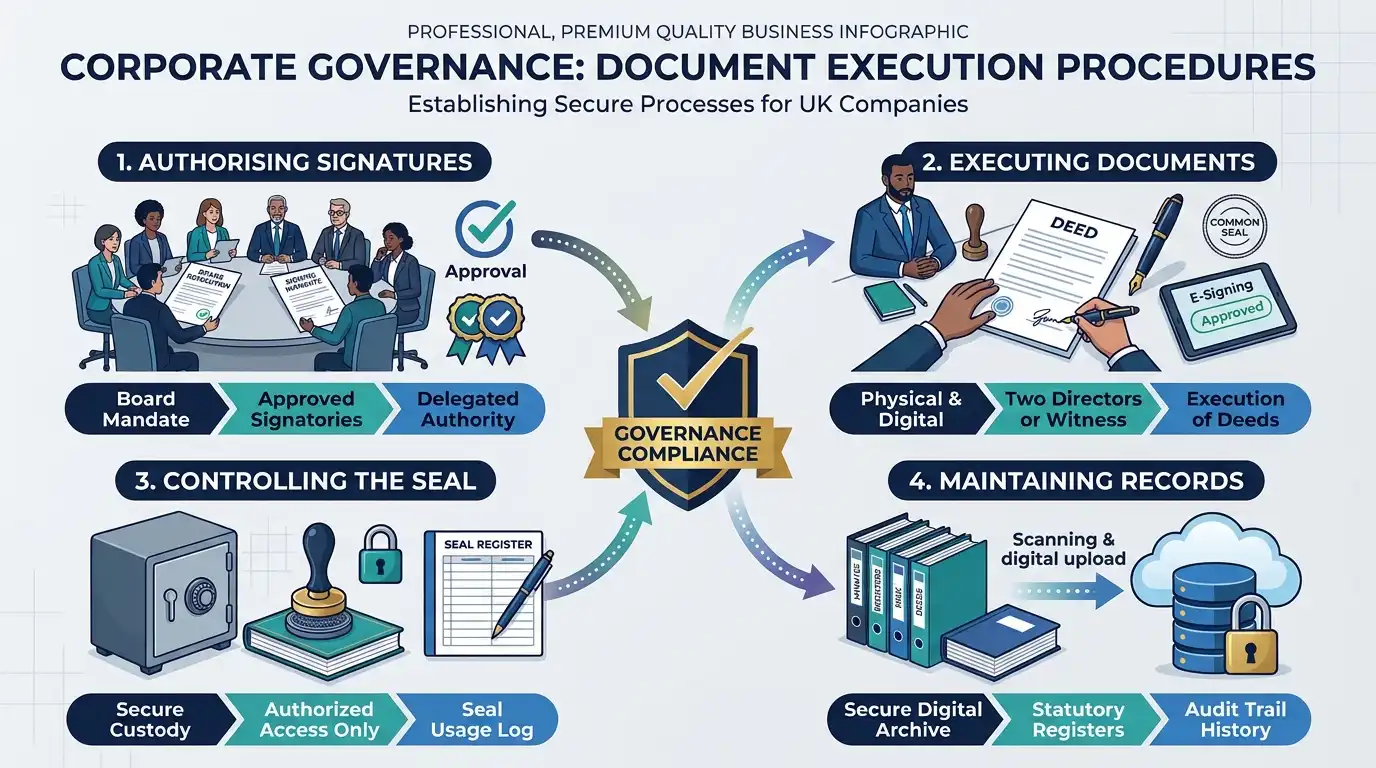
Board Authorisation and Meeting Records
Important transactions may require approval by the board or members, depending on the company’s articles, the nature of the transaction and applicable law.
Recording significant decisions helps demonstrate that the company followed its internal governance procedures. Businesses should maintain accurate minutes and supporting resolutions where required.
For more information, explore our guide to UK company board meeting and minute-taking requirements.
Maintaining Company Records
Companies should retain executed deeds, contracts, relevant resolutions and other corporate records in an organised and accessible format.
Clear documentation helps directors establish who approved a transaction, which individuals signed the document and whether the correct execution procedure was followed.
Company Secretarial Support
Company secretarial procedures help businesses manage statutory records, corporate decisions and ongoing administrative responsibilities. This becomes particularly important when companies regularly execute formal documents or make changes to their governance arrangements.
Our guide to company secretarial services and long-term UK regulatory compliance explains how organised corporate administration supports ongoing compliance.
Common Mistakes When Signing Without a Company Seal
Even when a common seal is unnecessary, mistakes during document execution can create legal and administrative problems.
Using an unauthorised signatory: A document may not satisfy the statutory execution requirements if the individuals signing do not qualify as authorised signatories.
Missing witness attestation: Where one director signs, the witness must be present and attest the signature.
Incorrect deed wording: A document intended to operate as a deed must satisfy the applicable requirements and clearly establish its intended status.
Ignoring delivery requirements: A deed must be delivered as a deed under Section 46 of the Companies Act 2006.
Overlooking the articles of association: Internal governance provisions should be checked before executing significant corporate documents.
Assuming overseas authorities follow UK rules: International recipients may impose additional requirements, including notarisation or authentication.
Poor record keeping: Companies should retain executed documents and relevant corporate approvals to support future reviews and transactions.
Avoiding these mistakes helps businesses maintain consistent document execution procedures and reduce the risk of disputes.
When Should a Business Seek Professional Company Secretarial Support?
Professional support can be valuable when a company regularly executes deeds, enters complex transactions or needs to maintain detailed corporate records.
A company secretary or external company secretarial provider can help businesses organise board documentation, maintain statutory records and follow appropriate corporate procedures.
Support may be particularly useful when:
- The company is executing complex agreements or deeds.
- Directors are unsure which execution method applies.
- The business is completing an overseas transaction.
- Corporate records or articles require review.
- Board approvals and formal resolutions need to be documented.
- The company wants to improve its ongoing compliance procedures.
Form My Company provides professional company secretarial services to help businesses manage corporate administration and maintain organised company records.
Frequently Asked Questions
Can a company sign a document without a company seal?
Yes. Under Section 44 of the Companies Act 2006, a company can execute documents through two authorised signatories or one director signing in the presence of a witness who attests the signature.
Is a company seal compulsory in the UK?
No. Section 45 of the Companies Act 2006 states that a company may have a common seal but is not required to have one.
Can one director sign a deed without a company seal?
Yes. One director can execute a deed on behalf of a company if the director signs in the presence of a witness who attests the signature. The deed must also be delivered as a deed.
Can two directors sign a deed without a company seal?
Yes. Two authorised signatories, such as two directors, can execute a company deed without using a common seal, subject to the applicable legal and execution requirements.
Does a company need a witness when two directors sign?
The statutory method involving two authorised signatories does not require an additional witness. A witness is required when the company uses the single-director signing method.
Is a company seal required for international business?
Not automatically. Some overseas authorities or institutions may request a common seal or another specific form of authentication. Businesses should check the requirements of the receiving jurisdiction before executing documents.
What is the difference between a company stamp and a company seal?
A company stamp generally uses ink to print company details onto a document. A common seal is a formal corporate instrument that embosses the company’s name onto a document. They serve different administrative purposes and should not be treated as interchangeable.
Can a company execute a deed electronically?
Electronic signatures may be used in appropriate circumstances, provided the applicable legal requirements are satisfied. Companies should also consider the deed’s wording, witness requirements and any transaction-specific formalities before using an electronic execution process.
Get Professional Company Secretarial Support from Form My Company
Signing without a company seal is a recognised option for UK companies, provided the correct statutory execution method is followed. Businesses can generally use authorised signatures for corporate documents and deeds without maintaining a physical common seal.
However, correct execution involves more than obtaining signatures. Companies must consider witness attestation, delivery requirements, internal authorisations and any additional conditions imposed by overseas authorities or counterparties.
Form My Company helps businesses manage corporate administration through professional company secretarial support. Explore our Company Secretarial Service to get assistance with company records, governance procedures and ongoing compliance.