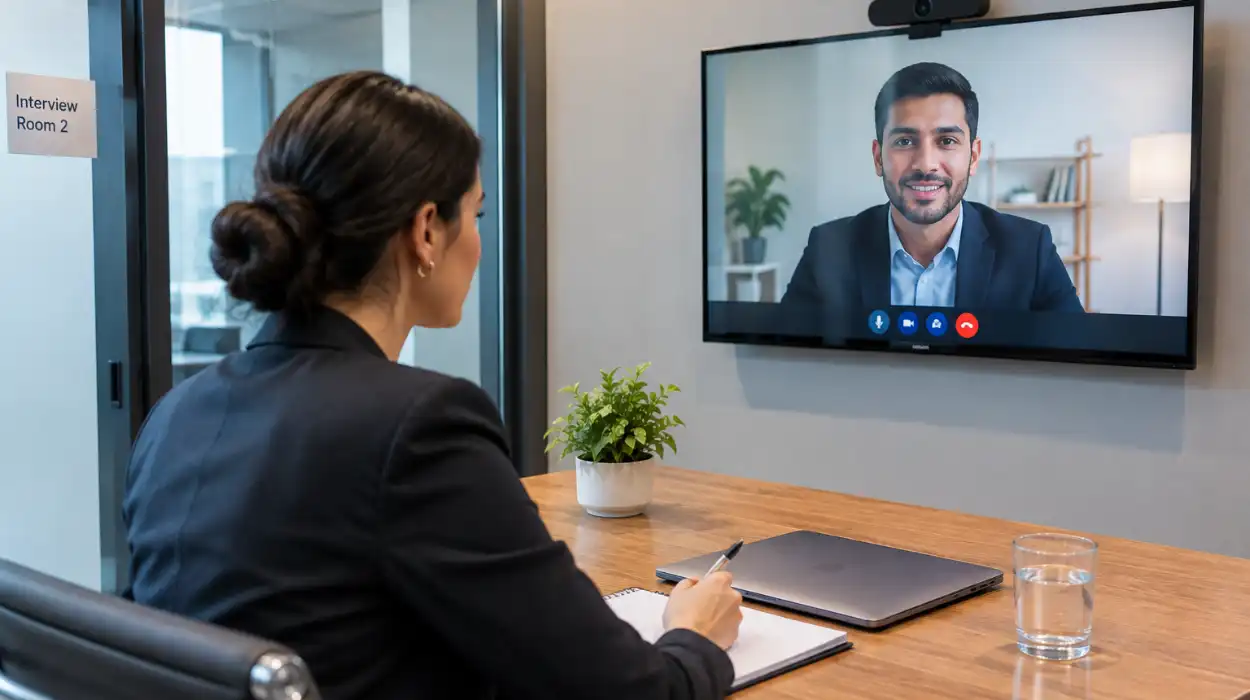
Company secretarial management is the administrative framework that ensures UK businesses comply with Companies Act 2006 requirements, file annual confirmation statements, maintain official statutory registers, and process director updates accurately to protect corporate legal standing and avoid severe financial penalties from Companies House.
Why Is Company Secretarial Essential for UK Regulatory Compliance?
Company secretarial maintains legal standing by ensuring timely Companies House filings, accurate statutory register management, and strict adherence to corporate governance laws, which protects officers from personal liability and keeps businesses fully compliant with statutory UK corporate regulations.
UK statutory compliance demands ongoing attention to corporate governance laws. The Companies Act 2006 mandates every registered business to submit operational updates, maintain internal records, and report structural changes. Failing to meet statutory deadlines results in automatic financial penalties, potential prosecution of directors, or striking off the company from the official register.
Professional management ensures that critical corporate events trigger immediate statutory updates. When corporate governance remains up to date, businesses prevent administrative oversights and legal vulnerabilities. Proper corporate administration establishes a reliable foundation for all commercial operations, keeping the enterprise in good standing with UK regulatory authorities.
What Are the Core Statutory Duties of a UK Company Secretary?
Core statutory duties include submitting annual confirmation statements, recording board meeting minutes, maintaining public statutory registers, filing financial accounts, managing share allocations, and updating Companies House whenever corporate governance, office locations, or director details officially change.
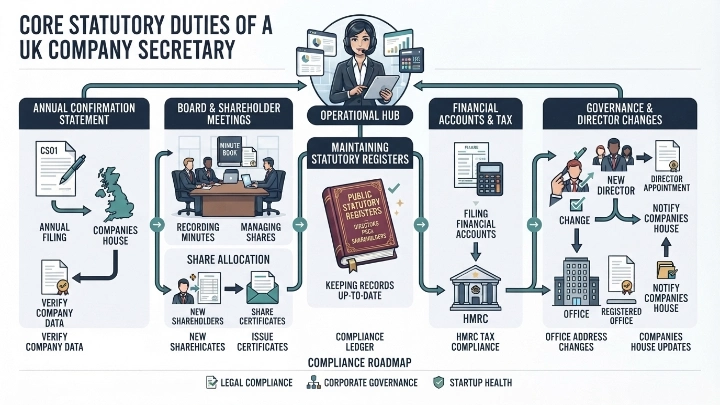
Corporate administration encompasses six core responsibilities: submitting confirmation statements, filing financial statements, updating PSC registers, logging director appointments, issuing share certificates, and recording formal board minutes. Executing these duties requires exact knowledge of UK corporate law and strict filing deadlines. Missing an annual confirmation statement deadline leads directly to late filing penalties or formal deregistration notices.
Maintaining statutory registers involves updating logs for members, directors, company secretaries, and people with significant control. Changes in corporate ownership structure require immediate updates to public records. When a business hires dedicated compliance professionals, administrative procedures remain accurate, audit-ready, and compliant with current UK governance frameworks.
How Does Poor Secretarial Management Impact Business Growth?
Poor secretarial management triggers automatic financial penalties, increases prosecution risks for company officers, damages commercial reputations, delays corporate financing rounds, and creates legal obstacles during due diligence processes that can halt essential business expansion plans.
Inaccurate administrative filings create significant commercial roadblocks during corporate growth phases. External investors, commercial lenders, and potential buyers demand flawless compliance records before committing capital. When statutory registers display missing filings, incorrect director details, or delayed accounts, external parties pause funding rounds to mitigate legal risk.
Administrative failures also expose corporate officers to personal liability under UK law. Persistent non-compliance allows regulatory bodies to issue formal warnings, enforce director disqualifications, or initiate criminal prosecutions. Delegating compliance tasks prevents costly operational disruptions, protecting corporate assets and securing future expansion opportunities.
What Role Do Physical Facilities Play in Corporate Governance?
Physical facilities provide registered office addresses for official service of notices, secure physical storage for statutory registers, and compliant corporate meeting environments where directors conduct formal board meetings to draft legally binding governance resolutions.
Official governance frameworks require verifiable physical locations for corporate operations. UK law dictates that companies must maintain a designated registered office to receive official correspondence from Companies House and HM Revenue and Customs. Directors also require professional venues to conduct formal annual general meetings and record official board minutes.
Businesses often utilize dedicated venues such as a professional conference room to execute formal corporate governance procedures in a secure environment. Hosting official shareholder gatherings and director meetings in fully equipped facilities ensures complete privacy, facilitates accurate minuting, and upholds corporate standards during critical operational reviews.
How Do Automated Tools and Professional Services Streamline Compliance?
Automated compliance tools and professional services streamline governance by tracking statutory deadlines automatically, standardizing legal documentation formatting, simplifying register updates, and managing Companies House data submissions without requiring internal administrative overhead.
Manual administrative tracking often leads to human error and missed filing windows. Digital compliance software automates statutory deadline alerts, ensuring confirmation statements and annual returns arrive on schedule. Systematized processes convert operational shifts—such as address updates or officer appointments—into properly formatted electronic submissions.
Integrating structured administrative platforms reduces time spent on repetitive corporate tasks. When internal teams shift away from routine governance paperwork, they focus resources on core commercial development. Combining modern software solutions with expert guidance secures ongoing accuracy, maintains updated PSC registries, and ensures long-term operational peace of mind.
Should Your Business Hire an In-House Secretary or Outsourced Compliance Expert?
Businesses should select outsourced compliance experts to reduce overhead costs, access specialized corporate law expertise, eliminate single-point-of-failure risks, and secure continuous corporate oversight without paying full-time administrative staff salaries.
Choosing the right administrative structure depends on operational complexity and available resources. Small to medium-sized enterprises frequently struggle to justify the fixed overhead costs of full-time legal staff. Balancing internal resources against external expertise requires evaluating operational needs, financial capacity, and long-term compliance strategy.
Evaluating In-House Secretarial vs. Outsourced Compliance: Finding Your Balance helps business leaders determine the most cost-effective path for their legal obligations. Outsourced compliance partners deliver continuous legal support, direct regulatory experience, and automated filing oversight at a fraction of internal staffing expenses.
How Do You Transition to Professional Secretarial Oversight Seamlessly?
Transitioning to professional oversight involves auditing existing statutory records, rectifying historic filing errors, updating public Companies House registers, establishing digital filing calendars, and assigning administrative authority to an experienced corporate governance partner.
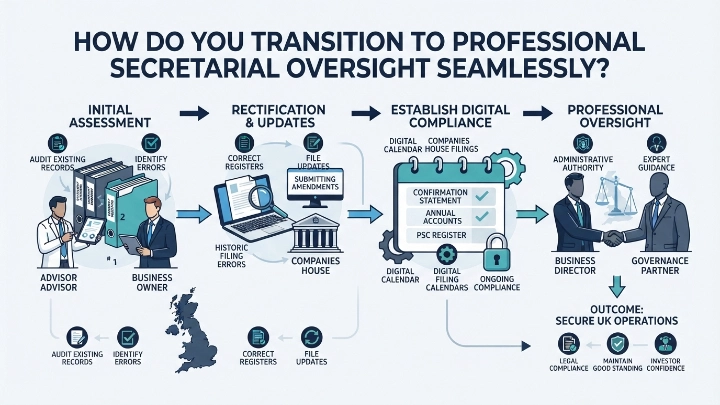
Migrating administrative duties begins with a comprehensive audit of current corporate records. Professional advisors review internal registers against public Companies House databases to identify discrepancies, missing director updates, or unrecorded share issuances. Correcting historic errors prevents regulatory complications during future commercial audits.
Once records align, external compliance specialists establish standardized tracking protocols for all upcoming statutory obligations. Transferring administrative duties eliminates legal gaps, ensures ongoing precision, and establishes a clear administrative framework. Engaging specialized partners guarantees that every future operational change complies fully with UK company law.
How Does Form My Company Support Growing Businesses?
Form My Company supports growing UK enterprises by providing complete corporate administrative management, maintaining accurate statutory registers, submitting timely regulatory filings, and delivering reliable physical infrastructure solutions that guarantee total corporate legal compliance.
Sustained commercial growth demands consistent adherence to UK corporate governance laws. Expanding enterprises require predictable compliance frameworks that adapt to changing operational requirements. Partnering with experienced corporate administrators protects legal standing and eliminates costly regulatory distractions.
Growing enterprises rely on Reliable Company Secretarial Services for Growing UK Firms to manage complex governance workloads efficiently. Form My Company handles essential administrative responsibilities, executes accurate Companies House filings, and maintains precise statutory records, allowing business leaders to focus entirely on scaling their commercial operations safely.
Explore our Conference Room guides,
PAYE Registration: Understanding Your Employer Obligations in the UK
VAT Registration: Do You Know Your Business Turnover Thresholds?
Frequently Asked Questions
What Facilities Are Included with Form My Company Conference Room Hire?
Form My Company provides conference rooms equipped with high-speed fibre internet, large presentation screens or displays, and configurable seating arrangements like boardroom or presentation layouts. Clients also gain access to reception welcome services, tea and coffee stations, and essential presentation tools like flipcharts and markers.
How Flexible Are the Booking Options for Conference Rooms?
Conference room hire from Form My Company offers flexible reservation terms ranging from hourly slots to half-day and full-day bookings. Businesses can reserve fully equipped physical meeting spaces as needed without committing to long-term commercial lease agreements.
Why Should UK Businesses Use a Professional Conference Room for Corporate Governance?
Hosting board meetings and general assemblies in a dedicated conference room ensures a private, secure environment for minuting official resolutions and conducting executive proceedings. Using professional corporate meeting venues provided by Form My Company supports regulatory compliance by offering a verifiable venue for formal director interactions and shareholder presentations.
Can Form My Company Conference Rooms Support Hybrid Meetings?
Yes, Form My Company conference rooms feature audio-visual capabilities and high-speed Wi-Fi designed to support hybrid meetings and remote video calls. Remote participants can seamlessly join in-person attendees using on-site screens and presentation setups.
Where Are Form My Company Conference Room Venues Located?
Form My Company offers professional conference room facilities across prime UK business locations, including key regional hubs like Manchester/Bolton and Liverpool/Liscard. These centrally located meeting venues provide convenient transport access and on-site reception support for visiting clients and corporate directors.