
Outsourcing corporate compliance offers 40% to 60% lower costs, specialised expertise, and reduced risk, whereas in-house secretarial management provides immediate internal control, direct oversight, and physical presence. Balancing both allows firms to delegate administrative filings while keeping core strategic decisions in-house.
How do you evaluate in-house secretarial teams against outsourced compliance?
Evaluating internal secretarial teams against outsourced corporate compliance requires assessing fixed operational overheads, technical legal expertise, administrative capacity, and statutory deadline management. Most growing UK SMEs compare payroll costs, training expenses, software overheads, and regulatory risk before selecting a strategy.
In-house secretarial staff provide daily physical presence, rapid context-switching, and direct alignment with board-level operations. A dedicated company secretary manages internal communications, prepares physical board packages, and monitors daily governance tasks. Full-time personnel require regular salaries, pension contributions, continuous training, and office infrastructure. These expenses create fixed financial commitments regardless of monthly statutory workload fluctuations.
Outsourced compliance models replace permanent overhead with predictable, tiered service structures. External compliance providers maintain dedicated teams of legal and secretarial specialists who monitor UK Companies House regulatory shifts continuously. These external firms process confirmation statements, maintain statutory registers, and file director updates at lower baseline operational costs. Contracting external specialists reduces the burden on internal HR departments, eliminating recruitment cycles and specialized training costs.
Selecting the optimal path depends on your firm’s operational complexity and structural capacity. Small businesses with routine filing needs benefit from outsourced efficiency. Larger enterprises often deploy a hybrid framework, combining in-house governance leaders with external processing infrastructure.
Why do growing UK firms struggle with internal compliance overheads?
Growing UK firms struggle with internal compliance overheads due to volatile regulatory deadlines, high full-time salary demands, specialized software licensing fees, and continuous staff training requirements. Managing these complex legal responsibilities internally diverts critical executive time and resources from primary revenue-generating activities.
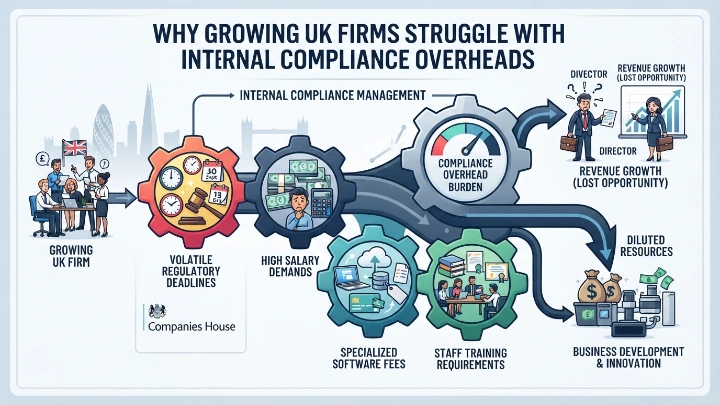
Maintaining compliance internally demands continuous expenditure on software systems, specialized legal databases, and administrative personnel. The average annual salary for a qualified UK company secretary exceeds £55,000, excluding additional employee costs like National Insurance, benefits, and workplace provisions. Small and mid-sized enterprises often find this fixed expenditure disproportionate to their actual monthly filing requirements.
Compliance management involves volatile operational workloads rather than constant daily administration. Annual filings, director changes, and share transfers occur sporadically throughout the financial year. Internal secretarial staff experience periods of underutilisation followed by intense crunch periods around filing deadlines. Paying full-time salaries for fluctuating workloads creates cost inefficiencies across your finance and operations departments.
In addition to salary constraints, regulatory standards under the Economic Crime and Corporate Transparency Act demand rigorous verification processes. Internal teams must continuously update their technical knowledge to avoid statutory fines. Failing to register information accurately leads to severe civil penalties or corporate prosecution. Outsourcing shifts this legal monitoring burden to specialized external vendors who absorb training and tool costs.
When should a business transition from in-house management to outsourced compliance?
A business should transition to outsourced compliance when statutory filings strain internal capacity, administrative expenses exceed market service rates, regulatory updates overwhelm existing staff, or corporate restructuring demands advanced legal precision. Scaling firms shift to external providers to maintain absolute statutory compliance.
Companies reaching specific growth thresholds experience increased corporate secretarial complexity. Adding new directors, issuing fresh equity, or creating secondary subsidiaries generates heavy documentation requirements. Internal administrative assistants without specialized corporate law expertise struggle to execute these transactions accurately. Partnering with external experts ensures every official filing complies with UK company law standards.
Operational expansion into new domestic markets or physical locations introduces complex facility requirements. Growing businesses often need dedicated physical spaces to host formal corporate meetings, shareholder gatherings, and official audits. Utilizing professional external facilities, such as a bookable UK conference room, provides proper corporate hosting infrastructure without requiring long-term commercial lease commitments.
Financial audits and investor due diligence processes also signal the ideal time to transition. Institutional investors scrutinize statutory registers, historical filings, and board minutes before committing capital. Experienced compliance service providers perform comprehensive register reconciliations, correcting historical filing errors and establishing clean corporate records. Transitioning early prevents costly deal delays during corporate transactions.
How does outsourcing corporate secretarial duties reduce compliance risk?
Outsourcing corporate secretarial duties reduces compliance risk by transferring routine filing responsibilities to dedicated legal specialists who maintain automated tracking systems, execute double-checked statutory submissions, and guarantee timely adherence to current UK corporate legislation.
Statutory compliance errors trigger strict penalties under UK corporate law. Missing a confirmation statement deadline results in automatic financial fines, late filing penalties, and potential company strike-off proceedings by Companies House. External secretarial vendors utilize automated tracking software and rigorous dual-authorisation controls to process every mandatory disclosure well before legal cutoff dates.
Third-party providers handle complex corporate filings across three key compliance operational areas:
Register statutory updates by recording director appointments, resignations, and address changes within required timeframes.
File annual financial disclosures by processing balance sheets, director reports, and confirmation statements accurately.
Execute capital restructures by drafting resolutions, issuing share certificates, and filing formal statements of capital.
External compliance specialists handle continuous regulatory change monitoring on your behalf. Statutory legislation updates require swift updates to corporate record-keeping practices. Dedicated secretarial services implement legal amendments immediately across all client accounts. This systematic approach shields directors from personal liability arising from administrative oversights.
What framework creates the ideal hybrid compliance model?
The ideal hybrid compliance model assigns strategic corporate governance, internal board advising, and executive decision-making to internal leaders while delegating routine filings, statutory register maintenance, and legal document drafting to external secretarial service providers.
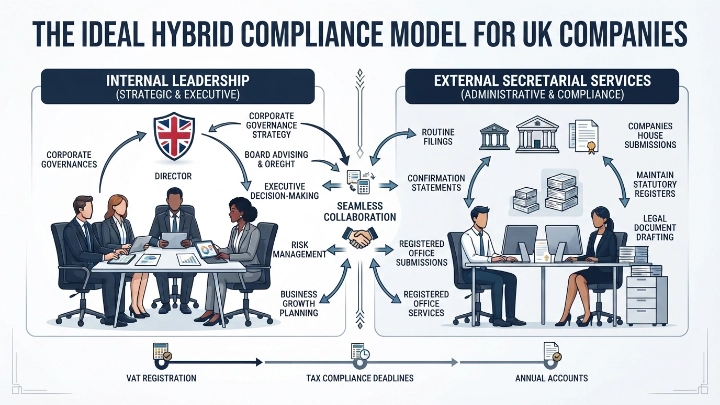
A successful hybrid structure establishes clear boundaries between internal strategic governance and external administrative execution. Senior management retains direct control over high-level decision-making, shareholder relations, and business strategy. Meanwhile, external providers handle time-consuming operational tasks like filing officer updates, submitting confirmation statements, and keeping statutory books updated.
Executing a seamless hybrid workflow requires clear division across four operational pillars:
Authorize strategic actions internally through formal board discussions and executive resolutions.
Draft statutory documentation externally using specialized legal templates and secretarial tools.
Verify corporate data internally using verified officer credentials and accurate company records.
Submit official filings externally through secure electronic interfaces directly to statutory registries.
This structural separation optimizes executive time while guaranteeing absolute legal compliance. Internal staff focus on growing the core business without losing hours to administrative procedures. Your company maintains high-level governance oversight while leveraging the operational speed and lower cost structure of a specialized external agency. To assess your current governance framework, read Company Secretarial: The Secret to Long-Term UK Regulatory Compliance to evaluate internal administrative gaps.
How do costs compare between in-house secretarial teams and outsourced compliance?
In-house secretarial teams require high fixed annual costs including full-time salaries, employee benefits, software licenses, and ongoing training, whereas outsourced compliance operates on predictable, variable pricing models where businesses pay only for specific services rendered.
Financial comparisons between internal departments and external service models reveal substantial cost variances. An internal secretarial role involves permanent overheads that scale up as the company grows. Beyond base pay, employers fund workplace pensions, national insurance contributions, continuous professional development courses, and specialized corporate secretarial software seats.
| Cost Component | In-House Secretarial Team | Outsourced Compliance Service |
| Base Overhead | Fixed annual salary (£45,000 – £65,000) | Variable or tiered monthly fee |
| Software & Tools | Direct software subscription costs | Included in service package |
| Training & Upgrades | Employer-funded legal training | Provider-funded expert training |
| Scalability Cost | High (requires additional hiring) | Low (instant tier adjustment) |
| Filing Execution | Internal hourly staff expenditure | Direct flat-rate execution |
Outsourced models convert fixed labor liabilities into manageable, variable operating costs. Businesses purchase targeted service packages scaled precisely to their corporate structure and transaction volume. A simple firm with minimal annual changes pays a modest recurring fee, while a multi-subsidiary group scales its service tier to match expanding filing needs.
Eliminating unnecessary overhead unlocks financial resources for core business investments. Companies reduce risk, eliminate training costs, and access expert corporate guidance at a fraction of full-time hiring expense. For tailored enterprise support, explore Reliable Company Secretarial Services for Growing UK Firms to select a compliance package matched to your growth trajectory.
How can Form My Company streamline your corporate compliance?
Form My Company delivers full-spectrum corporate secretarial and statutory compliance solutions tailored for growing UK businesses. Managing corporate registers, executing director updates, and submitting annual confirmation statements requires meticulous precision. Form My Company removes administrative burdens by deploying qualified compliance experts supported by secure digital filing systems.
By partnering with Form My Company, your business secures expert oversight for statutory filings, corporate record maintenance, and governance administration. Our flexible service plans scale seamlessly with your corporate structure, ensuring absolute compliance with UK legal standards while lowering your operational costs. Form My Company provides the reliable administrative foundation your enterprise needs to focus on sustainable, long-term growth.
Explore our Conference Room guides,
PAYE Registration vs. Payroll Management: Choosing Your Workflow
VAT Registration vs. Flat Rate: Which Scheme Saves More?
Frequently Asked Questions
How do I book a conference room through Form My Company?
You can reserve a meeting space directly online by selecting your preferred location, date, and duration on the Form My Company platform. Each booking includes access to high-speed internet, audiovisual equipment, and optional catering support. Reservations can be scheduled by the hour or for full-day professional events.
What amenities are included with Form My Company’s conference room rentals?
Form My Company conference rooms come equipped with high-definition presentation displays, video conferencing tools, high-speed Wi-Fi, and ergonomic seating. Additionally, complimentary tea and coffee services, printing access, and administrative support are available upon request. These facilities cater to client presentations, team workshops, and board meetings.
Can non-members rent meeting spaces at Form My Company?
Yes, non-members can easily rent conference rooms and meeting spaces on demand without requiring a long-term contract or monthly subscription. Form My Company offers flexible pay-as-you-go pricing for freelancers, remote teams, and visiting executives. Booking in advance ensures availability at your preferred location.
How much does it cost to rent a conference room with Form My Company?
Conference room rental rates with Form My Company vary based on room capacity, duration, and specific location requirements. Flexible hourly and daily packages allow businesses to scale space according to their meeting size and budget. Upfront pricing includes core amenities with optional add-ons for catering and advanced tech support.
Where are Form My Company’s conference rooms located?
Form My Company provides conference rooms and meeting venues in key commercial districts, making them easily accessible for team members and external guests. Locations are chosen for their proximity to major transport hubs, professional surroundings, and secure business environments. Detailed venue addresses and parking availability are provided upon reservation.