
Registering a VAT group requires a designated representative member to submit form VAT50 and form VAT51 to HMRC online. All participating corporate entities must maintain an established UK business presence and meet strict common control criteria under Section 43A of the Value Added Tax Act 1994.
What Are the Eligibility Requirements for UK VAT Group Registration?
Two or more corporate bodies qualify for UK VAT group registration when each entity maintains a permanent UK establishment and falls under common control. One parent company, individual, or partnership must hold over 50% of voting rights across every participating corporate entity.
HMRC evaluates eligibility using strict statutory criteria defined in the Value Added Tax Act 1994. Corporate entities include limited companies, limited liability partnerships (LLPs), and registered overseas corporations with fixed UK branches. Unincorporated associations and sole proprietorships remain excluded from joining a VAT group structure.
Control exists when a controlling entity holds the majority of voting shares or commands board appointment powers. This controlling party does not require VAT registration itself to establish group eligibility. If a parent company holds 51% equity in three UK subsidiaries, all four entities satisfy the common control test.
Every prospective member must operate a fixed place of business within the United Kingdom. A registered office address alone fails to satisfy HMRC physical establishment standards. Entities require active operational premises, local management personnel, or physical trading infrastructure inside UK jurisdiction.
Certain corporate structures trigger mandatory HMRC compliance reviews before approval. HMRC rejects applications that create artificial tax advantages or distort standard input tax recovery rules. Companies operating within the financial services or insurance sectors frequently undergo enhanced scrutiny regarding partial exemption calculations.
Which HMRC Forms Are Required to Apply for a VAT Group?
Applicants must complete three core HMRC forms: form VAT1 for new VAT registration, form VAT50 to nominate the representative member, and form VAT51 to list all group members. Digital submission occurs through the official HMRC Government Gateway portal.
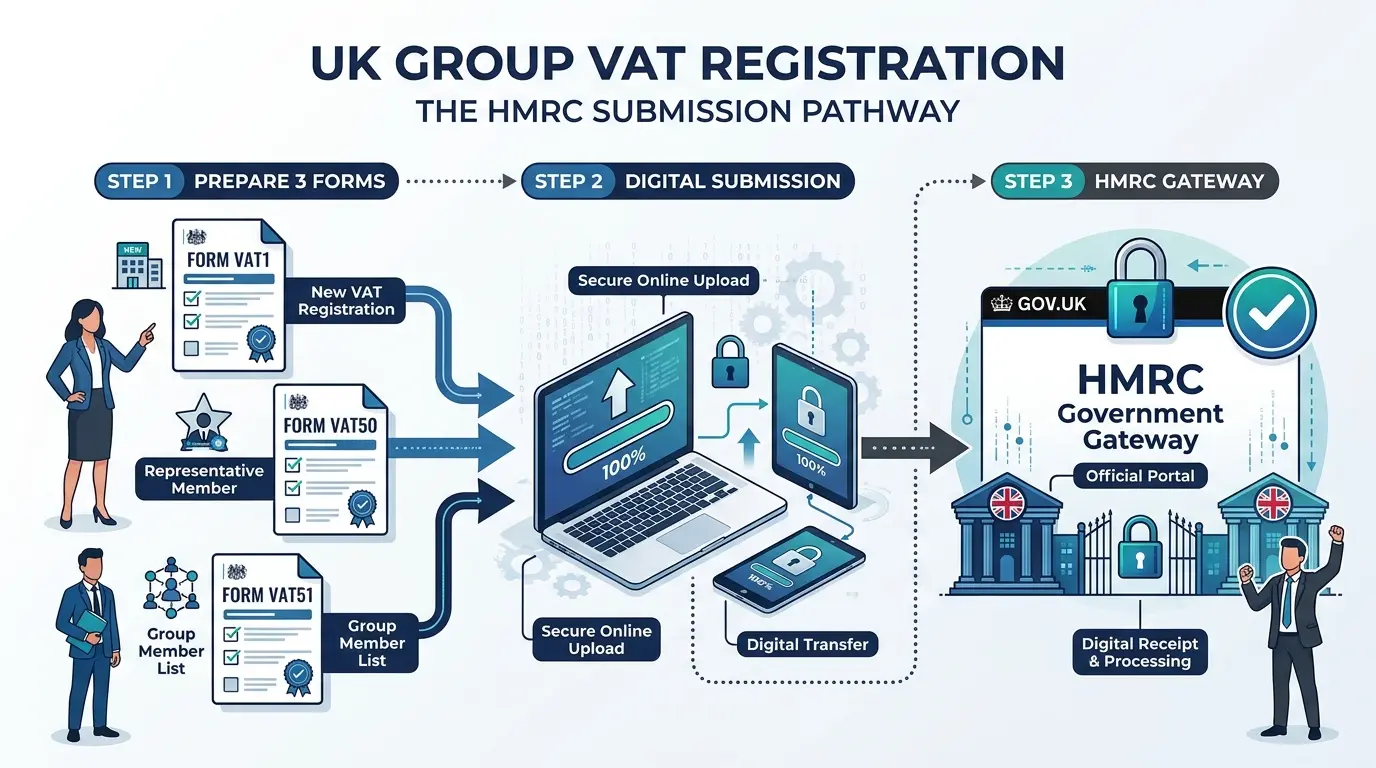
Form VAT1 establishes the primary tax profile when the corporate group lacks an existing VAT registration number. If one subsidiary already holds an active VAT number, the group adopts that existing registration identifier. Adopting an active registration prevents administrative delays during the HMRC verification phase.
Form VAT50 captures the legal details, trading activities, and bank account credentials of the nominated representative member. The representative member assumes direct statutory accountability for filing consolidated returns and remitting tax liabilities. Directors of the representative entity must authorize this appointment prior to digital submission.
Form VAT51 records the corporate registration numbers, incorporation dates, and control relationships for every joining subsidiary. Complex corporate hierarchies require an accompanying organisational chart illustrating exact shareholding percentages. Clear documentation accelerates HMRC officer validation and minimizes follow-up information requests.
Securing professional VAT Registration Assistance ensures accurate form completion and prevents costly HMRC processing rejections. Specialist tax advisors verify shareholding thresholds and audit establishment evidence before submitting digital applications. Accurate initial filings reduce approval timelines from twelve weeks to four weeks.
How Does the Step-by-Step VAT Group Application Process Work?
The VAT group registration process follows four sequential stages: verifying corporate control, appointing a representative member, submitting digital HMRC forms, and configuring consolidated accounting software. HMRC typically processes complete applications within 30 working days.
Stage 1: Audit Corporate Structure and Control Thresholds
Corporate administrators begin by mapping all parent and subsidiary relationships across the group. Legal teams verify statutory registers, articles of association, and shareholder agreements to confirm majority voting control. Any entity falling below the 50% control threshold gets excluded from the application scope.
Stage 2: Nominate the Representative Member
Group directors select one eligible UK entity to act as the official representative member. This entity manages all correspondence with HMRC and coordinates internal tax settlements between group companies. Selecting an entity with robust internal accounting infrastructure simplifies ongoing compliance management.
Stage 3: Submit Digital Forms via Government Gateway
The nominated representative logs into the HMRC online portal to upload forms VAT1, VAT50, and VAT51. Applicants specify a proposed effective registration date, which normally aligns with the start of a VAT accounting period. HMRC issues an automated digital receipt confirming submission timestamp and reference numbers.
Stage 4: Align Accounting Systems for Consolidated Reporting
Finance teams configure enterprise resource planning (ERP) software to eliminate inter-company VAT charges from the effective date. Understanding What Is Digital Record Keeping Under Making Tax Digital (MTD) for VAT? ensures seamless compliance across all grouped subsidiaries. Digital links must connect individual subsidiary ledgers directly to the representative member’s central VAT return software.
What Are the Financial and Operational Benefits of VAT Grouping?
VAT grouping eliminates VAT charges on intra-group transactions, consolidates quarterly tax filings into one return, and improves cash flow across connected entities. Participating companies avoid funding upfront VAT payments on internal management fees, intellectual property licenses, and shared services.
Standard trading between separate limited companies requires charging 20% VAT on taxable supplies. When one subsidiary incurs delays reclaiming input tax, the corporate group suffers temporary cash flow friction. VAT grouping treats all members as a single taxable person, rendering intra-group supplies outside the scope of VAT.
Administrative overheads decrease significantly when finance teams submit a single consolidated VAT return instead of multiple individual filings. A corporate structure with six subsidiaries reduces annual VAT return submissions from 24 filings down to four quarterly filings. Consolidated reporting lowers external accounting fees and reduces manual data entry errors.
Partially exempt businesses gain substantial cost savings through VAT group structures. Standard partially exempt entities lose the ability to reclaim input VAT on internal administrative services provided by sister companies. Grouping eliminates the VAT charge on those internal recharges, permanently removing irrecoverable tax leakage.
What Compliance Obligations Apply After VAT Group Approval?
All VAT group members share joint and several liability for the group’s entire VAT debt, even after a subsidiary exits the group. The representative member must maintain MTD-compliant digital links and file consolidated quarterly returns by statutory deadlines.
Joint and several liability represents the primary legal risk within a UK VAT group structure. If the representative member defaults on a £150,000 VAT liability, HMRC pursues any individual group member for the full unpaid balance. Directors must evaluate counterparty risk across all participating subsidiaries before finalizing group membership.
Making Tax Digital regulations mandate end-to-end digital record keeping for every entity inside the VAT group. Subsidiaries cannot manually re-key sales totals into a spreadsheet for the representative member to transcribe. Automated API integrations or formula-linked spreadsheets must transfer transaction data between member ledgers and HMRC submission software.
Corporate restructuring requires immediate notification to HMRC within 30 days of any structural change. Selling a subsidiary, acquiring a new entity, or altering voting share structures modifies group eligibility. Administrators submit updated VAT50 or VAT51 amendments online to add new members or remove departing companies.
Errors in group eligibility or missed filing deadlines trigger strict HMRC financial penalties. HMRC applies a points-based penalty system for late submissions alongside daily interest charges on overdue tax balances. For corporate teams seeking Complete Peace of Mind: Let Form My Company Handle Your Complex VAT Application Forms, delegating regulatory oversight protects against costly compliance failures.
How Should Corporate Groups Prepare for HMRC Registration Reviews?
Corporate groups prepare for HMRC reviews by compiling statutory share registers, UK lease agreements, board minutes, and inter-company service contracts prior to submission. Complete documentary evidence prevents HMRC compliance officers from placing applications into extended manual review queues.
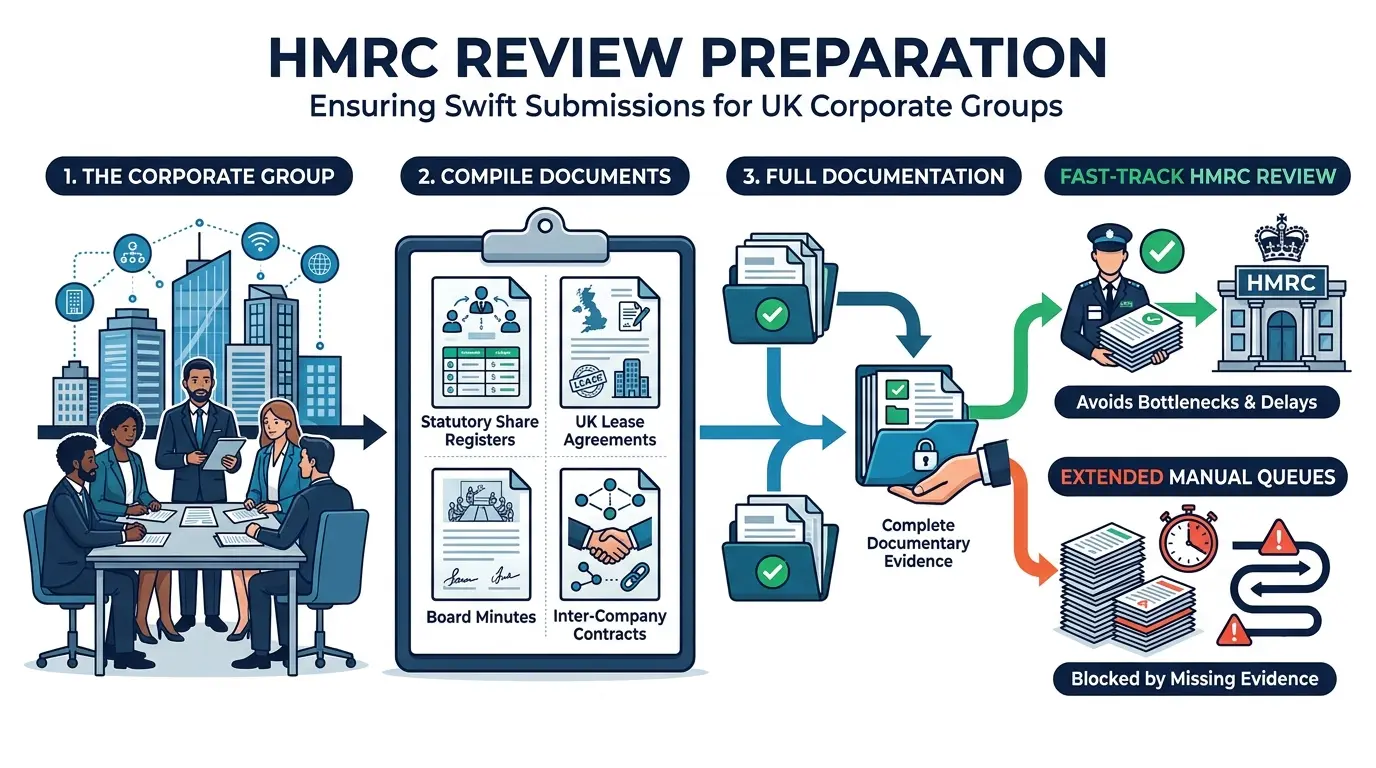
HMRC frequently issues pre-registration verification letters requesting proof of physical UK trading activity. Providing commercial property leases, UK utility bills, and local employee payroll records satisfies establishment requirements immediately. Relying on virtual office addresses or mail-forwarding services triggers automatic compliance delays.
Detailed inter-company agreements demonstrate genuine commercial substance behind group transactions. Documents outlining shared staff costs, central IT infrastructure, and intellectual property licensing prove legitimate operational integration. Transparent documentation reinforces eligibility during routine HMRC post-registration audits.
Form My Company delivers end-to-end corporate compliance support for multi-entity UK businesses navigating complex tax registrations. Through dedicated VAT Registration Assistance, Form My Company audits corporate control structures, prepares forms VAT50 and VAT51, and manages direct HMRC submissions. Engaging Form My Company ensures accurate regulatory alignment from initial eligibility assessment through final group activation.
Explore More VAT Registration Assistance Guide,
How to Manage Cash Flow Challenges When Paying Quarterly VAT Bills
How to Handle Import and Export VAT Obligations Following Recent Trade Rules
Frequently Asked Questions
When must a UK business register for VAT with HMRC?
A UK business must register for VAT if its taxable turnover exceeds £90,000 over any rolling 12-month period, or if it expects to surpass that £90,000 threshold within the next 30 days alone. Overseas businesses without a fixed UK establishment must register before making their first taxable UK sale regardless of turnover. Using Form My Company for VAT Registration Assistance ensures timely digital submission within HMRC’s strict 30-day notification window to prevent late registration penalties.
How long does it take to get a UK VAT registration number?
HMRC typically processes online VAT applications and issues a registration number within 30 working days. Applications requiring manual compliance checks, overseas entity verification, or group registration forms (such as VAT50 and VAT51) can take longer if documentation is incomplete. Form My Company reduces processing delays through its VAT Registration Assistance by auditing corporate details, bank credentials, and trading evidence prior to submission.
What documents and information are required for UK VAT registration?
Applicants must provide their Companies House registration number, director identification details, UK business bank account information, business activity descriptions, and accurate taxable turnover figures. Newly incorporated companies or businesses registering voluntarily often need supplementary evidence of trading activity, such as commercial leases, invoices, or supplier contracts. Through professional VAT Registration Assistance, Form My Company compiles and verifies all statutory records to satisfy HMRC pre-registration checks on the first attempt.
Can a business reclaim VAT paid on purchases before its registration date?
Yes, VAT-registered businesses can reclaim input VAT on goods purchased up to four years before registration if those assets are still held and used by the business, as well as on services received within six months prior to registration. Accurately calculating pre-registration input tax requires original VAT invoices and proper effective date alignment on the initial application. Form My Company incorporates pre-registration reclaim reviews into its VAT Registration Assistance to help businesses recover eligible start-up costs compliantly.
What are the obligations after receiving a UK VAT registration number?
Once registered, a business must charge the applicable VAT rate on taxable supplies from its effective date of registration, issue compliant VAT invoices, and submit digital returns under Making Tax Digital (MTD) rules. Most companies file quarterly VAT returns using MTD-compatible accounting software within one month and seven days after each accounting period ends. Form My Company supports businesses throughout the VAT Registration Assistance process by configuring effective registration dates and aligning accounting schemes—such as Flat Rate or Cash Accounting—with operational cash flow.