
UK businesses securing professional VAT registration help ensure full compliance with HMRC regulations, accurate turnover tracking against statutory thresholds, and error-free submission of tax documentation. Expert guidance eliminates filing delays, prevents costly financial penalties, and optimizes tax scheme selections tailored to operational models.
What Is the UK VAT Threshold and When Must Businesses Register?
UK businesses must register for VAT when their taxable turnover exceeds £90,000 within a rolling twelve-month period. Mandatory registration requires prompt notification to HMRC to avoid late notification penalties and backdated tax assessments.
UK tax law dictates that companies monitor their gross revenue on a continuous twelve-month rolling basis rather than a standard calendar year. Exceeding the £90,000 threshold requires immediate action to notify HM Revenue and Customs (HMRC). Delaying notification results in mandatory backdated tax payments and administrative penalties.
Businesses must also register if they expect their taxable turnover to exceed the statutory limit within the next 30 days alone. Early voluntary registration remains an option for firms below the threshold. Voluntary registration allows businesses to reclaim input VAT on commercial purchases, equipment acquisitions, and operational expenditures.
Managing turnover tracking requires precision accounting. Professional advisors monitor revenue streams, evaluate distance selling metrics, and track digital service sales. Accessing expert assistance ensures companies calculate taxable turnover accurately without misclassifying zero-rated or exempt goods. Business owners often review VAT Registration: Do You Know Your Business Turnover Thresholds? to evaluate their immediate reporting obligations before exceeding legal limits.
How Does Professional VAT Registration Help Prevent Penalties?
Professional VAT registration help prevents penalties by submitting accurate financial documentation, validating director identity credentials, and adhering strictly to statutory HMRC filing deadlines. Expert oversight eliminates submission errors that trigger formal tax audits.
HMRC enforces strict penalty frameworks for inaccurate VAT submissions, late applications, and incorrect turnover declarations. Filing errors often lead to default surcharges, interest charges on unpaid liabilities, and detailed compliance reviews. Expert advisors verify all application details against official UK business records before submission.
Registration requires complete verification of business entity details, banking documentation, and trade sector activities. Errors in legal entity names or bank details delay the issuance of a valid VAT number. Delayed numbers prevent businesses from charging VAT legally or issuing compliant tax invoices to commercial clients.
Specialist advisory services streamline communication with HMRC inspectors. Professional agents manage query resolutions, validate identity checks, and upload evidence of trading operations. Working with experienced corporate service providers minimizes administrative disruption, allowing business leaders to focus on core operations. Companies seeking direct administrative assistance can utilize Get Professional VAT Registration Help from Form My Company to complete their filings correctly.
Which VAT Scheme Provides the Highest Cost Savings for Your Business?
The optimal VAT scheme depends on annual business turnover, sector-specific profit margins, and total operational expenditure volume. Comparing the Standard Rate Scheme, Flat Rate Scheme, and Cash Accounting Scheme identifies maximum tax savings.
Selecting the wrong VAT scheme leads to unnecessary tax liabilities and restricted cash flow. The Standard Rate Scheme requires paying the difference between output tax charged to customers and input tax paid on purchases. This traditional approach benefits companies with substantial wholesale supplies and high overhead costs.
The Flat Rate Scheme allows small businesses to pay a fixed percentage of gross turnover to HMRC while charging clients the standard VAT rate. The specific percentage depends entirely on the commercial sector, ranging from 4% to 16.5%. Businesses operating with low cost of goods sold must evaluate limited-cost trader rules to avoid higher flat rates. Readers frequently compare options using VAT Registration vs. Flat Rate: Which Scheme Saves More? to calculate precise margin impacts.
Cash Accounting improves liquidity by requiring VAT payments only when clients settle invoices. This structure protects companies against cash flow shortages caused by delayed client payments. Specialized advisors model financial projections across all available schemes to select the structure that maximizes capital retention.
How Does VAT Registration Impact Corporate Governance and International Trade?
VAT registration strengthens corporate credibility, enables seamless cross-border trade within international markets, and ensures compliance with UK import-export tax frameworks. Proper registration establishes transparent accounting standards required by institutional enterprise partners.
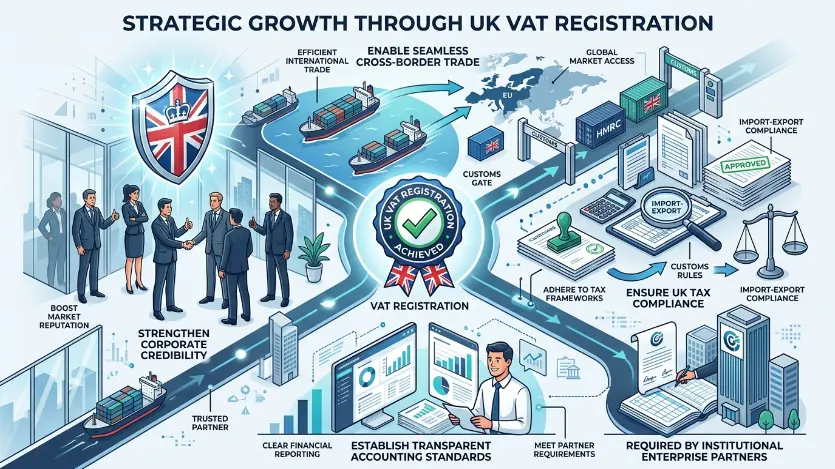
Commercial clients often prefer dealing exclusively with VAT-registered suppliers. Holding an active VAT number confirms business scale, operational legitimacy, and compliance with statutory frameworks. Unregistered entities face perceived credibility barriers when bidding for large corporate contracts or public sector tenders.
Cross-border trading introduces complex tax regulations for goods and services moving between the UK, the European Union, and non-EU territories. Registered businesses must apply Postponed VAT Accounting (PVA) for imports to avoid upfront cash outlays at customs borders. Incorrect zero-rating on export invoices results in severe retrospective tax assessments during compliance reviews.
Expanding companies require robust operational infrastructure alongside compliant tax structures. Corporate governance extends beyond filing tax returns to maintaining professional operational bases. Organizations upgrading their corporate infrastructure often book a professional Conference Room to host board meetings, conduct auditor reviews, and present transparent financial structures to stakeholders.
What Steps Are Included in the VAT Registration Process?
The VAT registration process involves collecting company credentials, submitting financial evidence through the HMRC portal, selecting tax accounting schemes, and setting up Making Tax Digital compliance software. Structured execution guarantees rapid approval without administrative rejections.
Form My Company guides corporate clients through every stage of official tax registration:
Gather incorporation certificates, official proof of address, and director identification documents.
Calculate historical twelve-month turnover figures and projected revenue metrics.
Select the appropriate tax accounting scheme based on sector-specific profitability.
Submit the complete digital application through the government gateway infrastructure.
Link business bank accounts to compliant Making Tax Digital (MTD) accounting platforms.
Making Tax Digital compliance requires businesses to maintain digital records and submit quarterly returns via HMRC-approved software. Manual record-keeping no longer satisfies statutory regulations. Specialist advisors configure software integrations, ensuring automated data transfer between internal sales ledgers and tax reporting channels.
Once HMRC approves the application, the business receives a official VAT registration certificate. This document confirms the unique nine-digit VAT number, effective date of registration, and official quarterly submission schedules. Adhering to structured workflows guarantees complete alignment with UK commercial tax laws.
How Does Form My Company Simplify Tax Compliance for Growing Businesses?
Form My Company simplifies ongoing tax compliance by handling complex administrative filings, monitoring statutory threshold updates, and managing corporate documentation for UK enterprises. Professional intervention protects organizations from legal oversights and financial penalties.
Navigating tax administration consumes valuable internal resources. Form My Company offers comprehensive corporate services that allow enterprise leadership teams to focus on revenue expansion while maintaining compliance standards. Expert managers oversee corporate filings, verify entity records, and coordinate statutory documentation.
Integrated business services streamline setup phases for domestic startups and expanding overseas entities. Managing corporate governance, statutory compliance, and operational workspace requirements through a single provider eliminates miscommunication. Form My Company establishes reliable administrative foundations across all corporate functions.
Partnering with established business specialists guarantees long-term compliance stability. Professional advisors adapt corporate reporting structures as tax legislation evolves. Engaging external compliance management ensures businesses maintain structural alignment with HMRC demands throughout every growth phase.
Explore our Conference Room guide,
Save Costs with Form My Company’s Director Appointment Bundle
Submit Your Confirmation Statement with Form My Company
Frequently Asked Questions
What equipment and facilities are included with Form My Company conference rooms?
Form My Company conference rooms come equipped with high-speed fiber internet, HD audio-visual presentation displays, dynamic video conferencing equipment, and interactive whiteboards. Modern meeting environments also feature climate control, ergonomically designed seating, and complimentary refreshment stations to support seamless corporate events.
How do I book a meeting room or conference facility through Form My Company?
Reserving a conference room through Form My Company involves choosing your desired venue location, picking the date and time, and selecting specific room capacities or technical setups. The streamlined online booking process instantly confirms space availability for seamless client presentations, board meetings, and team workshops.
What flexible pricing options are available for corporate conference room rentals?
Form My Company offers flexible room rental plans, including hourly bookings, half-day rates, and full-day packages tailored to varying business needs. Flexible pricing options allow startups and established enterprises to access executive meeting spaces without the ongoing overhead costs of a long-term lease.
Can conference room configurations be customized for different event types?
Yes, Form My Company conference rooms can be configured into multiple layouts, including boardroom style, classroom setups, U-shape arrangements, or theater seating. Adaptable furniture arrangements accommodate formal board meetings, collaborative group training sessions, or private corporate interviews.
Where are Form My Company conference rooms located for business meetings?
Form My Company conference rooms are situated in prime commercial business districts with accessible public transport links and nearby parking facilities. These centralized executive locations provide a professional environment for hosting client negotiations, investor pitches, and team collaboration sessions.