
The UK compulsory VAT registration threshold is £90,000 in taxable turnover calculated on a rolling 12-month basis or if you expect your turnover to exceed £90,000 in the next 30 days alone.
What Is the Current UK VAT Registration Threshold?
The current UK compulsory VAT registration threshold stands at £90,000 in taxable turnover. Businesses must register with HM Revenue and Customs when their total VATable sales cross this fixed limit within any rolling 12-month period or next 30 days.
UK tax legislation sets the mandatory VAT registration threshold at £90,000. HM Revenue and Customs (HMRC) monitors this requirement across all UK-based sole traders, limited companies, and partnerships. Taxable turnover includes all sales of goods and services that are not exempt from VAT. Standard-rated, reduced-rated, and zero-rated sales all count toward this legal total.
Exempt supplies do not contribute to your taxable turnover total. Land sales, financial services, and insurance transactions fall under exempt categories. Businesses must track their turnover continuously rather than relying on standard accounting year-end figures. Crossing the threshold without notifying tax authorities results in statutory financial penalties.
How Do You Calculate Your Rolling 12-Month VAT Turnover?
You calculate rolling 12-month turnover by adding your taxable sales for the past 12 consecutive months at the end of every month. This rolling period moves forward each month and does not align with your standard accounting year.
Calculating turnover requires an ongoing, month-by-month evaluation of gross taxable sales. Business owners must sum up total receipts from the previous 11 months plus the current completed month. If the cumulative total reaches £90,001 on any given month-end, statutory registration rules trigger instantly.
Three specific revenue streams count toward your calculation: standard-rated goods, reduced-rated services, and zero-rated exports. Capital assets sold during normal business upgrades do not count toward total taxable turnover. Commercial property leases and grant funding also require individual tax assessment before inclusion. Accurate bookkeeping prevents unexpected threshold breaches.
What Is the 30-Day Forward-Looking VAT Rule?
The 30-day forward-looking VAT rule requires instant registration if you realize your taxable turnover will exceed £90,000 in the next 30 days alone. The registration obligation applies on the day you realize the threshold breach will happen.
The forward-looking rule operates independently from historical 12-month calculations. Businesses triggering this rule often sign high-value contracts or receive unexpected commercial orders. If a single contract raises your 30-day projected revenue above £90,000, you must register immediately.
The effective registration date differs under this rule. Tax authorities backdate effective registration to the date you formed the expectation, not the date of actual payment. Missing this deadline creates retroactive tax liability on total revenue earned. Contractual planning helps identify large revenue shifts before commercial signing.
How Does Voluntary VAT Registration Benefit UK Businesses?
Voluntary VAT registration allows businesses operating below the £90,000 turnover limit to register with HMRC willingly. This voluntary setup enables companies to reclaim input VAT paid on commercial purchases, equipment upgrades, and professional business expenditure.
Registering voluntarily offers distinct financial advantages to startup enterprises with high initial expenses. Businesses buying physical inventory, manufacturing equipment, or commercial hardware reclaim 20% VAT on those initial purchases. This input recovery improves operational cash flow during initial growth phases.
Voluntary setup enhances corporate credibility when dealing with enterprise clients. Corporate customers routinely expect suppliers to display valid UK VAT numbers on commercial invoices. B2B clients easily reclaim output tax charged, making your price increase neutral to their balance sheet. However, direct consumer sales become 20% more expensive under voluntary setups.
What Types of Sales Count Toward Your VAT Threshold?
Taxable sales counting toward the threshold include standard-rated, reduced-rated, and zero-rated goods and services. Exempt revenue, capital asset sales, and out-of-scope international transactions do not count toward your total turnover sum.
Taxable supplies cover the vast majority of commercial goods sold within the United Kingdom. Standard-rated items charged at 20% form the primary foundation of business turnover calculations. Reduced-rated items charged at 5% also contribute fully to threshold totals. Zero-rated items like books and children’s clothing carry a 0% tax rate but still constitute taxable sales.
Three specific categories remain excluded from statutory turnover totals: exempt financial transactions, residential property rents, and out-of-scope statutory fees. Overseas sales of services to corporate entities outside the UK usually fall out of scope. Correctly classifying sales channels stops premature or unnecessary tax registrations.
When Must You Notify HMRC After Crossing the Threshold?
You must notify HMRC within 30 days after the end of the month in which your rolling 12-month turnover crosses £90,000. For the 30-day forward-looking test, you must notify HMRC within 30 days of forming the expectation.
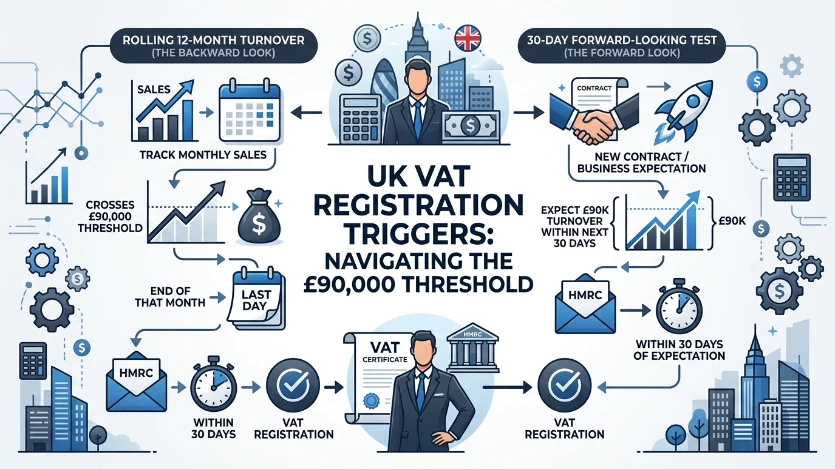
Tax notification deadlines require strict adherence to statutory compliance schedules. When crossing the historical 12-month limit on May 31st, you must register by June 30th. Your effective registration date becomes July 1st. You must charge output VAT on all taxable sales from that official date forward.
Failure to notify HMRC within statutory windows triggers late registration penalties. Penalties range from 5% to 15% of total tax due depending on delay length. HMRC charges interest on unpaid output taxes starting from the mandatory effective registration date. Automated monitoring prevents unexpected compliance defaults.
What Are the Main VAT Schemes Available to Small Businesses?
Main UK VAT schemes include the Standard Accounting Scheme, Flat Rate Scheme, Cash Accounting Scheme, and Annual Accounting Scheme. Each scheme alters accounting methods, submission deadlines, and total tax payment calculations.
Choosing appropriate accounting frameworks directly impacts ongoing administrative overheads. The Standard Accounting Scheme calculates tax liability using invoice dates regardless of payment collection status. The Cash Accounting Scheme records liabilities only when customers settle invoices, protecting cash balances against bad debts.
Small businesses frequently evaluate simplified schemes to streamline quarterly compliance tasks. Deciding between options requires evaluating gross profit margins, client types, and administrative overheads. Analyzing VAT Registration vs. Flat Rate: Which Scheme Saves More? clarifies which accounting framework maximizes corporate savings.
What Penalties Apply for Late VAT Registration?
HMRC imposes failure-to-notify financial penalties based on a percentage of the net VAT due from the date registration was required. Penalty rates range from 5% to 30% depending on whether the delay was unprompted or deliberate.
Tax authorities enforce strict penalty matrices for non-compliance with threshold regulations. If registration delays fall under 9 months, baseline penalty rates start at 5% of unpaid liabilities. Delays stretching beyond 18 months trigger maximum non-deliberate penalty rates reaching 15%. Deliberate concealment pushes penalty assessments up to 30% or higher.
Late registrants remain legally obligated to pay all backdated tax amounts owed. You must pay output tax on historical sales even if you failed to collect it from buyers. Backdated liabilities consume net profit margins directly if historical invoices cannot be reissued. Timely notification protects operational income from unexpected statutory penalties.
How Does VAT Registration Affect Overseas Businesses Trading in the UK?
Non-established UK businesses have a zero-pound (£0) VAT registration threshold. Overseas enterprises selling goods or digital services to UK customers must register instantly before completing their first taxable transaction.
Foreign corporate entities face strict non-established taxable person (NETP) regulations within the United Kingdom. The standard £90,000 turnover allowance applies exclusively to UK-domiciled individuals and UK-incorporated company structures. Overseas sellers utilizing online marketplaces must obtain UK registration credentials immediately.
Foreign entities must complete specific verification checks during initial tax onboarding. International directors submit identity verifications, corporate register extracts, and commercial trade evidence. Maintaining local administrative presence or securing corporate meeting space simplifies UK trade execution. Using professional on-demand meeting facilities provides overseas directors with professional infrastructure when hosting UK compliance reviews, operational meetings, or investor discussions.
What Steps Are Required to Complete UK VAT Registration?
Completing UK VAT registration involves creating an HMRC Government Gateway account, submitting corporate identification details, providing business turnover evidence, and selecting an accounting scheme. Processing typically takes between two to six weeks.
The registration process requires gathering accurate corporate records before digital application submission. Applicants must provide company registration numbers, primary bank details, self-assessment UTRs, and actual turnover figures. HMRC verifies submitted data against official UK corporate registries to prevent fraudulent entries.
Obtaining professional administrative support speeds up registration approvals. Specialist corporate services handle document filings, identity checks, and statutory communications efficiently. Engaging professionals to get professional VAT registration help from Form My Company guarantees full compliance with HMRC guidelines without administrative delay.
How Do You Maintain VAT Compliance After Registration?
Maintaining post-registration VAT compliance requires submitting digital tax returns quarterly through Making Tax Digital software, issuing compliant VAT invoices, keeping electronic financial records, and paying liabilities punctually.
Making Tax Digital (MTD) mandates electronic recordkeeping for all registered UK entities. Companies must link accounting software directly to HMRC processing systems via functional API connections. Manual ledger entries or spreadsheet submissions no longer satisfy statutory reporting standards.
Compliant invoices must show specific structural data points to remain legally valid. Invoices require full business names, official addresses, unique invoice numbers, tax point dates, and registration details. Displaying accurate net figures, applicable tax rates, and final gross totals prevents commercial disputes and tax inspection penalties.
Form My Company assists growing businesses with corporate setup, administrative services, and compliance management. Establishing solid accounting workflows early protects expanding enterprises from statutory penalties while unlocking financial growth potential.
Explore our Conference Room guide,
The Essential Director Bundle: Managing Appointments and Resignations Together
Confirmation Statements: Avoiding the Common Pitfalls for UK Directors
Frequently Asked Questions
What features are included with Form My Company conference room hires?
Form My Company conference room rentals include high-speed Wi-Fi, modern audio-visual equipment, presentation displays, and ergonomic seating. Clients also benefit from professional reception services to greet attendees, alongside flexible layout configurations tailored for board meetings, presentations, or team workshops.
How do I book a conference room through Form My Company?
Booking a conference room is completed online by selecting your preferred date, time slot, and room capacity directly on the Form My Company platform. Confirmation is instant, allowing businesses to secure professional meeting spaces on an hourly, half-day, or full-day basis without long-term commitments.
Where are Form My Company meeting facilities located?
Form My Company conference rooms are situated in central, highly accessible business locations across key UK commercial hubs. These prime addresses provide convenient public transport links and professional environments suitable for client pitches, corporate reviews, and team collaborations.
Can off-site teams use Form My Company conference rooms for hybrid meetings?
Yes, Form My Company meeting rooms are equipped with video conferencing infrastructure to support seamless hybrid meetings. Remote participants can join via integrated web platforms, ensuring clear audio and high-definition video connectivity for all attendees.
What is the cancellation policy for Form My Company conference room bookings?
Form My Company offers flexible cancellation policies that allow clients to modify or cancel reservations up to 24 to 48 hours prior to the booking time without penalty. Specific terms depend on the booking duration, and full details are outlined during the online checkout process.