
UK directors avoid Confirmation Statement errors by reviewing company register details, verifying PSC data, tracking strict filing deadlines, and accurately logging changes before submission to Companies House. Regular audits prevent £5,000 fines, director disqualification, and involuntary corporate dissolution.
What Is a Confirmation Statement and Why Is It Mandatory?
A Confirmation Statement is an annual filing verifying that Companies House holds accurate, up-to-date information about a registered UK company. It confirms legal registers, share capital details, officer appointments, and persons with significant control records under UK corporate law.
UK law requires every active and dormant company registered in England, Wales, Scotland, and Northern Ireland to deliver a Confirmation Statement to the Registrar of Companies once every 12 months. The requirement originates from Section 853A of the Companies Act 2006. This filing replaced the traditional Annual Return (Form AR01) to streamline reporting while increasing corporate transparency across the United Kingdom.
Directors submit this document to validate existing records rather than report financial performance. The legal statement confirms that the public register accurately reflects the statutory structure of the enterprise on the designated review date. Companies House uses these updates to maintain the public record, fight financial crime, and give financial institutions accurate information about corporate governance structures.
What Are the Most Common Confirmation Statement Errors Made by Directors?
Directors most frequently fail by submitting outdated officer addresses, omitting updated Persons with Significant Control details, entering incorrect share capital allocations, misclassifying SIC industry codes, and missing statutory 14-day filing windows.
Understanding common filing mistakes helps board members protect their legal standing and corporate reputation.
Three primary categories of clerical mistakes cause administrative delays and legal scrutiny:
Omit Person with Significant Control (PSC) updates. Directors regularly change shareholder equity without updating PSC records. If an individual acquires more than 25% of voting rights, Companies House requires prompt identification.
Fail to update registered office and correspondence details. Company directors frequently move home addresses or office spaces without updating their service address on the public index.
Submit incorrect Standard Industrial Classification (SIC) codes. Operating activities evolve, yet companies leave outdated trade classification codes intact during the annual review.
Data discrepancies disrupt corporate banking relationships and slow down investor due diligence processes. When potential partners evaluate business credentials, public register errors raise immediate compliance red flags. Resolving conflicting records requires formal corrective filings, which cost administrative time and legal overhead.
How Does a Confirmation Statement Differ from Annual Accounts?
A Confirmation Statement verifies corporate structure, officer identities, and ownership data, whereas Annual Accounts document financial performance, profit margins, balance sheets, and tax liabilities. Both filings serve entirely different statutory purposes under UK law.
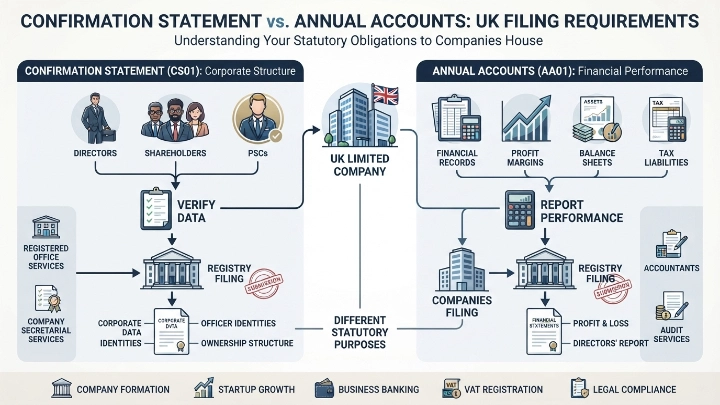
Directors often confuse these obligations because both recur on an annual schedule. Distinguishing between administrative verification and financial reporting protects companies from non-compliance. Evaluating corporate structure against financial accounting reveals clear procedural boundaries. Directors who need a clear breakdown of structural vs. financial reporting can review Confirmation Statement vs. Annual Accounts: The Difference Explained to understand compliance timelines.
The Confirmation Statement provides snapshot verification of administrative records. It contains zero financial balance sheet data. Conversely, Annual Accounts detail profit, loss, asset distribution, and tax calculations for submission to both Companies House and HM Revenue and Customs (HMRC). Filing one document does not fulfill the legal obligation to submit the other.
What Are the Legal Consequences of Missing a Confirmation Statement Deadline?
Failing to file a Confirmation Statement results in personal criminal liability for directors, civil prosecution, fines up to £5,000, credit score degradation, and Companies House striking the company off the register.
The statutory filing window gives directors exactly 14 days after the end of their review period to submit Form CS01. Missing this window places the company and its board members in immediate default under Section 853A of the Companies Act 2006.
Three severe legal consequences escalate rapidly when compliance deadlines pass:
Prosecute individual directors directly. The law treats late submission as a criminal offense, exposing board members to personal fines and criminal records.
Initiate compulsory strike-off procedures. Companies House assumes inactive operational status and publishes formal notices in the London, Edinburgh, or Belfast Gazette to dissolve the entity.
Freeze business bank accounts automatically. Financial institutions monitor the Companies House database and restrict corporate accounts when a company faces compulsory striking-off.
When compulsory strike-off occurs, all corporate assets and property transfer directly to the Crown under bona vacantia principles. Restoring a dissolved business requires expensive High Court petitions, accountant interventions, and administrative restoration fees.
How Do Directors Maintain Accurate PSC and Share Capital Records?
Directors maintain accurate PSC and share capital records by tracking equity transfers immediately, recording changes in statutory registers within 14 days, and auditing shareholder voting power before completing the confirmation report.
Verification of beneficial ownership forms the core foundation of modern UK corporate compliance. Economic Crime and Corporate Transparency regulations mandate strict oversight of everyone holding significant influence over a registered company.
Four distinct thresholds require immediate PSC registration and verification:
Identify share capital holdings exceeding 25%. Individuals holding more than one-quarter of total issued equity qualify as reportable persons.
Track voting right allocations above 25%. Shares with weighted voting structures alter control calculations regardless of nominal share values.
Record board appointment powers directly. Entitlements to appoint or remove the majority of executive directors require public declaration.
Document actual managerial control. Individuals exercising dominant influence over business strategy require registration despite holding no formal shares.
Maintaining statutory books inside the company office or secure digital systems ensures seamless annual submissions. Board members must audit their internal registers against public record files to confirm complete parity before executing annual signatures.
How Can Professionals Assist with Filing Accuracy and Corporate Governance?
Professional corporate secretarial services prevent submission errors, maintain statutory registers, handle electronic filings, monitor statutory deadlines, and protect directors from personal liability through expert compliance oversight.
Managing statutory books while running core commercial operations creates operational friction for business leaders. Professional services ensure compliance filings align precisely with changing Companies House standards. Using modern infrastructure allows enterprise management teams to focus on revenue growth while keeping legal records accurate.
Proper corporate governance also requires secure venues for shareholder meetings and board oversight functions. Businesses can book a professional Conference Room to host formal board meetings, review annual statutory registers, and execute corporate filings with full administrative privacy.
Corporate secretarial teams track statutory compliance dates using automated software tools. Professional oversight prevents missing filing dates, eliminates clerical errors on Form CS01, and protects directors from unnecessary personal liabilities.
How Do You File a Confirmation Statement Step-by-Step?
Filing a Confirmation Statement involves auditing internal company registers, verifying officer data, logging into Companies House WebFiling, checking PSC details, paying the statutory filing fee, and submitting the electronic Form CS01.
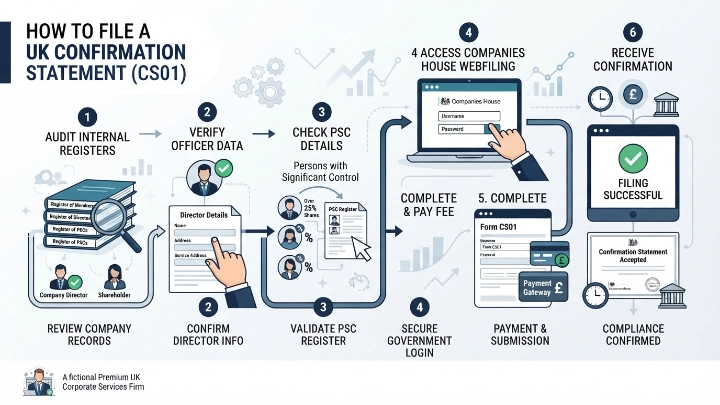
Executing an accurate annual filing requires a systematic approach to verifying data before final transmission.
Once submitted, Companies House issues an electronic receipt confirming successful delivery. Directors should archive this receipt alongside internal corporate minutes to maintain audit trails.
What Role Does a Confirmation Statement Play in Business Transparency?
The Confirmation Statement enhances financial transparency, prevents corporate identity theft, validates legal ownership, supports anti-money laundering frameworks, and builds institutional trust across the UK commercial ecosystem.
The United Kingdom framework relies heavily on open public records. Financial institutions, suppliers, commercial landlords, and venture capital investors examine public records before entering commercial contracts.
Three economic functions depend on accurate statutory filings:
Validate identity details for commercial banking. Lenders conduct automated identity checks using public registry records before issuing business accounts or loans.
Strengthen anti-money laundering compliance. Clear PSC declarations allow regulatory bodies to trace ultimate beneficial ownership and suppress illicit financial flows.
Protect against fraudulent corporate hijacking. Regular verification prevents unauthorized third parties from registering fake directors or changing official company locations without authorization.
Maintaining clean, verified records projects professionalism and commercial health. Transparency reduces friction during investor due diligence and speeds up commercial transactions. When directors need support managing their annual filings, they can Submit Your Confirmation Statement with Form My Company to ensure compliance.
Partnering with professional corporate service providers guarantees every detail matches statutory expectations. Form My Company manages administrative requirements, protects executive boards from compliance errors, and delivers accurate corporate secretarial solutions for growing UK businesses.
Explore our Conference Room guides,
Director Resignation: A Simple Guide to Maintaining Compliance
The Essential Director Bundle: Managing Appointments and Resignations Together
Frequently Asked Questions
What is corporate identity theft and how does it affect UK limited companies?
Corporate identity theft occurs when unauthorized third parties submit fraudulent filings to Companies House to alter a UK business’s registered address, director details, or share capital. Fraudsters use compromised corporate credentials to apply for unauthorized loans, order trade goods, or open fraudulent bank accounts using the company’s established credit reputation.
How does Form My Company protect UK businesses from Companies House fraud?
The Form My Company Fraud Protection service provides continuous 24/7 digital surveillance over a business’s public registry profile. It triggers immediate real-time email notifications whenever a document or statutory change is submitted to Companies House, allowing directors to identify and stop unauthorized filings before financial damage occurs.
Can existing UK companies enroll in the Form My Company Fraud Protection service?
Yes, any active UK Limited Company or LLP can enroll in the Form My Company Fraud Protection service regardless of which formation agent originally incorporated the entity. Form My Company seamlessly syncs the company registration number to an active monitoring queue to deliver automated monitoring and unauthorized filing alerts.
How does company fraud protection differ from the Companies House PROOF scheme?
While the free Companies House PROOF (Protected Online Filing) scheme prevents physical paper form submissions, the Form My Company Fraud Protection service delivers real-time email alerts for any electronic or online filings made against a corporate record. This monitoring alerts directors to unauthorized digital filings made using compromised company authentication codes.
What should directors do if an unauthorized filing is detected on Companies House?
Directors who discover unauthorized changes to their corporate records must act immediately by notifying Companies House, contacting Action Fraud, and informing their corporate bank. Enrolling in Form My Company Fraud Protection ensures company officers receive early detection alerts and direct administrative assistance to rapidly apply for statutory record rectifications.