
Managing director appointments and resignations together ensures real-time Companies House register accuracy, prevents legal liability gaps, and slashes corporate administration time. Bundling these statutory updates eliminates redundant filings, aligns board governance immediately, and maintains continuous compliance for corporate entities across the United Kingdom.
What Is the Essential Director Bundle for UK Board Restructuring?
The Essential Director Bundle is a consolidated corporate secretarial service that processes board appointments and resignations simultaneously. It unifies Companies House forms AP01 and TM01 into one coordinated compliance workflow, ensuring immediate register updates and reducing statutory filing overheads.
Board restructuring requires immediate updates to public registers. UK company law dictates that changes to directorships must reflect on Companies House within 14 days. Filing these updates individually increases administrative overhead and leaves room for oversight. A consolidated approach streamlines compliance by synchronizing every board change in a single administrative transaction.
When companies onboard new board members, they usually transition outgoing directors out of governance roles. Processing these updates separately creates temporal gaps on the official record. A bundled administrative procedure ensures that director responsibilities transfer seamlessly without exposing the business to governance risks.
Company secretaries and legal officers rely on unified filing procedures to maintain accurate public records. Statutory filings require specific information including full legal names, service addresses, residential details, and dates of birth. Bundling the processing of these details minimizes repetitive identity verification and cuts down data entry errors.
Corporate changes often require formal physical meetings to document board consent. Utilizing professional corporate venues like a Conference Room provides the formal environment necessary to execute statutory director appointments and board resignations according to legal standards. Coordinating physical meeting spaces with statutory filing tools accelerates the entire board restructuring lifecycle.
How Does Simultaneous Filing Prevent Legal and Compliance Gaps?
Simultaneous filing eliminates operational latency between outgoing and incoming directorships on the public register. It prevents legal ambiguity regarding board quorum, fiduciary duties, and authorized signatures, guaranteeing continuous corporate representation and regulatory compliance under the Companies Act 2006.
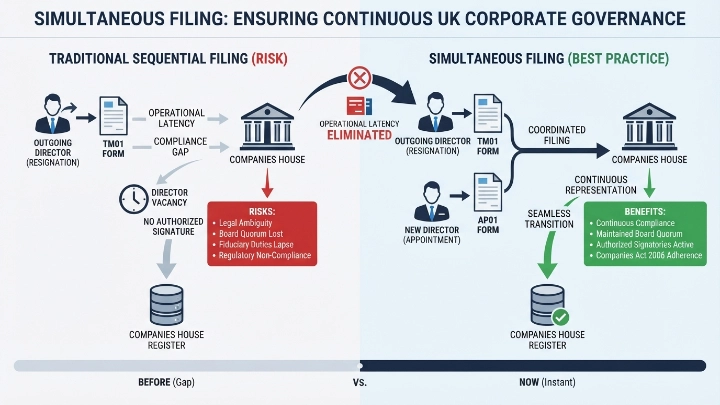
Public registers reflect statutory liability. If a director resigns but the notification remains unfiled, that individual retains legal duties to external entities. Conversely, an appointed director cannot legally execute official corporate actions until proper documentation exists. Processing both changes at once ensures legal representation remains uninterrupted.
Regulatory bodies inspect corporate filings for continuity gaps. Unaligned filings trigger administrative queries from Companies House, delaying statutory approvals. Simultaneous updates align identity verification, consent forms, and official registers in a single compliance pass.
Banks, lenders, and institutional investors verify board composition before approving credit lines or funding. Discrepancies between physical board minutes and public records stall financial due diligence. Unified filings align official records with legal reality instantly, supporting uninterrupted banking operations and financial transactions.
Corporate governance frameworks rely on clear chains of authority. Three governance risks emerge from staggered board filings: temporary loss of board quorum, unauthorized contract execution, and misallocated statutory notice liabilities. Simultaneous filing mitigates these risks by locking in updated directorship structures immediately.
What Are the Cost and Time Efficiency Gains of Bundled Director Filings?
Bundling director filings reduces corporate administration costs by eliminating duplicate statutory processing fees and legal overhead. It cuts submission times by half through unified data entry, streamlined verification workflows, and consolidated submission to Companies House.
Filing statutory notices individually consumes valuable administrative hours. Each manual entry requires independent verification of corporate reference numbers, officer details, and filing consent forms. Consolidating filings into a single process eliminates redundant data input and streamlines approval procedures.
Corporate secretarial service providers charge per transaction or processing hour. Submitting separate filings for every board change inflates legal and administrative bills unnecessarily. Exploring Bundle Filing vs. Separate Filings: Saving Time and Money demonstrates how consolidated submissions lower total compliance spending while improving output accuracy.
Operational efficiency improves when internal compliance teams handle officer changes together. Instead of tracking multiple pending filings across different statutory deadlines, corporate secretaries close out board changes in a single operational step. This administrative efficiency reduces internal resource allocation for statutory upkeep.
Time savings extend directly to identity verification procedures. The Economic Crime and Corporate Transparency Act mandates strict identity checks for all registered directors. Bundled workflows aggregate identity checks for both incoming and outgoing directors into one verification queue, preventing administrative bottlenecks.
How Do You Execute a Director Appointment and Resignation Workflow?
Executing a director workflow requires passing board resolutions, collecting officer consent, verifying identities, and submitting unified forms to Companies House. The process finishes when public registers update, statutory registers refresh internally, and third-party stakeholders receive formal notification.
The corporate restructuring workflow follows strict statutory protocols. Companies must document every step to withstand future corporate audits and legal reviews. Adhering to a standardized operational sequence ensures that every regulatory requirement is met efficiently.
Executing this process requires specific corporate actions:
Collect written consent and identity details from the incoming director
Draft formal board minutes reflecting the resignation and new appointment
Verify the identity of incoming officers using official government documents
Complete Companies House statutory notifications for both board members
Update the internal register of directors held at the registered office
Notify relevant financial institutions, insurers, and key commercial stakeholders
When board decisions require physical ratification, convening officers in a professional business setting ensures meeting validity. Completing minutes and statutory forms during the meeting prevents administrative delays post-assembly. Once officers execute the documents, compliance software transmits the data to official registers.
After Companies House accepts the submissions, statutory registers within the company records must update immediately. Maintaining mismatched internal registers violates statutory guidelines and creates friction during corporate audits. Completing internal and public records simultaneously ensures absolute legal consistency.
Why Is Data Accuracy Critical When Managing Board Changes?
Data accuracy in director filings guarantees public register integrity, prevents corporate fraud, and avoids statutory rejection by Companies House. Inaccurate names, dates, or service addresses delay legal approvals and can lead to financial penalties for corporate officers.
Companies House automatically screens digital filings for clerical errors and structural discrepancies. Simple mistakes like misspelled names or incorrect birth dates cause instant filing rejections. Rejection resets statutory notification windows and creates avoidable compliance delays.
Officer service addresses dictate where public bodies send legal communications. Failing to update service addresses properly leaves directors vulnerable to missed statutory notices or court summons. Unified filings ensure that address records update across all operational profiles concurrently.
Public transparency rules demand accurate reporting of Persons with Significant Control (PSC). Director changes frequently trigger changes in voting power or managerial influence. Updating officer profiles alongside PSC register notifications guarantees complete compliance across all regulatory disclosures.
Corporate security relies on precise officer data. Identity theft and fraudulent board appointments disrupt business operations and damage commercial reputation. Rigorous identity authentication paired with structured compliance filing protocols safeguards the enterprise against unauthorized corporate changes.
What Corporate Governance Standards Apply to Directorship Updates?
UK corporate governance standards require directors to exercise reasonable care, maintain independent judgment, and disclose conflicts of interest under the Companies Act 2006. Updating official registers promptly ensures public visibility of board accountability and legal fiduciary duties.
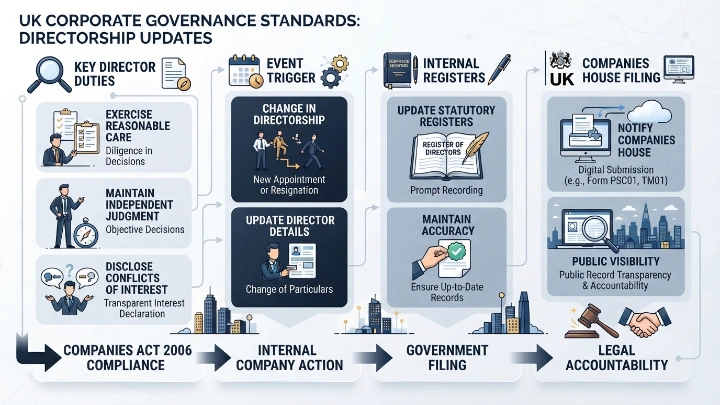
Board members carry specific fiduciary responsibilities from the exact moment their appointment takes effect. Public transparency ensures that suppliers, creditors, and shareholders know who holds governing authority over the corporate entity. Prompt public notifications uphold statutory transparency standards.
Resigning directors must be formally discharged from statutory duties to avoid lingering liability for future board decisions. Official submission of resignation forms provides clear legal proof of the exact date duties ceased. This clear cutoff protects former officers from corporate liabilities incurred after their departure.
Proper documentation requires clear evidence of corporate authority. Board minutes must explicitly record the acceptance of resignations and the approval of new appointments. These records serve as legal proof during shareholder disputes or regulatory audits.
Organizing corporate documentation requires reliable secretarial infrastructure. Companies that Save Costs with Form My Company’s Director Appointment Bundle optimize their secretarial processes while remaining compliant with current UK statutory standards. Professional governance solutions safeguard corporate standing while controlling operational expense.
Streamlining Board Administration with Form My Company
Maintaining corporate compliance requires efficient administrative procedures. Managing board appointments and resignations through unified compliance processes eliminates operational delays, lowers filing overhead, and guarantees statutory register accuracy.
Form My Company delivers corporate secretarial solutions tailored to UK business compliance needs. By unifying directorship updates, Form My Company ensures accurate Companies House filings, minimizes administrative burdens, and keeps corporate structures fully compliant with UK law.
Explore our Conference Room guides,
Director Appointment: How to Properly Structure Your Board in 2026
Director Resignation: A Simple Guide to Maintaining Compliance
Frequently Asked Questions
How does company fraud protection prevent unauthorized changes at Companies House?
Company fraud protection monitors official UK business records and automatically blocks or flags unverified modifications to directors, shareholdings, or registered addresses. By integrating with secure regulatory systems, services like Form My Company’s fraud protection alert business owners to fraudulent activity instantly, allowing swift legal intervention before unauthorized corporate changes take effect.
Why do UK businesses need protection against corporate identity theft?
Corporate identity theft occurs when bad actors alter a company’s registered details to secure credit lines, order goods, or hijack assets in the business’s name. Utilizing targeted identity monitoring and registered address security through Form My Company shields business credentials from exploitation, protecting corporate credit ratings and commercial reputation.
What is the process for monitoring statutory register updates?
Statutory register monitoring tracks any electronic submissions made to Companies House regarding officer appointments, filings, or PSC disclosures. Specialized corporate security services provide real-time alerts whenever a filing is initiated, ensuring company directors can validate legitimate filings and reject fraudulent submissions immediately.
Can registered office protection prevent business address hijacking?
Yes, registered office protection prevents fraudsters from fraudulently changing a company’s legal address to intercept sensitive mail or establish fake credit presence. Professional address monitoring solutions provided by Form My Company ensure that only verified legal representatives can update registered office details with official UK registries.
How quickly are business owners alerted to fraudulent Companies House filings?
Advanced corporate defense services issue immediate automated notifications the moment a filing attempt is detected against a business registration number. Early detection enables corporate secretaries and business owners to contact regulatory authorities and freeze unauthorized changes before legal or financial damage occurs.