
To process a UK company director resignation, submit Form TM01 to Companies House within 14 days of the effective resignation date. The remaining board members must update the internal register of directors and record the formal departure in the official meeting minutes.
Processing a director departure requires adherence to statutory UK corporate governance standards. Every limited company registered in England, Wales, Scotland, or Northern Ireland must maintain an accurate record of its officers at Companies House. Failure to submit notifications on time results in inaccurate public records, potential administrative penalties, and ongoing legal liability for the departing individual.
Proper administrative handling protects both the business entity and the departing executive. When an officer leaves a board, the corporate entity must ensure that statutory obligations remain fulfilled. The statutory framework established under the Companies Act 2006 dictates the precise steps required to formalize a board change.
What Is Form TM01 and Why Is It Mandatory?
Form TM01 is the official Companies House document used to terminate the appointment of a company director. Submitting this form updates the UK public register and officially ends the director’s legal duties to the corporate entity.
Companies House requires Form TM01 for every voluntary or involuntary board departure. The document collects specific corporate details, including the registered company number, the legal name of the entity, the departing officer’s full name, and the exact date of termination. Submitting this document ensures that third parties, financial institutions, and regulatory authorities see an accurate reflection of board membership.
Accuracy on Form TM01 prevents administrative delays and rejections from Companies House. The date entered on the form establishes the legal boundary for officer responsibilities. Officers retain fiduciary duties and legal liabilities for corporate actions taken prior to that recorded departure date.
Digital submission through the Companies House online portal processes faster than paper forms. Electronic filings process within 24 hours, whereas paper forms sent by post can take up to 10 business days. Maintaining digital records reduces administrative friction during executive transitions.
How Long Do You Have to Report a Director Resignation?
UK companies must notify Companies House of a director resignation within 14 days of the resignation date. Missing this 14-day statutory deadline breaches Section 167 of the Companies Act 2006 and risks compliance penalties.
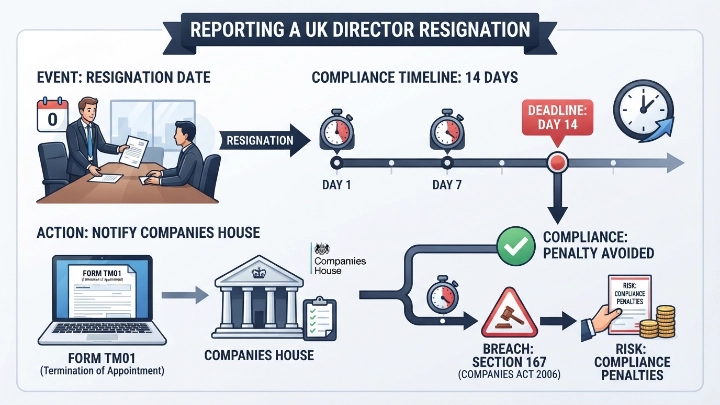
The 14-day statutory window begins on the exact date the board receives or accepts the formal resignation notice. Corporate secretaries and remaining directors must act promptly once notice is served. Delaying the Companies House filing causes inconsistencies between internal registers and public records.
Failing to meet the 14-day filing requirement creates regulatory compliance issues. 68% of UK SMEs face administrative delays during corporate filings due to inaccurate officer details or late submissions. Persistent delays in updating officer details can trigger formal compliance inquiries from corporate registrars.
Late reporting also creates legal ambiguity regarding officer authority. Third parties, such as banks or suppliers, rely on public records to confirm who can bind the company to financial agreements. Timely filing ensures that former officers cannot enter into contracts on behalf of the corporate entity.
What Steps Are Required to Process a Director Departure?
Processing a departure requires receiving a written resignation, holding a board meeting, updating internal company registers, and filing Form TM01. Completing these four steps ensures full compliance with UK corporate law and protects the business.
The formal process begins when the departing officer submits a written notice of resignation to the company address. This letter must state the clear intent to resign and specify the exact termination date. Board members must review the company’s Articles of Association to verify any specific contractual notice periods or departure requirements.
The remaining officers must convene a formal board meeting to accept the resignation letter. The corporate secretary records this acceptance in the official board minutes. Documenting this step provides auditable evidence that the board followed proper internal corporate procedures.
After the board meeting, the company must update its internal statutory register of directors within 14 days. This register must reflect the departure date alongside historical records of the officer’s tenure. Simultaneously, the administrator completes the filing of Form TM01 via Companies House WebFiling services.
What Internal Company Records Need Updating After a Departure?
Companies must update the internal Register of Directors, board meeting minutes, bank signature mandates, and official stationery. Updating these records within 14 days maintains internal administrative accuracy and prevents unauthorized corporate actions.
The internal Register of Directors is a legal record kept at the company’s registered office or single alternative inspection location. When a director leaves, the corporate administrator must record the exact date of termination directly in this register. Leaving internal registers unupdated violates statutory record-keeping duties under the Companies Act 2006.
Financial accounts and banking relationships require immediate updates following an executive change. Corporate secretaries must remove departing officers from bank authorization lists, payment portals, and credit card accounts. Updating financial access rights protects corporate assets and prevents administrative confusion regarding signature approvals.
Companies must also update commercial documentation and digital channels. Business letters, order forms, websites, and official email footers must reflect the current board structure. UK law mandates that corporate stationery listing director names must list all current directors or none at all.
How Does a Resignation Affect Board Quorum Requirements?
A resignation reduces the total board headcount, which can prevent the board from reaching its legal quorum requirements. Articles of Association specify the minimum number of directors needed to legally pass corporate resolutions.
Every private limited company in the UK must maintain at least one active director at all times. If a single-director company experiences a resignation, the departing director cannot leave until a replacement officer is officially appointed. Operating a UK limited company without at least one active director breaches statutory requirements.
Articles of Association set the quorum—the minimum number of board members required to hold valid votes. If a departure drops the board size below this quorum threshold, remaining directors cannot pass legally binding resolutions. The remaining board must appoint a new director immediately to restore operational decision-making capacity.
When corporate boards plan executive transitions, they often evaluate the structural differences between Voluntary vs. Forced Director Resignation: What You Should Know. Understanding these distinctions ensures that remaining board members handle removals or voluntary departures without breaching shareholder agreements or legal notice requirements.
How Do You Maintain Professional Address Privacy During Transitions?
Directors maintain address privacy by using a commercial service address rather than a private residential address on public records. Utilizing professional service addresses keeps personal residential details off the public Companies House database.
UK corporate law requires every director to provide two addresses: a residential address and a service address. Companies House displays the service address on the public register, while keeping the residential address on a protected private record. Using a personal home address as a service address makes that home address permanently visible online.
When board changes occur, companies must ensure incoming or remaining officers maintain privacy compliance. Utilizing a dedicated service address protects corporate officers from unsolicited mail, identity fraud, and privacy intrusions. Professional corporate address services forward official government correspondence directly to company administrators while masking private residences.
Offices using a dedicated corporate venue, such as a flexible Conference Room, easily host required board meetings to record executive changes offsite. Holding formal governance meetings in private professional settings protects confidential discussions regarding leadership restructures and executive board changes.
What Are the Fiduciary Duties of a Resigning Director?
Resigning directors owe ongoing duties to avoid conflicts of interest, protect confidential information, and refrain from misusing company assets. Section 170 of the Companies Act 2006 enforces these obligations even after a director officially steps down.
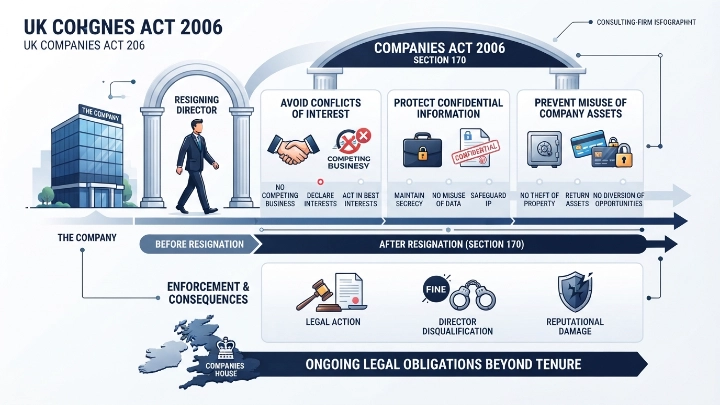
A departing officer cannot use proprietary trade secrets, client databases, or corporate intellectual property acquired during their tenure for personal gain. Fiduciary duties regarding corporate opportunities survive the termination of the directorship. If a director resigns specifically to exploit a commercial opportunity discovered while on the board, the company can pursue legal remedies.
Director duties divide into three legal categories: pre-resignation duties, transition duties, and post-resignation duties.
Maintain confidentiality regarding proprietary business data and operational strategies
Disclose any personal interest in existing corporate contracts before departing
Return all corporate property, devices, access keys, and administrative records
Refrain from persuading existing corporate clients or employees to break contracts
Proper exit management minimizes legal risks for both the business and the departing individual. Drafting clear settlement agreements or exit deeds clarifies post-resignation restrictive covenants. Having legal agreements in place ensures smooth operational continuity without ongoing legal disputes.
How Do You Ensure Total Compliance During Officer Changes?
Ensuring total compliance requires systematic record keeping, timely filing of Form TM01, updating internal registers, and reviewing corporate governance rules. Following a standardized compliance process prevents statutory breaches and penalties.
Managing officer departures without professional assistance can lead to filing errors, missed statutory deadlines, or incomplete record updates. Missing simple details on Companies House forms results in formal rejections, forcing administrators to restart the filing process. Working with corporate secretarial specialists prevents administrative mistakes and maintains flawless corporate records.
Companies that need to process board changes efficiently often choose to File Your Director Resignation Fast with Form My Company. Professional corporate support simplifies statutory filings, updates corporate registers, and confirms compliance with UK company law.
Systematic management of board changes keeps your business running smoothly while meeting regulatory obligations. Maintaining accurate corporate records builds trust with financial institutions, regulatory authorities, and commercial partners.
Managing a director resignation in the UK requires strict adherence to corporate regulations, accurate record keeping, and timely filing of Form TM01. Completing statutory updates within the required 14-day window protects your business entity from regulatory penalties and legal ambiguity.
Form My Company delivers expert corporate secretarial support to simplify officer transitions, manage Companies House filings, and maintain statutory registers. Professional governance services ensure your company remains fully compliant with UK legal frameworks throughout every organizational change.
Explore our Conference Room guides,
Director Appointment: How to Properly Structure Your Board in 2026
How to Make Your Small Business Look Like a Global Corporation
Frequently Asked Questions
How Does Corporate Identity Theft Happen in the UK?
Corporate identity theft occurs when unauthorized individuals alter a company’s public records at Companies House, such as changing registered office addresses or director details. Criminals use these updated public records to gain credibility, open fraudulent bank accounts, take out loans, or order high-value goods in the company’s name.
What Is the Form My Company Fraud Protection Service?
The Form My Company Fraud Protection service is an automated watchdog system designed to safeguard UK limited companies against corporate identity theft and unauthorized filings. It continuously monitors official corporate records at Companies House and delivers real-time email alerts whenever any changes or filings are submitted against your company profile.
How Does Real-Time Companies House Monitoring Protect a Business?
Real-time monitoring acts as an early warning tripwire by immediately notifying directors when a document—such as a change of address or director appointment—is filed under their company registration number. This immediate alert enables business owners to detect unauthorized modifications instantly and contact authorities before fraudulent activity leads to financial damage.
Why Is Companies House Online Filing Vulnerable to Unauthorized Changes?
Companies House historically processes statutory documents on a “good faith” basis, making filings visible on the public register before thoroughly verifying paper signatures or submitter credentials. The Form My Company Fraud Protection service closes this vulnerability by tracking registry API updates 24/7 and ensuring directors are notified of any unverified corporate changes.
Can Existing UK Limited Companies Enable Fraud Protection?
Yes, any existing UK Limited Company or LLP can activate Form My Company Fraud Protection regardless of where or when the entity was originally formed. By syncing the company registration number with the security platform, business owners gain continuous registry monitoring and automatic protection against unauthorized corporate filings.