
Bundle filing combines multiple corporate updates into a single submission, whereas separate filings process each update individually. Submitting changes together reduces Companies House administration fees, eliminates repetitive data entry, prevents compliance delays, and keeps your official company register accurate.
What Is Bundle Filing Compared to Separate Filings?
Bundle filing consolidates multiple corporate changes into one unified transaction, whereas separate filings submit each regulatory update individually. Grouping administrative tasks streamlines Companies House reporting, lowers processing errors, and cuts down on redundant statutory paperwork for company directors.
Company secretarial management requires regular updates to official registers. Directors often update personal details, change registered addresses, and alter board structures throughout the financial year. Traditional processes require submitting individual forms for each distinct update. Separate filings force business owners to input the same company identification details multiple times. This approach increases administrative workloads and creates higher margins for human error.
Bundle filing replaces fragmented submissions by grouping related corporate actions into a single operational process. Companies House receives all required statutory changes simultaneously. Processing multiple updates together ensures consistent effective dates across all public record entries. Three common components of a bundle filing: director appointments, director resignations, and updated correspondence addresses. Consolidating these actions ensures total synchronisation between internal company records and the central UK register.
How Does Bundle Filing Save UK Businesses Time?
Bundle filing saves time by eliminating duplicate data entry, reducing statutory paperwork, and streamlining identity verification into a single workflow. Consolidating administrative updates allows UK directors to process board changes in minutes rather than managing staggered Companies House submissions.
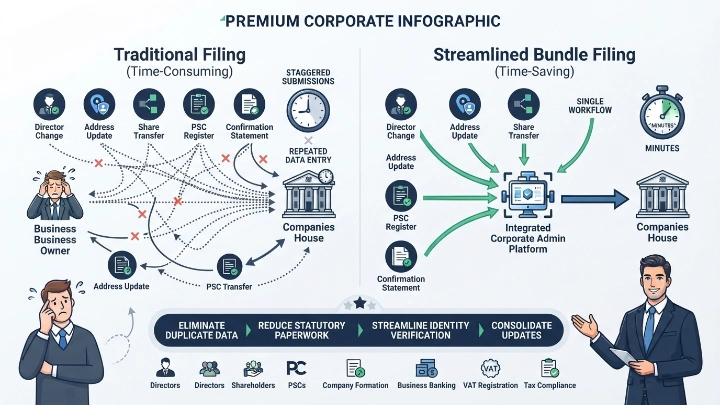
Filing statutory updates individually consumes valuable operational hours. Submitting separate forms requires logging into filing systems, entering security codes, and verifying corporate identity details for every single change. A company updating three board positions spends three times the necessary effort on basic identity entry. Staggered processes also create tracking delays while waiting for sequential approval notifications from Companies House.
Streamlining updates into a combined workflow eliminates administrative redundancy. Directors enter master company information once to process multiple structural adjustments simultaneously. Integrated digital platforms authenticate credentials in a single session. Three distinct time-saving mechanisms: single-point data entry, batch identity verification, and unified confirmation receipts. Businesses executing structural shifts complete their legal reporting duties faster, allowing management to focus entirely on core business operations.
Can Bundle Filing Reduce Company Administrative Costs?
Bundle filing reduces administrative costs by lowering service fees, minimizing billable secretarial hours, and preventing costly compliance penalties. Consolidating corporate updates cuts professional filing expenses by processing structural business changes under a single transaction fee structure.
Processing separate corporate filings generates higher overall expense structures for small and medium-sized enterprises. Third-party corporate service providers charge individual submission fees for every form lodged with Companies House. Submitting three separate director forms incurs three separate management fees. Furthermore, manual processing across multiple dates increases internal labor costs, as administrative staff spend extra hours managing tracking spreadsheets and cross-referencing public documents.
Grouping compliance updates delivers direct cost efficiencies across corporate operations. Combined submissions lower service charges by eliminating repeat transaction costs. Professional firms process combined instructions faster, passing structural savings directly to clients. Three quantifiable financial advantages: reduced secretarial retainer costs, single transaction processing fees, and lower risks of late-filing fines. Managing corporate records efficiently preserves operational budgets while keeping statutory compliance fully up to date.
What Compliance Risks Exist With Separate Corporate Filings?
Separate corporate filings increase compliance risks by creating data discrepancies, delaying public register updates, and triggering missed reporting deadlines. Staggered submissions frequently leave statutory registers out of alignment, exposing UK company directors to avoidable regulatory penalties and legal liabilities.
Maintaining public records requires strict adherence to statutory timelines. UK company law requires prompt notifications for structural board changes and official detail updates. When businesses process updates through separate filings over several weeks, public records become temporarily inaccurate. A resigned director might remain listed on the official register while an incoming director awaits processing. This mismatch creates confusion for banking partners, credit agencies, and prospective commercial clients executing due diligence.
Single-item filings also raise the statistical probability of missed deadlines and administrative oversights. Managing multiple filing schedules creates tracking gaps, leading to forgotten submissions and incomplete public entries. Three major regulatory risks: conflicting officer effective dates, delayed identity validation records, and statutory fines for non-compliance. Consolidating changes into one structured submission guarantees all corporate records update simultaneously, ensuring total compliance accuracy across public domain registries.
When Should Your Business Use Bundle Filings Over Separate Submissions?
Businesses should use bundle filings when restructuring board leadership, updating director details, or altering official registered offices. Combining administrative updates during corporate transitions ensures seamless reporting accuracy, protects credit ratings, and keeps statutory registers fully updated.
Corporate events rarely occur in total isolation. Business growth triggers simultaneous changes across executive structures, operational addresses, and statutory roles. When a company appoints a new executive, an outgoing officer frequently steps down at the same moment. Processing these interlinked actions separately creates unnecessary administrative gaps. Updating leadership records alongside correspondence addresses ensures full transparency across all corporate filings.
Planning updates around major business events maximises operational efficiency. Combining structural changes simplifies legal reporting during acquisitions, internal restructurings, and annual compliance reviews. Three strategic trigger events for bundle submissions: executive board rotations, corporate relocation processes, and comprehensive annual record audits. Utilizing unified filing systems allows corporate leaders to execute governance transitions smoothly while maintaining complete compliance integrity.
How Do You Execute a Combined Filing Step-by-Step?
Executing a combined filing requires gathering verified officer details, drafting statutory notices, verifying director identities, and submitting a unified electronic payload. Following a structured submission process ensures Companies House accepts all corporate updates without delays or administrative rejections.
Successful corporate submissions rely on accurate preparation and strict adherence to official reporting standards. Business owners must collect complete legal credentials before initiating digital filings. Missing middle names, incorrect residential addresses, or outdated identity verification records cause immediate Companies House rejections. Preparing documentation systematically avoids processing delays and eliminates costly resubmission fees.
Digital filing platforms simplify corporate updates through structured data collection workflows. System forms guide administrators through each required field before transmitting encrypted data directly to Companies House. Three execution steps: collect verified director personal details, validate legal identities against statutory databases, and transmit the unified filing payload. Modern digital submission systems validate entries instantly, issuing immediate confirmation once public registries register the structural changes.
Why Is Director Management Central to Corporate Governance?
Director management forms the foundation of corporate governance by ensuring transparent leadership records, maintaining statutory compliance, and protecting shareholder interests. Accurate board registries validate authority, streamline legal agreements, and uphold institutional credibility across public UK business sector networks.
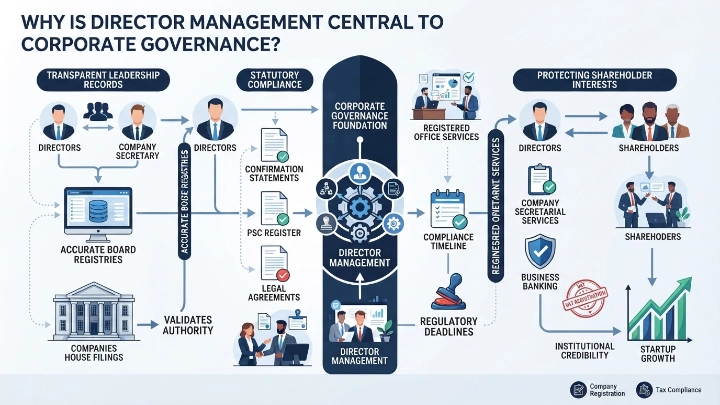
Transparent corporate governance relies directly on accurate legal representation. Financial institutions, legal advisors, and enterprise clients review public registers before entering binding commercial contracts. Inaccurate director listings undermine corporate credibility, delay loan applications, and derail strategic commercial partnerships. Keeping public registries precise ensures clear lines of operational authority and legal accountability.
Managing board changes efficiently protects corporate entities from governance disputes. Outdated officer records create legal ambiguity regarding who holds authority to execute corporate documents or access company bank accounts. Establishing clear governance processes prevents internal disputes and ensures full regulatory compliance. Evaluating strategic options like Bundle Filing vs. Separate Filings: Saving Time and Money helps businesses streamline administrative oversight while cutting maintenance costs. Proper governance management safeguards corporate reputation and supports long-term commercial growth.
How Do Combined Updates Simplify Corporate Restructuring?
Combined updates simplify corporate restructuring by processing board additions, resignations, and operational adjustments in one seamless submission sequence. Synchronizing structural changes prevents legal gaps in representation and keeps public company records fully accurate during major corporate transitions.
Enterprise restructuring requires precise timing across multiple statutory filings. During ownership transitions or board reorganisations, incoming directors must take office precisely as outgoing officers resign. Submitting changes separately introduces processing gaps, leaving the company temporarily without officially registered leadership or displaying incorrect board balances. Synchronised filings protect legal continuity throughout complex corporate realignments.
Streamlining structural updates allows executive leadership to execute transition plans without administrative friction. Businesses can review comprehensive guide frameworks such as The Essential Director Bundle: Managing Appointments and Resignations Together to understand how simultaneous board processing minimizes operational downtime. Three structural advantages of unified processing: continuous legal representation, synchronized effective dates, and simplified statutory record maintenance. Maintaining complete administrative alignment ensures smooth leadership transitions across all public records.
What Financial Savings Can Businesses Expect From Integrated Filings?
Integrated filings deliver financial savings by reducing professional secretarial fees, cutting administrative processing hours, and eliminating late-filing penalties. Streamlining corporate updates allows UK firms to lower overhead expenses while maintaining high governance standards across all public compliance filings.
Quantifying administrative savings reveals the clear cost advantages of consolidated compliance management. Processing statutory updates through individual filings generates recurring service fees and inflates internal labor costs. Small businesses often spend unnecessary operational budget managing repetitive filings that could be handled in a single transaction. Eliminating redundant administrative tasks lowers compliance overhead significantly.
Adopting integrated compliance models frees up capital and operational resources for core business activities. Forward-thinking companies leverage cost-effective solutions like Save Costs with Form My Company’s Director Appointment Bundle to minimize legal maintenance expenses while ensuring complete statutory accuracy. Three clear financial benefits: reduced professional advisory costs, streamlined administrative workflows, and total protection against compliance penalties. Integrated filing strategies optimize business operations, driving long-term administrative efficiency.
Streamlining Your Company Filings for Future Growth
Consolidating corporate filings represents a practical, cost-effective strategy for managing UK company compliance. Bundle filing eliminates duplicate administrative tasks, lowers secretarial service fees, and prevents compliance errors that risk regulatory penalties. Grouping director appointments, resignations, and statutory detail updates into a single submission keeps public registries accurate while saving valuable operational time. Form My Company provides integrated business solutions designed to simplify corporate governance, reduce administrative overhead, and help your business maintain flawless compliance standards as it grows.
Explore our Conference Room guides,
Certificate of Good Standing vs. Company Extract: Which do you need?
Voluntary vs. Forced Director Resignation: What You Should Know
Frequently Asked Questions
What is the Form My Company Fraud Protection service?
The Form My Company Fraud Protection service is an automated watchdog system that provides 24/7 continuous surveillance over your UK company’s official public records at Companies House. The service monitors your business registration details and sends instant email alerts whenever a document or corporate change is submitted against your company name. This continuous monitoring protects your business from identity theft, unauthorized officer changes, and corporate hijacking.
How does Form My Company protect my business from corporate identity theft?
Form My Company protects your business by immediately flagging unauthorized filings—such as changes to your registered office address, director appointments, or share capital—the moment they hit the public registry. Early detection allows directors to spot suspicious activity instantly and take swift legal action before fraudsters can open unauthorized bank accounts or enter contracts in your business name. Additionally, the service acts as a vital safety net alongside standard Companies House PROOF security controls.
Can existing UK companies sign up for Form My Company Fraud Protection?
Yes, the Form My Company Fraud Protection service can be enabled for any existing UK Limited Company or Limited Liability Partnership (LLP). You simply sync your active Company Registration Number within the secure Form My Company dashboard to activate round-the-clock monitoring. The service operates seamlessly regardless of who originally incorporated your enterprise or where your current registered office is located.
How does Form My Company Fraud Protection differ from the free Companies House PROOF scheme?
While the free Companies House PROOF scheme strictly prevents paper-based filing attempts, Form My Company Fraud Protection offers real-time digital monitoring for all electronic and online submissions. It delivers instant email notifications for every processed filing type, giving directors full oversight over all public record transactions. Using both services together provides a complete defense system against both physical and digital business hijacking attempts.
What happens when an unauthorized filing is detected by Form My Company?
When an unauthorized filing attempt is detected, Form My Company sends an immediate notification alert directly to your registered email address. This real-time warning provides essential documentation and evidence, allowing company officers to notify Companies House and law enforcement within minutes. Rapid response prevents fraudulent corporate changes from impacting your business credit score or commercial operations.