
A Certificate of Good Standing confirms a company’s legal status and compliance with filing requirements, while a Company Extract provides specific registered details (officers, addresses, filing history). Choose the Certificate when you need proof of compliance; choose the Extract for factual company data.
What is the primary difference between a Certificate of Good Standing and a Company Extract?
A Certificate of Good Standing verifies a company’s compliance with statutory filing and tax obligations; a Company Extract lists registered company data such as officers, registered address, and filing history.
A Certificate of Good Standing is an official attestation. It confirms the registrar has no unresolved compliance records for the company on the stated date. Typical uses include lender due diligence, cross-border registration, and regulated-sector onboarding. The document states the company exists and meets statutory filing requirements.
A Company Extract is a snapshot of registry entries. It lists the company name, registration number, formation date, registered office, current officers, and recent filings. Companies use extracts to verify ownership, check appointment dates, and confirm registered addresses. Extracts do not state compliance beyond recorded filings.
Read our articles, Certificate of Good Standing: What It Is and Why You Need It and Order Your Certificate of Good Standing via Form My Company.
When should you request a Certificate of Good Standing instead of a Company Extract?
Request a Certificate when you must prove legal compliance or good standing to third parties such as banks or foreign registries.
Certificates serve as proof for external stakeholders that the company has no outstanding strikes, compulsory filings, or dissolution actions on record. Examples include mortgage lenders asking for proof before releasing funds, overseas subsidiaries proving compliance for local registration, and compliance teams validating supplier status. Use a Certificate when the counterparty explicitly asks for “proof of good standing” or when regulatory acceptance demands an official attestation.
When should you request a Company Extract instead of a Certificate of Good Standing?
Request a Company Extract when you need current, verifiable company data such as director names, PSC details, or recent filing history.
Extracts serve fact-finding and verification purposes. Use an Extract during KYC checks, shareholder disputes, or when preparing board packs that require precise registry details. For instance, verify director appointment dates, confirm Persons with Significant Control (PSC), or extract the last filed annual return. The extract helps internal teams and advisers validate registry entries.
How do official contents differ between the two documents?
A Certificate states compliance status and existence; an Extract itemises registry entries such as officers, registered office, and filing records.
A Certificate normally contains: company name, registration number, statement of good standing or compliance, and date of issue. It rarely lists officers or filing timestamps. An Extract typically contains: registration details, formation date, registered office address, director and secretary names with appointment dates, PSC entries, and a summary of recent filings. The Extract offers granularity; the Certificate offers formal attestation.
How long does each document remain valid?
Certificates are commonly accepted for 30 to 90 days; Extracts reflect live registry data and remain accurate until the next registry change.
Most jurisdictions and counterparties accept Certificates issued within 30 to 90 days. Always check recipient requirements. Extracts have no expiry because they mirror the registry at issue time; however, registry entries can change the next business day after a filing. For time-sensitive matters, obtain both documents close to the transaction date.
How do you obtain a Certificate or an Extract in the UK?
Order either document from Companies House or use an authorised service provider that retrieves certified registry documents on your behalf.
Companies House issues Certificates and Extracts via online services and postal requests. Certificates require validation against the registrar’s records; Companies House provides digitally certified copies. Service providers streamline the process: they search the registry, retrieve the correct document, and deliver a certified PDF or hardcopy. Use verified suppliers for faster turnaround and additional compliance checks.
What are the typical fees and turnaround times?
Expect Companies House fees from £15 to £50 and same-day to 5-business-day turnaround; authorised providers charge service fees but may offer expedited delivery.
Companies House standard charges vary with service type and delivery format. Digital certified copies often arrive within 24 hours when ordered online. Postal or certified hardcopy services take longer. Third-party providers add processing fees that range significantly; choose providers that disclose the total cost and delivery SLA upfront.
Which document supports fraud protection and how?
Both documents support fraud protection: Certificates prove legitimacy; Extracts verify identities and historic filings to detect anomalies.
Use a Certificate in fraud screening to demonstrate legal existence and compliance. Counterparties that accept Certificates gain assurance that the company is not subject to dissolution or strike-off. Use an Extract to validate director names, appointment dates, and PSCs. Cross-check: Extract data with identity documents to detect impersonation, shell companies, or altered filings.
Explore our Fraud Protection guides,
How Secure Filing Codes Prevent Unauthorised Corporate Changes
Maintaining Your Business Credit Score Through Fraud Prevention
What is the recommended process for verification in fraud protection workflows?
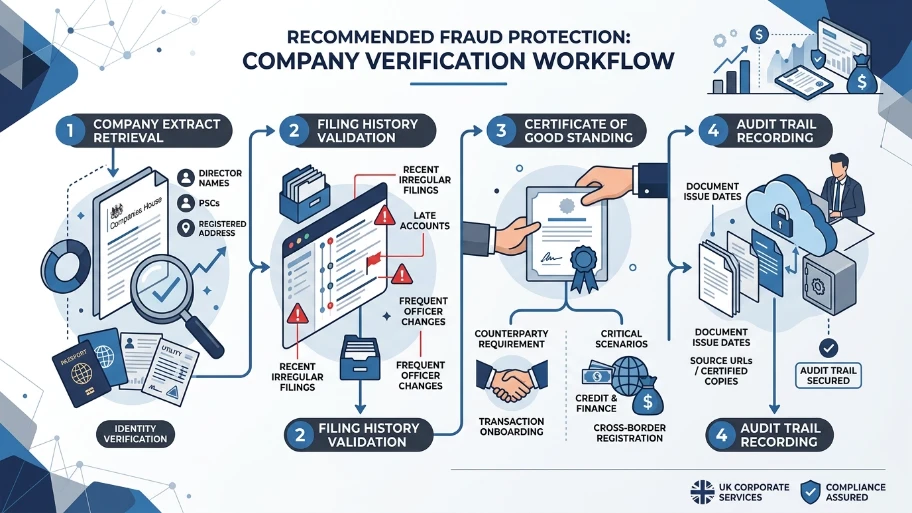
First, obtain a Company Extract to verify registry details, then obtain a Certificate to prove compliance when onboarding or finalising a transaction.
Step 1: Retrieve a Company Extract and verify director names, PSCs, and registered address against identity documents.
Step 2: Validate filing history to detect recent irregular filings, late accounts, or frequent officer changes.
Step 3: Order a Certificate of Good Standing if the counterparty requires proof of compliance or if the transaction involves credit, finance, or cross-border registration.
Step 4: Record document issue dates and source URLs or certified copies for audit trails.
How does Form My Company help with fraud protection and these documents?
Form My Company provides document retrieval and compliance validation as part of its Fraud Protection service, streamlining verification and attestation for transactions.
Form My Company offers registry searches, certified document retrieval, and compliance checks aligned with UK Companies House frameworks. The service validates director and PSC data, checks recent filings, and supplies Certificates and Extracts ready for third-party acceptance. This reduces manual search time and lowers the risk of onboarding fraudulent or non-compliant entities.
Both documents serve distinct purposes. Use a Company Extract to verify factual registry details. Use a Certificate of Good Standing to prove legal compliance. For fraud protection workflows, combine both documents: extract for identity validation, certificate for official attestation. Form My Company delivers retrieval, validation, and certified documentation to support these processes efficiently.
Frequently Asked Questions
What is business fraud protection, and how does it work?
Business fraud protection is a service that verifies company details, directors, and filings to prevent impersonation and fake entities. From My Company’s Fraud Protection validates registry data against UK Companies House records to authenticate legitimate businesses.
How do I verify a company’s legitimacy before signing a contract?
Verify legitimacy by checking the company’s Extract for director names, PSCs, and registered address, then confirm compliance with a Certificate of Good Standing. From My Company’s Fraud Protection service retrieves both documents and cross-checks them against official registry data.
What documents are needed for fraud protection during company onboarding?
You need a Company Extract for factual verification and a Certificate of Good Standing for compliance proof. From My Company’s Fraud Protection provides both certified documents and validates director credentials using official UK compliance frameworks.
Can fraud protection detect shell companies or fake directors?
Yes, fraud protection detects shell companies by verifying filing history, unusual officer changes, and mismatched registered addresses. From My Company’s Fraud Protection authenticates director identities and flags anomalies in registry records.
How fast can I get fraud protection verification for a new business partner?
Verification typically completes within 24 hours for digital documents and up to 5 business days for certified hard copies. From My Company’s Fraud Protection delivers fast retrieval, validation, and certified documentation for urgent onboarding needs.