
Import VAT is a 20% consumption tax charged by HM Revenue and Customs on goods entering the United Kingdom from overseas. Postponed VAT Accounting allows UK VAT-registered businesses to declare and recover this import tax simultaneously on their standard VAT return, eliminating upfront border payments.
Cross-border trade requires strict tax compliance at every UK port of entry. Businesses importing commercial goods from the European Union or the rest of the world face immediate tax liabilities upon customs clearance. HM Revenue and Customs (HMRC) enforces these charges to ensure imported products carry the same tax burden as domestic goods.
Standard import procedures require traders to pay Value Added Tax before customs authorities release their stock. This payment model creates immediate cash flow bottlenecks for growing enterprises. Postponed VAT Accounting (PVA) resolves this liquidity challenge by shifting tax settlement from the border to the periodic VAT return.
What Is Import VAT and When Does HMRC Charge It?
Import VAT is the tax levied on goods brought into Great Britain from outside the UK, or into Northern Ireland from outside the UK and EU. HMRC calculates this charge at the standard 20% rate on the total customs value, including shipping and insurance costs.
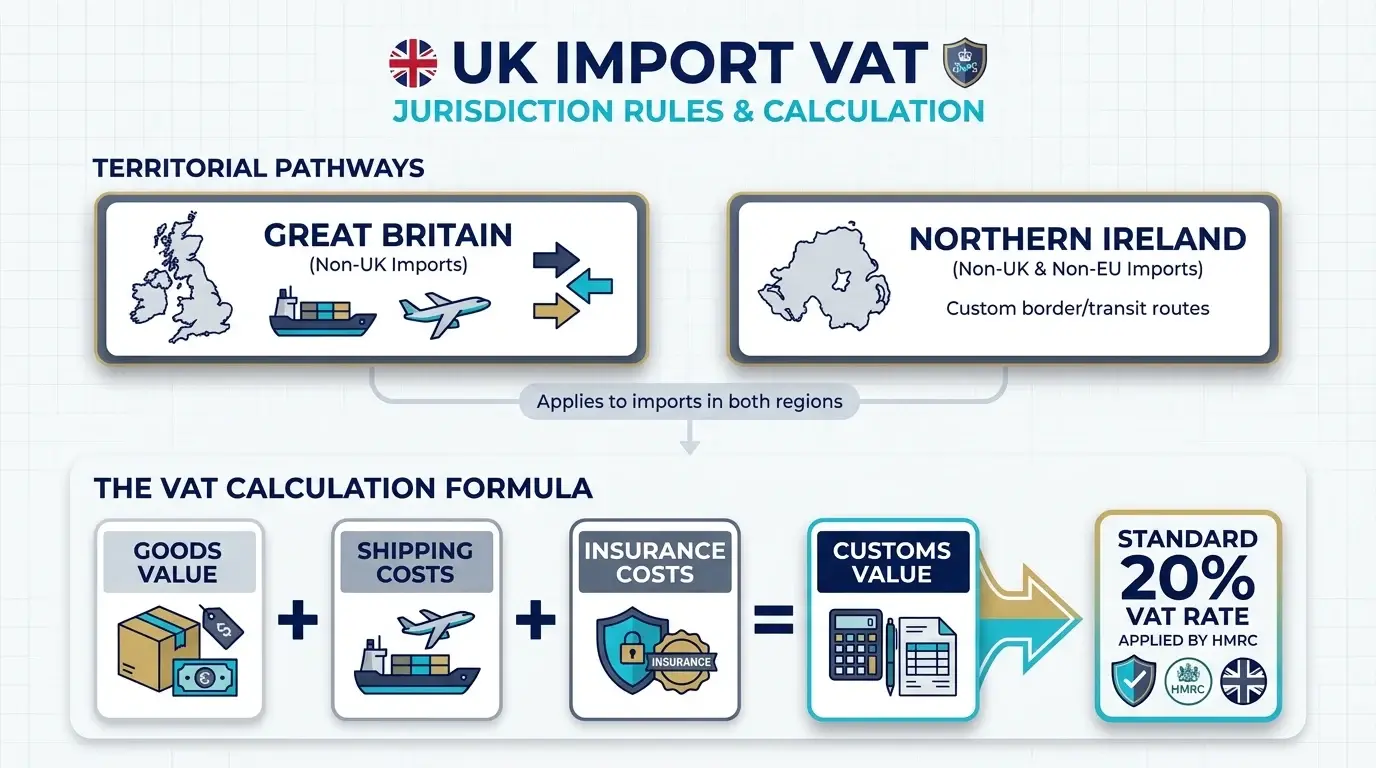
HMRC assesses import VAT the exact moment commercial goods clear UK customs borders. The taxable value comprises three core elements: the purchase price of the goods, international freight charges, and transit insurance premiums. Customs duty and any applicable excise duties also enter this base calculation before HMRC applies the 20% tax rate.
Certain product categories qualify for reduced rates or zero-rating under UK tax law. Children’s car seats and domestic fuel attract a reduced 5% rate, while most basic foodstuffs and printed books carry a 0% rate. Importers must verify the correct commodity code in the UK Global Tariff to apply accurate tax rates.
Consignments valued at £135 or less follow distinct collection rules. For low-value imports sold directly to UK consumers, overseas sellers or online marketplaces collect UK supply VAT at the point of sale. Business-to-business shipments under £135 shift the accounting responsibility to the UK VAT-registered buyer via the reverse charge mechanism.
How Does Postponed VAT Accounting Work for UK Importers?
Postponed VAT Accounting lets VAT-registered importers account for import VAT on their regular VAT return instead of paying upfront at customs. Businesses declare the tax due as output VAT and simultaneously reclaim it as input VAT within the exact same accounting period.
Under standard border payment rules, an importer pays 20% VAT at the port and waits up to four months to reclaim it. Postponed VAT Accounting removes this cash outflow completely. The transaction becomes a paper exercise on the quarterly or monthly VAT return, resulting in a net-zero cash impact for fully taxable businesses.
Importers access this scheme by selecting the relevant option on their customs declaration. Traders using the Customs Declaration Service (CDS) enter their Economic Operators Registration and Identification (EORI) number starting with GB alongside their nine-digit VAT registration number. Freight forwarders and customs agents require written authorization from the importer before selecting PVA on their behalf.
HMRC generates monthly online statements detailing all postponed import VAT declarations from the previous month. Importers download these Postponed Import VAT Statements via the Customs Declaration Service portal during the first half of each month. Finance teams use these official statements to populate Boxes 1, 4, and 7 on their periodic VAT returns.
Who Is Eligible to Use Postponed VAT Accounting?
Any UK VAT-registered business importing goods for business purposes is eligible to use Postponed VAT Accounting. No prior HMRC application or special authorization is required, provided the importer holds a valid GB EORI number and declares the goods for commercial use.
Eligibility extends to all VAT-registered entities regardless of annual turnover or industry sector. Sole traders, limited companies, partnerships, and overseas businesses with UK VAT registration qualify automatically. When a business imports goods intended solely for private, non-business use, HMRC prohibits the use of Postponed VAT Accounting.
Businesses importing goods for mixed business and personal use remain eligible to use the scheme. In these instances, the business postpones the full import VAT at the border and restricts its input tax recovery on the VAT return to the business-use proportion. Securing compliant tax status early through professional VAT Registration Assistance ensures businesses hold active credentials before their first shipment arrives.
What Happens If an Importer Is Not VAT-Registered?
Non-VAT-registered businesses cannot use Postponed VAT Accounting and must pay import VAT upfront before customs releases their goods. Because they lack a VAT registration number, these businesses cannot reclaim the 20% border tax from HMRC, turning the charge into a permanent operational cost.
Unregistered importers face immediate financial friction at UK ports. Customs agents hold shipments in temporary storage until the importer settles the VAT invoice, often adding daily storage fees to the total bill. Voluntary VAT registration solves this issue when a business imports commercial stock regularly, even if domestic turnover sits below the £90,000 mandatory registration threshold.
What Are the Financial and Operational Benefits of Postponed VAT Accounting?
Postponed VAT Accounting improves working capital by eliminating upfront border tax payments and removing the need for costly customs deferment accounts. Importers avoid customs clearance delays caused by unpaid tax invoices and eliminate bank guarantee fees previously required to defer duty and VAT.
Cash flow preservation stands as the primary financial advantage of PVA. Consider a UK retailer importing £200,000 worth of stock every quarter. Under traditional rules, the retailer pays £40,000 in import VAT upfront at the port and waits up to 90 days for HMRC to refund the balance. PVA keeps that £40,000 inside the company bank account continuously.
Operational efficiency also improves across the supply chain. Before PVA existed, businesses relied on Duty Deferment Accounts (DDAs) to delay import VAT payments by an average of 30 days. Setting up a DDA required a bank guarantee covering twice the monthly liability, tying up valuable credit facilities and incurring recurring bank charges.
Customs clearance speeds increase significantly when traders use PVA. Freight forwarders clear goods immediately upon arrival without waiting for the importer to transfer funds for VAT settlement. Faster port release prevents demurrage charges, reduces port congestion penalties, and accelerates inventory delivery to UK warehouses.
How Do Businesses Record Postponed Import VAT on Their VAT Return?
Importers record postponed import VAT across three specific boxes on their UK VAT return using figures from their monthly CDS statements. Box 1 records the import VAT due, Box 4 reclaims the deductible input tax, and Box 7 captures the total net value of imported goods.
Accurate bookkeeping requires reconciling monthly HMRC statements against commercial supplier invoices before submitting the digital return. HMRC publishes two distinct statement types on the CDS dashboard: monthly statements for standard declarations and supplementary statements for delayed entries. Finance teams must retain digital copies of these statements for six years to satisfy Making Tax Digital (MTD) audit requirements.
When completing the VAT return, accountants follow three exact reporting steps:
Enter the total postponed import VAT due from the monthly statement into Box 1 alongside standard sales VAT.
Include the recoverable portion of that exact import VAT figure in Box 4 alongside standard purchase input tax.
Record the total customs value of all imported goods, excluding the VAT amount, inside Box 7.
If a business produces exempt supplies, such as financial services or healthcare, partial exemption rules restrict Box 4 recovery. In this scenario, the importer declares 100% of the import VAT in Box 1 but reclaims only the permitted percentage in Box 4. Evaluating whether internal staff or external specialists handle these complex calculations accurately is straightforward when reviewing how to evaluate whether outsourcing VAT management saves money versus in-house.
What Common Mistakes Cause Postponed VAT Accounting Compliance Errors?
Common PVA errors include failing to download monthly CDS statements before they expire, misreporting Box 1 and Box 4 figures, and allowing freight forwarders to pay import VAT upfront without authorization. These mistakes trigger HMRC compliance audits, cash flow disruptions, and financial penalties.
HMRC removes monthly Postponed Import VAT Statements from the online portal after six months. Many businesses fail to download these PDFs regularly, leaving accountants without official evidence to substantiate Box 4 input tax claims during an HMRC inspection. If an importer cannot produce the official CDS statement, HMRC disallows the VAT deduction and demands immediate repayment plus interest.
Miscommunication with customs agents creates another frequent compliance failure. Customs brokers operate under direct or indirect representation rules and must follow explicit written instructions from the importer. When an importer forgets to instruct their freight forwarder to use PVA, the agent defaults to paying import VAT upfront via their own deferment account and bills the importer immediately with an administrative surcharge.
Incorrect currency conversions also distort VAT return figures. Importers must convert foreign currency invoice values into Pound Sterling using HMRC’s published monthly exchange rates rather than commercial bank spot rates. Applying the wrong exchange rate creates discrepancies between the customs declaration and the accounting ledger, triggering automated HMRC risk alerts.
How Can Businesses Ensure Seamless Cross-Border VAT Compliance?
Businesses ensure seamless cross-border VAT compliance by securing accurate VAT registration, issuing clear written instructions to customs agents, and reconciling monthly CDS statements against accounting records. Implementing structured compliance workflows prevents customs delays and protects working capital across international supply chains.
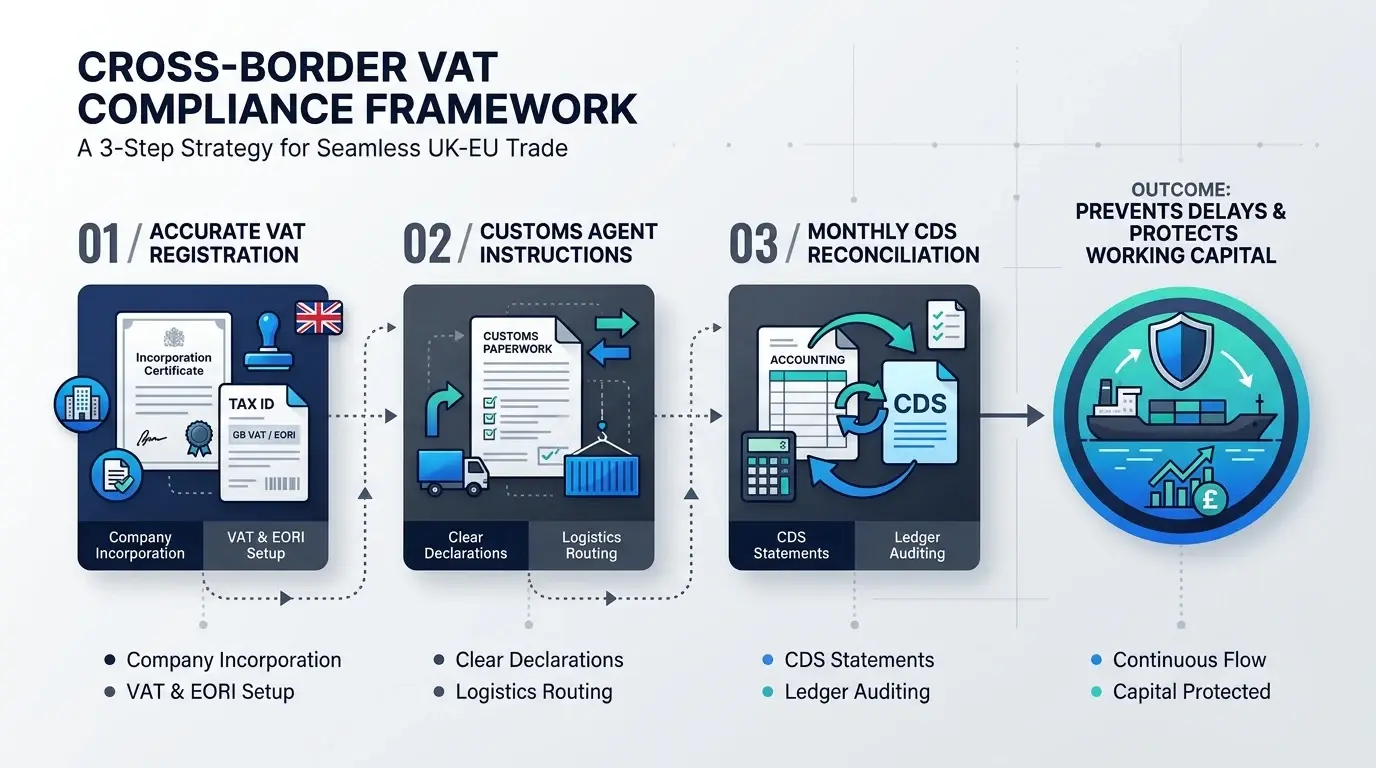
Maintaining compliant import processes requires coordinating customs brokers, accounting software, and HMRC portals. Importers must verify that their Making Tax Digital software supports PVA tax codes so Box 1 and Box 4 entries populate automatically without manual overrides. Establishing a monthly calendar reminder to download CDS statements on the tenth working day ensures no audit evidence ever expires.
Companies expanding into international trade benefit from specialized compliance support to navigate shifting tariff rules and VAT obligations. Securing expert guidance on import/export VAT: how Form My Company streamlines international trade equips importers with the structural frameworks needed to scale globally without tax friction.
Import VAT imposes a 20% tax charge on goods entering the United Kingdom, while Postponed VAT Accounting eliminates upfront border payments by shifting tax settlement to the periodic VAT return. UK VAT-registered importers protect their working capital, accelerate customs clearance, and simplify tax reporting when they declare and reclaim import VAT simultaneously using monthly CDS statements.
Form My Company delivers end-to-end VAT Registration Assistance, ensuring UK businesses obtain active VAT numbers, valid GB EORI credentials, and compliant accounting setups before importing commercial goods.
Explore More VAT Registration Assistance Guide,
What Is Margin Scheme VAT and Who Uses It for Second-Hand Goods?
What Is Digital Record Keeping Under Making Tax Digital (MTD) for VAT?
Frequently Asked Questions
When is UK VAT registration mandatory for a business?
UK VAT registration is compulsory when your business’s VAT-taxable turnover exceeds £90,000 over any rolling 12-month period, or if you expect it to cross £90,000 within the next 30 days alone. Overseas businesses without a fixed UK establishment must register from their first UK sale regardless of turnover. Using Form My Company’s VAT Registration Assistance ensures your application is submitted within HMRC’s strict 30-day deadline to prevent late registration penalties.
How long does HMRC take to approve a VAT registration application?
HMRC typically processes standard online VAT applications within 40 working days, though timelines vary if additional compliance checks or supporting trade evidence are required. Submitting incomplete documentation or vague business descriptions often triggers manual reviews that reset the processing window. Form My Company manages the end-to-end submission process through its VAT Registration Assistance service, verifying all company records and turnover projections beforehand to prevent avoidable delays.
What documents are needed to register for VAT in the UK?
To register for VAT with HMRC, limited companies and sole traders must provide their Unique Taxpayer Reference (UTR) or Companies House registration number, UK business bank account details, director identification, and accurate turnover records. HMRC may also request proof of active trading, such as commercial contracts, supplier invoices, or lease agreements, during security checks. Through Form My Company’s VAT Registration Assistance, every required document and business activity description is audited prior to filing to meet HMRC verification standards.
Can a small business register for VAT voluntarily below the £90,000 threshold?
Yes, any UK business making or intending to make taxable supplies can apply for voluntary VAT registration even if annual turnover is below £90,000. Registering voluntarily allows businesses to reclaim 20% input VAT on eligible startup equipment, software, and supplier purchases, while enhancing credibility with VAT-registered B2B clients. Form My Company provides tailored VAT Registration Assistance to help startups evaluate flat-rate or standard accounting schemes and backdate registration where permitted.
Can a business charge VAT while waiting for its HMRC VAT number?
You cannot show VAT as a separate line item or issue formal VAT invoices until HMRC issues your nine-digit VAT registration number. Instead, businesses must adjust their gross prices to account for the 20% tax liability from their effective date of registration and reissue valid VAT invoices once the certificate arrives. Form My Company supports applicants throughout this interim period as part of its VAT Registration Assistance, ensuring accurate bookkeeping and Making Tax Digital (MTD) readiness from day one.