
You correct minor VAT mistakes on past returns by adjusting your current VAT account directly if the net error value is £10,000 or less. For errors between £10,000 and £50,000, you adjust the current return only when the discrepancy stays below 1% of your Box 6 turnover.
HM Revenue and Customs (HMRC) governs VAT error corrections through VAT Notice 700/45. Business owners frequently discover clerical miscalculations, omitted purchase invoices, or incorrect tax point dates after submitting quarterly figures. Proper execution of these adjustment rules prevents statutory penalties and keeps company ledgers aligned with Making Tax Digital (MTD) standards.
Correcting historical discrepancies requires exact calculations before modifying any digital tax records. You must determine the net value of all errors discovered within a specific accounting period. Combining overpayments and underpayments establishes the final net figure that dictates your legal reporting pathway.
What Are the HMRC Thresholds for Adjusting Past VAT Mistakes?
HMRC sets two strict financial thresholds for adjusting past VAT mistakes on a current return: a £10,000 net error limit for all businesses, and an upper limit of £50,000 provided the net error remains under 1% of your Box 6 net outputs.
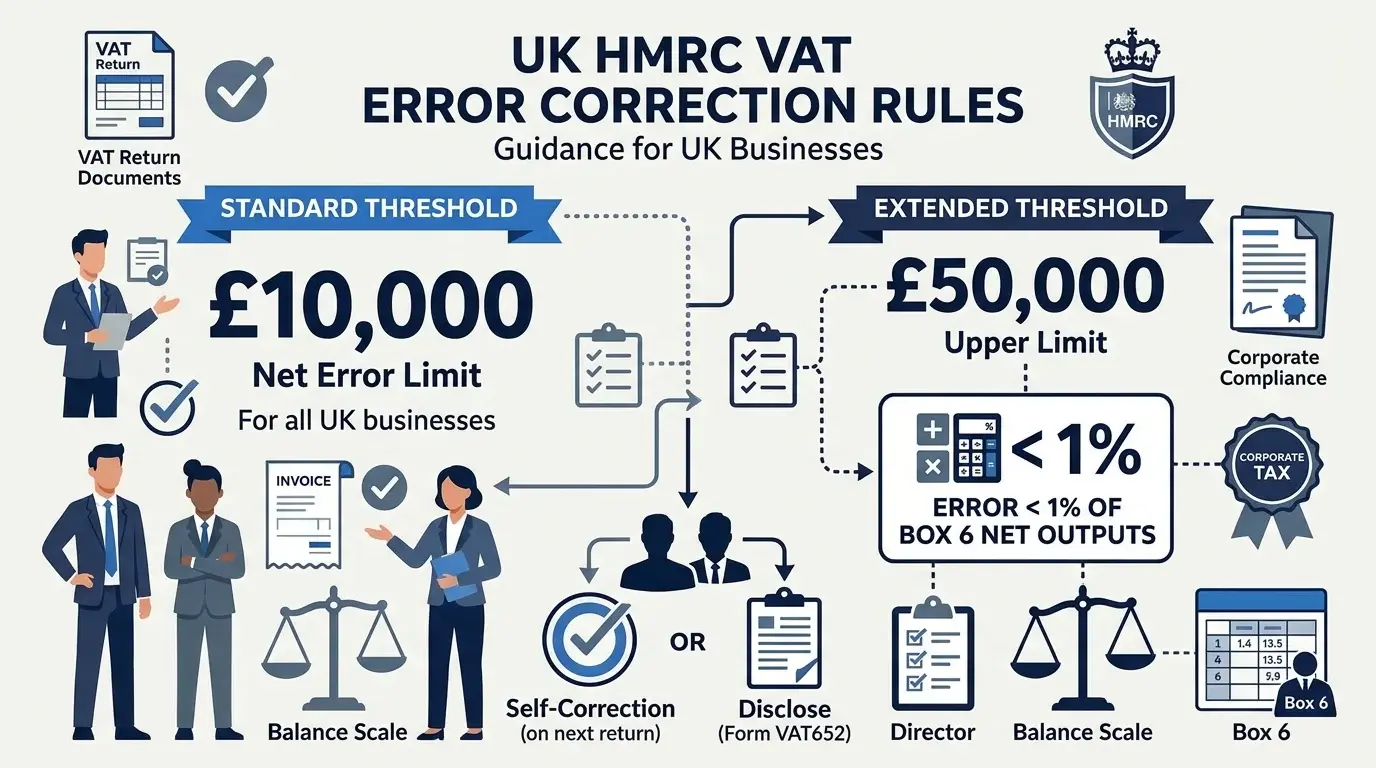
The £10,000 threshold applies universally to every VAT-registered entity in the United Kingdom. When your net error totals £10,000 or less, you include the adjustment directly in your next scheduled VAT return. This streamlined method eliminates the administrative burden of submitting separate disclosure forms to tax authorities.
Businesses with higher revenues access the extended £50,000 threshold under specific conditions. You calculate 1% of the total value of sales and all other outputs excluding VAT, which appears in Box 6 of your current return. If your net error falls between £10,000.01 and £50,000, the discrepancy must remain strictly below that 1% Box 6 ceiling to qualify for a direct return adjustment.
Errors exceeding £50,000 never qualify for direct inclusion on a subsequent VAT return. Similarly, any net mistake exceeding 1% of your Box 6 figure requires formal external reporting regardless of whether the absolute value sits below £50,000. Exceeding these statutory boundaries mandates separate notification to HMRC to avoid compliance breaches.
How Do You Calculate Net VAT Errors Before Making an Adjustment?
You calculate net VAT errors by subtracting the total value of overdeclared output tax and underdeclared input tax from the total value of underdeclared output tax and overdeclared input tax across the affected accounting periods.
Accurate calculation begins with isolating every individual accounting mistake discovered during your internal ledger audit. You separate these discrepancies into two distinct financial categories: amounts owed to HMRC and amounts owed back to your business. Grouping errors by tax direction prevents double-counting and establishes a clear audit trail.
Four specific error types occur most frequently in UK business bookkeeping:
Omitting valid supplier VAT receipts from purchase ledgers
Applying standard 20% VAT rates to zero-rated or exempt goods
Recording sales invoices in the wrong quarterly accounting period
Claiming input tax on blocked business entertainment expenses
Once you categorize every mistake, you sum the figures that represent an underpayment to HMRC. Next, you sum the figures that represent an overpayment to HMRC. Subtracting the smaller total from the larger total yields the absolute net error value that you test against HMRC thresholds.
You must complete this net calculation using exact pound and pence figures rather than rounded estimates. Because HMRC compliance officers audit the underlying working papers, your spreadsheet must link every adjustment figure to specific invoice numbers and transaction dates. Maintaining granular records substantiates your threshold eligibility during routine tax inspections.
Which Boxes on Your Current VAT Return Require Adjustment?
You adjust Box 1 of your current VAT return when the net error shows you owe additional VAT to HMRC, and you adjust Box 4 when the net error shows HMRC owes a VAT refund to your business.
Box 1 records the total VAT due on sales and other outputs for the current accounting period. When your net error calculation reveals an underpayment to HMRC, you add that net amount directly to your current Box 1 total. This action increases your overall tax liability for the active quarter and settles the historical shortfall simultaneously.
Box 4 captures the total VAT reclaimed on purchases and other inputs for the active period. When your net error calculation reveals that you previously overpaid tax or missed valid input claims, you add that net amount to your current Box 4 figure. This adjustment reduces your current VAT bill or increases your quarterly repayment claim.
You never alter Box 6 or Box 7 figures when executing minor VAT adjustments on a current return. Box 6 displays total net sales, while Box 7 displays total net purchases for the active quarter alone. Adjusting only Box 1 or Box 4 ensures your underlying turnover statistics remain accurate for statistical and threshold monitoring purposes.
When Must You Submit Form VAT652 Instead of Adjusting a Return?
You must submit Form VAT652 to HMRC when your net VAT error exceeds £50,000, exceeds 1% of your Box 6 turnover up to £50,000, or stems from deliberate misconduct rather than careless accounting mistakes.
Form VAT652 serves as the official notification document for errors that fall outside the direct adjustment rules. Businesses also use this form when they discover errors after deregistering from VAT, because they no longer submit regular quarterly returns. Submitting Form VAT652 initiates a formal review by HMRC’s Error Correction Team.
Deliberate errors never qualify for the self-adjustment mechanism regardless of their monetary value. If an error resulted from intentional underreporting or falsified records, you must disclose the discrepancy formally using Form VAT652. Attempting to hide a deliberate error inside a routine quarterly adjustment exposes company directors to severe financial penalties and criminal prosecution.
You submit Form VAT652 electronically through your Government Gateway account or by posting a physical copy to the HMRC VAT Error Correction Team. The submission must include a complete schedule detailing each accounting period affected, the exact figures involved, and a factual explanation of how the errors occurred. HMRC processes the disclosure and issues a formal notice of assessment confirming the final balance due or repayable.
What Records Must You Keep Under Making Tax Digital Rules?
Under Making Tax Digital rules, you must retain digital records of the error discovery date, the accounting periods affected, the exact calculation method, and the specific VAT return boxes adjusted for at least six years.
Making Tax Digital (MTD) mandates that all VAT-registered businesses maintain digital links between their primary accounting software and their HMRC submission portals. When you execute a minor VAT adjustment, you cannot simply type a revised total into your bridging software. Your accounting system must house a distinct digital journal entry documenting the correction.
Compliance auditors verify three essential data points inside your digital VAT account:
Record the exact date you identified the historical mistake
Document the original tax point dates for every corrected transaction
Link the adjustment journal directly to the active quarterly VAT return
Retaining these digital audit trails for six years satisfies Section 58 of the Value Added Tax Act 1994. If HMRC opens a compliance check within the four-year statutory time limit for VAT assessments, your digital records demonstrate immediate transparency. Structured documentation proves that your accounting team followed statutory self-correction protocols without attempting to manipulate tax liabilities.
Businesses operating complex tax schemes often encounter unique recordkeeping rules during error reviews. For instance, dealers calculating tax on profit margins follow strict stock-book rules, which you can explore in our guide on What Is Margin Scheme VAT and Who Uses It for Second-Hand Goods?. Understanding scheme-specific documentation prevents secondary errors when adjusting historical returns.
How Do HMRC Penalties and Interest Apply to Corrected VAT Errors?
HMRC charges statutory late payment interest on net VAT underpayments from the original due date until payment, while careless error penalties range from 0% to 30% depending on whether your disclosure is unprompted or prompted.
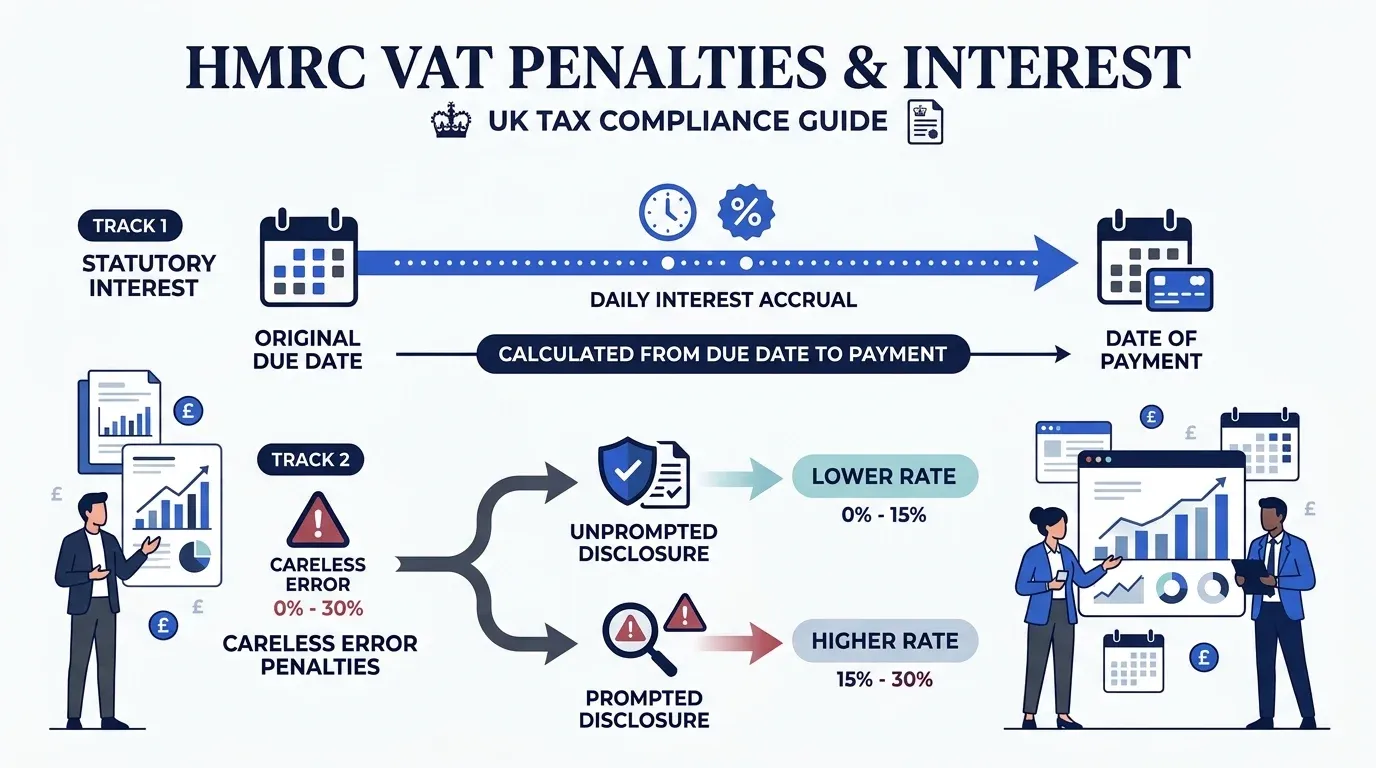
Adjusting a minor error on your current VAT return counts as an unprompted disclosure, provided HMRC has not already announced a compliance inspection. For unprompted disclosures of careless errors, HMRC typically reduces the penalty range to between 0% and 15% of the potential lost revenue. If you took reasonable care when submitting the original return, HMRC waives the penalty entirely and charges zero fines.
Prompted disclosures occur when you uncover and report a mistake only after HMRC notifies you of an upcoming audit or investigation. When a disclosure is prompted, statutory penalties for careless errors increase to between 15% and 30% of the unpaid tax. Acting quickly to audit internal ledgers and execute adjustments before HMRC initiates contact protects your company from unnecessary financial sanctions.
Statutory interest applies separately from behavior-based penalties whenever a correction increases your tax liability. HMRC calculates daily interest at the Bank of England base rate plus 2.5% from the date the tax was originally due. Establishing accurate tax workflows early prevents these compounding costs, and our VAT Registration Assistance ensures your initial compliance framework meets every statutory requirement.
Why Should Growing Businesses Establish Proactive VAT Compliance Systems?
Growing businesses establish proactive VAT compliance systems to eliminate recurring clerical errors, maintain uninterrupted cash flow, and avoid HMRC compliance interventions as transaction volumes scale past the £90,000 registration threshold.
Rapid revenue growth multiplies the volume of daily sales invoices, supplier bills, and cross-border transactions. Manual spreadsheet tracking breaks down under high transaction loads, leading to frequent tax code mismatches and missed input tax claims. Implementing automated MTD-compatible accounting software flags anomalies before quarterly returns reach HMRC.
Scheduled internal VAT reviews conducted ten days prior to every filing deadline catch discrepancies early. Finance teams reconcile the VAT control account against bank statements and verify that every high-value purchase invoice displays a valid supplier VAT registration number. Consistent pre-filing audits reduce reliance on retrospective error adjustments and keep working capital predictable.
Companies scaling their operations benefit from structured professional guidance during setup and expansion phases. You can examine how established enterprises streamline their tax operations by reading Fast-Track Your Tax Setup: Why Growing Businesses Rely on Form My Company for VAT Assistance. Proactive compliance architecture transforms VAT management from a reactive administrative burden into a predictable financial process.
Correcting minor VAT mistakes on past returns requires strict adherence to HMRC’s £10,000 and £50,000 net error thresholds, accurate Box 1 or Box 4 adjustments, and complete digital audit trails under Making Tax Digital rules. Applying these procedures systematically keeps your company compliant and prevents avoidable penalties. Form My Company delivers structured VAT Registration Assistance and ongoing compliance support to help UK businesses maintain accurate tax records from day one.
Explore More VAT Registration Assistance Guide,
How to Manage Cash Flow Challenges When Paying Quarterly VAT Bills
How to Handle Import and Export VAT Obligations Following Recent Trade Rules
Frequently Asked Questions
When is VAT registration mandatory for a UK business?
UK businesses must register for VAT with HM Revenue and Customs (HMRC) when their taxable turnover exceeds £90,000 over any rolling 12-month period, or if they expect it to exceed £90,000 within the next 30 days alone. Non-established taxable persons selling into the UK have a zero threshold and must register before making their first taxable sale. Form My Company monitors these statutory triggers through its VAT Registration Assistance to ensure businesses apply within the mandatory 30-day notification window.
What documents and information are required to apply for a UK VAT number?
Applying for a UK VAT registration number requires your company incorporation number or Unique Taxpayer Reference (UTR), business bank account details, National Insurance number, valid director identification, and accurate taxable turnover figures. HMRC also requires a detailed description of your business activities and proof of trading—such as sales invoices, signed contracts, or supplier agreements—to verify commercial legitimacy. Through VAT Registration Assistance, Form My Company compiles and validates these supporting compliance documents prior to submission to prevent HMRC security checks and processing delays.
How long does HMRC take to process a UK VAT registration application?
HMRC typically processes straightforward online VAT registration applications within 40 working days, though manual security reviews or missing documentation can extend timelines. You must still account for VAT from your effective date of registration while awaiting your certificate, issuing revised VAT invoices once your number arrives. Form My Company reduces processing delays via its VAT Registration Assistance by ensuring business descriptions, bank details, and effective registration dates match official Companies House and HMRC records on the first submission.
Can a small business register for VAT voluntarily below the £90,000 threshold?
Yes, UK businesses with taxable turnover below £90,000 can register voluntarily for VAT at any time, provided they make or intend to make taxable supplies. Voluntary registration allows businesses to reclaim input VAT on eligible commercial purchases and pre-registration expenses—up to four years for goods still on hand and six months for services—while enhancing credibility with VAT-registered B2B clients. Form My Company evaluates your supplier costs and client profile during VAT Registration Assistance to determine whether voluntary registration improves your net cash flow.
Which HMRC VAT accounting scheme should a newly registered business choose?
Newly registered businesses can choose between Standard VAT Accounting, the Flat Rate Scheme (for taxable turnover up to £150,000), the Cash Accounting Scheme (up to £1.35 million), or the Annual Accounting Scheme (up to £1.35 million). Selecting the optimal scheme depends on your profit margins, customer base, and whether you prefer paying VAT only after receiving customer payments rather than upon issuing invoices. As part of its VAT Registration Assistance, Form My Company analyzes your projected turnover and expense structure to align your registration with the most tax-efficient Making Tax Digital (MTD) scheme.