A limited company can involve more administration than working as a sole trader, but the right structure depends on how you plan to run your business. The cost of setting up a company in the UK in 2026 includes a £100 digital incorporation fee, according to Companies House, while registering with HMRC as a sole trader for Self Assessment is typically free.
The initial fee is only one part of the decision. A limited company has ongoing filing responsibilities, so weigh those costs against the structure you want and the work needed to keep the company compliant.
This guide explains the main formation costs and compares them with the costs of operating as a sole trader. It also covers the basic requirements for directors, shareholders and share capital, so you can understand what setting up a limited company involves before deciding how to proceed.
Key Takeaways
- Compare the simpler setup of a sole trader with the separate filing and administration responsibilities of a limited company.
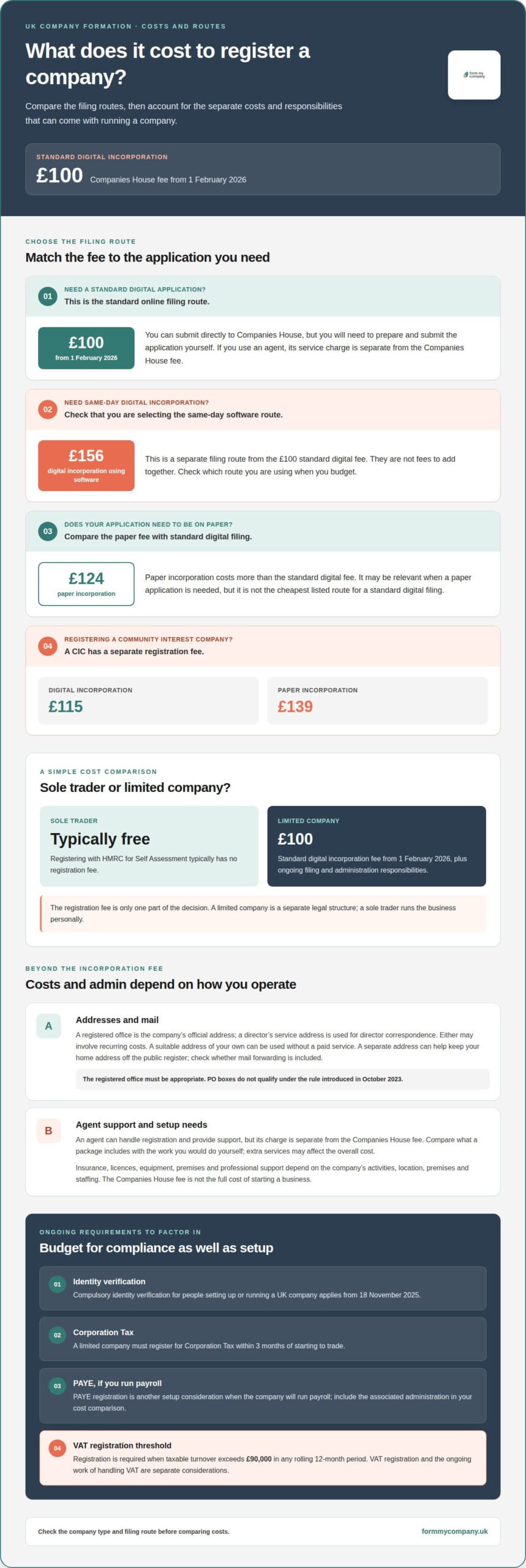
- Companies House sets the digital incorporation fee at £100 from 1 February 2026, so include it when estimating your initial setup costs.
- HM Revenue & Customs requires VAT registration when taxable turnover exceeds £90,000 in any rolling 12-month period.
- Understand the basic director and shareholder requirements before deciding who will own and manage the company.
- A limited company can be formed with minimal share capital, but the share structure should reflect how ownership is arranged.
Why set up a limited company rather than operating as a sole trader?
A limited company is a separate legal structure, while a sole trader runs the business personally. This affects how you organise ownership, finances and administration. The right choice depends on how you plan to operate.
Registered office and service address costs
A registered office is the company’s official address. A director’s service address is used for correspondence with the director. Both may involve recurring costs, and the registered office appears on the public register.
According to Companies House, the address must be appropriate, and PO boxes do not qualify under the rule introduced in October 2023.
You do not need a paid registered office service if your company has a suitable address of its own. Using a separate address can help keep your home address off the public register. When comparing packages, check whether mail forwarding is included.
Insurance, licences and startup costs
Insurance, licences and other startup costs depend on the company’s activities, premises and staffing. For instance, a business that works at clients’ premises may need different cover from one that sells services remotely.
Licensing requirements also depend on the activity and location. Include relevant permissions, equipment, premises and professional support in your budget. The Companies House registration fee is not the full cost of starting a business.
The registration fee for the same company type applies across the UK. It does not change simply because the business is in England and Wales, Scotland or Northern Ireland. Address services and activity-related expenses may still vary depending on the company’s arrangements.
Community interest companies have a separate registration fee. Paper incorporation of a community interest company costs £139 from 1 February 2026, while digital incorporation costs £115. The route and company type therefore affect the initial amount.
Registering directly avoids an agent’s service charge, but you must prepare and submit the application yourself. A formation agent can handle registration and provide setup support. Compare what each package includes with the tasks you would otherwise complete.
Companies House requires people setting up or running a company in the UK to undergo compulsory identity verification from 18 November 2025. The verification process is a separate administrative requirement from choosing a registered office or deciding whether to use an agent.
A limited company must register for Corporation Tax within 3 months of starting to trade. If the company will run payroll, PAYE registration is another setup consideration; account for the associated administration when comparing company costs with sole trader costs.
HM Revenue & Customs requires a UK company to register for VAT when its taxable turnover exceeds £90,000 in any rolling 12-month period. VAT registration and the ongoing work of handling VAT are distinct considerations, so include the business’s expected turnover and VAT administration in your planning.
What is the most cost-effective way to have a company registered in the UK?
For a standard digital application, the Companies House fee is the main fixed incorporation cost. The most suitable route depends on whether you want to prepare the application yourself or use software or a formation agent.
Companies House fee changes
Companies House fee changes are revised charges for filing and registration, and they affect the amount due when you incorporate. According to Companies House, the digital filing fee to incorporate a company in the UK will be £100 from 1 February 2026.
Some Companies House fees changed on 1 February 2026, so older guides may quote a different registration fee. Digital incorporation cost £50 from 1 May 2024 until January 2026, following a previous fee of £12 before 1 May 2024. Use the charge that applies on your submission date.
Digital incorporation fees
Digital incorporation covers an online application submitted directly or through software. Companies House charges £156 for same-day digital company incorporation using software, compared with £100 for the standard digital filing fee from 1 February 2026.
These are separate filing routes, not fees to add together. Check which route you are using when you budget. You will need the registered office address and company information ready for submission either way.
Registering directly with Companies House can limit the cost to the government filing fee, but you will need to prepare and submit the application. This may suit a straightforward private company with settled ownership and company details.
A formation agent can handle the application and provide formation support. The agent’s charge is separate from the Companies House fee, so compare the package contents with the work you would otherwise do yourself. The lowest-priced package may not be the cheapest overall if you need extra services.
Paper incorporation costs £124, making it more expensive than the standard digital fee. It may still be relevant where a paper application is needed, but it is not the cheapest listed route for a standard digital filing.
To manage costs, first identify the company type and filing route you need. Then separate the Companies House registration fee from any agent’s service charge. Avoid paying for unnecessary support, while accounting for the time and care required to prepare the application accurately.
If you prefer support with company formation, review the formation package options and consider which level of assistance fits your application.
Limited company costs compared with sole trader costs
A sole trader can register for Self Assessment with HMRC without a registration fee. A limited company has a Companies House incorporation fee, then separate responsibilities for accounts, tax returns and company records. The cost of setting up a company in the UK 2026 is only one part of the comparison; factor in ongoing administration too.
For a limited company, submitting annual accounts to Companies House on time normally carries no filing fee. The accounts are still required, and the filing deadline is within 9 months of the company’s financial year end. Sole traders do not file company accounts with Companies House, so their reporting workload is different.
Accountancy costs can affect the comparison. A sole trader may also pay for accountancy support, but the records and tax filings required are different.
Tax outcomes depend on profit and how a company owner takes income. For a business with £60,000 profit, one estimate puts sole-trader tax at approximately £14,300, compared with approximately £9,700 for a limited company using salary and dividends. After additional accounting costs, the estimated company saving is approximately £4,500 per year. Treat this as an illustration, not a universal result.
Formation packages differ in what they include. Compare application handling, documents, registered address options and filing support, then separate those features from Companies House charges. Some packages may include initial support while ongoing filing services renew separately. Check the renewal terms and what the service covers after the initial period.
A business that needs only incorporation support has different requirements from one seeking ongoing help with company filings. List each task you need covered, including annual accounts preparation, before comparing packages. This makes recurring costs easier to identify, rather than focusing only on the first payment.
Comparing the UK with other jurisdictions involves more than comparing incorporation fees. Each has its own registration process, filing obligations, tax rules and address requirements. Establish where the business will operate and which company obligations apply before comparing costs. A low initial registration charge elsewhere may not reflect the full cost of running the company.
Build a like-for-like comparison: registration, annual accounts, tax support and any recurring filing service. For a sole trader, include Self Assessment support; for a limited company, include company reporting and ongoing administration. To compare the cost of setting up a company in the UK 2026 with sole trader expenses, include both initial payments and recurring work.
Director and shareholder requirements
A director manages the company’s affairs, while shareholders own its shares. One founder may take both roles, or several people may divide ownership and management. Decide how responsibilities and ownership will work before preparing the registration documents, as these choices shape company records and future decisions.
A UK company director must be at least 16 years old. The person’s details form part of the company’s official information, so choose directors who understand the responsibilities attached to the role. For example, if one founder will lead daily operations and another will only invest, record those roles and the share ownership clearly.
Shareholders hold the company’s shares, and the allocation determines how ownership is divided. Consider whether one person will own all the shares or whether several people will hold them. For example, two founders might agree to split ownership equally or allocate different proportions to reflect their contributions and involvement.
Make sure the share register and company documents show ownership consistently. Record each shareholder’s name and share allocation, and keep company records up to date when ownership changes. A formation agent can help prepare the initial company information, but the founders must agree who owns what before submitting the application.
A person holding more than 25% of a company’s shares must register as a person with significant control. This makes it important to consider ownership proportions alongside director appointments. For example, a shareholder with a controlling shareholding may need to be recorded as a person with significant control, even if another person manages the company.
Consider possible changes as well as the initial setup. If a founder leaves, sells shares or later becomes a director, company documents and public information may need updating. Clear records help keep ownership information and filings consistent, rather than relying on informal agreements.
Before registration, agree on the proposed directors, shareholders and share allocation. Check that names and details match across the application and supporting documents. If several founders are involved, agree how decisions will be made and record those arrangements. This gives the registration a clear starting point and helps prevent later confusion about capital, control or responsibilities.
For a typical small company, the key preparation is not choosing a complicated structure. It is identifying who will manage the company, who will own its shares and whether anyone meets the significant-control threshold. Those choices affect the company’s records and provide a practical basis for preparing its accounts and future statements.
Minimum share capital
A UK company can be incorporated with a single £0.01 share and no capital deposit. Share capital records the value of shares issued to owners; it is separate from the Companies House fee and the company’s operating budget.
For a single-founder company, a common structure is 100 shares at £1 each. This gives the founder 100 shares, with each share representing a portion of ownership. The total nominal share value is £100, but it does not mean the company must deposit £100 before incorporation.
Choose a structure that matches how ownership should be divided. One founder might hold all 100 shares, while two founders could receive 50 shares each. Those examples show how allocations can work, but the founders should agree the proportions that reflect their arrangements before registration.
Share numbers can make later ownership changes easier to express. If a company has 100 shares, transferring 10 shares represents a different proportion from transferring one share. Record the allocation accurately in the company’s documents, so the shareholder details and ownership records remain consistent.
Share capital is not the same as cash available for expenses. Budget separately for registration, a registered office address, equipment and ongoing costs. If the business expects monthly expenses, plan its working cash separately rather than treating the nominal value of its shares as its full startup fund.
Companies House filings also create costs beyond initial incorporation. According to Companies House, the digital filing fee for a confirmation statement will be £50 from 1 February 2026. Registering a company charge digitally costs £14, a separate filing that may apply when a charge is registered against company assets.
These charges are not determined by whether the company issues one £0.01 share or 100 shares at £1 each. The share structure describes ownership; filing fees relate to particular applications and records. Keep both in the budget, but do not confuse the share value with a Companies House fee.
Before submitting the application, decide the number and value of the shares and each shareholder’s allocation. Make sure these details match across the formation documents. A formation agent can prepare the registration using the agreed structure, while the founders decide how ownership should be arranged.
If you’re ready to register a company with an agreed share structure, arrange your company formation with Form My Company.
Form My Company
Form My Company helps founders form UK companies and choose a package to suit their registration needs. If you’re setting up a limited company, the Digital Package and Digital & Print Package are available. Limited Liability Partnership (LLP) Formation is also offered.
Turn to Form My Company if you want support with formation and prefer a professional to handle the registration. Before you proceed, decide who will act as director, how shares will be allocated and which address the company will use. These details help establish what information the application requires.
Contact Form My Company to discuss your company formation.
Choose a structure that fits your next stage
Your business structure should support how you plan to own, manage and grow the venture, not just minimise its initial setup cost. Use your expected workload, ownership plans and appetite for company administration to guide the decision. Once those choices are clear, the cost of setting up a company in the UK in 2026 becomes easier to assess against the responsibilities you’re taking on.
Form My Company offers the Digital Package, Digital & Print Package and Entrepreneurs Choice Package for company formation. Consider which level of support suits your needs, then proceed with your chosen structure and company details ready.
Contact Form My Company to discuss your company formation and move your plans forward with confidence.
Frequently Asked Questions
Are Accountancy & Formation Fees Tax-Deductible?
Accountancy fees for statutory accounts, Corporation Tax returns and bookkeeping are allowable business expenses. The incorporation fee is treated differently: it is a capital cost and does not qualify for Corporation Tax relief as a trading expense. Keep invoices and records separate so recurring accountancy work is not confused with the one-off cost of forming the company.
Company formation comparison: what will you actually spend?
Your total cost depends on the structure and support you choose. For a limited company, include the Companies House incorporation fee, any formation assistance and ongoing accounts and filing work. Registering as a sole trader with HMRC for Self Assessment is typically free, though you may still pay for accounting support. Compare the initial payment separately from recurring work to understand the practical difference.
So, how much should you budget overall?
Start with the relevant incorporation fee, then budget for the work your company will need after registration. This may include preparing annual accounts and Corporation Tax returns, a registered office address and accounting software. A founder using a home address and managing records independently will have different costs from a company paying for address services and professional accountancy support.
What about the ongoing costs of running a company?
Budget for annual accounts, tax reporting and any recurring services the company uses. Companies House does not normally charge for filing annual accounts on time, but other filing requirements may incur fees.
What is the Companies House fee to register a UK limited company in 2026?
According to Companies House, the digital filing fee to incorporate a company will be £100 from 1 February 2026. The same-day digital incorporation fee using software is £156. These are different filing routes, so identify which application method applies before estimating the registration outlay. The fee covers incorporation, not optional formation support or later company services.
How much does it cost to set up a UK company through an accountant or formation agent in 2026?
A formation agent’s total charge depends on the package and its included services, such as application preparation or additional company documents. Compare the work covered rather than treating the service charge and statutory filing fee as the same cost.
What are the costs of registering as a sole trader or partnership compared with a UK limited company?
Registering as a sole trader with HMRC for Self Assessment is typically free. A limited company has a Companies House incorporation fee, and subsequent accounts and filing responsibilities can add costs. Partnership arrangements vary according to their legal structure and registration route. Compare the relevant registration requirements and ongoing reporting needs rather than assuming every partnership has the same setup cost.
What are the UK company name, registered office and director requirements, and their costs?
A limited company name must end in “Limited” or “Ltd”, and the company needs an appropriate registered office address that appears on the public register. A director must be at least 16 years old. Address costs depend on whether the company uses its own suitable premises or pays for an address service. Include identity verification and the required company details in your setup planning.