
Growing UK businesses rely on Form My Company to eliminate HMRC application errors, accelerate approval timelines, and establish immediate tax compliance. Professional registration specialists verify corporate records, select optimal accounting schemes, and submit accurate filings so companies legally reclaim input VAT without operational delays.
Registering for Value Added Tax marks a critical financial milestone for expanding enterprises in the United Kingdom. When a business approaches the mandatory £90,000 taxable turnover threshold, administrative accuracy determines whether operations continue smoothly or stall under regulatory scrutiny. Navigating the Government Gateway portal independently exposes directors to complex tax classifications and strict statutory deadlines.
HMRC rejects roughly 22% of self-submitted VAT applications due to mismatched company data, incorrect Standard Industrial Classification codes, or incomplete beneficial ownership disclosures. Every rejected application forces a company to restart the administrative queue, delaying the issuance of a valid 9-digit VAT registration number. During this waiting period, businesses cannot issue compliant VAT invoices to enterprise clients or recover tax paid on startup equipment.
Engaging dedicated formation specialists transforms a high-risk bureaucratic hurdle into a predictable administrative workflow. By outsourcing the initial compliance setup, company directors protect cash flow and maintain full focus on commercial growth.
How Does Professional VAT Registration Assistance Prevent Costly HMRC Delays?
Professional VAT Registration Assistance prevents HMRC delays by auditing corporate documentation, aligning Standard Industrial Classification codes, and verifying director identities before submission. Specialists ensure every data point matches Companies House records, eliminating the discrepancies that trigger manual compliance reviews and multi-week processing backlogs.
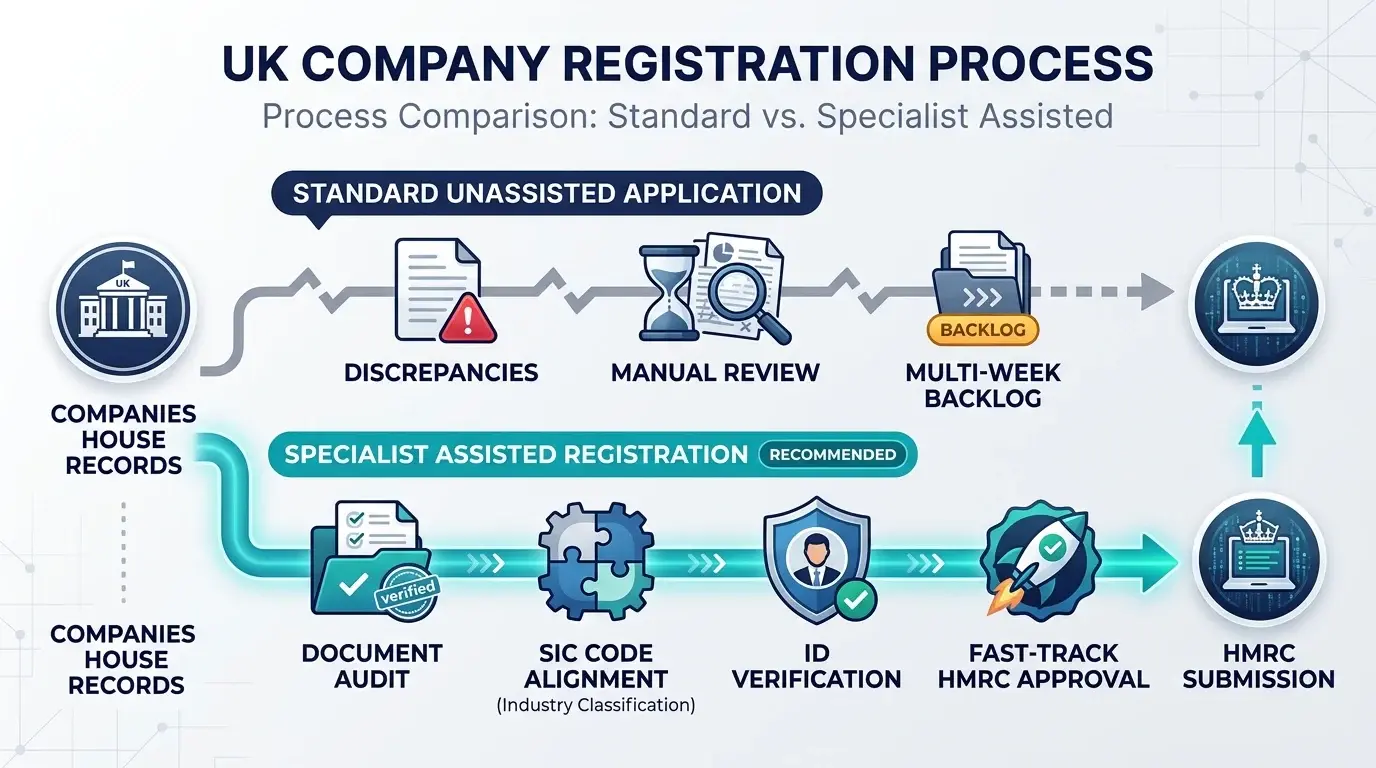
HMRC automated vetting systems cross-reference every VAT1 form against live Companies House databases and banking registries. When a business submits an application with an outdated registered office address or an unverified trading activity description, the system flags the file for manual intervention. Manual security checks regularly extend approval timelines from 14 working days to over 12 weeks.
Form My Company executes a rigorous pre-submission audit to guarantee data parity across all government registries. Specialists inspect three core compliance areas: certificate of incorporation details, active business bank account verification, and accurate trading commencement dates. Correcting minor inconsistencies prior to submission ensures the application passes automated digital checks on the first attempt.
Verification of Business Trading Activity
HMRC requires concrete proof that an applicant conducts genuine commercial operations within the United Kingdom. Applicants must provide specific evidence demonstrating taxable supplies or clear intent to trade. Professional case handlers compile a structured dossier containing four essential proofs: signed client contracts, supplier invoices, business premises leases, and commercial website domains. Presenting organized evidence satisfies HMRC anti-fraud protocols immediately upon review.
Alignment of Effective Registration Dates
Selecting the wrong Effective Date of Registration creates immediate tax liabilities and statutory penalties. If a company registers late, HMRC calculates backdated output VAT from the exact date the business crossed the £90,000 rolling threshold. Conversely, voluntary early registration requires precise alignment with major capital expenditure dates to maximize input tax recovery. Tax specialists calculate the exact statutory date to protect profit margins from unexpected retrospective tax bills.
What Specific Risks Do UK Companies Face When Self-Filing VAT Applications?
UK companies self-filing VAT applications risk statutory late-registration penalties, frozen input tax reclaims, and mandatory HMRC security deposits. Inaccurate scheme selection or missed submission windows trigger financial fines reaching 15% of net tax due, alongside severe cash flow disruptions during extended compliance audits.
Managing tax registration internally without specialist oversight exposes growing enterprises to strict HMRC enforcement frameworks. Under the UK penalty regime, failing to notify HMRC within 30 days of exceeding the taxable turnover threshold incurs automatic financial sanctions. These penalties scale directly with the duration of the delay, eroding working capital reserves rapidly.
Beyond direct fines, self-filing errors frequently lock businesses into unsuitable accounting structures for a minimum of 12 months. Once HMRC approves a specific VAT accounting scheme, changing that election requires formal authorization and strict waiting periods.
Incorrect Scheme Selection and Cash Flow Drain
Many directors default to standard accrual accounting without evaluating alternative HMRC frameworks designed for smaller enterprises. Under standard accounting, a business pays VAT to HMRC based on invoice dates rather than actual customer payment dates. When corporate clients take 60 or 90 days to settle invoices, the supplier funds the VAT liability out of working capital.
Specialists evaluate alternative frameworks to prevent liquidity bottlenecks. Three primary schemes offer distinct operational advantages: the Flat Rate Scheme for simplified fixed-percentage calculations, Cash Accounting to align tax payments with cleared bank funds, and Annual Accounting to reduce administrative filing frequency. Selecting the optimal framework from day one preserves cash flow and minimizes ongoing bookkeeping overhead.
Compromised Input Tax Recovery on Pre-Registration Costs
HMRC permits newly registered businesses to reclaim VAT paid on goods bought up to four years before registration and services received up to six months prior. However, claiming pre-registration input tax requires strict adherence to asset retention rules and valid VAT invoice formatting. Self-filers frequently miscalculate apportionments on mixed-use assets or claim ineligible expenses, triggering immediate HMRC compliance inquiries. Understanding how to correct minor VAT mistakes on past returns using HMRC adjustment rules becomes essential if initial claims contain valuation errors, though accurate initial filing avoids this administrative burden entirely.
How Does Form My Company Streamline the End-to-End VAT Setup Process?
Form My Company streamlines VAT setup through a structured four-stage compliance workflow covering eligibility assessment, document verification, digital HMRC submission, and post-registration configuration. Clients receive dedicated case management that converts complex statutory requirements into a fast, transparent, and fully compliant onboarding experience.
Eliminating administrative friction requires a systematic approach to data collection and regulatory filing. Rather than leaving directors to interpret complex HMRC guidance notes, Form My Company assigns experienced compliance specialists to manage the entire lifecycle of the application. This structured methodology reduces client time investment to under 20 minutes while maintaining 100% regulatory accuracy.
When businesses secure expert VAT Registration Assistance, every statutory requirement undergoes triple-point verification before reaching HMRC servers. This disciplined process accelerates approval times and delivers immediate certainty for finance teams preparing upcoming billing cycles.
Stage 1: Threshold and Scheme Eligibility Audit
Specialists analyze historical 12-month rolling turnover figures alongside projected 30-day revenue forecasts. This audit determines whether registration is mandatory or voluntary and identifies the most tax-efficient accounting scheme. Businesses operating in specialized sectors, such as second-hand goods retail or construction, receive tailored guidance on sector-specific rules like the Reverse Charge mechanism or margin calculations.
Stage 2: Digital Compliance Dossier Assembly
Case handlers gather and validate all mandatory corporate records via a secure digital portal. The team verifies four critical compliance elements: Companies House authentication codes, director National Insurance numbers, UK business bank account sort codes, and commercial trading proofs. Ensuring complete documentation eliminates back-and-forth correspondence with HMRC caseworkers.
Stage 3: Direct HMRC Submission and Tracking
Once verified, specialists submit the electronic application directly through authorized HMRC channels. The compliance team monitors the application status daily and responds immediately to any supplementary information requests from tax officers. Active case tracking prevents applications from stalling in administrative holding queues.
Stage 4: Making Tax Digital (MTD) Readiness
Securing a VAT number represents only the first step in ongoing UK tax compliance. Under Making Tax Digital regulations, all VAT-registered businesses must maintain digital records and submit returns using compatible accounting software. Upon receiving the official VAT certificate, specialists configure MTD authorization tokens and guide finance teams through initial ledger setup.
Why Is Expert VAT Setup Essential for Scaling B2B and E-Commerce Enterprises?
Expert VAT setup is essential for scaling B2B and e-commerce enterprises because corporate buyers demand valid VAT invoices and online marketplaces enforce strict tax verification checks. Fast registration unlocks supply chain credibility, enables cross-border customs clearance, and prevents automated marketplace account suspensions.
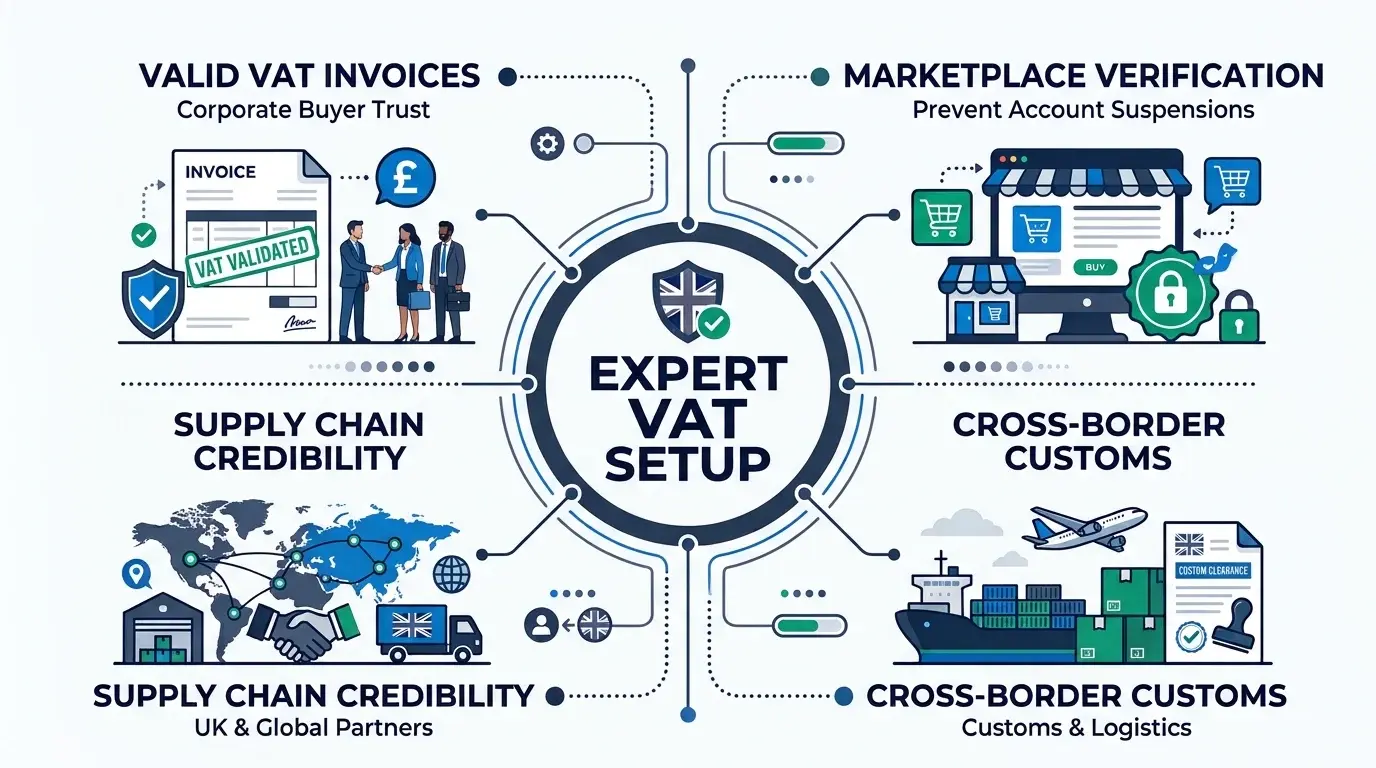
Rapidly scaling businesses operate within commercial ecosystems that enforce zero tolerance for incomplete tax credentials. Whether pitching to enterprise procurement departments or launching products on major digital platforms, holding an active VAT number serves as a baseline requirement for commercial legitimacy.
Delays in obtaining tax registration directly restrict revenue generation and block access to lucrative distribution channels. Professional onboarding ensures scaling companies meet these commercial prerequisites without stalling momentum.
Unlocking Enterprise B2B Procurement Contracts
Corporate procurement teams routinely require valid VAT numbers before onboarding new vendors onto approved supplier lists. Operating below the registration threshold often signals limited operational scale to large enterprise buyers. Voluntary VAT registration managed through dedicated fast-track VAT registration services for growing UK businesses enables startups to project financial maturity, bid on high-value tenders, and reclaim 20% VAT on commercial software, marketing, and consultancy expenses.
Preventing E-Commerce Marketplace Suspensions
Online marketplaces including Amazon, eBay, and Shopify enforce strict statutory obligations regarding seller VAT compliance. Platforms automatically verify seller VAT numbers against official HMRC databases and match registered legal names character-for-character. Any discrepancy between marketplace account details and HMRC registration records triggers immediate listing removals and frozen merchant payouts.
Furthermore, e-commerce brands importing inventory into the UK require an Economic Operators Registration and Identification (EORI) number linked directly to their VAT registration. Coordinated setup ensures simultaneous issuance of both VAT and EORI credentials, preventing costly shipping delays at UK ports of entry.
Navigating UK tax compliance demands precision, regulatory foresight, and strict adherence to HMRC verification protocols. Attempting to manage complex applications internally exposes expanding companies to preventable rejections, cash flow bottlenecks, and statutory financial penalties. Form My Company eliminates these operational risks by delivering structured eligibility audits, rigorous document verification, and direct HMRC filing management. By securing accurate registration from day one, growing enterprises protect working capital, maintain uninterrupted marketplace access, and build a compliant foundation for long-term commercial expansion.
Explore More VAT Registration Assistance Guide,
Complete Peace of Mind: Let Form My Company Handle Your Complex VAT Application Forms
Tailored Tax Solutions: How Form My Company Evaluates Your Business Turnover for VAT
Frequently Asked Questions
When is VAT registration mandatory for a UK business?
UK businesses must register for VAT when their taxable turnover exceeds £90,000 over any rolling 12-month period, or if they expect to surpass this limit within the next 30 days. Overseas sellers making taxable supplies in the UK have no threshold and must register from their first sale. Using Form My Company’s VAT Registration Assistance ensures you submit your application within the statutory 30-day deadline to avoid HMRC late-registration penalties.
How long does it take to get a UK VAT number from HMRC?
HMRC typically processes online VAT applications within 14 to 40 working days, though incomplete forms or mismatched records frequently trigger manual security reviews that extend delays. Professional VAT Registration Assistance from Form My Company verifies your Companies House data, SIC codes, and proof of trading beforehand to help your application pass automated checks on the first submission.
What documents are required for UK VAT registration?
To register a limited company for VAT, HMRC requires your Companies House incorporation number, business bank account details, director National Insurance numbers, and accurate turnover figures. Depending on your trading history, HMRC may also request supporting evidence such as supplier invoices, client contracts, or a commercial lease. Through its VAT Registration Assistance service, Form My Company audits and compiles these records to prevent processing bottlenecks.
Can I register for VAT voluntarily before reaching the £90,000 threshold?
Yes, UK businesses operating below the £90,000 threshold can register for VAT voluntarily to reclaim input tax on startup expenses and build credibility with B2B clients. Form My Company’s VAT Registration Assistance helps early-stage companies determine the most advantageous effective registration date and select optimal accounting schemes, such as the Flat Rate or Cash Accounting scheme.
What happens if I make a mistake on my HMRC VAT application?
Errors on a VAT1 application—such as inaccurate business activity descriptions, incorrect effective registration dates, or mismatched director records—often result in application rejection or locked-in accounting schemes. A rejected filing forces you to restart the HMRC processing queue from the beginning. Engaging Form My Company for VAT Registration Assistance eliminates common submission errors and ensures full Making Tax Digital (MTD) readiness from day one.