
A 20% charge is the standard answer, but it isn’t the whole UK VAT picture. According to HMRC, the standard rate is 20%; the reduced rate is 5%, and the zero rate is 0%. The rate that applies depends on what you sell, while digital services can raise extra questions when your customers are overseas.
If you’re working out whether to register, the current threshold is £90,000 of taxable turnover in a rolling 12-month period, according to HMRC. Once registered, you’ll also need to understand return deadlines and how the VAT treatment of your sales affects what you can reclaim on business purchases.
This guide explains the main UK VAT rates, when registration is required and when to file returns. It also clarifies the difference between zero-rated and exempt supplies, and what to consider when selling digital services to customers in the UK or abroad. Use it to identify the rules relevant to your business and plan your next steps.
Key Takeaways
- Check which VAT rate applies to what you sell: standard-rate, reduced-rate and zero-rated supplies have different effects on your pricing and returns.
- Track taxable turnover across a rolling 12-month period so you can spot when compulsory registration is approaching.
- Plan for the return deadline: VAT returns are generally due one calendar month and seven days after the accounting period ends.
- Distinguish zero-rated sales from exempt supplies, as the difference affects whether you can recover VAT on related business costs.
- For digital services, consider where your customer is based and whether you’re selling to consumers or businesses before deciding how VAT applies.
UK VAT rates
HM Revenue & Customs sets the standard VAT rate at 20% in the United Kingdom. The rate depends on the supply, not simply on the business’s turnover.
Standard and Reduced Rates
Standard and reduced rates are different VAT charges applied to eligible taxable goods and services. HM Revenue & Customs states that the standard rate is 20%; the reduced rate is 5%. The correct rate affects the amount added to a customer’s bill and the VAT reported on sales.
For example, a business charging £1,000 for a standard-rated service adds £200 VAT, making the total £1,200. A reduced-rate supply uses a different calculation: multiply its VAT-exclusive price by 1.05 to find the VAT-inclusive price. Apply the rate that matches the supply, rather than choosing a rate based on the customer or the business’s preferred price.
For imports, VAT treatment depends on the goods and how they enter the UK; for consignments worth £135 or less sent from outside the UK, VAT is charged at the point of sale. Exports of goods are among specified zero-rated supplies, so eligible exports can carry 0% VAT.
Rates and Taxable Turnover
Taxable turnover is the value of taxable sales, while the VAT rate determines the charge on each supply. These affect separate decisions: the rate affects individual prices and returns, while taxable turnover helps determine whether registration is required.
The UK VAT registration threshold is £90,000 of taxable turnover in a rolling 12-month period, according to HM Revenue & Customs. Include taxable sales when monitoring turnover, and distinguish them from supplies that are exempt. A business can therefore have taxable supplies at different rates, while turnover still informs its registration position.
Once registered, a business must charge VAT on taxable supplies from its effective registration date. It must also report zero-rated sales on VAT returns, even though no VAT is charged on them. Keep sales records separated by rate so invoices and returns reflect the correct treatment of each supply.
Changes to the Standard Rate
The standard VAT rate has changed over time, so historical invoices must use the rate applicable to their tax point. It was 15% from 18 June 1979 to 18 March 1991, then 17.5% from 19 March 1991 to 30 November 2008.
The rate returned to 15% from 1 December 2008 to 31 December 2009. It increased to 17.5% on 1 January 2010 and remained at that rate until 3 January 2011. The current standard rate is 20%, according to HM Revenue & Customs.
These changes matter when reviewing older accounts, credit notes or amended invoices. Match each transaction to its relevant date and supply, rather than applying today’s 20% rate to every historical record. Clear records help explain why transactions from different periods show different VAT charges.
The Flat Rate Scheme
The VAT Flat Rate Scheme lets eligible small traders calculate the VAT due by applying a flat-rate percentage to their turnover. The applicable percentage depends on the trader’s business category. Instead of accounting for VAT on each sale and purchase individually, the trader uses the scheme’s calculation to work out the payment due.
Certain small traders with supplies below £150,000 per annum may use a special flat-rate VAT scheme if they have a limited range of expenses. This can make the calculation more straightforward, but it can also affect how VAT on purchases is accounted for. Compare the scheme’s calculation with the business’s actual sales and costs before deciding whether it suits the business.
Keep accurate turnover records and apply the correct category rate consistently. The scheme changes how VAT due is calculated, not the rate charged on an individual taxable supply. For example, a standard-rated sale remains subject to the standard rate even when the trader uses a flat-rate calculation for their return.
VAT registration threshold
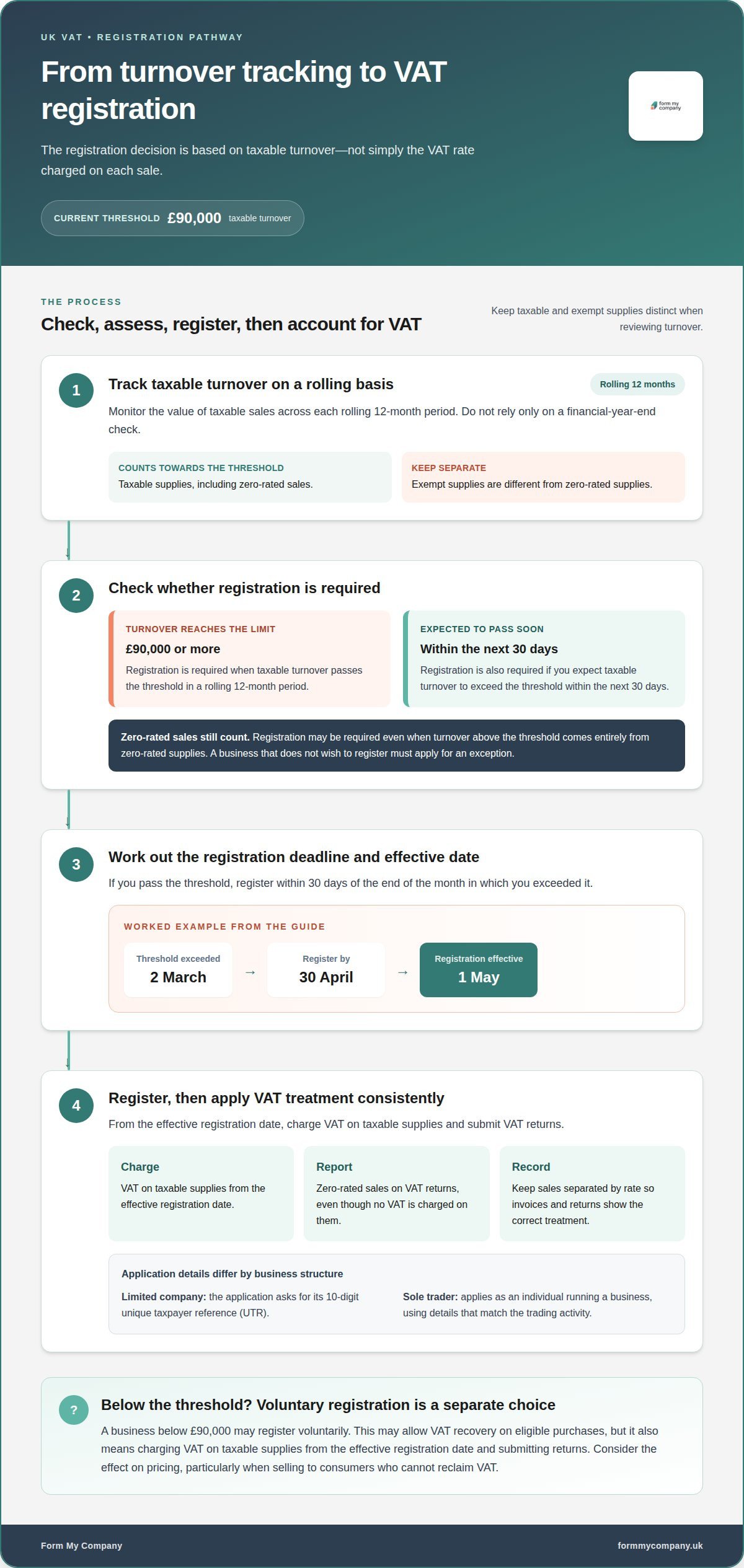
HM Revenue & Customs sets the UK VAT registration threshold at £90,000 of taxable turnover in a rolling 12-month period. A business must also register if it expects taxable turnover to exceed the threshold within the next 30 days. To register for VAT, submit an application to HMRC with details of the business and its taxable supplies.
If turnover passes the threshold, HM Revenue & Customs requires the business to register within 30 days of the end of the month in which it exceeded the limit. For example, a business that exceeded it on 2 March must register by 30 April, with registration taking effect from 1 May. Track taxable turnover on a rolling basis, rather than checking only at the end of a financial year.
A business below the threshold may choose to register voluntarily. Registration may allow it to reclaim VAT on eligible purchases, but it must also charge VAT on taxable supplies from its effective registration date and submit returns. This can affect pricing, particularly if customers are consumers who cannot reclaim VAT. Weigh the VAT on purchases against the added charging and reporting responsibilities.
The application details differ by business structure. A limited company registering for VAT is asked for its 10-digit unique taxpayer reference, or UTR. A sole trader applies as an individual running a business, and should use the business details that match its trading activity. In either case, accurate turnover and supply records help support the application.
Registration may also be required when turnover above the threshold comes entirely from zero-rated supplies. A business that does not wish to register must apply for an exception. For example, a retailer selling children’s clothing may make zero-rated sales, but those sales still count when assessing taxable turnover. Zero-rated supplies are not exempt.
After registration, the VAT number helps identify the registered business. The GOV.UK service can show the name and address linked to a VAT number, but it cannot search for registration by business name. You need the number you want to check. A UK VAT number is 9 digits long and will usually begin with GB.
Registration can support recovery of VAT on eligible purchases, but it also means charging VAT on taxable sales and keeping up with returns. Consider the balance between those effects, your customers and the type of supplies you make. If you’re preparing to register, VAT registration application support can help with the next step.
VAT return periods and filing deadline
VAT-registered businesses generally submit a return every three months. The accounting period shown in the business’s HMRC account determines the dates to report. HMRC sets the filing deadline at one calendar month and seven days after the accounting period ends. For example, a return covering a quarter must be filed and paid by the deadline calculated from that quarter’s end.
Some businesses use different return periods. Monthly returns may suit businesses that regularly expect VAT refunds, as they can claim sooner. Eligible businesses may use the Annual Accounting Scheme, subject to approval. Each option changes how often the business submits returns, but it must still report the VAT due for the relevant period.
Submit every return, including one that shows no VAT to pay or reclaim. A return records VAT charged on taxable sales and eligible input tax on purchases. The difference determines whether the business owes VAT to HMRC or can claim a repayment. Organise invoices and transaction records by accounting period, supply type and VAT rate so the figures can be supported.
Making Tax Digital for VAT began in April 2019. VAT returns must be filed electronically using Making Tax Digital-compatible software via HMRC. Businesses must also make electronic payments. This means the return and payment are separate tasks: submitting the figures does not itself settle the amount due. Allow time for the payment to reach HMRC by the applicable deadline.
Late filing and late payment have separate consequences. For late returns, HMRC applies a points-based penalty system. When the late-return points threshold is reached, HMRC issues a £200 penalty; further £200 penalties apply for later late submissions while the threshold remains breached. A return is still required even if the business has no VAT payable.
For late payment, there is no penalty if the amount due is paid within 15 days. From day 16, the first penalty is 3% of the amount unpaid at that point. From day 31, a further 3% applies to VAT unpaid at day 30, alongside a daily penalty at 10% a year until payment. These penalty rates have applied since 1 April 2025. Late payment interest is charged from the first day at the Bank of England base rate plus 4%.
Create a calendar based on the end of each accounting period, then schedule the return and payment ahead of the HMRC deadline. If taxable turnover exceeds the registration threshold, the business must register and meet the filing obligations from registration.
VAT-exempt supplies and input VAT recovery
HM Revenue & Customs sets the United Kingdom’s zero rate at 0%. The distinction between zero-rated and exempt sales affects both VAT charged and input tax recovery.
Exempt and Zero-Rated Supplies
Zero-rated and exempt supplies are treated differently for VAT purposes. This difference matters because zero-rated sales are reported on VAT returns and can support input VAT recovery; exempt sales can restrict recovery on related costs.
Specified zero-rated supplies include exports of goods, most food, children’s clothing, books and newspapers, and international transport. No VAT is charged on these supplies, but the business must still report them on its return. A reduced-rate supply is different: it is taxable at the reduced rate, not zero-rated or exempt.
VAT-exempt supplies also carry no VAT charge, but they are not the same as zero-rated goods or services. The treatment depends on the type of supply. For example, an eligible export may be zero-rated, whereas an exempt supply is outside the scope of taxable sales.
Partial Exemption
Partial exemption applies when a business makes both taxable and exempt supplies. It matters because input VAT on shared purchases may need to be apportioned between those activities, rather than reclaimed in full.
First, separate costs by use. Purchases used only for taxable supplies can be assessed against those supplies, while costs linked solely to exempt activity are treated differently. Shared overheads, such as premises costs used for both activities, require apportionment. Keep the calculation and supporting purchase records with the relevant VAT return.
For example, a business selling books and making exempt supplies needs to distinguish the sales and the costs connected with each. Book sales may be zero-rated, but that does not make them exempt. Correctly classifying each supply is essential to calculating the recoverable share.
Recovering Input VAT
Input VAT is VAT charged on purchases made for business activities. The supplies those purchases support affect whether the business can reclaim that VAT, so retain invoices and link each purchase to taxable or exempt activity.
For a purchase used exclusively to make zero-rated sales, the sales remain taxable at 0%, and must still appear on the VAT return. A purchase used exclusively for exempt supplies doesn’t qualify for recovery in the same way. Where a cost supports both, partial exemption rules determine the recoverable proportion.
Review sales and purchase records together before submitting a return. Separate zero-rated sales from exempt revenue, identify shared costs and keep a clear record of any apportionment. This helps prevent exempt supplies from being treated as zero-rated, or the reverse, when calculating input tax.
VAT on digital services
Digital sales can cross borders without physical goods moving, but the customer’s location still matters. For UK VAT, separate sales to UK consumers from sales to overseas customers, and record whether each customer is a consumer or a business. This information helps establish the applicable VAT treatment and what the supplier needs to account for.
Foreign businesses supplying digital services to UK consumers generally charge UK VAT at the standard rate of 20%. A business based outside the UK may need to register when it supplies goods or services to UK customers, regardless of turnover, where it is responsible for accounting for VAT. The UK registration threshold therefore doesn’t always determine an overseas supplier’s position.
For each transaction, identify the supplier, the customer’s country and status, and the service provided. Keep these details with the invoice and payment record. For example, a UK consumer buying a digital service from a foreign supplier is involved in a different transaction from a UK business buying the same service. Clear records help the business apply the correct UK VAT treatment consistently.
Cross-border sales to EU customers need separate attention. Since 1 January 2021, services between the UK and the EU have been treated as supplies of services to a third country. UK businesses supplying digital services to EU consumers must also consider the EU One-Stop Shop threshold of €10,000. Track those sales separately from UK sales so the relevant destination and customer type remain clear.
Northern Ireland has a distinct position for goods and services. EU VAT rules continue to apply to goods in Northern Ireland, but not to services. Do not assume that rules for goods moving across a border automatically determine the treatment of a digital service. Classify the transaction first, then record its destination and nature.
Digital platforms and direct sales can involve different parties in a transaction. Record who supplies the service and who is responsible for accounting for VAT, rather than relying only on the name shown to the customer. This is particularly useful when a platform processes payments but another business supplies the content or access. For accurate UK VAT reporting, keep records showing the service, customer, location and VAT charged.
Review these details for each accounting period before preparing a return. If your sales mean registration is required, arrange VAT registration assistance as your next step.
Form My Company
Form My Company can support your next step when VAT obligations become part of setting up or structuring a business. If you’re still choosing a legal structure, its Digital Package, Digital & Print Package and Entrepreneurs Choice Package offer company formation options, while Limited Liability Partnership (LLP) Formation is available for businesses choosing that structure.
Consider registration timing alongside your plans for trading, taxable sales and record-keeping. Choosing a business structure does not change which VAT rules apply, but organising the formation process can help clarify responsibilities as you move forward. For company formation support, contact Form My Company.
Build VAT planning into your next business decision
Include UK VAT in your planning as you decide how the business will trade. Consider who will manage transaction records and how sales information will reach them. A clear allocation of responsibility connects VAT tasks with day-to-day business activity.
As your business develops, review whether changes to its products, customers or sales channels affect its UK VAT processes. Include these decisions in your business planning so records and responsibilities can adapt alongside your operations.
If you’re ready to discuss your next business step, contact Form My Company. Build your UK VAT planning into a clear path forward and keep your business moving.
Frequently Asked Questions
What is the UK VAT rate?
The standard rate is 20%, with a reduced rate of 5% and a zero rate of 0%. The rate depends on the type of supply, so a business should classify each product or service before invoicing. A zero-rated sale still counts as a taxable supply, unlike an exempt sale. Check the relevant category when pricing a new product or changing the way you sell it.
How does VAT work?
VAT is charged on taxable sales, while a registered business may reclaim eligible VAT paid on purchases. The difference is reported to HMRC through a return. For example, a business that sells a service and buys equipment for its taxable activity records both the VAT on sales and eligible VAT on purchases. This is the basic mechanism behind UK VAT accounting.
What happens if you exceed the VAT threshold?
If taxable turnover exceeds the threshold, you must register within 30 days of the end of the month in which it was exceeded, according to HM Revenue & Customs. Registration may also be required if you expect to exceed the threshold within the next 30 days. Monitor taxable turnover as it accumulates, rather than relying only on a year-end total.
What is VAT and what are the benefits of being VAT registered?
VAT is a tax on taxable goods and services. Registration may let a business reclaim eligible VAT on purchases used for taxable activity, which can matter when it has business costs that include VAT. It also means the business must charge VAT on taxable supplies from its effective registration date and submit returns. Consider customers, pricing and purchase costs together before choosing voluntary registration.
What is a VAT return?
A VAT return reports a registered business’s VAT activity for an accounting period. It sets out VAT charged on sales and eligible VAT paid on purchases, then shows whether the business owes HMRC or can claim a repayment. Returns are required even when there is no VAT to pay or reclaim. Keep invoices and sales records organised so each amount can be traced.
Can you claim VAT back in the UK?
A VAT-registered business can generally reclaim eligible input VAT on purchases used for taxable business activity. The connection between a purchase and the business’s supplies matters: costs linked to exempt activity may restrict recovery, while shared costs may need apportionment. Keep purchase evidence and identify the activity each cost supports before including a claim in the relevant return.
Do charities pay VAT?
A charity’s status alone does not determine whether VAT applies. Treatment depends on the particular sale, purchase or activity, and whether it is taxable, exempt or eligible for zero rating. A charity making taxable sales may have different responsibilities from one making exempt supplies. Assess each activity separately, including fundraising and trading, and keep records showing how each transaction was treated.
Do sole traders pay VAT?
Sole traders follow the same VAT registration rules as other businesses. They must register when the compulsory registration criteria apply and may choose voluntary registration below the threshold. Once registered, a sole trader accounts for VAT on taxable sales and submits returns. VAT is separate from income tax: it concerns taxable business supplies, while income tax is based on taxable income.