
Articles of Association establish internal governance rules, director appointment protocols, voting thresholds, share transfer restrictions, and dividend distribution rights, creating a legally binding framework that regulates corporate control, operational compliance, and stakeholder accountability within a UK limited company.
Why Are Articles of Association Essential for UK Companies?
Articles of Association act as the constitutional blueprint for a company, defining legal boundaries, protecting minority stakeholders, and establishing mandatory operational compliance benchmarks for corporate governance.
Every limited company registered in the United Kingdom requires a constitutional document to operate lawfully under corporate legislation. Company founders adopt standard model articles or draft customized provisions to reflect specific commercial agreements. These legal clauses dictate how directors execute board decisions and how shareholders exercise voting power during general meetings. When external entities review a business, corporate investigators examine these internal rules to evaluate operational legitimacy and structural stability.
Establishing clear governance parameters prevents administrative deadlocks between founding members and incoming investors. Regulatory bodies require corporate constitutions to align with statutory legislation, ensuring directors maintain fiduciary duties toward the enterprise. Operational clarity reduces corporate litigation risks by outlining exact dispute resolution mechanisms. Directors utilize these administrative parameters to manage daily business activities without breaching statutory obligations. Shareholders review these governance terms to secure financial protections and monitor executive performance.
What Powers and Responsibilities Do Directors Exercise Under These Rules?
Director rules regulate executive appointments, board meeting quorums, voting majorities, conflict of interest disclosures, and the delegation of executive management authority to corporate officers.
Corporate constitutions specify the minimum and maximum number of directors permitted to sit on the board. Appointed executives derive their legal authority from these governance terms, enabling them to sign contracts, hire personnel, and manage commercial assets. When a board votes on commercial resolutions, the articles establish the exact quorum required to validate decisions. Directors must disclose personal financial interests during board deliberations to maintain legal compliance. If an executive breaches these constitutional boundaries, stakeholders can challenge corporate decisions through administrative tribunals.
Executive accountability remains central to corporate governance structures across the United Kingdom. Managing directors delegate specific operational tasks to departmental heads while retaining ultimate legal responsibility for corporate solvency. Statutory frameworks require directors to promote the success of the enterprise for the benefit of its members. Constitutional provisions outline the exact procedures for removing non-performing executives from office through ordinary or special resolutions. Companies often utilize Supplementary Company Documents to ensure their internal executive governance frameworks align with current statutory requirements. Maintaining precise documentation protects executive officers from personal liability claims during corporate audits.
What Shareholder Rights and Voting Thresholds Are Defined?
Shareholder provisions dictate voting power ratios, dividend payout entitlements, capital alteration procedures, and minority protection mechanisms during general meetings.
Equity ownership grants investors specific statutory rights that are expanded or restricted by internal corporate rules. Ordinary shareholders typically possess one vote per share held, enabling them to influence major corporate resolutions. Special resolutions require a seventy-five percent majority vote to pass, protecting foundational changes such as constitutional amendments. When directors declare dividends, payout distributions must follow the precise equity class percentages recorded in the company register. Investors analyze these financial entitlements before injecting capital into emerging enterprises.
Protecting minority investors requires specific pre-emption rights embedded within the corporate constitution. Pre-emption clauses ensure existing members receive the first opportunity to purchase newly issued shares, preventing ownership dilution. When internal disputes disrupt corporate operations, constitutional drag-along and tag-along clauses regulate share sales during corporate buyouts. Shareholders utilize structured How to Present Your Articles of Association to a Bank or Investor guides to understand how financial institutions evaluate voting structures. Clear equity terms reassure external financiers that their capital contributions remain protected against arbitrary internal decisions.
How Do These Rules Govern Share Transfers and Restrictions?
Share transfer restrictions control equity movements, enforce board approval mandates, set valuation formulas for departing members, and prevent hostile takeovers.
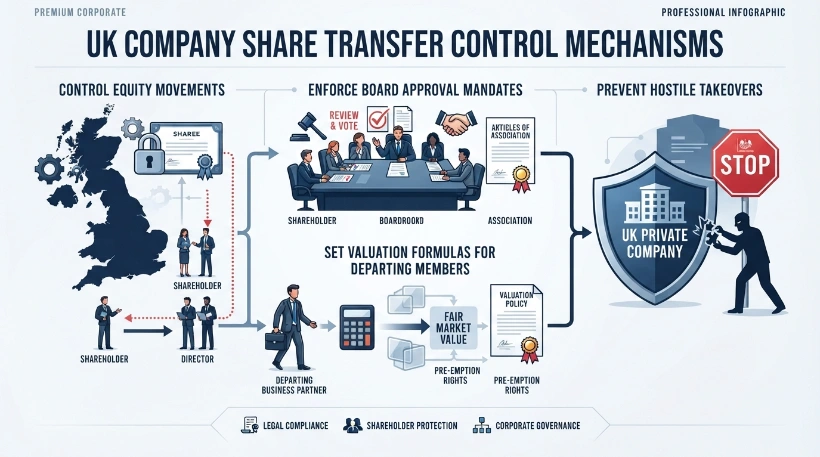
Private limited companies rely heavily on constitutional transfer restrictions to maintain control over company ownership. Directors often hold the discretionary power to refuse share transfers to external third parties without providing a justification. When a shareholder decides to sell equity, internal rules typically enforce a right of first refusal among existing members. This mechanism keeps ownership within a trusted circle of founders or family members. If valuation disputes arise during equity sales, the articles outline independent accounting formulas to determine fair market value.
Controlling equity distribution safeguards commercial confidentiality and prevents competitor infiltration. Restrictive clauses stop departing co-founders from transferring voting rights to rival business entities. Corporate compliance officers review share registers regularly to verify that all ownership transfers adhere to constitutional mandates. Implementing strict transfer protocols ensures long-term enterprise stability and preserves corporate culture. Businesses seeking comprehensive structural protection often explore Secure Your Company Constitution With Form My Company to implement robust governance frameworks tailored to their commercial objectives. Professional document preparation eliminates administrative vulnerabilities during equity restructuring phases.
Articles of Association establish the fundamental legal framework governing the relationship between directors, shareholders, and corporate entities. Defining voting thresholds, executive powers, and share transfer restrictions ensures long-term operational stability and regulatory compliance. Form My Company delivers professional administrative support and tailored governance solutions to help businesses secure their corporate constitutions efficiently.
Explore our Supplementary Company Documents guide,
How Much Does It Cost to Apostille a UK Document?
How Does Room Design Influence Interview Performance?
Frequently Asked Questions
Can I amend my company’s Articles of Association after incorporation?
Yes, UK limited companies can alter their Articles of Association post-incorporation by passing a special resolution with a 75% majority vote among shareholders. Form My Company provides expert guidance on drafting and filing these constitutional amendments with Companies House to ensure full legal compliance.
What is the difference between Articles of Association and a Shareholders’ Agreement?
Articles of Association form the public constitutional document registered at Companies House, whereas a Shareholders’ Agreement is a private contract regulating internal equity arrangements. Businesses utilize Supplementary Company Documents to align both instruments, ensuring operational consistency and robust governance protection.
Do I need custom Articles of Association or can I use model articles?
Startups can adopt standard model articles provided by UK legislation, but growing enterprises frequently require custom clauses to manage share transfers and voting rights. Form My Company helps businesses draft tailored Supplementary Company Documents that reflect precise commercial structures and investor requirements.
How do Articles of Association affect bank account opening and investments?
Banks and institutional investors review a company’s constitutional documents to verify authorized signatories, voting thresholds, and corporate governance standards. Providing properly structured Supplementary Company Documents reassures external financiers that the enterprise maintains transparent and legally sound internal operations.
Where should I file changes made to my company’s constitutional documents?
Companies House requires businesses to file an amended copy of their Articles of Association along with the special resolution within 15 days of the agreement. Form My Company assists corporate officers in managing these filings accurately to prevent administrative penalties and maintain register integrity.