

Model Articles suit standard single-shareholder startups with simple governance needs, while bespoke Articles serve companies requiring customized voting rights, special share classes, or strict transfer controls to protect unique shareholder arrangements and long-term control structures.
What Are Model Articles of Association and How Do They Work?
Model Articles serve as standard default governance rules set by the UK government for private limited companies incorporated under the Companies Act 2006.
The UK government provides these standard provisions to simplify incorporation for small business owners. When registering a new firm without custom documentation, Companies House automatically applies these standard terms. Every private company limited by shares relies on a constitutional framework. This framework dictates how directors make decisions, how shareholders vote, and how shares transfer between parties. Standard governance rules offer a predictable foundation for routine business operations.
Small business founders launch companies quickly by adopting these default regulations. These terms establish basic procedures for calling board meetings and recording written resolutions. They outline director decision-making powers and quorum requirements. Companies House charges no extra drafting fees for using default statutory provisions. Administrative burdens remain low because standard rules require minimal legal interpretation.
Standard provisions present distinct limitations for growing enterprises. A single class of ordinary shares represents the primary ownership structure under default terms. Every ordinary share carries equal voting rights and equal entitlement to dividends. Complex investment rounds often require special share classes with preferential liquidation rights. Default governance rules lack mechanisms for investor protection clauses or drag-along rights. Founders lose flexibility when external investors demand tailored voting thresholds or board veto powers.
Private enterprises often outgrow standard administrative frameworks rapidly. Growing firms encounter operational friction when multi-tier share allocations become necessary. Disputes arise if default rules fail to address deadlocks between equal shareholders. Directors must execute special resolutions to alter corporate governance frameworks later. Transitioning from standard terms to customized rules requires filing amended documents with Companies House.
When Should Your Business Choose Bespoke Articles of Association?
Bespoke Articles are necessary when companies issue multiple share classes, implement complex voting structures, or enforce strict share transfer restrictions.
Customized constitutional documents accommodate unique ownership dynamics and sophisticated investor requirements. Corporate legal advisors draft tailored provisions to reflect exact shareholder agreements. These customized rules override default statutory provisions to protect minority stakes or founder control. High-growth startups secure venture capital funding by embedding investor-friendly governance terms directly into their corporate constitution.
Complex share structures require specialized governance rules. Companies issue preference shares, non-voting shares, or redeemable shares to incentivize key employees and attract institutional capital. Tailored rules define distinct dividend entitlements and capital distribution hierarchies for each share class. Customized voting thresholds protect minority investors against dilution during subsequent financing rounds. Specialized clauses govern board composition, ensuring key stakeholders retain appointment rights.
Share transfer restrictions safeguard existing ownership stability. Private enterprises utilize customized rules to implement pre-emption rights on share transfers. These provisions compel departing shareholders to offer shares to existing members first. Valuation mechanisms within custom rules determine fair share prices during internal buyouts. Compulsory transfer triggers require exiting directors or employees to surrender shares upon termination.
Dispute resolution mechanisms prevent operational paralysis. Custom governance clauses establish tie-breaking procedures for equal voting boards. Leaver provisions categorize departing founders as good leavers or bad leavers, dictating share buyback pricing. Tag-along and drag-along clauses protect majority and minority stakeholders during company acquisitions. Companies utilizing Supplementary Company Documents establish robust legal structures that withstand rigorous due diligence from corporate acquirers and institutional lenders.
What Are the Key Differences Between Model and Bespoke Articles?
Key differences involve share class flexibility, director authority limits, transfer restrictions, and alignment with shareholder agreements.
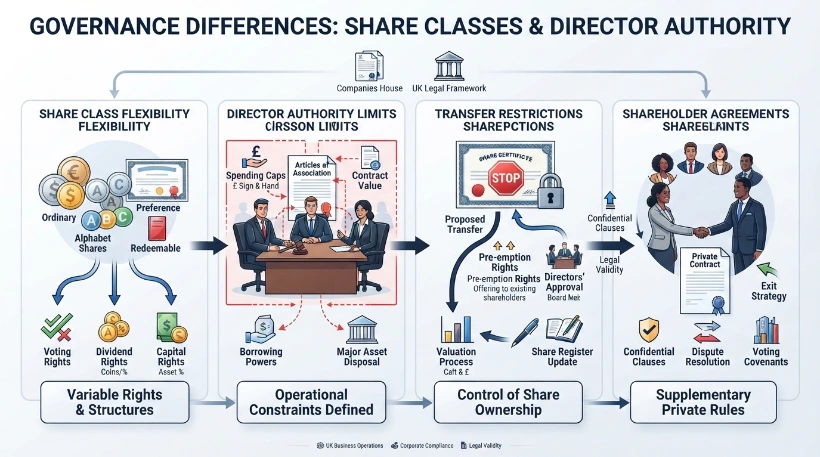
Constitutional design dictates how efficiently a business executes daily administrative tasks and major corporate transactions. Comparing standard statutory terms against tailored governance provisions highlights distinct operational impacts. Statutory default rules prioritize administrative simplicity for uniform corporate structures. Tailored provisions prioritize strategic protection and precise operational control.
Share capital management differs significantly between the two frameworks. Default rules mandate uniform ordinary shares with identical economic and voting rights. Customized rules permit complex multi-class capital structures with variable dividend rights. Companies managing multiple investor tiers require tailored capital rules to prevent equity disputes.
Director powers operate under different regulatory boundaries. Standard rules grant broad discretionary decision-making authority to the board of directors. Customized rules restrict board powers by introducing mandatory shareholder approval thresholds for large transactions. Founders utilize restrictive clauses to retain ultimate control over strategic borrowing and asset sales.
Share transfer protocols define ownership fluidity. Statutory rules allow straightforward share transfers unless directors refuse registration under specific statutory grounds. Tailored rules enforce rigorous approval processes, pre-emption rights, and valuation formulas. These controls prevent external entities from acquiring equity without existing stakeholder consent. Enterprises preparing for institutional financing often transition from default terms, as explored further in Why Do Banks Ask to See Your Articles of Association?, to satisfy corporate banking compliance teams.
How Do You Transition from Model to Bespoke Articles?
Transitioning requires drafting specialized constitutional text, passing a special resolution with a 75% shareholder vote, and filing the amended document with Companies House within 15 days.
Amending corporate governance documents is a formal legal procedure governed by the Companies Act 2006. Businesses must execute specific administrative steps to replace standard statutory rules with customized provisions. Proper execution ensures legal validity and maintains compliance with UK company law registries.
Drafting precise legal text initiates the transition process. Corporate governance specialists formulate custom clauses that address specific operational requirements. Every clause must comply with UK statutory regulations while superseding default provisions. Stakeholders review draft provisions to ensure alignment with existing shareholder agreements and investment terms.
Shareholder approval requires a formal voting procedure. Companies must convene a general meeting or circulate written resolutions to all voting members. Passing a special resolution mandates a minimum 75% majority vote by total voting rights. Directors record the resolution outcome and secure signatures from authorized company officers.
Registry filings complete the statutory transition. Companies must submit the newly adopted constitutional text to Companies House within 15 days of passing the resolution. Submitting Form CC04 alongside the amended document updates the public company register. Organizations seeking professional execution can Get Bank-Ready Articles of Association From Form My Company to ensure complete accuracy and compliance during corporate restructuring.
Model Articles provide a streamlined governance foundation for single-owner startups with straightforward equity structures. Bespoke Articles deliver essential legal protection and structural flexibility for companies managing multiple share classes, outside investors, or complex transfer controls. Form My Company assists business owners in evaluating corporate requirements and establishing legally robust governance frameworks tailored to long-term commercial objectives.
Explore our Supplementary Company Documents guide,
How to File a PSC Change With Companies House Correctly
How to Get a Bound Copy of Your Articles of Association
Frequently Asked Questions
Can I change my company’s Articles of Association after incorporation?
Yes, UK registered businesses can amend their constitutional framework at any time after incorporation. Directors must pass a special resolution requiring a 75% shareholder majority vote and file the amended text with Companies House. Form My Company provides professional Supplementary Company Documents to update your corporate governance accurately.
Are Model Articles of Association legally sufficient for most UK startups?
Model Articles provide a legally compliant default governance framework suitable for simple single-shareholder startups. However, growing enterprises issuing multiple share classes or seeking external investment frequently require tailored provisions. Form My Company supplies specialized Supplementary Company Documents to support complex ownership structures.
What is the difference between Model Articles and Bespoke Articles?
Model Articles are standard default regulations provided by the UK government with fixed rules for directors and shareholders. Bespoke Articles are customized constitutional documents drafted to accommodate specific voting rights, share transfer restrictions, and investor protections. Form My Company delivers customized Supplementary Company Documents tailored to unique operational requirements.
Why do banks require tailored Articles of Association during account opening?
Corporate banking compliance teams inspect constitutional documents to verify authorized signatories, voting thresholds, and borrowing powers. Standard default rules occasionally lack the precise definitions required by financial institutions during risk assessments. Form My Company assists businesses in securing compliant Supplementary Company Documents that satisfy strict banking requirements.
How long does it take to update Articles of Association with Companies House?
Companies House typically processes constitutional amendments within 2 to 5 working days following digital submission. Businesses must file the amended document alongside Form CC04 within 15 days of passing the special resolution. Form My Company streamlines this filing process through expert Supplementary Company Documents services.