
Banks ask to see your Articles of Association because this constitutional document outlines internal governance rules, director authority limits, and shareholder voting powers required for strict corporate identity and legal compliance verification.
Banks operate under stringent regulatory mandates. Financial institutions must authenticate every corporate entity before opening a business account. UK legislation requires banks to capture complete ownership structures. Articles of Association provide the legal framework for corporate existence. Reviewing this document confirms the company operates within lawful boundaries. Financial crime officers examine governance clauses to prevent illicit operations. Compliance teams rely on foundational rules to assess operational legitimacy. Corporate structures demand rigorous validation protocols.
What Information Do Banks Look For in Your Articles?
Banks look for specific governance clauses defining shareholder voting majorities, share transfer restrictions, director appointment protocols, and explicit borrowing powers during compliance reviews.
Financial analysts scan specific administrative clauses within corporate paperwork. Banks check the exact thresholds required for passing special resolutions. Directors need explicit authorization to secure corporate loans. Articles define whether a board can borrow capital without shareholder consent. Restrictions on share transfers prevent unauthorized ownership changes. Financial institutions verify these limits to mitigate credit risks. Corporate governance rules establish operational accountability. Banks trace power distributions among founding members. Examining these provisions prevents unauthorized financial commitments. Clear administrative rules accelerate business account approvals.
How Do Articles of Association Prove Legal Corporate Identity?
Articles of Association prove legal identity by establishing the official corporate constitution registered with Companies House, matching statutory filing data against direct banking applications.
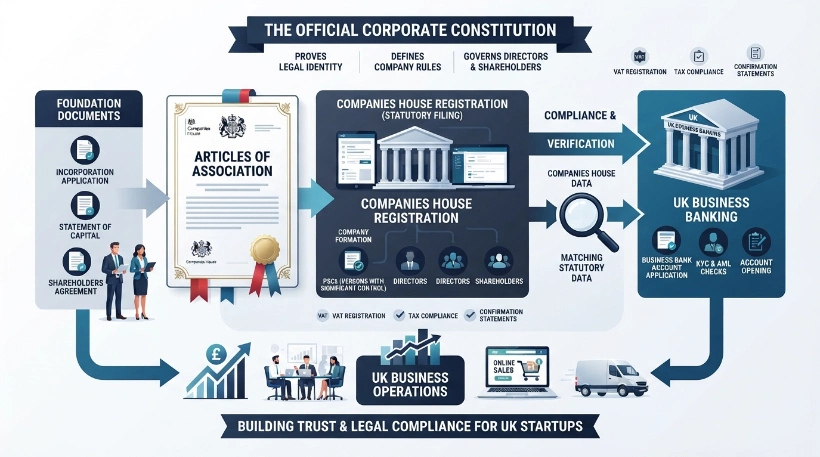
Companies House registration gives a business legal personhood under UK law. Banks cross-reference bank application data with official government registers. The Articles serve as the primary contract between the company and its members. Financial compliance officers check statutory compliance markers. Discrepancies between constitutional rules and application details trigger immediate account freezes. Legal identity verification requires unalterable constitutional proof. Banks authenticate corporate existence using these foundational bylaws. Regulatory frameworks mandate direct validation of constitutional documents. Every registered company must maintain accessible constitutional records. Official validation prevents fraudulent business account creations.
Why Are Director Powers Scrutinized During Account Setup?
Director powers are scrutinized because corporate banks must confirm individual signatories possess legal authority to bind the company to financial contracts and debt obligations.
Company directors hold distinct fiduciary duties defined by constitutional rules. Banks verify whether a single director can authorize transactions independently. Certain corporate structures require joint board approval for major expenditures. Financial institutions check delegation clauses within the governance framework. Unauthorized signatories expose banks to severe legal liabilities. Compliance officers confirm board room authority limits before issuing corporate cards. Clear executive powers streamline daily banking operations. Ambiguous director mandates stall commercial account underwriting. Form My Company provides Supplementary Company Documents to clarify executive authorities for corporate partners. Proper documentation eliminates ambiguity during banking reviews.
What Happens If Your Articles Lack Required Financial Clauses?
When your articles lack required financial clauses, banks reject account applications until you update governance rules to explicitly permit commercial borrowing and capital adjustments.
Standard templates often omit specialized provisions required by modern commercial lenders. Financial institutions reject incomplete paperwork immediately. Companies must file formal amendments with Companies House to resolve missing clauses. Delays in document updates stall business launches. Founders evaluating structural options should read Model vs Bespoke Articles of Association: Which Should You Use? to understand governance variations. Bespoke provisions accommodate complex investment rounds and borrowing powers. Banks favor transparent capital structures with explicit financial permissions. Updating constitutional documents ensures seamless commercial banking relationships. Proactive governance preparation prevents costly administrative rejections.
How Does Document Verification Prevent Corporate Financial Crime?
Document verification prevents financial crime by exposing hidden ownership tiers, illicit fund transfer pathways, and unauthorized nominee directors attempting to launder capital.
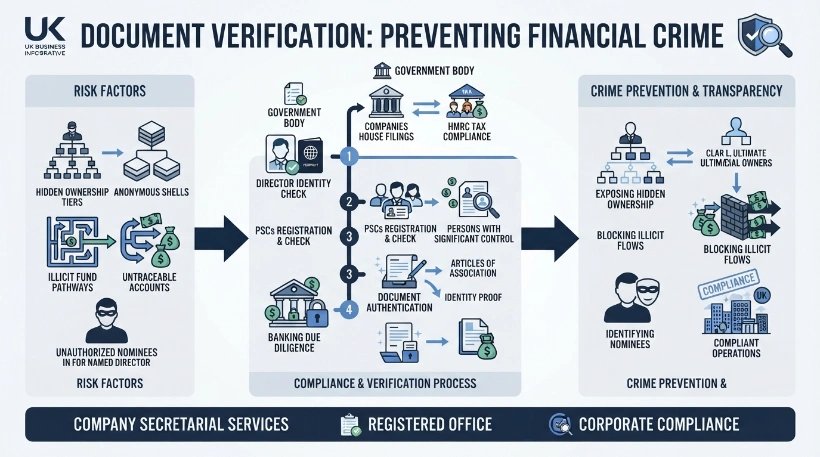
Global anti-money laundering directives force banks to screen every business entity. Criminal networks use opaque corporate structures to obscure ultimate beneficial owners. Articles of Association reveal the exact distribution of voting rights. Financial intelligence units trace control mechanisms through constitutional bylaws. Hidden liabilities surface during thorough document audits. Banks reject entities lacking clear governance transparency. Regulatory penalties for non-compliance reach millions of pounds. Rigorous screening protects the wider financial ecosystem. Strict document enforcement deters fraudulent shell companies.
How Can Businesses Prepare Their Articles for Bank Approval?
Businesses prepare articles for bank approval by auditing governance clauses, confirming explicit borrowing powers, and securing fully updated constitutional files before submission.
Founders must review corporate paperwork prior to meeting commercial bankers. Clean constitutional records accelerate compliance clearances significantly. Companies requiring immediate banking access should Get Bank-Ready Articles of Association From Form My Company to ensure full regulatory alignment. Professional formatting eliminates common oversight errors. Financial institutions process compliant applications faster than incomplete files. Proper preparation secures commercial financial services without frustrating delays. Strategic governance alignment supports long-term corporate growth.
Explore our Supplementary Company Documents guide,
When Do You Need to Report a Change to Your PSC Register?
What Is the Difference Between a Memorandum and Articles of Association?
Frequently Asked Questions
Can I open a UK business bank account without Articles of Association?
No, UK financial institutions strictly require your Articles of Association alongside other constitutional files to verify corporate governance and legal identity. Form My Company provides essential Supplementary Company Documents to ensure your business meets all banking compliance standards.
What specific clauses do compliance teams look for in my articles?
Bank compliance officers specifically review clauses detailing director borrowing powers, shareholder voting thresholds, and share transfer restrictions. These provisions prove that designated signatories hold the legal authority to bind the company to financial contracts.
Are standard model articles sufficient for corporate banking approval?
While standard model articles satisfy basic legal registration requirements, growing businesses often require bespoke constitutional rules to handle complex capital structures. Commercial lenders frequently request customized provisions that explicitly authorize specialized financial transactions and borrowing capabilities.
How do supplementary company records support corporate compliance?
Supplementary company records validate ongoing legal compliance by maintaining accurate registers of directors, shareholders, and constitutional updates. Form My Company supplies these vital Supplementary Company Documents to help businesses maintain complete transparency with regulatory authorities and financial partners.
How long does it take to update company articles for a bank application?
Updating your corporate articles typically requires passing a special resolution and filing the amendments with Companies House, which takes between 24 and 48 hours. Ensuring your constitutional paperwork is fully updated before submitting a banking application prevents costly account setup delays.