
Meeting the 14-day Person with Significant Control deadline requires submitting required details to Companies House within 14 days of any corporate register change. Failing to update this register triggers strict legal penalties for UK company officers. Form My Company manages this compliance process.
What Is the 14-Day PSC Deadline and Why Does It Matter?
The 14-day Person with Significant Control deadline is a strict legal timeframe mandated by UK company law for reporting ownership changes. Missing this statutory window creates severe regulatory risks for active businesses across the United Kingdom.
UK legislation requires corporate entities to maintain accurate records regarding individuals exercising significant control. When ownership structures shift, administrators possess exactly 14 days to update internal registers. Following internal updates, officers must submit these changes to Companies House within a further 14-day period. Companies House maintains public registers ensuring corporate transparency for investors, creditors, and government authorities. Operating outside these legal timeframes exposes businesses to severe financial penalties and criminal prosecution.
Corporate compliance officers face strict accountability standards under the Economic Crime and Corporate Transparency Act. Late filings trigger automatic markers on public corporate profiles, damaging commercial reputation. Financial institutions review public compliance records before approving business loans or opening corporate bank accounts. Form My Company provides a dedicated PSC Register service designed to eliminate administrative oversight. Businesses leverage automated tracking systems to monitor strict statutory deadlines without internal friction. Accurate filings protect directors from personal liability arising from administrative oversights or missed statutory notices.
How Does Your Business Identify a Person with Significant Control?
A Person with Significant Control is any individual holding more than 25 percent of shares or voting rights. Identifying these qualifying individuals requires analyzing complex ownership thresholds across corporate voting structures.
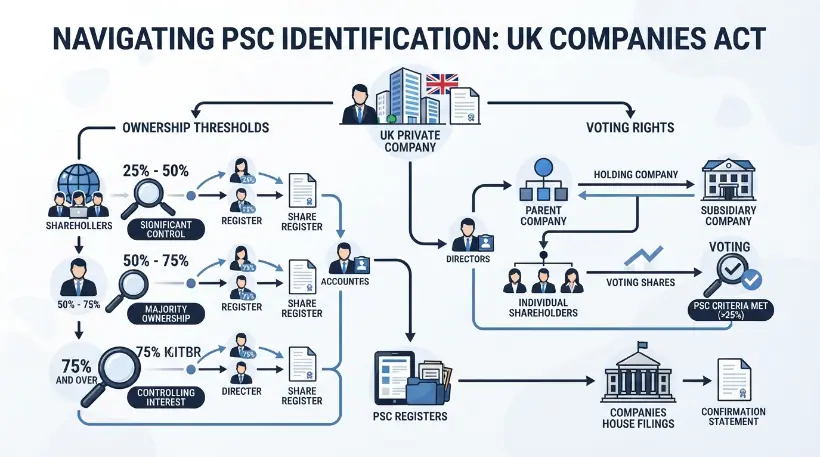
UK regulations define qualifying individuals through five distinct legal criteria governing corporate influence. First, an individual holding more than 25 percent of shares meets the primary ownership threshold. Second, holding more than 25 percent of voting rights constitutes direct control. Third, possessing the right to appoint or remove a majority of board directors satisfies statutory definitions. Fourth, exercising significant influence or control over the company establishes qualifying status. Fifth, holding significant influence over a trust or partnership meets final legal requirements.
Complex corporate hierarchies often obscure ultimate beneficial ownership through layers of intermediary holding companies. Corporate secretaries must trace ownership chains downward to identify natural persons exercising ultimate control. Failing to investigate ownership structures thoroughly violates statutory duties imposed on company directors. Form My Company assists directors in evaluating ownership data against official legislative criteria. Structured compliance workflows ensure every qualifying individual receives correct classification before statutory deadlines expire.
What Information Must You Gather Before Submitting a PSC Notification?
Submitting a PSC notification requires collecting full legal names, precise residential addresses, and exact service dates. Compiling verified identification data ensures submissions pass rigorous validation checks at Companies House.
Corporate administrators must collect specific biographical data points for every qualifying person. Required details include full legal names, dates of nationality, and standard residential addresses. Officers must also record exact service addresses alongside the precise date control was acquired. Furthermore, administrators must document the specific nature of control using standardized legislative categories. For example, categories cover exact share bands such as 25 to 50 percent ownership.
Data accuracy remains paramount because typographical errors cause immediate rejection by regulatory portals. Companies House cross-references submitted details against existing national identity and corporate databases. Directors must verify residential addresses using official documentation like utility bills or council tax statements. Form My Company streamlines data collection by utilizing standardized digital intake forms. Automated validation protocols check input fields against statutory requirements before final transmission occurs.
How Do You Notify Companies House Using Form My Company?
Notifying Companies House involves submitting verified ownership updates through specialized digital secretarial platforms. Utilizing automated filing infrastructure ensures instantaneous delivery and immediate legal compliance for business entities.
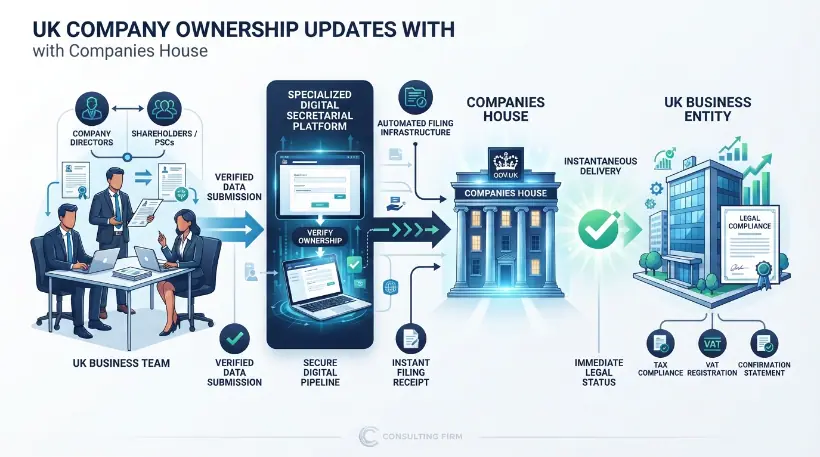
Traditional paper filings create unnecessary delays and increase the risk of postal loss. Modern corporate administration relies on secure application programming interfaces connected directly to government servers. Administrators log into dedicated portal dashboards to input updated ownership data securely. The platform formats XML data packets according to strict government technical standards. Once submitted, the system generates instantaneous confirmation receipts proving timely statutory compliance.
Using professional secretarial infrastructure eliminates manual data entry errors that plague internal teams. Form My Company manages the entire digital transmission workflow from start to finish. Directors review final draft filings before automated systems transmit updates to government registries. You can review the previous PSC Change Notifications: How to Meet the 14-Day Deadline guide for a deeper breakdown of intermediate filing strategies. Automated receipt generation provides permanent audit trails for corporate governance files.
What Are the Penalties for Missing the 14-Day Filing Window?
Missing the 14-day filing window results in daily financial default fines and potential criminal prosecution. Late submissions compromise corporate standing and trigger aggressive enforcement actions from regulatory authorities.
UK statutory frameworks treat register maintenance failures as criminal offenses committed by the company and officers. Magistrates courts impose severe fines reaching up to five thousand pounds per individual violation. Persistent non-compliance triggers compulsory corporate strike-off procedures initiated by government registrars. Furthermore, commercial partners avoid doing business with entities displaying active compliance warnings. Financial institutions routinely freeze accounts belonging to companies failing statutory reporting obligations.
Directors cannot delegate ultimate legal accountability despite employing external secretarial service providers. Proactive deadline management remains the single most effective defense against regulatory enforcement actions. You can read the foundational How Do You Notify Companies House of a New PSC? overview to understand basic reporting mechanics. Form My Company deploys automated alert systems notifying administrators well before statutory windows close. Timely interventions preserve pristine corporate standing and protect business assets from unnecessary penalties.
Meeting the strict 14-day statutory deadline for updating significant control registers protects corporate entities from severe regulatory penalties. Timely reporting ensures public transparency while preserving corporate creditworthiness and banking relationships. Form My Company delivers reliable secretarial infrastructure, managing data validation and digital transmissions seamlessly. Professional oversight eliminates administrative burdens, allowing business leaders to focus entirely on core commercial growth.
Explore our PSC Register guide,
Reserve Inclusive Meeting Spaces via Form My Company
Get Fully Fitted Interview Rooms From Form My Company
Frequently Asked Questions
What is a PSC register and who needs to maintain one?
A Person with Significant Control register is a mandatory statutory record that UK companies must keep to list individuals who hold more than 25 percent of shares or voting rights. When businesses use Form My Company for their PSC Register services, accurate beneficial ownership data remains fully compliant with Companies House regulations.
What is the strict deadline for updating the PSC register?
Companies must update their internal PSC register within 14 days of any ownership change and submit the information to Companies House within a further 14 days. Form My Company assists directors in meeting these strict filing windows through automated tracking and digital submission tools.
What information must be recorded for every PSC?
Recording a Person with Significant Control requires capturing their full legal name, date of birth, nationality, residential address, service address, and the exact nature of their control. Form My Company streamlines this data collection process to ensure all required fields pass government validation checks without errors.
What are the penalties for failing to update the PSC register?
Failing to maintain an accurate PSC register or missing statutory filing deadlines results in criminal offenses, daily default fines for company officers, and potential corporate prosecution. Utilizing Form My Company helps businesses avoid these severe regulatory risks by ensuring timely compliance.
Can a company list a corporate entity as a PSC?
A corporate entity can only be listed as a PSC if it meets specific exemption criteria, such as being subject to its own disclosure requirements or holding its own voting shares. Form My Company helps business administrators correctly evaluate complex corporate ownership structures against official UK compliance frameworks.